Track your nutrition and health goals

Foods for Insulin Resistance - Complete Indian Food List with GI Values
By Asfia Fatima, Chief Dietitian at Clearcals
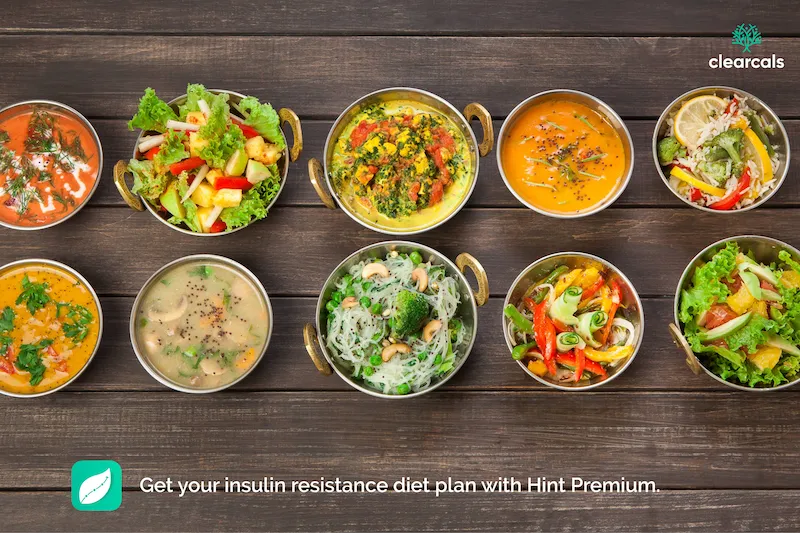
Choosing the right foods is the foundation of managing insulin resistance. With India's diverse culinary traditions, you have countless delicious options that support metabolic health.
This comprehensive guide provides a complete list of insulin-resistance-friendly Indian foods with their glycemic index values, portion recommendations, and practical meal combinations.
Whether you're managing PCOS, prediabetes, or type 2 diabetes, this food list will help you make informed choices at every meal.
Download the Hint app to access nutritional data for 1M+ Indian foods and track your meals effortlessly.
TL;DR
- Best foods: Vegetables (unlimited), whole grains (moderate), dals, lean proteins, nuts, low-GI fruits
- Choose low GI (<55): Slower blood sugar rise, better insulin response
- Portion control matters: Even healthy foods need appropriate portions
- Combine food groups: Protein + fiber + healthy fat = stable blood sugar
- Download the Hint app for instant food lookup and tracking
Understanding Glycemic Index (GI)
The Glycemic Index measures how quickly a food raises blood sugar on a scale of 0-100:
- Low GI (0-55): Best choice for insulin resistance
- Medium GI (56-69): Moderate, combine with protein/fat
- High GI (70+): Avoid or minimize
Why GI matters: Low-GI foods produce gradual blood sugar rises, reducing insulin demand and improving insulin sensitivity over time.
Vegetables - The Foundation (Unlimited)
Non-Starchy Vegetables (GI: 15-30)
Leafy Greens (Unlimited):
- Spinach (palak) - GI: 15
- Fenugreek leaves (methi) - GI: 15
- Amaranth (chaulai) - GI: 21
- Mustard greens (sarson ka saag) - GI: 15
- Cabbage (patta gobhi) - GI: 10
- Lettuce - GI: 15
Cruciferous (Unlimited):
- Cauliflower (gobhi) - GI: 15
- Broccoli - GI: 15
- Brussels sprouts - GI: 15
- Radish (mooli) - GI: 12
Other Low-GI Vegetables (Unlimited):
- Bitter gourd (karela) - GI: 18 - Excellent for insulin resistance
- Bottle gourd (lauki) - GI: 15
- Ridge gourd (turai) - GI: 15
- Cucumber (kheera) - GI: 15
- Tomatoes - GI: 15
- Bell peppers (shimla mirch) - GI: 15
- Eggplant (baingan) - GI: 15
- Okra (bhindi) - GI: 20
- Green beans - GI: 15
- Zucchini - GI: 15
- Mushrooms - GI: 10
Portion: Fill half your plate at each meal
Why they're great: High fiber, low calories, packed with vitamins/minerals, minimal effect on blood sugar.
Starchy Vegetables (Limit - GI varies)
Potatoes - GI: 85 (high) - Limit to 1/2 cup
- Boiling and cooling create resistant starch (lowers GI to 60)
Sweet potatoes - GI: 54 (medium) - Better choice, 1/2-3/4 cup
Corn - GI: 52 (medium) - 1/2 cup
Peas - GI: 48 (low-medium) - 1/2 cup
Beetroot - GI: 64 (medium) - Small portions
Pumpkin - GI: 75 (high) - Very small portions
Tip: Always combine starchy vegetables with protein and healthy fats to lower overall meal GI.
Whole Grains & Millets (Moderate Portions)
Whole Grains (GI: 28-55)
Best Choices:
- Barley (jau) - GI: 28 - Lowest GI grain
- Oats (steel-cut) - GI: 42
- Rolled oats - GI: 55
- Brown rice - GI: 50
- Quinoa - GI: 53
- Buckwheat (kuttu) - GI: 54
- Whole wheat roti - GI: 45-50
Portion: 1/4 of your plate or 1/2-1 cup cooked
Indian Millets (Excellent Choices - GI: 50-65)
- Foxtail millet (kangni) - GI: 50
- Finger millet (ragi) - GI: 50
- Pearl millet (bajra) - GI: 55
- Sorghum (jowar) - GI: 62
- Barnyard millet (sanwa) - GI: 50
- Little millet (kutki) - GI: 65
- Kodo millet (kodon) - GI: 66
Why millets are great: High fiber, gluten-free, rich in minerals, traditional Indian superfoods.
Portion: 2 small millet rotis or 3/4-1 cup cooked millet
Foods to Avoid (High GI 70+)
- White rice - GI: 73
- White bread - GI: 75
- Maida products (naan, paratha) - GI: 70-85
- Instant oats - GI: 79
- Cornflakes - GI: 81
- Puffed rice (murmura) - GI: 82
Lentils & Legumes - Protein Powerhouses (GI: 8-43)
Dal & Lentils (All Excellent Choices)
- Chana dal (split chickpeas) - GI: 8 - Lowest GI dal
- Toor dal (arhar/pigeon peas) - GI: 22
- Masoor dal (red lentils) - GI: 26
- Moong dal (mung beans) - GI: 38
- Urad dal (black gram) - GI: 43
Portion: 1 cup cooked dal
Whole Legumes
- Kidney beans (rajma) - GI: 29
- Chickpeas (kabuli chana) - GI: 28
- Black beans - GI: 30
- White beans - GI: 31
- Soybeans - GI: 16 - Excellent choice
- Black gram (whole urad) - GI: 43
Portion: 1/2-3/4 cup cooked
Why they're great: High protein and fiber, stabilize blood sugar, promote satiety, and are affordable.
Lean Proteins (Minimal GI Impact)
Plant-Based Proteins
- Tofu - GI: 15
- Tempeh - GI: 15
- Soy chunks (meal maker) - GI: 18
- Paneer (low-fat) - Minimal GI impact
- Curd/yogurt (low-fat, unsweetened) - GI: 33
Portion: 100-150g
Animal Proteins (Zero GI)
- Fish (salmon, mackerel, sardines, pomfret)
- Chicken breast (skinless)
- Turkey
- Eggs
- Lean mutton (occasional)
Portion: 100-150g (palm-sized)
Why they're important: Stabilize blood sugar, preserve muscle mass, improve satiety, zero glycemic impact.
Healthy Fats (Minimal GI Impact)
Nuts & Seeds (GI: 0-15)
Best Choices (1 serving = small handful):
- Almonds (badaam) - 10-12 nuts - GI: 0
- Walnuts (akhrot) - 4-5 halves - GI: 0
- Pistachios (pista) - 15-20 nuts - GI: 0
- Cashews (kaju) - 8-10 nuts - GI: 25 (higher carb, limit)
- Peanuts (moongfali) - Small handful - GI: 7
- Flaxseeds (alsi) - 1 tbsp ground - GI: 0
- Chia seeds - 1 tbsp - GI: 1
- Pumpkin seeds - 1 tbsp - GI: 0
- Sunflower seeds - 1 tbsp - GI: 0
Daily portion: 1-2 servings
Cooking Oils (Zero GI)
Best choices:
- Extra virgin olive oil
- Mustard oil (sarson ka tel)
- Coconut oil (moderate amounts)
- Sesame oil (til ka tel)
- Rice bran oil
- Avocado oil
Avoid:
- Vanaspati ghee (trans fats)
- Excessive saturated fats
- Reused/oxidized oils
Daily portion: 2-3 tablespoons total
Fruits - Choose Low GI (GI: 12-60)
Best Choices (Low GI <55)
- Guava - GI: 12-24 - Best fruit for insulin resistance
- Grapefruit - GI: 25
- Cherries - GI: 22
- Apples - GI: 36
- Pears - GI: 38
- Plums - GI: 39
- Oranges - GI: 43
- Strawberries - GI: 40
- Peaches - GI: 42
- Jamun (Indian blackberry) - GI: 25
Portion: 1 small-medium fruit or 1 cup berries
Moderate Choices (Medium GI 56-69)
- Papaya - GI: 60 - Small portions (1/2 cup)
- Grapes - GI: 59 - Very small portions (10-15 grapes)
- Mango - GI: 51 - Small portions (1/2 cup)
Portion: Limit to 1/2 cup
Fruits to Limit (High GI 70+)
- Watermelon - GI: 72 - Very small portions
- Pineapple - GI: 66 - Small portions
- Dates - GI: 103 - Avoid or 1-2 dates maximum
Tip: Always pair fruits with nuts or protein to lower overall glycemic impact.
Beverages
Best Choices (Zero Calories)
Water - 2-3 liters daily
Green tea - 3-4 cups - Improves insulin sensitivity
Black coffee - 1-2 cups (no sugar)
Herbal teas:
- Cinnamon tea
- Ginger tea
- Tulsi (holy basil) tea
- Chamomile tea
Moderate Choices
- Buttermilk (chaas) - Unsweetened, low-fat - 1 cup
- Coconut water - 1 cup (limit due to natural sugars)
- Vegetable juice - Fresh, no added sugar - 1 cup
Avoid
- Sugary drinks, sodas
- Packaged fruit juices
- Sweetened beverages
- Excessive alcohol (empty calories, disrupts blood sugar)
Sample Daily Meal Plan with GI Values
Breakfast (Total GI: Low)
- 2 moong dal cheelas (GI: 38) - 200 cal
- Green chutney + curd (GI: 33) - 100 cal
- Green tea (GI: 0)
- Total calories: ~300
Mid-Morning Snack
- 10 almonds (GI: 0) - 80 cal
- 1 apple (GI: 36) - 95 cal
- Total calories: 175
Lunch (Total GI: Low-Medium)
- 2 bajra rotis (GI: 55) - 150 cal
- 1 cup rajma curry (GI: 29) - 180 cal
- Palak sabzi (GI: 15) - 60 cal
- Side salad (GI: 15) - 30 cal
- Total calories: ~420
Evening Snack
- Roasted chana (GI: 28) - 1/2 cup - 120 cal
- Herbal tea (GI: 0)
- Total calories: 120
Dinner (Total GI: Low)
- Grilled fish (GI: 0) - 150g - 200 cal
- Brown rice (GI: 50) - 3/4 cup - 150 cal
- Mixed vegetable curry (GI: 15-20) - 80 cal
- Raita (GI: 33) - 50 cal
- Total calories: ~480
Daily Total: ~1495 calories | Average Meal GI: Low
Track all these foods effortlessly with the Hint app!
Food Combinations for Stable Blood Sugar
The order and combination of foods matter:
Best Combinations
Protein + Fiber + Healthy Fat
- Example: Dal + vegetables + 1 tsp ghee
- Effect: Slowest blood sugar rise
Whole Grain + Protein + Vegetables
- Example: Brown rice + chicken + sabzi
- Effect: Balanced macros, stable energy
Fruit + Nuts
- Example: Apple slices + almond butter
- Effect: Fat/protein slows fruit sugar absorption
Meal Order Matters
Eat in this sequence for lower blood sugar spikes:
- Vegetables first (fiber)
- Protein second
- Carbohydrates last
Research shows: Eating vegetables before carbs reduces post-meal blood sugar by 25-30%!
Indian Regional Adaptations
North India
Focus on:
- Bajra/jowar rotis instead of wheat
- Tandoori preparations (less oil)
- Dal makhani with low-fat dairy
- Rajma, chole with brown rice
Limit:
- Parathas, naan (maida)
- Heavy cream-based curries
- Excessive ghee
South India
Focus on:
- Ragi dosa/idli
- Sambar (excellent GI: 22)
- Coconut chutney (small portions)
- Fish curries
Limit:
- White rice dosa/idli
- Sweet chutneys
- Coconut in excess
West India
Focus on:
- Jowar/bajra rotis
- Dhokla (steamed, GI: 35)
- Moong dal khichdi
- Sprouted salads
Limit:
- Fried snacks (farsaan)
- High-sugar sweets
East India
Focus on:
- Fish (omega-3 rich)
- Mustard oil preparations
- Posto (poppy seed) dishes
- Brown rice
Limit:
- White rice portions
- Sweet dishes (rasgulla, sandesh)
How the Hint App Helps You
Tracking foods for insulin resistance is effortless with the Hint app:
With Hint (Free)
- Search from 1M+ Indian foods instantly
- See complete nutrition data (calories, carbs, protein, fat, fiber)
- Log meals in seconds
- Track daily macros
With Hint Pro
- Get personalized meal plans for insulin resistance
- Track glycemic load (not just GI)
- Access advanced nutrients (magnesium, chromium, omega-3)
- Use meal planning tools
With Hint Premium
- Unlimited consultations with expert dietitians
- Customized weekly meal plans
- Adjust for comorbid conditions (PCOS, diabetes, thyroid)
- Get ongoing support and accountability
Portion Control Visual Guide
| Food | Portion Size | Visual Cue |
|---|---|---|
| Cooked rice/grains | 1/2-1 cup | Fist-sized |
| Roti/chapati | 1-2 small | Palm-sized |
| Dal/legumes | 1 cup | Fist-sized |
| Vegetables | 1-2 cups | Two fists |
| Protein (meat/fish) | 100-150g | Palm + thickness of a deck of cards |
| Paneer | 50-75g | 2 matchbox sizes |
| Nuts | Small handful | Fits in the palm |
| Fruit | 1 medium | Tennis ball |
Conclusion
With this comprehensive food list and GI values, you have all the information needed to make insulin-resistance-friendly food choices at every meal.
Focus on low-GI foods, appropriate portions, and balanced meal combinations to improve your insulin sensitivity naturally.
The Hint app and Hint Premium make tracking these foods effortless, with expert support to guide your journey.
Start today—your metabolic health will thank you.
Frequently Asked Questions
1. Can I eat rice if I have insulin resistance?
Yes, but choose brown rice (GI: 50) over white rice (GI: 73) and limit portions to 1/2-3/4 cup per meal. Pair with plenty of vegetables, dal, and protein to lower the overall glycemic impact.
2. Which Indian bread is best for insulin resistance?
Best choices: Bajra roti (GI: 55), jowar roti (GI: 62), ragi roti (GI: 50), or whole wheat roti (GI: 45-50). Avoid maida-based breads like naan (GI: 70+).
3. Are bananas okay for insulin resistance?
Bananas have a moderate-high GI (62). If you eat them, choose slightly underripe bananas (lower GI), eat small portions (1/2 banana), and pair with nuts or yogurt to slow glucose absorption.
4. Can I eat potatoes?
Potatoes have a high GI (85), but you don't have to eliminate them. If eating potatoes: boil and cool them (creates resistant starch, lowers GI to 60), eat small portions (1/2 cup), and combine with protein/fat and vegetables.
5. Is jaggery better than sugar for insulin resistance?
Jaggery (gur) has a slightly lower GI (55) than white sugar (65), but it's still high and should be limited. Use minimal amounts if needed, or choose natural low-GI sweeteners like stevia.
6. What's the best dal for insulin resistance?
Chana dal has the lowest GI (8) among Indian dals, followed by toor dal (22) and masoor dal (26). All dals are excellent choices—eat 1 cup daily.
7. Can I eat fruits at night?
Yes, but choose low-GI fruits (apples, pears, guava) and eat 2-3 hours before bed. Avoid high-sugar fruits at night as they may affect blood sugar during sleep.
8. How many rotis can I eat per meal?
For insulin resistance: 1-2 small rotis (6 inches) per meal made from whole wheat or millets. Balance with 1 cup of dal, plenty of vegetables, and protein.
9. Is coconut good for insulin resistance?
Fresh coconut and coconut oil are fine in moderation (1-2 tablespoons). Coconut contains healthy fats that don't raise blood sugar. However, sweetened coconut products should be avoided.
10. Can I have cheat meals?
Occasional indulgences (1-2 times per month) won't derail progress if you're otherwise consistent. Plan them, enjoy mindfully, and return to healthy eating the next meal—don't let one meal become a "cheat week."
Exclusive Offer for Clearcals Store Customers 🎉
Upgrade your health tracking and nutrition journey with a free Hint subscription when you purchase a smartwatch from the Clearcals Store.
What you get:
- Buy select Garmin watches → Get 1 Month FREE Hint Premium (worth ₹1,999)
- Buy Apple Watch models → Get *FREE Hint Pro access
Your free Hint access includes:
✅ Unlimited dietitian consultations *(Hint Premium)*
✅ Personalized diet and workout plans
✅ Advanced calorie & nutrition tracking
✅ Smart insights synced with your smartwatch
🚀 Visit the Clearcals Store and make your smartwatch work smarter for your health.
About the Author
Asfia Fatima is the Chief Dietitian at Clearcals, with a Master's Degree in Dietetics and Clinical Nutrition and over a decade of experience in clinical nutrition and lifestyle management.
She specializes in evidence-based diet planning for weight loss, diabetes, and metabolic health.
At Clearcals, she leads the nutrition strategy behind the Hint app, helping users achieve their goals with science-backed guidance.
🔗 Connect with Asfia on LinkedIn