Track your nutrition and health goals

Boiled Potato Calories: 31 kcal per 100g | Nutrition, Protein & Benefits
By Asfia Fatima, Chief Dietitian at Clearcals
Potatoes — lovingly called "aloo" in India — are one of the most versatile and consumed vegetables worldwide. From crispy French fries to comforting aloo parathas, potatoes play a starring role in cuisines across the globe, especially in Indian kitchens.
Yet despite their popularity, potatoes often get a bad reputation for being "fattening" or "unhealthy." India is the world's second-largest producer of potatoes, and this humble tuber is a staple in countless regional dishes — aloo sabzi, aloo tikki, aloo gobhi, aloo matar, and so many more.
But how many calories are actually in a boiled potato? What about protein? And how does it compare to sweet potato?
TL;DR
- 100g boiled potato = 31 kcal — far lower than rice (130 kcal) or roti (260 kcal)
- 1 medium boiled potato (~150g) = ~46 kcal, 1g protein, 10g carbs
- Boiled potato protein per 100g = 0.67g — low, but meaningful at larger servings
- Cooking method is everything: boiled (31 kcal) vs chips (536 kcal) — 17× difference
- Boiled potatoes rank #1 on the satiety index — most filling food tested
- Sweet potato calories: ~76 kcal/100g boiled — 2.5× more calories but far more fibre and vitamin A
How Many Calories in a Boiled Potato?
| Serving | Weight | Calories | Carbs | Protein | Fat | Fibre |
|---|---|---|---|---|---|---|
| Small piece | 30g | 9.3 kcal | 2.0g | 0.2g | 0g | 0.3g |
| 50g boiled potato | 50g | 15.5 kcal | 3.4g | 0.3g | 0g | 0.5g |
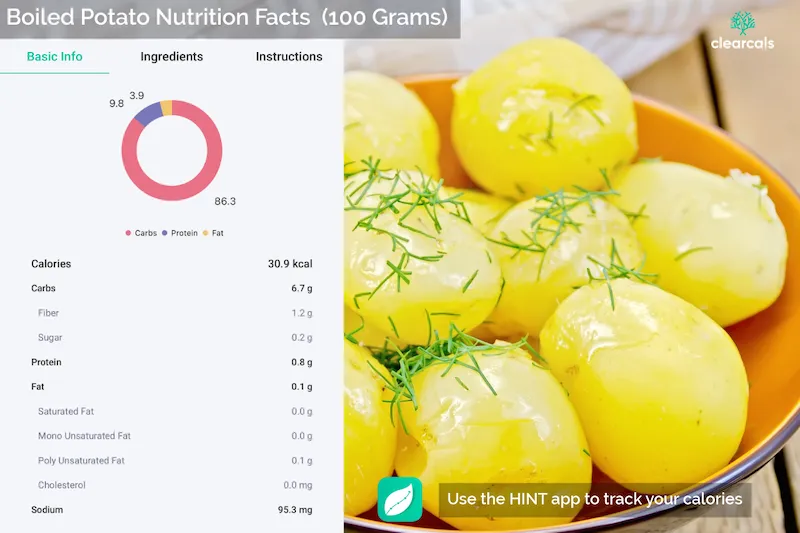
| 100g boiled potato | 100g | 31 kcal | 6.7g | 0.67g | 0g | 1.0g |
| 1 small boiled potato | ~100g | ~31 kcal | 6.7g | 0.67g | 0g | 1.0g |
| 1 medium boiled potato | ~150g | ~46 kcal | 10.1g | 1.0g | 0g | 1.5g |
| 1 large boiled potato | ~200g | ~62 kcal | 13.4g | 1.3g | 0g | 2.0g |
| 150g boiled potato | 150g | 46.5 kcal | 10.1g | 1.0g | 0g | 1.5g |
| 200g boiled potato | 200g | 62 kcal | 13.4g | 1.3g | 0g | 2.0g |
| 250g boiled potato | 250g | 77.5 kcal | 16.8g | 1.7g | 0g | 2.5g |
| 300g boiled potato | 300g | 93 kcal | 20.1g | 2.0g | 0g | 3.0g |
| 2 boiled potatoes (~300g) | ~300g | ~93 kcal | 20.1g | 2.0g | 0g | 3.0g |
| 3 boiled potatoes (~450g) | ~450g | ~140 kcal | 30.2g | 3.0g | 0g | 4.5g |
| 4 boiled potatoes (~600g) | ~600g | ~186 kcal | 40.2g | 4.0g | 0g | 6.0g |
Do aloo mein kitni calories hoti hai? 100g boiled aloo has 31 kcal — very low. One medium boiled aloo (~150g) has about 46–47 kcal.
As you can see, boiled potatoes are extremely low in calories — a 100g serving has just 31 calories. This makes them one of the most calorie-efficient carbohydrate sources available, perfect for those watching their weight.
Track exact boiled potato portions in the Hint app — log by weight for the most accurate calorie count.
Boiled Potato Protein Per 100g
Boiled potatoes are not a high-protein food, but they are not protein-free either:
| Serving | Protein |
|---|---|
| 100g boiled potato | 0.67g |
| 1 medium boiled potato (~150g) | ~1.0g |
| 200g boiled potato | ~1.3g |
| 300g boiled potato | ~2.0g |
| 1 bowl boiled potato (~250g) | ~1.7g |
Potato protein per 100g (boiled) = 0.67g. While this is low for a protein food, a large serving of boiled potato (300–400g) provides 2–2.7g protein — meaningful as part of a mixed meal.
For comparison, rice provides ~2.7g protein per 100g cooked, so potato and rice are in a similar range. For a high-protein meal, pair boiled potato with dal (8–9g protein/100g), paneer (18g), eggs (13g), or curd (3.5g).
Boiled Potato Nutrition Facts Per 100g
Boiled potatoes are often dismissed as "just carbs," but they're packed with essential vitamins and minerals:
| Nutrient | Per 100g boiled potato |
|---|---|
| Energy | 31 kcal |
| Protein | 0.67g |
| Carbohydrates | 6.7g |
| Dietary Fibre | 1.0g |
| Fat | 0g |
| Sugar | ~0.3g |
| Sodium | 1mg |
| Potassium | 379mg (8% DV) |
| Vitamin C | 13mg (14% DV) |
| Vitamin B6 | 0.3mg (17% DV) |
| Folate | 10mcg (3% DV) |
| Thiamin (B1) | 0.1mg (8% DV) |
| Niacin (B3) | 1.4mg (9% DV) |
| Magnesium | 22mg (5% DV) |
| Phosphorus | 44mg (4% DV) |
| Iron | 0.3mg (2% DV) |
Boiled potatoes are impressive sources of potassium (379mg/100g — supports heart health and blood pressure), vitamin C (13mg/100g — immune support), and vitamin B6 (0.3mg/100g — brain health and metabolism). Despite being very low in calories, they provide substantial nutritional value.
Calories in Potatoes by Cooking Method
One of the most important factors affecting potato calories is the cooking method:
| Cooking Method | Calories per 100g | Fat per 100g | Notes |
|---|---|---|---|
| Boiled potato (with skin) | 31 kcal | 0g | Healthiest option — retains nutrients |
| Steamed potato | 32–35 kcal | 0.1g | Similar to boiled, preserves nutrients |
| Baked potato (with skin) | 93 kcal | 0.1g | Low-calorie, high satiety |
| Roasted potato | 140–180 kcal | 4–7g | Depends on oil used |
| Mashed potato (with butter/milk) | 110–130 kcal | 4–5g | Varies based on added ingredients |
| French fries (deep fried) | 312 kcal | 15g | 10× more calories than boiled |
| Potato chips (fried) | 536 kcal | 35g | 17× more calories than boiled |
Key Takeaway: The potato itself is not the problem — it's the cooking method. Boiled (31 kcal) vs chips (536 kcal) is a 17× difference in calories from the same raw ingredient.
Health Benefits of Boiled Potatoes
1. Extremely Low in Calories
At just 31 kcal per 100g, boiled potatoes are one of the lowest-calorie carbohydrate sources available. This makes them ideal for weight management and calorie-controlled diets.
2. Rich in Antioxidants
Potatoes contain flavonoids, carotenoids, and phenolic acids — antioxidants that help neutralise free radicals and may reduce the risk of chronic diseases including heart disease and certain cancers.
3. Support Heart Health
The high potassium content (379mg/100g) helps regulate blood pressure by counteracting the effects of sodium. Studies link adequate potassium intake with reduced cardiovascular disease and stroke risk.
4. Improve Digestive Health
When potatoes are cooked and then cooled, a portion of starch transforms into resistant starch — a prebiotic that feeds beneficial gut bacteria, improves digestive health, and enhances insulin sensitivity. Cold potato salad (without mayo) is an excellent resistant starch source.
5. Naturally Gluten-Free
Potatoes are naturally gluten-free — a safe, nutritious, filling alternative to wheat-based foods for those with celiac disease or gluten sensitivity.
6. Promote Satiety and Weight Management
Despite being carb-rich, boiled potatoes rank #1 on the satiety index in research studies — meaning they keep you fuller longer than almost any other food. This significantly helps with portion control and reducing total calorie intake.
7. Support Brain Function
Vitamin B6 (0.3mg/100g) plays a key role in producing neurotransmitters including serotonin and dopamine, supporting mood regulation and cognitive function.
8. Fat-Free Carbohydrate Source
With zero fat, boiled potatoes are ideal for low-fat diets and pair well with any protein source for balanced meals.
Are Boiled Potatoes Good for Weight Loss?
Absolutely yes — boiled potatoes are excellent for weight loss.
Why Boiled Potatoes Support Weight Loss
- Extremely low calories: 31 kcal/100g — you can eat a very filling portion for very few calories
- #1 on the satiety index: Research by Holt et al. (1995) tested 38 common foods — boiled potatoes scored 323, making them 3.2× more filling than white bread and more satiating than many "diet" foods
- Zero fat: No added fats means minimal calorie density
- Nutrient-dense: Unlike refined carbs, boiled potatoes deliver vitamins and minerals
- Resistant starch: Cooled boiled potatoes contain resistant starch, which may improve insulin sensitivity and support fat metabolism
- High volume, low calories: A generous 300g serving of boiled potato = just 93 kcal
When Potatoes Hinder Weight Loss
- Deep-fried preparations (312–536 kcal per 100g vs 31 kcal boiled)
- Excessive added fats — butter, cheese, cream, ghee
- Large portions of masala or oil-heavy potato dishes without calorie awareness
Verdict: Boiled potatoes are one of the best foods for weight loss. If you're following a calorie deficit diet, boiled potato should be your go-to carbohydrate source. The Hint app helps you track boiled potato servings accurately within your daily goals.
Sweet Potato Calories vs Regular Potato
Sweet potato (shakkarkand / शकरकंद) is often compared to regular boiled potato. Here's how the two stack up nutritionally:
| Nutrient | Sweet Potato (boiled, 100g) | Regular Potato (boiled, 100g) |
|---|---|---|
| Calories | 76 kcal | 31 kcal |
| Protein | 1.4g | 0.67g |
| Carbs | 17.7g | 6.7g |
| Fat | 0.1g | 0g |
| Fibre | 2.5g | 1.0g |
| Vitamin A (beta-carotene) | 961mcg (107% DV) | 0mcg |
| Vitamin C | 13mg (14% DV) | 13mg (14% DV) |
| Potassium | 337mg (7% DV) | 379mg (8% DV) |
Key takeaway: Boiled sweet potato has 2.5× more calories than regular boiled potato (76 vs 31 kcal/100g), but delivers significantly more fibre (2.5g vs 1g) and vastly more Vitamin A (107% DV vs none). Regular boiled potato wins on minimum calories; sweet potato wins on micronutrients, fibre, and lower glycaemic index.
For a complete guide covering sweet potato benefits, glycaemic index, and whether it's suitable for weight loss and diabetes, see our dedicated article: Is Sweet Potato Good for Diabetes?
Indian Potato Dishes: Calorie Comparison
In Indian cuisine, aloo is the star of countless beloved dishes. Calorie content varies dramatically depending on preparation:
| Dish Name | Serving Size | Approx. Calories | Cooking Method |
|---|---|---|---|
| Boiled Potato | 1 medium (100g) | 31 kcal | Boiled |
| Boiled Potato | 1 large (150g) | 46.5 kcal | Boiled |
| Baked Potato | 1 medium (150g) | 140 kcal | Baked |
| Aloo Sabzi | 1 cup (200g) | 180–220 kcal | Sautéed with minimal oil |
| Aloo Paratha | 1 paratha (100g) | 250–320 kcal | Shallow fried with ghee |
| Aloo Tikki | 2 pieces (100g) | 200–280 kcal | Shallow/deep fried |
| Aloo Gobhi Matar | 1 cup (200g) | 150–190 kcal | Sautéed with spices |
| Aloo Matar | 1 cup (200g) | 160–200 kcal | Curry-style |
| French Fries (restaurant) | Medium (150g) | 450–500 kcal | Deep fried |
| Potato Chips (packaged) | 1 small pack (50g) | 270–300 kcal | Deep fried |
For more detail, see our guide on calories in aloo paratha. Compare with rice calories and roti calories.
Boiled Potato vs Rice vs Roti: Calorie Comparison
| Food | Calories per 100g | Protein | Carbs | Fibre |
|---|---|---|---|---|
| Boiled potato | 31 kcal | 0.67g | 6.7g | 1.0g |
| White rice (cooked) | 130 kcal | 2.7g | 28g | 0.4g |
| Brown rice (cooked) | 112 kcal | 2.6g | 23g | 1.8g |
| Roti/chapati (100g) | ~260 kcal | 8.4g | 50g | 3.2g |
| Sweet potato (boiled) | 76 kcal | 1.4g | 17.7g | 2.5g |
Boiled potato has 4× fewer calories than rice and 8× fewer calories than roti per 100g. Replacing rice with boiled potato saves ~100 kcal per 100g serving — a meaningful daily reduction for weight management.
How to Enjoy Boiled Potatoes for Maximum Health Benefits
1. Keep the Skin On
Potato skin contains fibre, vitamins, and minerals. Boil with skin on (after thorough washing) for maximum nutrition.
2. Cool Before Eating (For Resistant Starch)
Cooling boiled potatoes increases resistant starch content — acting like dietary fibre, supporting gut health and improving insulin sensitivity. Cold potato salad (without mayo) is an excellent option.
3. Pair with Protein
Combine boiled potatoes with dal, eggs, paneer, or chicken to create balanced meals that stabilise blood sugar and enhance satiety.
4. Season Without Added Fats
Use herbs, spices, lemon juice, and curd instead of butter or oil to keep calories minimal.
5. Use as a Rice/Roti Substitute
Replace rice (130 kcal/100g) with boiled potato (31 kcal/100g) for a 75% calorie reduction in the carbohydrate portion of your meal.
6. Meal Prep Friendly
Boil a batch at the start of the week and refrigerate. Cooled boiled potatoes are higher in resistant starch and easy to add to quick meals.
How the Hint App Helps You Track Boiled Potato Calories
Whether you're enjoying a simple boiled potato or an aloo paratha, accurate calorie tracking is essential for reaching your health goals.
The Hint app is designed specifically for the Indian diet, with:
- Indian Food Database: Hundreds of Indian potato dishes — aloo tikki, aloo sabzi, samosas, and more
- Portion Tracking: Log potatoes by size (small/medium/large) or weight (grams)
- Cooking Method Options: Differentiate between boiled, baked, fried, and roasted preparations
- Recipe Builder: Create custom potato recipes and save them for future logging
- Macro Breakdown: Calories, carbs, protein, fat, and fibre for each dish
- Dietitian Consultations: Personalised meal plans with Hint Premium
- Instant Diet Plans: Automated meal plans including healthy potato preparations suited to your goals
Frequently Asked Questions
How many calories are in one boiled potato?
A medium boiled potato (100g) has 31 calories. A small piece (30g) = 9.3 kcal, a large potato (150g) = 46.5 kcal, and 200g = 62 kcal. One of the most calorie-efficient carbohydrate sources available.
How many calories in 2 boiled potatoes?
Two medium boiled potatoes (~300g combined) contain approximately 93 kcal.
How many calories in 3 boiled potatoes?
Three medium boiled potatoes (~450g) contain approximately 140 kcal.
How much protein is in a boiled potato per 100g?
Boiled potato contains 0.67g protein per 100g. A medium potato (150g) provides ~1g protein. Low, but meaningful when combined with other protein foods.
Are boiled potatoes good for weight loss?
Yes. Boiled potatoes rank #1 on the satiety index — 3.2× more filling than white bread — at just 31 kcal/100g with zero fat. They are one of the best carbohydrate sources for weight management.
Are boiled potatoes better than sweet potatoes?
Regular boiled potato is lower in calories (31 vs 76 kcal/100g). Sweet potato is higher in fibre, vitamin A, and antioxidants. Both are healthy — choose based on your goals. Sweet potato for more micronutrients; regular boiled potato for minimum calories.
Do boiled potatoes have more calories than rice or roti?
No. Boiled potato (31 kcal/100g) has far fewer calories than cooked rice (130 kcal/100g) or roti (~260 kcal/100g). Replacing rice with boiled potato saves ~100 kcal per 100g serving.
Can diabetics eat boiled potatoes?
Yes, in moderation. Pair with protein (dal, eggs) and cool before eating to maximise resistant starch. For a deeper comparison with sweet potato, see our guide: Is Sweet Potato Good for Diabetes?
Which cooking method is healthiest for potatoes?
Boiling with the skin on (31 kcal/100g). Steaming is equally good. Baking increases calories to 93 kcal/100g. Deep frying multiplies calories by 10–17×.
What is resistant starch in potatoes?
Resistant starch forms when potatoes are cooked and then cooled. It acts like dietary fibre, feeding beneficial gut bacteria and improving insulin sensitivity. Cold boiled potato salad is an excellent source.
How many boiled potatoes can I eat per day for weight loss?
200–300g of boiled potato (62–93 kcal) as part of a balanced meal is reasonable for weight loss. Use the Hint app to track based on your personal calorie goals.
References
- Holt, S.H. et al. (1995). "A satiety index of common foods." European Journal of Clinical Nutrition, 49(9), 675–690. PMID: 7498104
- King, J.C. & Slavin, J.L. (2013). "White potatoes, human health, and dietary guidance." Advances in Nutrition, 4(3), 393S–401S. DOI: 10.3945/an.112.003525
- McGill, C.R. et al. (2013). "The effect of resistant starch on glycemic control." Journal of Functional Foods, 5(3), 883–890. DOI: 10.1016/j.jff.2013.01.032
- Patel, B. et al. (2017). "Potato: A Review on Nutritional Aspects, Pharmacological Properties and Traditional Uses." IJCMAS, 6(12), 2614–2625.
- Clearcals Recipe Database. Boiled Potato Nutrition Facts. https://clearcals.com/recipes/boiled-potato/
🎁 Exclusive Offer for Clearcals Store Customers
- Buy select Garmin watches → Get 1 Month FREE Hint Premium (worth ₹1,999)
- Buy Apple Watch models → Get FREE Hint Pro access
About the Author
Asfia Fatima is the Chief Dietitian at Clearcals, with a Master's Degree in Dietetics and Clinical Nutrition and over a decade of experience in clinical nutrition and lifestyle management.
She specialises in evidence-based diet planning for weight loss, diabetes, and metabolic health. At Clearcals, she leads the nutrition strategy behind the Hint app, helping users achieve their goals with science-backed guidance.
🔗 Connect with Asfia on LinkedIn