Track your nutrition and health goals

Puffed Rice Calories, Nutrition, and Health Benefits
By Asfia Fatima, Chief Dietitian at Clearcals
Puffed rice, known as murmura in Hindi, muri in Bengali, and lai in Marathi, is one of India's most beloved light snacks.
This airy, crunchy cereal is made by heating rice kernels under high pressure until they expand and "puff" into their characteristic fluffy texture.
Whether you're enjoying a bowl of bhel puri on the beach or munching on plain murmura as an evening snack, understanding the calorie and nutrition content of puffed rice can help you make smarter dietary choices.
At Clearcals, we believe that informed eating starts with knowing exactly what goes into your body. That's why we've developed the Hint app — a comprehensive nutrition tracker that makes counting calories effortless.
With the Hint app, you can log your daily puffed rice intake, track macronutrients, and monitor your progress toward your health goals with precision.
In this comprehensive guide, we'll explore everything you need to know about puffed rice calories, its nutritional profile, health benefits, and whether it's truly a weight-loss-friendly snack.
We'll also share delicious, healthy puffed rice recipes and show you how the Hint app can transform your nutrition journey.
TL;DR
- One medium cup (200g) of puffed rice contains 710 calories — a surprisingly high amount for what appears to be a light, airy snack.
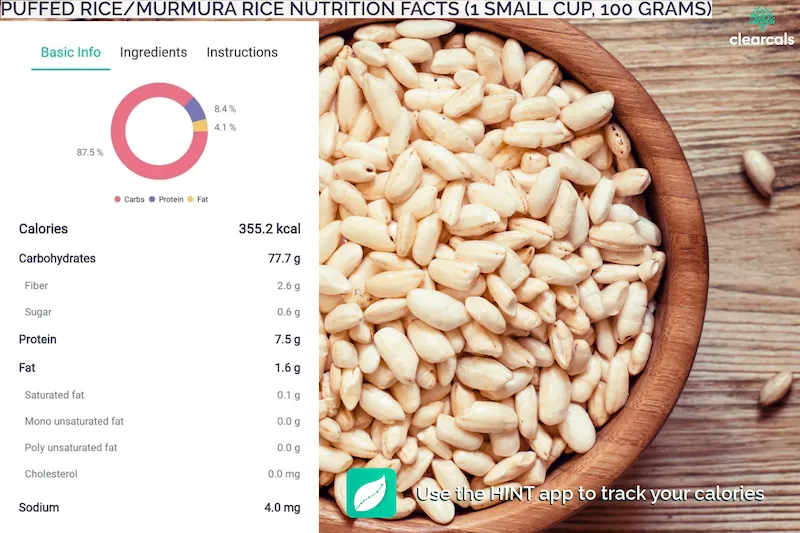
- Per 100 grams, puffed rice contains 355 calories, primarily from carbohydrates (77.7g), with moderate protein (7.45g) and minimal fat (1.6g).
- It's virtually fat-free and gluten-free, making it suitable for various dietary needs, though portion control is critical due to its caloric density.
- Puffed rice can fit into a balanced diet when consumed mindfully, but it's not a low-calorie food by volume as many people assume.
- The Hint app helps you track puffed rice calories accurately with a comprehensive Indian food database, barcode scanning, and AI-powered meal logging.
Puffed Rice Calories: How Many Calories Are in Murmura?
One of the most common misconceptions about puffed rice is that it's an extremely low-calorie snack. While it appears light and airy, the calorie content can surprise you.
Puffed rice has a moderate caloric density when measured by weight. A medium cup (200g) contains a substantial 710 calories, which is considerably more than many people expect. This is because puffed rice, while light in texture, is still primarily composed of starchy carbohydrates that contribute significant energy.
| Serving Size | Weight | Calories |
|---|---|---|
| 1 medium cup (puffed rice) | 200 g | 710 kcal |
| Per 100 grams | 100 g | 355 kcal |
| 50 grams (small handful) | 50 g | 178 kcal |
| 25 grams (1 small handful) | 25 g | 89 kcal |
| 150 grams (3/4 cup) | 150 g | 533 kcal |
As you can see, a full cup (200g) of puffed rice contains 710 calories — a significant amount that should be carefully considered in your daily calorie budget, especially if you're following a calorie deficit diet for weight loss.
Puffed Rice Nutrition Facts: Complete Breakdown
Understanding the complete nutritional profile of puffed rice helps you make informed decisions about incorporating it into your diet.
Let's break down the macronutrients, vitamins, and minerals found in 100 grams and 200 grams (1 medium cup) of plain puffed rice.
Macronutrients
| Nutrient | Per 100g | Per 200g (1 cup) | % Daily Value* (per 200g) |
|---|---|---|---|
| Calories | 355.2 kcal | 710.4 kcal | 35-36% |
| Carbohydrates | 77.7 g | 155.4 g | 52% |
| • Dietary Fiber | 2.55 g | 5.1 g | 18-20% |
| • Sugars | 0.65 g | 1.3 g | 1-2% |
| Protein | 7.45 g | 14.9 g | 30% |
| Fat | 1.6 g | 3.2 g | 4-5% |
| • Saturated Fat | 0.4 g | 0.8 g | 4% |
| Sodium | 4 mg | 8 mg | 0% |
*Based on a 2000-calorie diet
Macronutrient Percentage Breakdown (per 200g serving)
- Carbohydrates: 87.6% (155.4g × 4 cal/g = 622 kcal)
- Protein: 8.4% (14.9g × 4 cal/g = 60 kcal)
- Fat: 4.0% (3.2g × 9 cal/g = 29 kcal)
Vitamins & Minerals (per 100g)
| Vitamin/Mineral | Amount per 100g | % Daily Value* |
|---|---|---|
| Iron | 2.5-3.0 mg | 14-17% |
| Calcium | 8-10 mg | 1% |
| Potassium | 110-120 mg | 2-3% |
| Magnesium | 28-32 mg | 7-8% |
| Phosphorus | 115-120 mg | 9-10% |
| Thiamin (B1) | 0.4-0.5 mg | 30-35% |
| Niacin (B3) | 3.4-3.6 mg | 21-22% |
| Folate (B9) | 240-260 mcg (fortified) | 60-65% |
*Fortified varieties may contain higher amounts of vitamins and minerals
Key Nutritional Highlights:
- High in Carbohydrates: Puffed rice is primarily a carbohydrate source, similar to regular rice, providing quick energy with 77.7g per 100g.
- Low in Fat: With only 1.6g of fat per 100g, it's virtually fat-free — ideal for low-fat diets.
- Moderate Protein: Contains 7.45g of protein per 100g, which is reasonable for a grain-based food.
- Moderate Fiber: Contains 2.55g of fiber per 100g, better than some refined grains but lower than whole grains.
- Fortified Options: Many commercially available puffed rice products are fortified with B vitamins and iron, significantly increasing their nutritional value.
Health Benefits of Puffed Rice (Murmura)
While puffed rice is primarily an energy source, it offers several health benefits when consumed mindfully as part of a balanced diet:
1. Easy to Digest
Puffed rice is extremely easy on the digestive system. The puffing process gelatinizes the starch, making it highly digestible. This makes murmura an excellent choice for people with sensitive stomachs, those recovering from illness, or anyone seeking easily digestible carbohydrates.
2. Gluten-Free and Allergy-Friendly
Made entirely from rice, puffed rice is naturally gluten-free, making it safe for people with celiac disease or gluten sensitivity. It's also free from common allergens like nuts, dairy, and soy.
3. Quick Energy Source
The high carbohydrate content and moderate fiber mean that puffed rice provides relatively rapid energy. This makes it useful as a pre-workout snack or when you need an immediate energy boost. Athletes sometimes consume puffed rice before or after training sessions for quick-digesting carbs.
4. Low in Sodium and Saturated Fat
Plain puffed rice contains virtually no sodium (8mg per 200g) and minimal saturated fat (0.8g per 200g), making it heart-friendly when consumed without heavy seasoning or oil. This is particularly beneficial for people managing hypertension or cardiovascular health.
5. Versatile Base for Healthy Recipes
Puffed rice serves as an excellent vehicle for nutritious ingredients. You can combine it with vegetables, nuts, seeds, and lean proteins to create balanced snacks that are both satisfying and nutritious, like murmura chaat or bhel with extra vegetables.
6. Source of B Vitamins (Fortified Varieties)
Fortified puffed rice often contains significant amounts of thiamin (B1), niacin (B3), and folate (B9), which support energy metabolism, nervous system function, and cell growth. Check labels to find fortified options that provide additional nutritional value.
7. Provides Essential Minerals
Puffed rice contains modest amounts of iron, magnesium, and phosphorus — minerals essential for blood health, muscle function, and bone strength.
Is Puffed Rice Good for Weight Loss?
This is perhaps the most frequently asked question about murmura. The answer requires nuance: it depends entirely on portion control and preparation method.
Why Portion Control is Critical:
1. Moderate Calorie Density At 355 calories per 100g, puffed rice has a moderate caloric density. A full cup (200g) contains 710 calories — more than a typical meal for someone on a 1,500-calorie weight loss plan. Without portion awareness, it's easy to consume excess calories.
2. High Glycemic Index Puffed rice has a high glycemic index (GI), meaning it can cause rapid spikes in blood sugar. These spikes may lead to increased hunger shortly after eating, potentially causing overeating later.
3. Moderate Protein and Fiber While the protein (7.45g per 100g) and fiber (2.55g per 100g) are reasonable, they may not provide long-lasting satiety compared to whole food protein sources or high-fiber foods. Combining puffed rice with protein-rich foods can enhance fullness.
Can It Support Weight Loss?
Yes, when consumed strategically:
- Measure portions carefully: Use a food scale or measuring cup and log in the Hint app to track accurately.
- Stick to small servings: A 50g portion (178 calories) as a snack is more reasonable than a 200g cup.
- Combine with protein: Mix with roasted chana, peanuts, or yogurt to increase satiety and nutritional value.
- Choose plain preparations: Add vegetables, lime juice, and spices instead of oil, fried sev, and sugar.
- Time it strategically: Consider eating puffed rice as a mid-morning or post-workout snack when energy needs are higher.
Weight Loss Pitfalls to Avoid:
1. Loaded Preparations Street food versions like bhel puri often contain added oils, fried sev, sweet chutneys, and excessive portions. A typical serving of bhel puri can contain 350-500 calories, negating the benefits of choosing puffed rice.
2. Overconsumption Due to Light Texture The airy texture makes it easy to mindlessly consume large quantities. What feels like a "light snack" could be 400-500 calories if you're not measuring.
3. Using It as a Meal Replacement Puffed rice lacks essential nutrients and shouldn't replace nutrient-dense whole foods. Use it as a snack or part of a balanced meal, not as a meal replacement.
Best Practices for Weight Loss:
- Track everything: Log every serving in the Hint app — portion creep happens quickly with light, airy foods.
- Weigh your portions: Don't eyeball it — use a kitchen scale for accuracy.
- Add volume with vegetables: Mix generous amounts of cucumber, tomato, onion, and sprouts to increase volume and fiber.
- Choose it over higher-calorie snacks: Puffed rice is still better than chips, cookies, or fried snacks when you want something crunchy.
- Pair with protein and healthy fats: This slows digestion and improves satiety.
Healthy Puffed Rice Snack Ideas
Transform plain murmura into delicious, nutritious snacks with these healthy recipes:
1. Spicy Murmura Chaat
Combine 50g puffed rice with diced tomatoes, onions, cucumber, boiled chickpeas, lime juice, chaat masala, and fresh coriander. This version adds fiber, vitamins, and protein while keeping total calories around 250-280 per serving.
2. Murmura Upma
A savory South Indian preparation where 100g puffed rice is tempered with mustard seeds, curry leaves, green chilies, peanuts, and vegetables. This makes a light yet filling breakfast or evening snack (around 400-450 calories per serving).
3. Healthy Bhel with Extra Veggies
Load up traditional bhel puri with generous amounts of vegetables like raw mango, pomegranate seeds, and sprouted moong. Use only 50g puffed rice, minimal tamarind chutney, and skip the fried sev to keep it weight-loss friendly (approximately 220-260 calories per serving).
4. Murmura Ladoo
For a healthier sweet treat, make murmura ladoo with jaggery, minimal ghee, and nuts. While still a dessert, it's better than refined sugar-based sweets when enjoyed in moderation (about 100-120 calories per small ladoo).
5. Protein-Packed Puffed Rice Mix
Create your own trail mix by combining 50g puffed rice with almonds, walnuts, roasted chana, pumpkin seeds, and a sprinkle of rock salt. This combination provides healthy fats, protein, and sustained energy (approximately 300-350 calories per 75g serving).
6. Simple Puffed Rice
Sometimes, simple is best. Enjoy 50g plain roasted puffed rice seasoned with just a pinch of salt, turmeric, and curry leaves for a light, satisfying snack (178 calories).
7. Yogurt Parfait with Puffed Rice
Layer 150g Greek yogurt with 30g puffed rice, fresh berries, and a drizzle of honey for a crunchy, protein-rich breakfast or dessert (approximately 250-300 calories per serving).
All these recipes can be easily logged in the Hint app, which provides detailed nutritional breakdowns and helps you stay within your calorie goals.
How Hint App Helps You Track Puffed Rice Calories
Managing your puffed rice intake — and overall nutrition — becomes effortless with the Hint app by Clearcals. Here's how Hint transforms calorie tracking:
1. Comprehensive Indian Food Database
Hint includes an extensive database of Indian foods, including various puffed rice preparations:
- Plain murmura
- Murmura chaat
- Bhel puri
- Murmura ladoo
- Puffed rice upma
Simply search for your dish, and Hint provides accurate calorie and macro information based on the Clearcals recipe database.
2. Barcode Scanning
Many packaged puffed rice brands can be logged instantly by scanning the barcode. Hint automatically imports nutritional information, saving you time and ensuring accuracy.
3. AI-Powered Meal Logging
Take a photo of your puffed rice snack or meal, and Hint's AI technology identifies the food and estimates portions, making logging faster than ever — especially useful for homemade preparations.
4. Custom Recipe Builder
Creating your own puffed rice recipes at home? Use Hint's recipe builder to input all ingredients and get precise nutritional calculations. Save your favorite recipes for quick logging later.
5. Macro Tracking
Beyond calories, Hint tracks your daily intake of carbohydrates, protein, and fat. This helps you ensure puffed rice fits into your macro goals, especially if you're following specific diet plans.
6. Progress Monitoring
Visualize your weight loss journey with Hint's progress charts and analytics. See how incorporating mindful portions of weight loss snacks Indian style, like puffed rice, impacts your results over time.
7. Dietitian Consultations
Hint Premium subscribers get unlimited access to certified dietitians. Get personalized advice on incorporating puffed rice into your diet based on your specific health goals.
8. Meal Planning and Reminders
Set meal reminders, plan your daily menu in advance, and receive notifications to log your meals. Consistency is key to successful weight management.
The Hint app takes the guesswork out of calorie counting, making it simple to enjoy puffed rice while staying on track with your health goals.
Download it today and start your journey toward smarter, more mindful eating.
Final Thoughts
Puffed rice (murmura) is a versatile, traditional Indian snack that can certainly fit into a healthy, balanced diet — but portion control is absolutely critical.
At 710 calories per medium cup (200g), it's not the low-calorie food many people assume it to be. A 50g serving (178 calories) is more appropriate for snacking, especially if you're watching your calorie intake.
The key to successfully incorporating puffed rice into your diet is accurate tracking and mindful consumption.
Use the Hint app to measure and log your portions precisely — what feels like a small handful could easily be 100-150g (355-533 calories).
Remember that puffed rice works best as part of a diverse diet rich in whole grains, vegetables, fruits, lean proteins, and healthy fats.
Its moderate protein (7.45g per 100g) and fiber (2.55g per 100g) content means it shouldn't be your primary carbohydrate source, but rather an occasional snack or a component of more balanced preparations.
Whether you're enjoying murmura chaat, murmura upma, or simply plain roasted murmura, tracking your intake ensures you stay aligned with your health goals.
Combine this awareness with regular physical activity, adequate hydration, and sufficient sleep, and you'll be well on your way to sustainable weight management.
At Clearcals, we're committed to empowering you with accurate nutritional information and effective tools.
Similar to how we've explored the nutrition of other Indian staples like poha and makhana, understanding the calorie content of puffed rice helps you navigate your dietary landscape with confidence and precision.
Start your journey to better health today — track your puffed rice intake accurately, explore our healthy recipes, and let the Hint app guide you toward your goals.
Frequently Asked Questions (FAQs)
Q1: How many calories are in 1 cup of puffed rice?
One medium cup (200 grams) of plain puffed rice contains approximately 710 calories. This is significantly more than many people expect, making portion control essential for weight management.
Q2: Is puffed rice healthy for weight loss?
Puffed rice can fit into a weight loss diet, but only with careful portion control. A 50g serving (178 calories) is more appropriate for snacking than a full 200g cup (710 calories).
Combine it with vegetables, protein sources like yogurt or roasted chana, and track your portions accurately using the Hint app.
Q3: What is the nutritional value of 100g of puffed rice?
Per 100 grams, puffed rice contains approximately 355 calories, 77.7g carbohydrates, 7.45g protein, 1.6g fat, and 2.55g dietary fiber.
It's also a source of B vitamins (especially in fortified varieties) and minerals like iron and magnesium.
Q4: Does puffed rice increase blood sugar levels?
Yes, puffed rice has a high glycemic index, which means it can cause rapid spikes in blood sugar levels.
People with diabetes or prediabetes should consume it in small portions (25-50g) and pair it with protein or healthy fats to minimize its impact on blood sugar.
Q5: Can I eat puffed rice every day?
You can eat puffed rice occasionally as part of a balanced diet, but it shouldn't be a daily staple or replace more nutrient-dense whole grains like brown rice, quinoa, or oats.
Aim for variety in your grain intake to ensure you're getting adequate fiber, vitamins, and minerals. If you do consume it daily, keep portions small (50g or less).
Q6: Is puffed rice better than poha for weight loss?
Both have similar calorie content per 100g (poha has about 350-360 calories per 100g). Poha is often prepared with vegetables and peanuts, making it more nutritionally balanced and filling.
Puffed rice requires conscious additions of vegetables and protein to match poha's satiety. The best choice depends on how you prepare it and your portion sizes.
Q7: What's the difference between puffed rice and rice crisps?
Puffed rice (murmura) is made by heating rice kernels under pressure until they expand naturally, with no added ingredients.
Rice crisps or rice crackers are typically made from rice flour and may contain added oils, salt, and seasonings, often making them higher in calories and sodium than plain puffed rice.
Q8: How much puffed rice should I eat for a snack?
For weight management, aim for 25-50g (89-178 calories) as a snack serving. Combine it with protein sources, vegetables, and healthy fats to increase satiety and nutritional value.
Always measure your portions using a kitchen scale and log them in the Hint app for accuracy.
Exclusive Offer for Clearcals Store Customers 🎉
Upgrade your health tracking and nutrition journey with a free Hint subscription when you purchase a smartwatch from the Clearcals Store.
What you get:
- Buy select Garmin watches → Get 1 Month FREE Hint Premium (worth ₹1,999)
- Buy Apple Watch models → Get *FREE Hint Pro access
Your free Hint access includes:
✅ Unlimited dietitian consultations *(Hint Premium)*
✅ Personalized diet and workout plans
✅ Advanced calorie & nutrition tracking
✅ Smart insights synced with your smartwatch
🚀 Visit the Clearcals Store and make your smartwatch work smarter for your health.
References
- USDA National Nutrient Database for Standard Reference. "Cereals ready-to-eat, puffed rice." U.S. Department of Agriculture. https://fdc.nal.usda.gov/
- Atkinson FS, Foster-Powell K, Brand-Miller JC. "International tables of glycemic index and glycemic load values: 2008." Diabetes Care. 2008;31(12):2281-2283. PubMed PMID: 18835944.
- Slavin JL. "Dietary fiber and body weight." Nutrition. 2005;21(3):411-418. PubMed PMID: 15797686.
- Rolls BJ, Roe LS, Meengs JS. "Salad and satiety: energy density and portion size of a first-course salad affect energy intake at lunch." Journal of the American Dietetic Association. 2004;104(10):1570-1576. PubMed PMID: 15389416.
- Halton TL, Hu FB. "The effects of high protein diets on thermogenesis, satiety and weight loss: a critical review." Journal of the American College of Nutrition. 2004;23(5):373-385. PubMed PMID: 15466943.
About the Author
Asfia Fatima is the Chief Dietitian at Clearcals, with a Master's Degree in Dietetics and Clinical Nutrition and over a decade of experience in clinical nutrition and lifestyle management.
She specializes in evidence-based diet planning for weight loss, diabetes, and metabolic health.
At Clearcals, she leads the nutrition strategy behind the Hint app, helping users achieve their goals with science-backed guidance.
🔗 Connect with Asfia on LinkedIn