Track your nutrition and health goals

Garmin vs Fitbit 2026: Which Is Better for Fitness in India?
By Dr. Krishna Athmakuri, Co-Founder & CEO, Clearcals | Updated May 2026
Garmin and Fitbit serve genuinely different users. Garmin is built for athletes and serious fitness tracking — GPS accuracy, training analytics, and battery life are the priorities.
Fitbit (now owned by Google) is built for everyday wellness — step counting, sleep, stress, and Google service integration in a simpler, lighter package.
This guide compares both brands across what actually matters for Indian buyers: GPS, battery, health tracking, sports depth, app ecosystem, and price.
Garmin vs Fitbit: The Core Difference
| Feature | Garmin | Fitbit |
|---|---|---|
| Primary strength | Sports analytics, GPS accuracy, and long battery | Daily wellness tracking, simplicity, Google integration |
| Battery life | 7–40 days (model-dependent) | 1–7 days typical |
| GPS | Multi-band on mid/premium models; purpose-built accuracy | Built-in GPS on select models; less accurate than Garmin |
| Sports analytics depth | VO2 max, Training Readiness, Running Power, triathlon mode | Active Zone Minutes, basic workout tracking |
| Health monitoring | Body Battery, HRV Status, SpO2, skin temperature | Stress, SpO2, HRV (Sense 2), skin temperature (Sense 2) |
| App ecosystem | Garmin Connect; limited third-party apps | Google Fit, Google Wallet, Google Maps, Alexa |
| iPhone compatibility | Fully compatible — all features work | Fully compatible |
| Android compatibility | Fully compatible | Deep Google integration on Android |
| Best for | Runners, triathletes, outdoor users, structured athletes | Casual users, step-counters, Google ecosystem users |
GPS and Tracking Accuracy
This is where Garmin has the clearest edge. Garmin builds its own GPS chipsets and has decades of experience in outdoor navigation — the same technology used in aviation and marine devices. Mid-range and premium Garmin models use multi-band GPS with SatIQ, which automatically selects the best satellite combination for the current environment. In urban canyons, dense forests, and challenging terrain, Garmin GPS is consistently more accurate than Fitbit's GPS implementation.
Fitbit's GPS, available on the Charge 6, Sense 2, and Versa 4, is adequate for basic route and distance tracking on clear outdoor runs. For casual fitness walkers and city runners, the accuracy is sufficient. For athletes who rely on precise pace data, split tracking, or trail navigation, Garmin's GPS is meaningfully better.
Heart rate accuracy is comparable at rest and during moderate activity on both brands. During high-intensity intervals and sudden changes in intensity, Garmin's optical sensors have historically performed better — though neither brand matches a chest strap for maximum accuracy during intense training.
Battery Life
| Watch | Battery Life |
|---|---|
| Fitbit Charge 6 | Up to 7 days |
| Fitbit Sense 2 | Up to 6 days |
| Fitbit Versa 4 | Up to 6 days |
| Garmin Venu SQ 2 | Up to 11 days |
| Garmin Vivoactive 5 | Up to 11 days |
| Garmin Vivoactive 6 | Up to 11 days |
| Garmin Forerunner 165 | Up to 11 days |
| Garmin Instinct 3 Solar | Up to 28 days (unlimited with sun) |
Garmin's battery advantage is consistent across the lineup — even the most affordable Garmin models (Venu SQ 2 at ₹19,990, Forerunner 55 at ₹18,500) last nearly twice as long as Fitbit's top models. For continuous sleep and HRV monitoring without daily charging, Garmin is more practical.
1. Garmin Venu SQ 2 vs Fitbit Versa 4
The most direct comparison at the lifestyle smartwatch level.
Garmin Venu SQ 2 — ₹19,990
The Garmin Venu SQ 2 has a 1.41-inch AMOLED display, built-in GPS, 40+ sports modes, Body Battery, SpO2, HRV Status, stress tracking, Garmin Pay, and up to 11 days of battery. The Music edition adds offline Spotify and Deezer.
Fitbit Versa 4
The Fitbit Versa 4 has a colour AMOLED display, built-in GPS, 40+ exercise modes, Google Wallet, Google Assistant, and Amazon Alexa integration, and up to 6 days of battery. It integrates tightly with Google services on Android phones.
Which to buy: The Venu SQ 2 wins on battery life (11 days vs 6 days), GPS tracking depth, and sports analytics. The Fitbit Versa 4 wins on Google service integration — Google Wallet, Google Assistant, and Google Fit work more smoothly on Android. For iPhone users or battery-conscious buyers, the Venu SQ 2 is the stronger choice. For Android users embedded in Google's ecosystem, the Versa 4 is more seamlessly integrated.
Buy Garmin Venu SQ 2 at Clearcals — ₹19,990
2. Garmin Vivoactive 5 vs Fitbit Charge 6
The mid-range comparison that appears most frequently in search data.
Garmin Vivoactive 5 — ₹24,990
The Garmin Vivoactive 5 has an AMOLED touchscreen, 30+ sports modes, built-in GPS, Body Battery, HRV Status, SpO2, stress tracking, sleep tracking, Garmin Pay, and an 11-day battery.
Fitbit Charge 6
The Fitbit Charge 6 is a slim fitness tracker (not a full smartwatch) with built-in GPS, Google Maps integration, Google Wallet, ECG, HRV tracking, stress management, and up to 7 days of battery. It has a smaller form factor than a full watch and a narrower display.
Which to buy: The Vivoactive 5 is a full smartwatch with a larger AMOLED display and a more comprehensive sports mode library. The Fitbit Charge 6 is a compact fitness tracker with strong Google integration — Google Maps on the wrist is a genuine advantage for Android users navigating outdoors. For sports tracking depth, battery, and display quality, the Vivoactive 5 wins. For slim fit and the Google ecosystem, the Charge 6 suits Android-first users who prefer a tracker form factor.
Buy Garmin Vivoactive 5 at Clearcals — ₹24,990
3. Garmin Vivoactive 6 vs Fitbit Charge 6
For users deciding between Garmin's latest lifestyle watch and Fitbit's flagship tracker.
Garmin Vivoactive 6 — ₹40,990
The Garmin Vivoactive 6 adds Sleep Coach with nap tracking, a skin temperature sensor, Garmin Coach structured training plans, and 80+ sports modes over the Vivoactive 5 — at ₹40,990.
Fitbit Charge 6
The Fitbit Charge 6 is priced significantly lower than the Vivoactive 6 and offers a slimmer form factor, Google Maps, ECG, and Google Wallet in a band-style tracker. Battery life of 7 days.
Which to buy: At the Vivoactive 6's price point, the gap in sports analytics and health monitoring depth over the Fitbit Charge 6 is substantial. The VA6's Sleep Coach, skin temperature sensor, 80+ sports modes, and 11-day battery significantly outclass the Charge 6 for serious fitness users. The Fitbit Charge 6 wins on price and form factor for users who want a lightweight tracker rather than a full smartwatch.
Buy Garmin Vivoactive 6 at Clearcals — ₹40,990
4. Garmin Instinct 3 vs Fitbit Sense 2
For outdoor users and health-focused buyers at a higher price point.
Garmin Instinct 3 AMOLED — ₹55,990
The Garmin Instinct 3 AMOLED is MIL-STD-810 certified, 10 ATM water resistant, has a built-in flashlight, multi-band GPS with SatIQ, full adventure sport modes, HRV Status, Body Battery, and up to 18 days of battery. The Solar variant (₹48,990) extends battery life to 28+ days.
Fitbit Sense 2
The Fitbit Sense 2 is a health-focused smartwatch with a skin temperature sensor, ECG, stress management, cEDA (continuous electrodermal activity for stress), built-in GPS, and up to 6 days of battery. It has a premium design but lacks rugged durability and has significantly shorter battery life.
Which to buy: The Instinct 3 is in a different category for outdoor use — MIL-STD-810 durability, multi-band GPS for trail navigation, and solar battery endurance make it the clear choice for trekkers, trail runners, and adventure users. The Fitbit Sense 2 is better suited to users who want advanced stress and ECG monitoring in a sleek everyday smartwatch and don't need rugged durability or extended battery.
Buy Garmin Instinct 3 AMOLED at Clearcals — ₹55,990 Buy Garmin Instinct 3 Solar at Clearcals — ₹48,990
Garmin vs Fitbit: Head-to-Head Summary
| Use Case | Better Choice |
|---|---|
| Serious running and sports training | Garmin (significantly) |
| GPS accuracy for outdoor activities | Garmin (multi-band GPS) |
| Battery life | Garmin (consistently 2–4× longer) |
| Google service integration (Android) | Fitbit/Google |
| Simplicity for casual step tracking | Fitbit |
| ECG at a lower price | Fitbit Charge 6 / Sense 2 |
| Rugged outdoor and adventure use | Garmin (Instinct series) |
| Triathlon and multisport | Garmin (Forerunner 265+) |
| Everyday lifestyle health monitoring | Garmin (Vivoactive 5 or 6) at similar prices |
| Budget: under ₹20,000 | Garmin Forerunner 55 (₹18,500) or Venu SQ 2 (₹19,990) |
Buy a Garmin Watch with Free Hint Premium at Clearcals
Every Garmin watch from Clearcals comes with a free Hint Premium subscription (worth ₹1,999) — registered dietitian consultations, personalised meal plans, and 300+ guided workout routines.
Shop All Garmin Watches at Clearcals
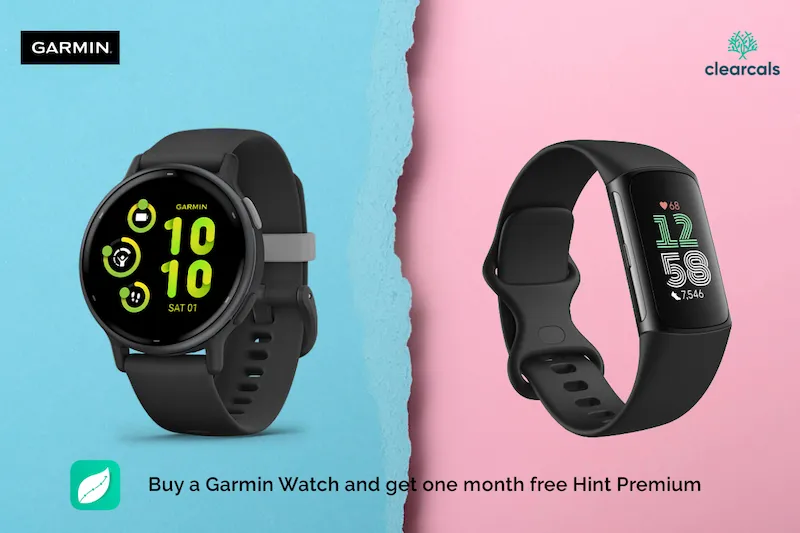
Garmin users: Buy a Garmin watch and get Hint Premium free for 1 month (worth ₹1,999) — including unlimited dietitian consultations.
Frequently Asked Questions
Is Garmin better than Fitbit? Garmin is better than Fitbit for sports performance, GPS accuracy, battery life, and structured training analytics. Fitbit is better for simplicity, Google service integration on Android, and ECG features at lower prices. If fitness tracking depth and GPS accuracy matter, Garmin is the stronger choice. If you use Android and want seamless Google Wallet, Maps, and Google Fit integration in a lightweight tracker, Fitbit performs better in that context.
What is the difference between Garmin and Fitbit? Garmin is primarily a sports and GPS performance brand. Its watches prioritise GPS accuracy, multi-day battery, running analytics (VO2 max, Training Readiness, Running Power), and sports-specific features. Fitbit is a wellness and step-tracking brand now owned by Google, with strong integration into Google services but shorter battery life and less depth in sports analytics.
Does Garmin work with iPhone? Yes. Garmin watches are fully compatible with iPhone via the Garmin Connect app. Smart notifications, health sync, Garmin Pay, and all watch features work normally with an iPhone. Garmin's ecosystem is phone-agnostic, unlike Fitbit, which has deeper Google/Android integration on newer models.
Is the Fitbit Charge 6 better than the Garmin Vivoactive 5? The Garmin Vivoactive 5 (₹24,990) is better for sports tracking, battery life (11 days vs 7 days), and overall health analytics depth with HRV Status and Body Battery. The Fitbit Charge 6 is better for Google integration — Google Maps, Google Wallet, and Google Fit work more natively — and has a slimmer tracker form factor. For most Indian fitness users, the Vivoactive 5 offers more value at a comparable price.
Which Garmin watch is closest to a Fitbit in price and size? The Garmin Venu SQ 2 at ₹19,990 is the most Fitbit-like Garmin watch — AMOLED display, compact design, broad health monitoring, and casual fitness tracking. It has better battery life and GPS depth than any Fitbit at a similar or lower price, while remaining easy to use for non-athletes.
Does Fitbit work with Garmin? Fitbit and Garmin are separate ecosystems. Fitbit data goes to the Fitbit app and Google Fit; Garmin data goes to Garmin Connect. There is no direct official integration between Garmin and Fitbit. However, Garmin Connect can sync to Google Fit (via Connected Apps in the Garmin Connect settings), which then shares data with any Google-connected apps.
About the Author
Dr. Krishna Athmakuri is the Co-Founder and CEO of Clearcals, where he leads the development of data-driven health technology through the Hint app.
With a Ph.D. in Chemical Engineering from Rensselaer Polytechnic Institute, New York, his expertise spans analytics, protein chemistry, and biotechnology.
Earlier in his career, he developed biotherapeutics for diabetes and metabolic diseases at companies like Aurobindo Pharma and Dr. Reddy's Laboratories.
At Clearcals, he now applies that scientific rigour to build personalised fitness tools — including Hint Pro Workouts, nutrition tracking, and real-time metabolic insights — helping users make smarter health decisions through technology.
Connect with Dr. Krishna on LinkedIn
Also Read
- Garmin vs Samsung Watch: Which Should You Buy in India?
- The Best Garmin Watches in India: Ultimate Buyer's Guide 2026
- Garmin Venu SQ 2 Review: India Price, Features & Is It Worth Buying?
- Garmin Vivoactive 5 Review: India Price, Features & Should You Buy It?
- Cheapest Garmin Watches in India 2026: Budget Picks from ₹18,500
- Garmin Body Battery Explained: How It Works & What Each Score Means
- Shop All Garmin Watches at Clearcals