Track your nutrition and health goals

What Is the Metabolic Confusion Diet? How It Works, Meal Plan & Results
By Hafsaa Farooq | Medically Reviewed | Updated April 2026
If you have ever lost weight on a diet only to hit a frustrating plateau where the scale refuses to move, you have experienced metabolic adaptation.
The metabolic confusion diet is a structured eating strategy designed specifically to prevent this from happening.
This guide explains what metabolic confusion is, whether the science supports it, and how to apply it practically with an Indian meal plan.
| Quick Answer: The metabolic confusion diet alternates between high-calorie and low-calorie days to keep your metabolism from adapting to a fixed calorie intake. By varying your daily calorie intake, the strategy aims to sustain fat loss without triggering the hormonal slowdowns that make conventional diets stall. |
|---|
What Is Metabolic Confusion?
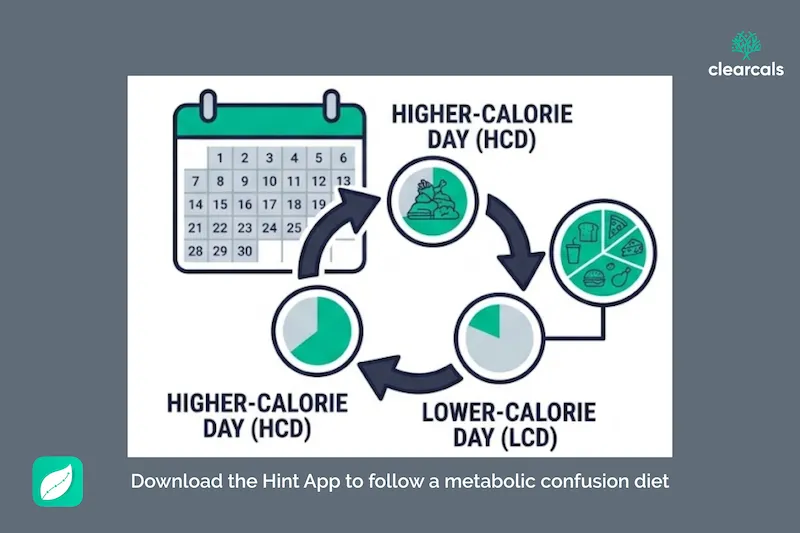
Metabolic confusion, also called calorie cycling or calorie shifting, is a dietary strategy that involves alternating between higher-calorie and lower-calorie days rather than eating the same number of calories every day.
The core idea is rooted in the well-documented phenomenon of metabolic adaptation.
When you consistently eat fewer calories, your body responds by slowing down its metabolic rate to conserve energy. [1]
This is why most people find that a diet that worked initially becomes less effective over time.
Metabolic confusion is designed to disrupt this adaptive process by keeping the body guessing, preventing it from settling into a lower metabolic rate.
Metabolic Confusion vs Calorie Restriction: The Key Difference
| Traditional Calorie Restriction | Metabolic Confusion | |
|---|---|---|
| Calorie intake | Fixed the deficit every day | Alternates high and low days |
| Metabolic adaptation | High risk after 4 to 6 weeks | Reduced by varying intake |
| Hormonal response | Leptin drops, hunger rises | Leptin levels are better maintained |
| Sustainability | Often difficult long-term | More flexible, easier to maintain |
The Science Behind Metabolic Confusion
Why Steady Calorie Restriction Stops Working
When you eat at a consistent calorie deficit, your body interprets the reduced energy intake as a potential threat and initiates a series of compensatory adaptations: [1]
- Basal metabolic rate (BMR) decreases, sometimes by 10 to 15%
- Levels of leptin, the hormone that signals fullness and supports metabolic rate, drop significantly [2]
- Levels of ghrelin, the hunger hormone, increase, making you feel hungrier [2]
- The body becomes more efficient at storing fat from the food you do eat
These adaptations are collectively called adaptive thermogenesis. They are the body's evolutionary defence against starvation, but they are deeply inconvenient for anyone trying to lose weight sustainably. [1]
How Calorie Cycling Counters Adaptation
A landmark clinical trial known as the MATADOR study (Minimising Adaptive Thermogenesis And Deactivating Obesity Rebound) published in the International Journal of Obesity found that participants who alternated between two weeks of calorie restriction and two weeks of maintenance calories lost significantly more weight and preserved more lean muscle mass than those on continuous calorie restriction, despite consuming the same total calories over the study period. [3]
A separate study published in the International Journal of Preventive Medicine compared a calorie-shifting diet (where participants changed their calorie intake across days within a four-day cycle) against standard calorie restriction.
The calorie shifting group lost more weight, showed lower drops in resting metabolic rate, and reported greater adherence to the programme. [4]
| Key Research Finding: The MATADOR study found that intermittent calorie restriction was 47% more efficient at producing fat loss compared to continuous restriction, largely because it minimised the drop in resting metabolic rate that undermines conventional diets. [3] |
|---|
How the Metabolic Confusion Diet Works in Practice
There is no single universally standardised metabolic confusion protocol. The most common approaches involve:
Option 1: High Day / Low Day Alternation
The simplest version alternates between high-calorie days (at or slightly above your maintenance calorie level) and low-calorie days (400 to 600 calories below maintenance). A common pattern is 2 low days followed by 1 high day, or alternating every other day.
Option 2: Weekly Calorie Cycling
You eat at a significant deficit for 5 days per week and at maintenance for 2 days. This is easier to plan around a weekly routine and suits people who find daily counting difficult.
Option 3: Bi-Weekly Cycling (MATADOR Protocol)
Based on the MATADOR study, you alternate between 2 weeks of calorie restriction and 2 weeks of maintenance eating. This is the most research-backed version but requires more commitment to long-term planning. [3]
| How to Find Your Numbers: Maintenance calories = your Total Daily Energy Expenditure (TDEE). Low day calories = TDEE minus 500 to 600 kcal. High day calories = TDEE or TDEE plus 100 to 200 kcal. Your TDEE depends on your weight, height, age, and activity level. The Hint app can calculate this for you automatically. |
|---|
What to Eat on the Metabolic Confusion Diet
The metabolic confusion diet is not a specific food plan; it is a calorie management strategy. That said, the quality of food you eat on both high and low days matters significantly for results and health.
Principles That Apply on All Days
- Prioritise protein: Aim for 1.2 to 1.6 g of protein per kg of body weight daily to preserve muscle mass during low-calorie days. [5] Good Indian sources include dal, paneer, eggs, chicken, fish, tofu, and curd.
- Keep fibre high: Vegetables, legumes, and whole grains on both high and low days improve satiety and gut health.
- Limit added sugar and refined carbs: These cause blood sugar spikes that drive hunger and fat storage regardless of which day you are on.
- Stay hydrated: Drink 2.5 to 3 litres of water daily. Adequate hydration supports metabolic function and helps manage appetite.
On Low-Calorie Days
- Focus on low-calorie-dense foods: leafy greens, cucumber, tomatoes, broth-based soups, dal, and lean proteins
- Avoid calorie-dense items like ghee, nuts in large quantities, fried foods, and white rice in large portions
- Eat 4 to 5 smaller meals to manage hunger rather than 2 to 3 large ones
On High-Calorie Days
- Include complex carbohydrates: brown rice, daliya, oats, jowar, or bajra rotis
- Add healthy fats in moderate quantities: a small portion of ghee, a handful of nuts, or avocado
- This is not a cheat day. High-calorie days should still prioritise whole, nutritious foods, just in larger quantities
7-Day Metabolic Confusion Meal Plan (Indian)
The following plan uses a 5 low-day, 2 high-day weekly pattern. Days 3 and 6 are high-calorie days. Adjust portions based on your personal calorie targets.
| Day | Breakfast | Mid-Morning | Lunch | Evening | Dinner |
|---|---|---|---|---|---|
| Day 1 (Low) | Oats with chia seeds and amla powder | Handful of walnuts | 1 chapati + moong dal + mixed vegetable sabzi + salad | Green tea + cucumber slices | Daliya khichdi + palak soup + low-fat curd |
| Day 2 (Low) | Egg white omelette (2 eggs) + black coffee | Sprout chaat with lemon | Grilled/baked chicken or fish + sauteed vegetables + salad | Roasted chana (small handful) | Moong dal + lauki sabzi + 1 chapati |
| Day 3 (High) | Vegetable daliya upma + 1 boiled egg | 1 banana or 2 dates + almonds | 2 chapatis + rajma + mixed sabzi + raita | Peanut butter on 2 whole wheat crackers | Brown rice + chicken curry + salad + curd |
| Day 4 (Low) | Ragi dosa (no butter) + sambar (small portion) | Green tea + cucumber | Palak soup + 1 chapati + chana dal | 1 apple | Vegetable khichdi (small) + low-fat curd |
| Day 5 (Low) | Poha (minimal oil) + jeera water | Boiled egg + 5 almonds | 1 jowar roti + arhar dal + bhindi sabzi + salad | Papaya (1 cup) | Moong dal soup + 1 chapati + sauteed greens |
| Day 6 (High) | Vegetable uttapam (2 small) + coconut chutney | Fruit bowl (papaya, guava, pear) | 2 bajra rotis + paneer sabzi + dal + raita | Roasted makhana + green tea | Daliya pulao + chicken/fish + curd + salad |
| Day 7 (Low) | Overnight oats + flaxseeds | Handful of walnuts | Sprout salad + 1 chapati + lauki sabzi + dal | Black coffee | Palak soup + daliya + low-fat curd |
Note: Use the Hint app to track your calorie intake on each day and ensure high days and low days hit the right targets for your individual TDEE.
Does the Metabolic Confusion Diet Actually Work?
The honest answer is: yes, the underlying principle is well-supported by evidence, but results depend heavily on execution.
The research on calorie cycling consistently shows two advantages over conventional continuous calorie restriction: [3]
- Less suppression of resting metabolic rate, meaning your body does not slow down as much during the diet
- Better preservation of lean muscle mass, which is critical for long-term metabolic health
- Greater adherence rates, because the flexibility of high-calorie days makes the diet easier to sustain
However, the metabolic confusion diet is not magic. Total calories consumed over a week or month still determine fat loss.
If high-calorie days become uncontrolled eating days, the calorie deficit that drives fat loss disappears. The strategy works when high days are genuinely at maintenance, not far above it.
| Who Benefits Most: - People who have hit a plateau on a conventional calorie-restricted diet - People with metabolic syndrome or insulin resistance, where metabolic flexibility is impaired - People who find strict daily calorie restriction psychologically difficult to maintain long-term. Who Should Be Cautious: - People with a history of disordered eating (the day-to-day variation can be difficult to manage) - People with type 1 diabetes (requires careful medical supervision) - Those who are pregnant or breastfeeding |
|---|
Metabolic Confusion and Metabolic Syndrome
For people with metabolic syndrome, insulin resistance is often a central problem.
Research shows that varying calorie intake across the week can improve insulin sensitivity more effectively than a fixed daily deficit, because periodic higher-calorie days help restore leptin levels and reduce the hormonal stress response associated with continuous restriction. [2]
Combined with a diet rich in fibre, lean protein, and complex carbohydrates, and paired with regular exercise, calorie cycling can be a particularly effective tool for reducing the components of metabolic syndrome over time.
Track Metabolic Confusion with Hint
The metabolic confusion diet requires accurate calorie tracking to be effective, since the difference between a high day and a low day hinges on hitting specific calorie targets. Hint makes this straightforward:
- Set separate high-day and low-day calorie targets based on your TDEE
- Log Indian meals with accurate nutritional data from an extensive local food database
- Get weekly progress reports showing whether your calorie cycling is on track
- Access metabolic confusion meal plans designed by certified dietitians (Hint Premium)
- Track weight trends over time to see the plateau-breaking effect of calorie cycling
Download the Hint app from the App Store or Google Play to get started.
Frequently Asked Questions
How many calories should I eat on high and low days?
This depends on your individual TDEE. As a general guide, low days should be 400 to 600 kcal below your TDEE, and high days should be at or up to 200 kcal above your TDEE. The Hint app can calculate your TDEE and set these targets for you automatically.
Is metabolic confusion the same as intermittent fasting?
No. Intermittent fasting focuses on when you eat (restricting eating to a time window), while metabolic confusion focuses on how much you eat across different days. They can be combined, but they are distinct approaches.
How long does it take to see results with metabolic confusion?
Most people notice that the scale starts moving again within 2 to 3 weeks if they were previously on a plateau. For those starting fresh, weight loss results typically become visible within 4 to 6 weeks of consistent practice.
Can I follow the metabolic confusion diet as a vegetarian or vegan?
Yes. The strategy is about calorie cycling, not specific foods. Indian vegetarian and vegan diets are well-suited to this approach. Focus on dal, legumes, tofu, paneer (if vegetarian), vegetables, and whole grains as your protein and carbohydrate sources.
Is the metabolic confusion diet safe for people with diabetes?
For people with type 2 diabetes, calorie cycling can be beneficial for insulin sensitivity, but should be undertaken with medical supervision. For type 1 diabetes, the variation in carbohydrate intake across high and low days requires careful insulin management and must be supervised by a doctor.
Do I need to exercise on the metabolic confusion diet?
Exercise significantly improves outcomes. Scheduling strength training on high-calorie days helps direct the extra calories toward muscle building rather than fat storage. Cardio can be done on either type of day. [6] Exercise also independently improves metabolic flexibility, which complements the calorie cycling approach.
References
- Rosenbaum M, Leibel RL. Adaptive thermogenesis in humans. Int J Obes (Lond). 2010;34(Suppl 1):S47-55. PubMed: https://pubmed.ncbi.nlm.nih.gov/21109785/
- Mantzoros CS. The role of leptin in human obesity and disease: a review of current evidence. Ann Intern Med. 1999;130(8):671-680. PubMed: https://pubmed.ncbi.nlm.nih.gov/10215564/
- Byrne NM, Sainsbury A, King NA, Hills AP, Wood RE. Intermittent energy restriction improves weight loss efficiency in obese men: the MATADOR study. Int J Obes (Lond). 2018;42(2):129-138. PubMed: https://pubmed.ncbi.nlm.nih.gov/27136388/
- Davoodi SH, Ajami M, Ayatollahi SA, Dowlatshahi K, Javedan G, Pazoki-Toroudi HR. Calorie shifting diet versus calorie restriction diet: a comparative clinical trial study. Int J Prev Med. 2014;5(4):447-456. PubMed: https://pubmed.ncbi.nlm.nih.gov/24829732/
- Leidy HJ, Clifton PM, Astrup A, et al. The role of protein in weight loss and maintenance. Am J Clin Nutr. 2015;101(6):1320S-1329S. PubMed: https://pubmed.ncbi.nlm.nih.gov/25926512/
- Donnelly JE, Blair SN, Jakicic JM, et al. American College of Sports Medicine Position Stand: Appropriate physical activity intervention strategies for weight loss and prevention of weight regain for adults. Med Sci Sports Exerc. 2009;41(2):459-471. PubMed: https://pubmed.ncbi.nlm.nih.gov/19127177/
About the Author
Hafsaa Farooq is a Consultant Dietitian at Clearcals with a strong passion for nutrition, fitness, and evidence-based health practices.
She is deeply interested in clinical nutrition and enjoys helping individuals build healthier lifestyles through practical dietary guidance.
Beyond her professional work, Hafsaa enjoys developing healthy recipes, writing evidence-based nutrition blogs, and staying active through sports.
She is also expanding her expertise in the science of exercise and weight training to better support holistic health and fitness goals.
🔗 Connect with Hafsaa on LinkedIn