Track your nutrition and health goals

Is Banana Good for Weight Loss? Calories, Timing & Myths Busted
By Asfia Fatima, Chief Dietitian at Clearcals
Bananas have an unfairly bad reputation in Indian weight-loss circles — "banana makes you fat" is a common myth with no real basis. In reality, a banana is a moderate-calorie, fibre- and potassium-rich fruit that fits comfortably into a weight-loss diet for almost everyone. The confusion usually comes from quantity (eating several at once) or pairing (banana milkshakes loaded with sugar), not the fruit itself.
TL;DR
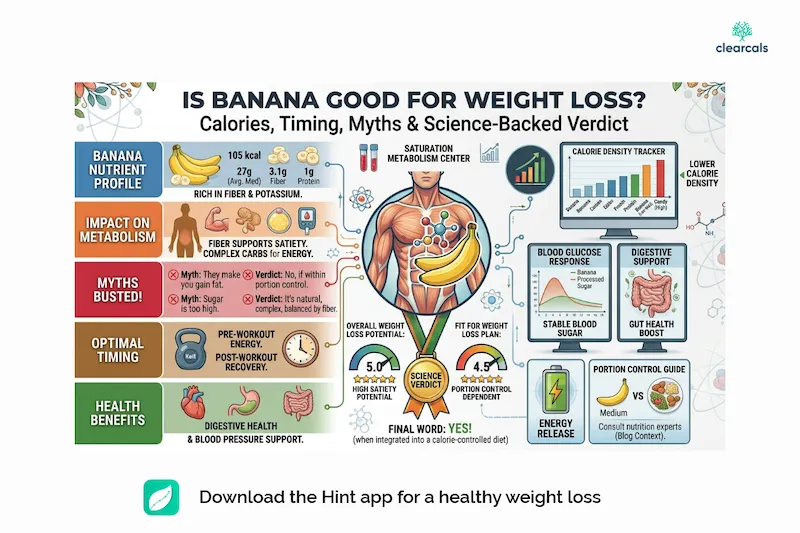
- Calories: A medium banana (
118g) has **105 kcal**; size varies the count significantly - Weight loss: Good fibre and potassium content support satiety and digestion; not a "fattening" food at normal quantities
- Ripeness matters: Riper bananas have a higher glycaemic impact than slightly under-ripe ones
- Watch the pairing: Banana milkshake with sugar, or banana with ghee/honey, changes the calorie math significantly
- Best time: Works well pre- or post-workout, or as a snack — timing matters less than total daily calories
- Track banana by size and ripeness with the Hint app
Banana Calories — By Size
| Size | Weight | Calories |
|---|---|---|
| Small banana | ~90g | ~80 kcal |
| Medium banana | ~118g | ~105 kcal |
| Large banana | ~136g | ~121 kcal |
| 1 banana, mashed (smoothie base) | 118g | ~105 kcal |
| Banana chips (fried, store-bought) | 30g | ~150 kcal |
| Banana milkshake (with sugar, full-fat milk) | 1 glass (~250ml) | ~250-300 kcal |
The fruit itself is moderate in calories — the dramatic jumps come from how it's prepared. Fried banana chips and sweetened milkshakes are a different calorie category entirely from a fresh banana.
Track your banana intake by exact size and preparation with the Hint app for an accurate daily total.
Is Banana Good for Weight Loss?
Yes — the "banana causes weight gain" claim doesn't hold up:
1. Good Fibre Content Supports Satiety
A medium banana has about 3g of fibre, helping slow digestion and extend fullness compared to lower-fibre snacks of similar calories.
2. Resistant Starch in Less-Ripe Bananas
Slightly under-ripe (greener) bananas contain more resistant starch, a type of fibre that resists digestion in the small intestine, supports gut bacteria, and has a lower glycaemic impact than fully ripe bananas.
3. High in Potassium
Potassium supports fluid balance and can help offset bloating from high-sodium meals — relevant for the "feeling lighter" aspect of a weight-loss journey, separate from actual fat loss.
4. A Better Sugar-Craving Substitute Than Processed Sweets
A banana's natural sugars come packaged with fibre, potassium, and vitamins — a meaningfully better choice than reaching for a sugary processed snack when a craving hits.
Where the myth comes from: Eating 3-4 bananas at once, or banana prepared with ghee, sugar, or full-fat milk (banana milkshake, banana halwa), adds up calories quickly. The fruit in isolation, at a normal 1-2 servings per day, is not a weight-loss obstacle for most people.
Best Time to Eat Banana for Weight Loss
There's no single "best" time scientifically, but practical guidance:
- Pre-workout: A banana 30-60 minutes before exercise provides quick, digestible energy.
- Post-workout: Pairs well with a protein source (curd, milk, protein shake) to support recovery.
- As a snack between meals: A good fibre-containing alternative to processed snacks.
- Avoid relying on it as a meal replacement — a banana alone lacks protein and fat for a balanced, filling meal.
Does Eating Banana at Night Cause Weight Gain?
No credible evidence supports this common belief. Total daily calorie intake determines weight change, not the specific time a particular fruit is eaten. A banana at night, within your daily calorie budget, will not cause weight gain any more than eating it in the morning.
How the Hint App Supports Smart Banana Tracking
The Hint app clears up exactly this kind of "is this food good or bad" confusion with real data:
- Size-accurate logging: Track small, medium, or large bananas separately instead of a single generic entry
- Recipe tracking: Log banana smoothies, milkshakes, or banana-based dishes with their full ingredient list, not just the fruit
- Personalised diet plans: Hint Pro fits fruit like banana into your daily plan based on your actual calorie target
- Dietitian consultations: Hint Premium for myth-busting, personalised nutrition guidance
Frequently Asked Questions
Does banana increase weight?
Not at normal serving sizes (1-2 per day). Weight gain results from a sustained calorie surplus, not from any single fruit. Banana milkshakes with added sugar and full-fat milk are the more likely culprit when banana is blamed for weight gain.
How many bananas can I eat per day for weight loss?
1-2 medium bananas per day fits comfortably into most weight-loss calorie budgets, alongside other fruits and vegetables for variety.
Is banana good for weight loss at night?
Yes, if it fits your remaining daily calories. There's no metabolic reason a banana eaten at night is treated differently by the body than one eaten in the morning.
Which is better for weight loss — ripe or raw banana?
Less-ripe (slightly green) bananas have more resistant starch and a lower glycaemic impact, which may support satiety slightly better. Fully ripe bananas are not "bad" — they're simply digested a little faster.
Can I drink banana shake for weight loss?
A banana shake made with skim or low-fat milk, no added sugar, and a measured portion can fit a weight-loss diet. Standard sweetened, full-fat milkshakes are considerably higher in calories and better treated as an occasional treat.
Is banana good before or after a workout?
Both work well — before for quick energy, after (ideally with a protein source) for recovery. Choose based on your routine rather than a strict rule.
References
- Englyst KN, et al. Resistant starch in bananas: effect on glycaemic and insulinaemic response. Br J Nutr. 2002. DOI: 10.1079/BJN2001585
- Mathews R, Singh DK. Composition of resistant starch in unripe bananas and its role in glycaemic response. J Food Sci Technol. Various.
- USDA FoodData Central — Banana, raw.
Explore More
- Is Mango Good for Weight Loss?
- Is Oats Good for Weight Loss?
- Weight Loss Diet Plan — India
- Weight Loss Breakfast Ideas (Indian)
About the Author
Asfia Fatima is the Chief Dietitian at Clearcals, with a Master's Degree in Dietetics and Clinical Nutrition and over a decade of experience in clinical nutrition and lifestyle management.
She specialises in evidence-based diet planning for weight loss, diabetes, and metabolic health. At Clearcals, she leads the nutrition strategy behind the Hint app, helping users achieve their goals with science-backed guidance.
🔗 Connect with Asfia on LinkedIn