Track your nutrition and health goals

Best Exercises for Weight Loss at Home (No Equipment Needed)
By Asfia Fatima, Chief Dietitian at Clearcals
Not having a gym membership or equipment isn't a real barrier to losing weight through exercise — bodyweight training, done consistently, can build the same calorie deficit and muscle-preserving effect as a gym routine. This guide lays out a complete home workout structure, with no equipment required, for Indian readers training in limited space.
TL;DR
- Exercise alone rarely causes major weight loss — its real value is preserving muscle, improving metabolic health, and making a calorie deficit more sustainable
- Best home options: Bodyweight strength circuits, HIIT-style cardio intervals, brisk walking/stair climbing, and yoga for recovery and stress management
- Aim for: 3-4 strength sessions + 2-3 cardio sessions per week, around 30-45 minutes each
- Consistency beats intensity — a moderate routine you actually follow for months beats an intense one you abandon after two weeks
- Track your activity alongside your diet with the Hint app to see the full picture, not just calories burned
Why Exercise Matters for Weight Loss (and Why It's Not the Main Lever)
Diet creates the calorie deficit that drives most weight loss — exercise's biggest contributions are preserving lean muscle mass during that deficit (so the weight lost is more fat, less muscle), improving insulin sensitivity, and making long-term weight maintenance easier. Relying on exercise alone to "burn off" a poor diet is inefficient: a 30-minute home workout might burn 150-300 kcal, while a single calorie-dense snack can easily exceed that.
The Home Workout Structure
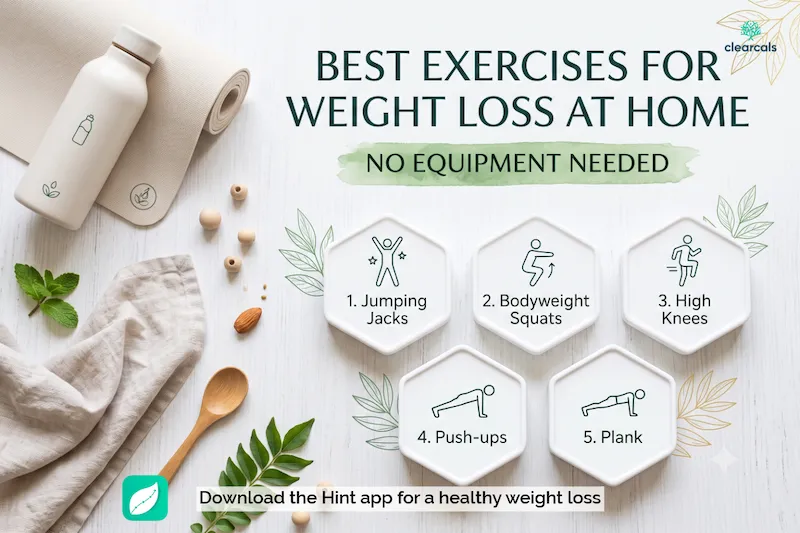
1. Bodyweight Strength Training (3-4x/week)
Strength work preserves muscle during a deficit and raises resting metabolic rate more than cardio alone. A simple full-body circuit, repeated 3-4 rounds:
| Exercise | Reps/Time | Targets |
|---|---|---|
| Squats | 15-20 reps | Legs, glutes |
| Push-ups (or knee push-ups) | 10-15 reps | Chest, shoulders, triceps |
| Glute bridges | 15-20 reps | Glutes, hamstrings |
| Plank | 30-45 seconds | Core |
| Lunges (alternating) | 12-15 reps per leg | Legs, balance |
| Superman holds | 12-15 reps | Lower back, posture |
Rest 60-90 seconds between rounds. As these get easier, add reps, slow the tempo, or move to single-leg variations before considering equipment like resistance bands.
2. HIIT-Style Cardio Intervals (2x/week)
High-intensity interval training in short bursts is time-efficient and doesn't require space beyond a small room:
- 30 seconds jumping jacks / 30 seconds rest — repeat 8 rounds
- 30 seconds high knees / 30 seconds rest — repeat 8 rounds
- 30 seconds mountain climbers / 30 seconds rest — repeat 8 rounds
A full session (15-20 minutes including rest) is enough; longer isn't necessarily better for HIIT specifically.
3. Low-Intensity Cardio (1-2x/week)
Brisk walking, stair climbing (if available), or simply pacing while on calls all count. This type of activity is easier to sustain daily and contributes meaningfully to total weekly energy expenditure without the recovery demands of HIIT.
4. Yoga or Mobility Work (1-2x/week, or daily as a short routine)
Beyond flexibility, yoga supports stress and cortisol management, which indirectly supports weight-loss consistency — chronically elevated stress is linked to increased appetite and cravings. See our guide on stress and weight loss for the connection in more detail.
Sample Weekly Schedule
| Day | Focus |
|---|---|
| Monday | Bodyweight strength circuit |
| Tuesday | HIIT cardio (15-20 min) |
| Wednesday | Bodyweight strength circuit |
| Thursday | Yoga / mobility + brisk walk |
| Friday | Bodyweight strength circuit |
| Saturday | HIIT cardio or stair climbing |
| Sunday | Rest or light walk |
Common Mistakes to Avoid
- Doing only cardio, skipping strength work — this increases the risk of losing muscle along with fat, which can slow long-term metabolism
- Going all-out in week one — soreness and burnout from an unsustainable start are a common reason people quit within the first month
- Ignoring progressive overload — if a circuit stops feeling challenging, increase reps, reduce rest, or slow the movement rather than staying static indefinitely
- Treating exercise as "permission" to eat more — it's easy to overestimate calories burned and offset the deficit accidentally; see our strength training for weight loss guide for more on this balance
How the Hint App Supports a Home Workout Routine
The Hint app connects your activity to your actual results:
- Activity and calorie tracking together: See your real net calorie balance instead of guessing how much a workout "earned" you
- Personalised plans: Hint Pro adjusts your nutrition targets to match your activity level, including strength-training days
- Progress trends: Track body measurements and weight trends over time, not just daily fluctuations
- Dietitian consultations: Hint Premium for a combined nutrition and activity plan tailored to your routine
Frequently Asked Questions
Can I lose weight with home workouts alone, no gym?
Yes — consistent bodyweight strength training and cardio can produce the same fat-loss and muscle-preservation benefits as gym training, provided intensity and progression are managed. Combined with a calorie deficit, equipment isn't required.
How long should a home workout be for weight loss?
30-45 minutes is sufficient for most people, 3-5 times a week. Longer sessions aren't necessarily better — consistency and gradual progression matter more than session length.
Is cardio or strength training better for weight loss?
Both contribute, but strength training is often underrated — it helps preserve muscle mass during a deficit, which cardio alone does not. A combination of both, as outlined above, is generally more effective than either alone.
Do I need any equipment to start?
No. Bodyweight exercises are sufficient to start and can be progressed significantly before equipment becomes necessary. Items like resistance bands or dumbbells can be added later for further progression.
How soon will I see results from home workouts?
Strength and fitness improvements are often noticeable within 2-4 weeks; visible body composition changes typically take 6-8 weeks or more, depending on diet consistency alongside the exercise routine.
Can yoga alone help with weight loss?
Yoga contributes more through stress reduction, flexibility, and mindfulness around eating than through direct calorie burn. It's a useful complement to strength and cardio training, not usually a standalone weight-loss method.
References
- Westcott WL. Resistance training is medicine: effects of strength training on health. Curr Sports Med Rep. 2012;11(4):209-16. DOI: 10.1249/JSR.0b013e31825dabb8
- Wewege M, et al. The effects of high-intensity interval training vs. moderate-intensity continuous training on body composition in overweight and obese adults: a systematic review and meta-analysis. Obes Rev. 2017;18(6):635-646. DOI: 10.1111/obr.12532
- Black DS, Slavich GM. Mindfulness meditation and the immune system: a systematic review of randomized controlled trials. Ann N Y Acad Sci. 2016;1373(1):13-24. DOI: 10.1111/nyas.12998
Explore More
- The Benefits of Strength Training for Weight Loss
- Stress and Weight Loss: Techniques to Manage Stress Effectively
- How to Lose Weight Fast, Safely
- Weight Loss Diet Plan — India
About the Author
Asfia Fatima is the Chief Dietitian at Clearcals, with a Master's Degree in Dietetics and Clinical Nutrition and over a decade of experience in clinical nutrition and lifestyle management.
She specialises in evidence-based diet planning for weight loss, diabetes, and metabolic health. At Clearcals, she leads the nutrition strategy behind the Hint app, helping users achieve their goals with science-backed guidance.
🔗 Connect with Asfia on LinkedIn