Track your nutrition and health goals

Fatty Liver Diet Chart: Indian Foods, 7-Day Meal Plan & What to Avoid
By Hafsaa Farooq | Medically Reviewed | Updated April 2026
One of the most frequently asked questions after a fatty liver diagnosis is: What should I eat?
The right diet can significantly reduce liver fat, improve liver function tests, and even reverse fatty liver disease.
This guide gives you a complete Indian fatty liver diet chart, a practical 7-day meal plan, and clear guidance on what foods to avoid.
| Key Principle: Fatty liver responds best to a diet that is low in refined carbohydrates and added sugars, moderate in healthy fats, and high in fibre. There is no single superfood, but a consistent dietary pattern makes all the difference. |
|---|
Why Diet Matters for Fatty Liver
The liver processes everything you eat and drink.
When you regularly consume excess sugar, refined carbohydrates, and unhealthy fats, the liver converts the surplus into fat and stores it within its own cells.
Over time, this leads to fatty liver disease (medically called NAFLD, non-alcoholic fatty liver disease).
Research shows that losing even 5 to 10% of body weight through diet alone can reduce liver fat by 30 to 40%. Combined with exercise, the effect is even greater. For Grade 1 and Grade 2 fatty liver, dietary changes are the primary treatment.
Best Indian Foods for Fatty Liver
These foods are liver-friendly, anti-inflammatory, and widely available across India:
Whole Grains and Complex Carbohydrates
- Daliya (broken wheat): rich in fibre, low glycaemic index, filling
- Oats: reduces blood cholesterol and liver fat
- Brown rice or red rice: better than white rice; eat in moderate portions
- Jowar, bajra, and ragi: excellent alternatives to wheat-based rotis
- Whole wheat atta chapati: 1 to 2 rotis per meal is appropriate
Protein Sources
- Moong dal, masoor dal, chana dal: high protein, low fat, liver-supportive
- Eggs (especially whites): lean protein, minimal saturated fat
- Paneer in moderation: choose low-fat paneer; avoid deep-fried versions
- Chicken breast (skinless) and fish: excellent lean protein sources
- Sprouted legumes: highly nutritious, easily digestible
Vegetables
- Leafy greens (palak, methi, drumstick leaves): rich in folate and antioxidants
- Broccoli and cauliflower: cruciferous vegetables reduce liver fat
- Karela (bitter gourd): supports liver enzyme normalisation
- Lauki (bottle gourd): low-calorie, hydrating, liver-friendly
- Tomatoes: rich in lycopene, which reduces oxidative stress in the liver
Fruits (Portion-Controlled)
- Amla (Indian gooseberry): one of the best liver-cleansing foods; high in Vitamin C
- Papaya: aids digestion and has liver-protective properties
- Guava and pear: high fibre, moderate sugar
- Berries (when available): blueberries and strawberries reduce liver inflammation
- Avoid: mango, banana, grapes, and chikoo in large quantities due to high sugar content
Healthy Fats
- Cold-pressed mustard oil or olive oil for cooking (use minimally, 2 to 3 tsp per day)
- A small handful of walnuts or almonds daily: omega-3 and antioxidant-rich
- Flaxseeds: sprinkle on salads or add to curd; excellent source of omega-3
- Avocado (when available): reduces liver fat markers
Beverages
- Water: aim for 2.5 to 3 litres per day
- Green tea: contains catechins that reduce liver fat accumulation
- Black coffee without sugar: studies show 2 to 3 cups per day may reduce liver fibrosis risk
- Jeera water or haldi milk (without sugar): anti-inflammatory options
Foods to Avoid with Fatty Liver
Equally important is knowing what to cut out. These foods directly worsen liver fat and inflammation:
| Food to Avoid | Why It Harms the Liver |
|---|---|
| Sugary drinks (cola, packaged juices, energy drinks) | High fructose overloads the liver and accelerates fat storage |
| Maida (refined flour) products: white bread, biscuits, naan | Spikes blood sugar; promotes fat accumulation |
| Deep-fried foods: samosa, pakoda, chips, poori | High in trans fats and saturated fats, it worsens inflammation |
| Alcohol | Directly toxic to liver cells; must be avoided completely |
| Processed and packaged foods | Contains hidden sugars, sodium, and preservatives |
| High-fat dairy: full-fat milk, ghee in excess, cream | Saturated fat increases liver fat load |
| Red meat (especially processed: sausage, salami) | High saturated fat is linked to NASH progression |
| White rice and white bread in excess | Rapidly digested carbohydrates spike insulin |
| Quick Tip on Ghee: A small amount of ghee (half a teaspoon) is acceptable in an Indian diet. But more than 1 teaspoon per day adds a significant saturated fat load to the liver and should be avoided during the reversal phase. |
|---|
7-Day Indian Fatty Liver Diet Chart
Below is a practical 7-day meal plan using common Indian foods. Adjust portion sizes based on your calorie target, which your dietitian or the Hint app can calculate for you.
| Day | Breakfast | Mid-Morning | Lunch | Evening Snack | Dinner |
|---|---|---|---|---|---|
| Day 1 (Monday) | Overnight oats with chia seeds and amla powder | Moong dal chilla with mint chutney | 1 chapati + palak dal + mixed vegetable sabzi + salad | A small handful of walnuts | Daliya khichdi + raita (low-fat curd) + cucumber salad |
| Day 2 (Tuesday) | Vegetable daliya upma + green tea | Sprout chaat with lemon and coriander | Brown rice + rajma (kidney beans) + lauki sabzi + salad | Papaya (1 cup) | 2 chapatis + chicken breast curry (less oil) + palak soup |
| Day 3 (Wednesday) | Poha made with minimal oil + jeera water | Boiled egg (2 whites, 1 whole) + cucumber | 2 jowar rotis + chana dal + bhindi sabzi + salad | Guava or pear (1 medium) | Vegetable soup + moong dal khichdi + curd |
| Day 4 (Thursday) | Ragi dosa (no butter) + sambar (low oil) | Roasted makhana (fox nuts) or a handful of almonds | 1 to 2 chapatis + fish curry (grilled or lightly cooked) + methi sabzi | Green tea + 2 whole wheat biscuits | Palak soup + 2 chapatis + rajma or paneer (low fat) |
| Day 5 (Friday) | Oats porridge with flaxseeds and a few berries | Sprout and vegetable salad with lemon dressing | Brown rice + arhar dal + lauki + salad | 1 apple or a pear | Daliya pulao (vegetables) + raita |
| Day 6 (Saturday) | Vegetable uttapam (no butter) + coconut chutney (small amount) | Boiled corn or roasted chana | 2 bajra rotis + mixed dal + karela sabzi + salad | Amla juice or a small bowl of papaya | Vegetable khichdi + curd + sauteed spinach |
| Day 7 (Sunday) | Egg white omelette with vegetables + black coffee | A handful of walnuts or almonds | 2 chapatis + chicken or fish (baked or grilled) + salad | Green tea + roasted chana | Palak or lauki soup + daliya + low-fat curd |
Note: Use cold-pressed mustard oil or olive oil for cooking. Limit total oil to 2 to 3 teaspoons per day. Cook using methods like steaming, boiling, grilling, or light sauteing. Avoid deep frying.
How Many Calories Should You Eat?
Your calorie target depends on your current weight, height, age, and activity level. As a general guide for people with fatty liver, aim for gradual weight loss:
- Women: 1,200 to 1,500 kcal per day (depending on activity level)
- Men: 1,500 to 1,800 kcal per day
A calorie deficit of 500 kcal per day leads to approximately 0.5 kg of weight loss per week, which is the recommended rate for liver fat reduction.
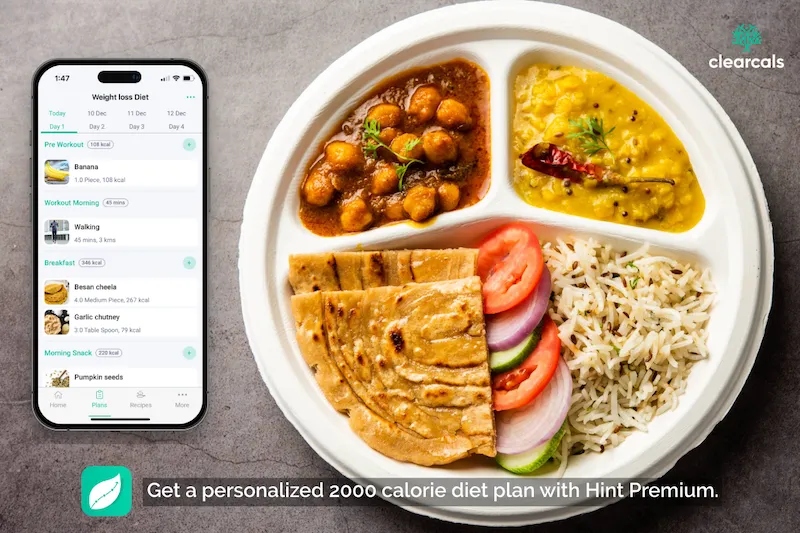
The Hint app can calculate your personal calorie target and track your daily intake with an extensive Indian food database.
Diet Tips by Grade
Grade 1 Fatty Liver Diet
At Grade 1, dietary changes alone are often sufficient for reversal.
Focus on reducing sugar and refined carbs, adding fibre-rich foods, and losing 5 to 7% of body weight. Consistency over 3 to 6 months is the key.
See our complete Grade 1 Fatty Liver guide for more details.
Grade 2 Fatty Liver Diet
At Grade 2, a stricter approach is needed. Pair diet with regular exercise and monitor liver enzymes every 3 months. Aim for a 7 to 10% weight loss.
Your doctor may also recommend medications alongside dietary changes.
See our Grade 2 Fatty Liver guide for a detailed treatment plan.
Grade 3 Fatty Liver Diet
Grade 3 requires medical supervision alongside dietary management. Reversal is possible but takes longer (12 to 24 months). A registered dietitian consultation is strongly recommended.
Read our Grade 3 Fatty Liver guide for more information.
Track Your Fatty Liver Diet with Hint
Managing a fatty liver diet in an Indian household can be challenging: navigating family meals, social events, and the wide variety of regional foods. Hint makes it easier by giving you tools built for Indian eating habits.
- Search and log Indian foods with accurate calorie and macronutrient data
- Get a personalised calorie target and macro split based on your health profile
- Access Indian fatty liver meal plans created by certified dietitians (Hint Premium)
- Track weight loss progress towards your reversal goal
- Log water intake, sleep, and activity in one place
Download the Hint app from the App Store or Google Play to start your liver health journey today.
Frequently Asked Questions
Can I eat rice if I have fatty liver?
Yes, but in moderation and preferably brown rice or red rice over white rice. Keep portions to half a cup (cooked) per meal and pair it with plenty of dal and vegetables to slow down carbohydrate absorption.
Is curd (yoghurt) good for fatty liver?
Yes. Low-fat or fat-free curd is excellent for fatty liver. It provides probiotics that support gut health and indirectly improve liver health. Avoid full-fat curd in large quantities.
Can I eat paneer with fatty liver?
Yes, in moderation. Choose low-fat paneer and avoid deep-fried preparations. A 50 to 80 gram portion, 3 to 4 times per week, is generally fine.
Is coffee good for fatty liver?
Yes. Research shows that black coffee (without sugar or cream) consumed 2 to 3 cups per day is associated with a lower risk of liver fibrosis and improved liver enzyme levels.
See our detailed guide on black coffee and fatty liver.
How long before I see improvement on a fatty liver diet?
Most people see improvement in liver enzyme levels (blood tests) within 4 to 8 weeks of consistent dietary changes. Ultrasound-visible improvement typically takes 3 to 6 months for Grade 1 and 6 to 12 months for Grade 2.
Should I avoid ghee completely?
Not necessarily. Small amounts of ghee (half a teaspoon) are acceptable in an Indian diet.
However, during active liver fat reversal, limit it to no more than 1 teaspoon per day and avoid it on days when you eat other high-fat foods.
About the Author
Hafsaa Farooq is a Consultant Dietitian at Clearcals with a strong passion for nutrition, fitness, and evidence-based health practices.
She is deeply interested in clinical nutrition and enjoys helping individuals build healthier lifestyles through practical dietary guidance.
Beyond her professional work, Hafsaa enjoys developing healthy recipes, writing evidence-based nutrition blogs, and staying active through sports.
She is also expanding her expertise in the science of exercise and weight training to better support holistic health and fitness goals.
🔗 Connect with Hafsaa on LinkedIn