Track your nutrition and health goals

High-Protein Vegetarian Foods in India: 20 Options Ranked Per 100g
By Asfia Fatima, Chief Dietitian at Clearcals
India is home to one of the world's largest vegetarian populations — and one of the most protein-deficient. The gap is not inevitable: a well-structured Indian vegetarian diet can comfortably deliver 80–120g of protein per day. The key is knowing which foods to prioritise.
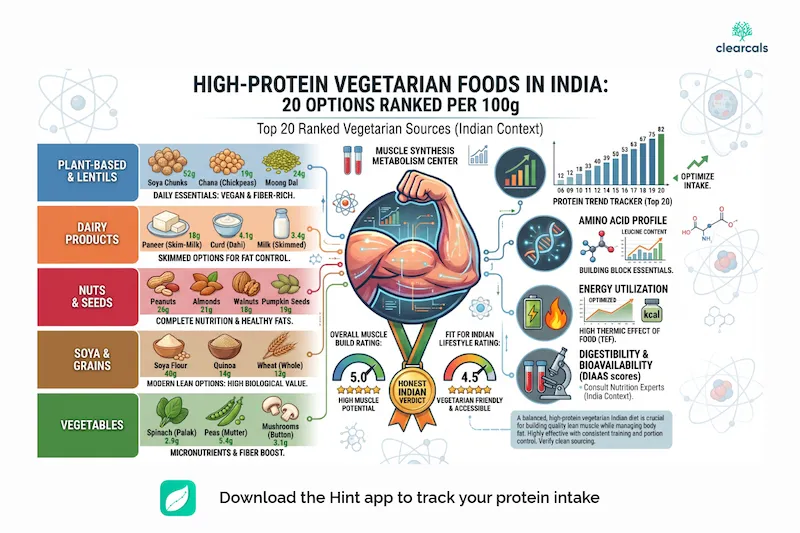
This guide ranks 20 high-protein vegetarian foods available in India by protein per 100g, with practical per-serving amounts for everyday meal planning.
The Top 20 High-Protein Vegetarian Foods in India
1. Soya Chunks (Meal Maker) — ~52g protein per 100g (raw)
Soya chunks are the undisputed protein champion of Indian vegetarian cooking. At 52g protein per 100g dry weight, they out-protein chicken breast on paper — though this falls to 14–17g per 100g after boiling as water absorption expands the chunks considerably.
| Metric | Value |
|---|---|
| Protein per 100g (raw/dry) | ~52g |
| Protein per 100g (cooked) | ~14–17g |
| Protein per 1 katori cooked (~100g) | ~14–17g |
| Calories per 100g (cooked) | ~98 kcal |
| Carbs per 100g (cooked) | ~11g |
Best Indian uses: Soya chunks curry, pulao, dry fry, keema-style, biryani addition
2. Roasted Peanuts / Groundnuts — ~26g protein per 100g
Peanuts are India's most affordable high-protein food. A 50g handful of roasted peanuts delivers 13g protein at roughly ₹5–10.
| Metric | Value |
|---|---|
| Protein per 100g | ~25–26g |
| Calories per 100g | ~567 kcal |
| Protein per 30g handful | ~7.5–8g |
Best uses: Roasted chana-peanut mix, peanut butter on toast, peanut chutney, trail mix
3. Urad Dal (Black Gram) — ~25g protein per 100g (raw)
| Metric | Value |
|---|---|
| Protein per 100g (raw) | ~24–25g |
| Protein per 100g (cooked) | ~8–9g |
| Protein per 1 katori cooked | ~12–13g |
| Calories per 100g (cooked) | ~105 kcal |
Best uses: Dal makhani, medu vada, idli/dosa batter (urad + rice combination)
4. Moong Dal (Green Gram) — ~24g protein per 100g (raw)
Moong dal is the most digestible legume in Indian cooking and one of the fastest to cook. Sprouted moong offers better bioavailability.
| Metric | Value |
|---|---|
| Protein per 100g (raw) | ~24g |
| Protein per 100g (cooked) | ~7–9g |
| Protein per 1 katori cooked | ~10–13g |
| Calories per 100g (cooked) | ~105 kcal |
Best uses: Moong dal tadka, khichdi, moong chilla, sprouted salad
5. Rajma (Kidney Beans) — ~22–24g protein per 100g (raw)
| Metric | Value |
|---|---|
| Protein per 100g (raw) | ~22–24g |
| Protein per 100g (cooked) | ~8–9g |
| Protein per 1 katori cooked (~150g) | ~12g |
| Calories per 100g (cooked) | ~127 kcal |
Best uses: Rajma masala, rajma chawal, rajma soup
6. Toor Dal (Arhar Dal) — ~22g protein per 100g (raw)
India's most consumed dal — the backbone of everyday protein intake for most Indian households.
| Metric | Value |
|---|---|
| Protein per 100g (raw) | ~22g |
| Protein per 100g (cooked) | ~7–8g |
| Protein per 1 katori cooked | ~10–12g |
| Calories per 100g (cooked) | ~116 kcal |
Best uses: Sambar, plain dal fry, dal tadka
7. Chana Dal (Bengal Gram Dal) — ~20–22g protein per 100g (raw)
| Metric | Value |
|---|---|
| Protein per 100g (raw) | ~20–22g |
| Protein per 100g (cooked) | ~8–9g |
| Calories per 100g (cooked) | ~164 kcal |
Best uses: Chana dal tadka, chana dal paratha, sundal
8. Paneer — ~19g protein per 100g
Paneer is the most popular high-protein food for Indian vegetarians — high in protein and zero carbohydrates, making it suitable for all diet types including keto and diabetic-friendly plans.
| Metric | Value |
|---|---|
| Protein per 100g | ~18.9g |
| Calories per 100g | ~258 kcal |
| Protein per 1 katori (~75g) | ~14g |
| Protein per 150g serving | ~28g |
Best uses: Paneer bhurji, palak paneer, paneer tikka, paneer in sabji
9. Sattu (Roasted Chana Flour) — ~20g protein per 100g
Sattu is one of India's most underrated protein foods — a traditional staple of Bihar and Uttar Pradesh with impressive nutrition at minimal cost.
| Metric | Value |
|---|---|
| Protein per 100g | ~20g |
| Calories per 100g | ~350 kcal |
| Fibre per 100g | ~18g |
| Protein per 60g serving | ~12g |
Best uses: Sattu sharbat, sattu paratha filling, sattu laddoo
10. Tofu — ~8–10g protein per 100g (firm)
Tofu is made from soy milk and is the closest vegan equivalent to paneer in texture and cooking versatility.
| Metric | Value |
|---|---|
| Protein per 100g (firm tofu) | ~8–10g |
| Calories per 100g | ~76–100 kcal |
| Carbs per 100g | ~2g |
Best uses: Tofu bhurji (substitute for paneer bhurji), tofu stir fry, tofu tikka
11. Masoor Dal (Red Lentil) — ~24g protein per 100g (raw)
| Metric | Value |
|---|---|
| Protein per 100g (raw) | ~24g |
| Protein per 100g (cooked) | ~7–8g |
| Calories per 100g (cooked) | ~100 kcal |
One of the fastest-cooking dals with a mild flavour. High in folate — beneficial for women of reproductive age.
12. Oats — ~13–17g protein per 100g
Plain rolled oats provide more protein than most grains, and high-protein fortified oats (Pintola, Alpino) reach 25–27g per 100g.
| Metric | Value |
|---|---|
| Protein per 100g (raw oats) | ~13–17g |
| Protein per 50g serving | ~7–8g |
| Calories per 100g | ~370 kcal |
Best uses: Oats porridge with milk, overnight oats with curd, oats chilla, oats khichdi
13. Quinoa — ~14g protein per 100g (raw), complete protein
Quinoa is one of very few plant foods that is a complete protein — containing all nine essential amino acids.
| Metric | Value |
|---|---|
| Protein per 100g (raw) | ~14g |
| Protein per 100g (cooked) | ~4.4g |
| Calories per 100g (cooked) | ~120 kcal |
Best uses: Quinoa khichdi, quinoa pulao, quinoa salad
14. Edamame (Green Soybeans) — ~11g protein per 100g (cooked)
Edamame is becoming more accessible in Indian cities. It is a complete protein source with excellent bioavailability.
| Metric | Value |
|---|---|
| Protein per 100g (cooked) | ~11g |
| Calories per 100g | ~122 kcal |
Best uses: Edamame sundal, boiled edamame as snack, added to salads and pulao
15. Almonds — ~21g protein per 100g
Almonds are calorie-dense but protein-rich. A small handful (20g) provides 4g protein alongside healthy fats.
| Metric | Value |
|---|---|
| Protein per 100g | ~21g |
| Calories per 100g | ~579 kcal |
| Protein per 20g handful | ~4g |
16. Hemp Seeds — ~32g protein per 100g
Hemp seeds are not widely used in Indian cooking but are increasingly available online and in health stores. They are a complete protein with an excellent omega-3 to omega-6 ratio.
| Metric | Value |
|---|---|
| Protein per 100g | ~32g |
| Calories per 100g | ~553 kcal |
| Protein per 3 tbsp (30g) | ~10g |
Best uses: Added to smoothies, sprinkled over curd or salads, mixed into oats
17. Pumpkin Seeds — ~19–30g protein per 100g
Pumpkin seeds are one of the most protein-dense seeds and are also rich in zinc, magnesium, and iron.
| Metric | Value |
|---|---|
| Protein per 100g | ~19–30g |
| Calories per 100g | ~559 kcal |
| Protein per 30g serving | ~6–9g |
18. Milk (Whole) — ~3.2g protein per 100ml
Milk is an accessible, affordable complete protein source that most Indians already consume daily.
| Metric | Value |
|---|---|
| Protein per 100ml | ~3.2–3.4g |
| Protein per 250ml glass | ~8g |
| Calories per 100ml | ~61 kcal |
Amul High Protein Milk delivers ~6–7g protein per 100ml — nearly double regular milk.
19. Greek Dahi / Hung Curd — ~10–12g protein per 100g
Regular dahi contains 3.5–4g protein per 100g, but straining it overnight (hung curd) concentrates the protein to 10–12g per 100g — comparable to paneer in protein density per calorie.
| Metric | Value |
|---|---|
| Protein per 100g (hung curd) | ~10–12g |
| Calories per 100g | ~90–100 kcal |
20. Chia Seeds — ~17g protein per 100g
Chia seeds are a compact, versatile protein and fibre source with no cooking required.
| Metric | Value |
|---|---|
| Protein per 100g | ~17g |
| Fibre per 100g | ~34g |
| Protein per 2 tbsp (20g) | ~3.4g |
| Calories per 100g | ~486 kcal |
Best uses: Chia seed pudding with milk, added to buttermilk, sprinkled on oats
All 20 Foods Ranked: Quick Reference Table
| Rank | Food | Protein per 100g (raw/dry) | Protein per 100g (cooked/as eaten) | Calories (cooked) |
|---|---|---|---|---|
| 1 | Soya chunks | ~52g | ~14–17g | ~98 kcal |
| 2 | Hemp seeds | ~32g | N/A (eaten as is) | ~553 kcal |
| 3 | Pumpkin seeds | ~19–30g | N/A | ~559 kcal |
| 4 | Roasted peanuts | ~26g | N/A | ~567 kcal |
| 5 | Urad dal | ~24–25g | ~8–9g | ~105 kcal |
| 6 | Masoor dal | ~24g | ~7–8g | ~100 kcal |
| 7 | Moong dal | ~24g | ~7–9g | ~105 kcal |
| 8 | Almonds | ~21g | N/A | ~579 kcal |
| 9 | Sattu | ~20g | N/A (drink/paratha) | ~350 kcal |
| 10 | Chana dal | ~20–22g | ~8–9g | ~164 kcal |
| 11 | Rajma | ~22–24g | ~8–9g | ~127 kcal |
| 12 | Toor dal | ~22g | ~7–8g | ~116 kcal |
| 13 | Quinoa | ~14g | ~4.4g | ~120 kcal |
| 14 | Oats | ~13–17g | ~7–9g | ~370 kcal |
| 15 | Chia seeds | ~17g | N/A | ~486 kcal |
| 16 | Paneer | ~19g | ~19g | ~258 kcal |
| 17 | Edamame | ~12g | ~11g | ~122 kcal |
| 18 | Tofu | ~8–10g | ~8–10g | ~76–100 kcal |
| 19 | Hung curd | ~10–12g | ~10–12g | ~90 kcal |
| 20 | Milk (whole) | ~3.2g/100ml | ~3.2g/100ml | ~61 kcal |
Sample High-Protein Vegetarian Day (80–100g Protein)
| Meal | Foods | Protein |
|---|---|---|
| Breakfast | 50g rolled oats cooked in 250ml milk + 1 tbsp peanut butter | ~19g |
| Mid-morning snack | 1 katori sprouted moong salad + 30g roasted peanuts | ~16g |
| Lunch | 2 rotis + 1 katori rajma curry + 1 katori curd | ~20g |
| Evening snack | 100g hung curd + berries | ~10–12g |
| Dinner | 150g paneer sabji + 1 katori dal | ~36g |
| Total | ~101–105g |
FAQs
Which vegetarian food has the most protein in India? Soya chunks at 52g protein per 100g dry weight, followed by peanuts (26g), urad dal (25g), and moong dal (24g).
Can I build muscle on a vegetarian diet? Yes. Hitting 1.6–2.2g protein per kg body weight through soya chunks, paneer, dal, legumes, oats, and a protein supplement if needed is entirely achievable for vegetarians.
Is paneer the best vegetarian protein? It's the most versatile and widely consumed, but not the highest per 100g. Soya chunks, peanuts, and dals all have more protein per 100g raw weight. Paneer's advantage is that it's eaten as-is without cooking-induced protein concentration loss.
Final Thoughts
A varied Indian vegetarian diet — built around dal, paneer, soya chunks, legumes, oats, and dairy — can easily meet daily protein requirements. The key is including a protein source at every meal rather than relying on one or two foods.
Track your vegetarian protein intake across every meal using the Hint app, built on the NIN-ICMR Indian food database for the most accurate vegetarian protein data available.
References
- Nutritional Profile of Indian Vegetarian Diets — the Indian Migration Study (IMS) — PMC, 2014
- Animal Protein versus Plant Protein in Supporting Lean Mass and Muscle Strength: A Systematic Review and Meta-Analysis — PMC, 2021
- Achieving High Protein Quality Is a Challenge in Vegan Diets: A Narrative Review — PMC, 2025
- Effect of Plant Versus Animal Protein on Muscle Mass, Strength, Physical Performance, and Sarcopenia: A Systematic Review and Meta-Analysis — Nutrition Reviews, 2025
- National Institute of Nutrition (NIN-ICMR): Recommended Dietary Allowances for Indians — NIN, 2020
🎁 Free Hint with Every Watch Purchase
Garmin watches: Purchase any Garmin watch from the Clearcals Store and receive 1 month of Hint Premium (worth ₹1,999) free.
Apple Watch: Purchase any Apple Watch from the Clearcals Store and receive a free Hint Pro subscription.
About the Author
Asfia Fatima is the Chief Dietitian at Clearcals, with a Master's Degree in Dietetics and Clinical Nutrition and over a decade of experience in clinical nutrition and lifestyle management.
🔗 Connect with Asfia on LinkedIn