Track your nutrition and health goals

Khichdi Calories & Nutrition: Dal vs. Sabudana vs. Millet (Is It Healthy?)
Khichdi Calories & Nutrition: Dal vs. Sabudana vs. Millet (Is It Healthy?)
Is Khichdi Healthy? The Short Answer
Yes, genuinely so — khichdi is one of the few Indian comfort foods that's about as healthy as it is comforting.
At its core, it's rice and a lentil (usually moong dal) cooked together with turmeric and mild spices, which pairs a grain with a legume to give a more complete amino acid profile than either would provide alone.
It's easy to digest, moderate in calories, and flexible enough to load up with vegetables or swap in a whole grain without losing what makes it work.
The one dish that doesn't fit this description is sabudana khichdi, which, despite sharing the name, is a completely different food nutritionally — covered separately below.
Khichdi Calories: Quick Reference (per bowl, ~200g cooked)
| Type | Approx. Calories |
|---|---|
| Plain moong dal khichdi (minimal ghee) | 259 kcal |
| Masala khichdi (with tadka and spices) | ~220-260 kcal |
| Vegetable khichdi | ~200-240 kcal |
| Dal khichdi (higher dal ratio) | ~190-230 kcal |
| Quinoa khichdi | ~180-210 kcal |
| Millet khichdi (bajra/jowar/foxtail) | ~190-230 kcal |
| Dalia (broken wheat) khichdi | ~170-200 kcal |
| Oats khichdi | ~150-190 kcal |
| Sabudana khichdi | ~250-300 kcal |
A standard bowl of khichdi sits in a moderate calorie range for a full meal — lighter than most rice-and-curry combinations, mainly because it uses less oil and typically comes with fewer separate accompaniments.
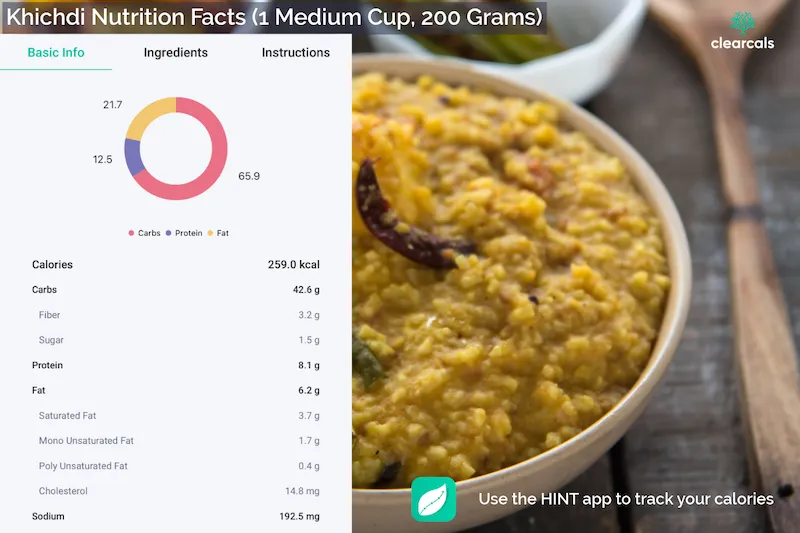
Full Nutrition Facts (1 Bowl Plain Moong Dal Khichdi, ~200g)
| Nutrient | Amount |
|---|---|
| Calories | 259 kcal |
| Protein | 8.1g |
| Carbohydrates | 42.6g |
| Fat | 6.2g |
| Fibre | 3.2g |
Does Khichdi Have Protein?
Khichdi has a modest but genuinely useful amount of protein for a rice-based dish — roughly 8g per bowl, almost entirely from the moong dal (or whichever lentil is used).
Rice alone is quite low in protein and is missing certain essential amino acids that lentils provide, so combining the two — a practice called protein complementation — gives you a fuller amino acid profile than either food eaten on its own.
It's not a high-protein meal by modern standards, but it's a meaningfully better protein source than plain rice, and using a higher dal-to-rice ratio (as in "dal khichdi") increases it further.
Sabudana Khichdi: A Completely Different Dish
Despite the shared name, sabudana khichdi has almost nothing in common with dal khichdi nutritionally. It's made from sabudana (tapioca pearls, also called sago) rather than rice and lentils, and is traditionally eaten during religious fasting (vrat/upvas) — Navratri and Ekadashi in particular — when grains and lentils are avoided.
A typical bowl, made with peanuts, ghee, and potato, runs noticeably higher in calories (~250-300 kcal) than a bowl of dal khichdi, largely because tapioca pearls are almost pure starch and the dish is usually cooked with a generous amount of oil or ghee plus a good handful of peanuts.
It's also considerably lower in protein than dal khichdi, since it has no lentils in it at all — what protein it does have comes mostly from the peanuts. If you're eating sabudana khichdi specifically because it's a fasting-day staple, it's worth knowing it isn't a "lighter" option than regular khichdi — often the opposite.
Khichdi Made with Millets, Quinoa, and Other Grains
Swapping rice for a different grain is one of the most common ways people adapt khichdi, and it's a reasonable one:
- Millet khichdi (bajra, jowar, foxtail, or barnyard millet) brings more fibre and a lower glycemic profile than white rice, generally landing in a similar or slightly lower calorie range.
- Quinoa khichdi adds a modest protein boost, since quinoa (unlike rice) contains all nine essential amino acids on its own.
- Dalia (broken wheat) khichdi is a lighter, high-fibre option that's often used specifically for easy digestion.
- Oats khichdi tends to be the lowest-calorie version of the group, though it's a more recent, less traditional variation.
These swaps don't dramatically change the calorie count — the bigger nutritional gain is in fibre and micronutrient variety, not a large calorie cut.
Is Khichdi Good for Weight Loss?
Khichdi is a genuinely reasonable choice while trying to lose weight — it's moderate in calories for a filling, complete meal, doesn't rely on deep-frying or heavy oil, and the fibre and protein from the dal help with satiety.
That said, it's still a carbohydrate-forward dish, so portion size and how much ghee is added matter more here than with a lower-carb meal. A vegetable-loaded khichdi with a lighter hand on the ghee is a better everyday weight-loss option than a very rich, buttery masala khichdi.
Is Khichdi Good for Diabetes?
Khichdi can fit into a diabetes-friendly diet more easily than plain white rice on its own, since the lentils add protein and fibre that slow down how quickly the meal raises blood sugar.
Using a higher proportion of dal and vegetables to rice, or swapping in a millet or dalia base, generally makes it a gentler option. That said, individual blood sugar response varies, and rice-based meals still deserve attention to portion size if you're managing diabetes — it's worth discussing how khichdi fits your specific diet with your doctor or dietitian rather than relying on a general rule.
Khichdi for Digestion, Illness, and Recovery
Khichdi has a long-standing reputation in India as the food you eat when you're unwell, or your digestion needs a break — during fever, an upset stomach, or while recovering from illness. This isn't just tradition without basis: a soft, well-cooked khichdi made with minimal spice is genuinely easy to digest, gentle on the stomach, and provides some protein and calories without demanding much from your digestive system.
It's not a treatment for any specific condition, and if you're managing an ongoing illness or recovering from something more serious, it's worth checking with your doctor about what your diet should look like rather than relying on khichdi alone.
Khichdi for Babies
Khichdi (typically a very soft, well-mashed moong dal khichdi with a little ghee) is one of the most common first foods introduced to babies in India, usually starting around 6 months alongside other weaning foods. Its soft texture, mild flavour, and combination of carbohydrates and protein make it a practical early food.
As with any weaning decision, timing and texture should be guided by your pediatrician's advice rather than a general age guideline.
How to Make a Lighter, More Nutritious Khichdi
A few adjustments make a real difference without changing what khichdi fundamentally is:
- Load up on vegetables — carrots, peas, spinach, and beans add volume, fibre, and micronutrients for very few extra calories.
- Go easy on the ghee — a teaspoon or two of ghee for flavour is plenty; several tablespoons meaningfully increase the calorie count.
- Increase the dal-to-rice ratio for more protein and a lower glycemic load per bowl.
- Swap in a millet, quinoa, or dalia base occasionally for more fibre and nutritional variety.
- An Instant Pot or pressure cooker works well for a quick, consistent khichdi without extra oil, which is part of why it's become a popular weeknight staple, especially among the Indian diaspora cooking with US kitchen appliances.
Track Your Khichdi With Hint
Because khichdi's calorie count swings quite a bit based on how much ghee, dal, and vegetables go in, "a bowl of khichdi" can mean anywhere from about 180 kcal to well over 300 kcal for a sabudana version.
The Hint app lets you log khichdi by type and preparation, so your tracking reflects the actual dish rather than a rough average. For more low-calorie evening meal ideas beyond khichdi, see our Indian weight-loss dinner guide.
FAQs
How many calories are in a bowl of khichdi? A standard bowl of moong dal khichdi (~200g) is roughly 260 kcal, depending on how much ghee and dal are used.
Is khichdi good for weight loss? Yes, generally — it's moderate in calories, filling, and doesn't rely on frying, though portion size and added ghee still matter.
Does khichdi have protein? A modest but useful amount — roughly 7- 8 g per bowl, mostly from the dal, which also gives it a fuller amino acid profile than rice alone.
How many calories are in sabudana khichdi? Roughly 250-300 kcal per bowl — notably more than regular dal khichdi, since tapioca pearls, peanuts, and ghee are all calorie-dense.
Is sabudana khichdi the same as dal khichdi? No — despite the shared name, sabudana khichdi is made from tapioca pearls rather than rice and lentils, is traditionally eaten during religious fasting, and has a different (and generally higher) calorie and lower protein profile.
Is khichdi good for an upset stomach or when you're sick? It's a traditional choice for exactly this reason — a soft, mildly spiced khichdi is easy to digest and gentle on the stomach, though it isn't a treatment for any specific illness.
Can diabetics eat khichdi? It can be a reasonable option, especially with more dal and vegetables relative to rice, but individual response varies — check with your doctor or dietitian about how it fits your diet.
What is khichdi called in English? There isn't an exact English equivalent — it's often loosely described as a rice-and-lentil porridge or stew, but "khichdi" is generally used as-is even in English-language contexts.
About the Author
Asfia Fatima is the Chief Dietitian at Clearcals, with a Master's Degree in Dietetics and Clinical Nutrition and over a decade of experience in clinical nutrition and lifestyle management. She specialises in evidence-based diet planning for weight loss, diabetes, and metabolic health, and leads the nutrition strategy behind the Hint app.
Connect with Asfia on LinkedIn