Track your nutrition and health goals

Zinc Rich Foods in India: Veg List, Daily Need, Deficiency
Zinc-Rich Foods in India: Vegetarian and Non-Vegetarian Sources, Daily Need and Absorption
By Dr. Sumedha Verma, Consultant Physician at Clearcals
The short answer
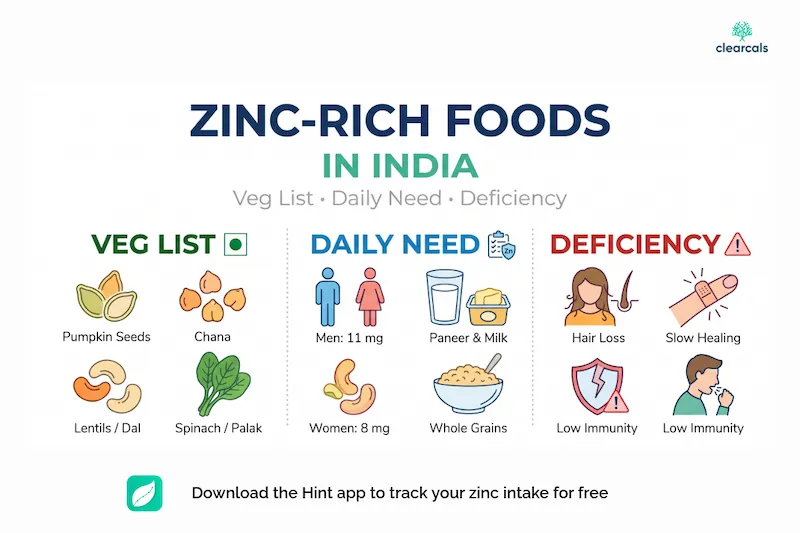
Zinc is found in pumpkin seeds, sesame, cashews and other nuts, chickpeas, rajma and dals, whole grains and millets, curd, milk, paneer, eggs, chicken, mutton and shellfish. Animal foods give zinc that the body absorbs more easily, while plant foods contain phytates that reduce absorption, so vegetarians in India often need to eat more zinc-rich foods and prepare grains and pulses well by soaking, sprouting and fermenting. Most people who eat a varied diet get enough. A zinc supplement should be your doctor's decision, because too much causes problems of its own.
- Best vegetarian foods: pumpkin seeds, sesame, cashews, chana, rajma, dals, whole wheat, oats, bajra, ragi, paneer, curd, milk, soya.
- Best non-vegetarian foods: shellfish such as oysters, mutton, chicken, eggs and fish.
- Absorb more: soak, sprout and ferment grains and pulses, and eat them with some protein.
- Supplements: only on advice. Long-term high doses can lower copper and cause nausea and anaemia.
Why zinc matters
Zinc supports your immune system, wound healing, taste and smell, growth and normal development in children, and fertility, and it is part of hundreds of enzymes. Your body does not store much, so you need it regularly from food.
How much zinc do you need?
Needs differ by age and sex, and guidelines vary. As per ICMR-NIN, adult men need around 17 mg a day and adult women around 13 mg, with pregnancy and breastfeeding raising the need, and children needing less by age. Because plant zinc is absorbed less well, vegetarians may need more than these numbers suggest. Your doctor or dietitian may advise a different target if you have a gut, liver, or kidney condition. Taking more than about 40 mg a day from all sources, mostly through supplements, is not advised for adults over the long term.
Zinc-rich foods: Indian list
The numbers are rough amounts per typical serving. They vary by variety and preparation, and they show the zinc in the food, not what you absorb.
| Food | Typical serving | Roughly how much zinc |
|---|---|---|
| Pumpkin seeds | 30 g (2 tablespoons) | about 2 to 3 mg |
| Sesame seeds (til) | 1 tablespoon | about 1 mg |
| Cashews | 30 g | about 1.5 mg |
| Almonds | 10 to 12 | about 1 mg |
| Chickpeas (chana or chole, cooked) | 1 katori (150 g) | about 1.5 to 2 mg |
| Rajma (cooked) | 1 katori | about 1.5 mg |
| Dals (cooked) | 1 katori | about 1 to 1.5 mg |
| Soya chunks (dry) | 30 g | about 1.5 to 2 mg |
| Whole wheat roti | 2 rotis | about 1.5 mg |
| Oats | 40 g | about 1.5 mg |
| Bajra and ragi | 50 g flour | about 1 to 1.5 mg |
| Paneer | 50 g | about 1.5 mg |
| Milk | 1 glass (250 ml) | about 1 mg |
| Curd | 1 katori (100 g) | about 0.5 mg |
| Dark chocolate | 20 g | about 1 mg |
Non-vegetarian sources
| Food | Typical serving | Roughly how much zinc |
|---|---|---|
| Oysters | 6 medium | 30 mg or more. Extremely rich, but not a common Indian food. |
| Mutton or beef | 100 g cooked | about 4 to 5 mg |
| Chicken | 100 g cooked | about 1.5 to 2 mg |
| Crab and prawns | 100 g | about 2 to 4 mg |
| Egg | 1 | about 0.6 to 1 mg |
| Fish | 100 g | about 0.5 to 1 mg |
Zinc-rich fruits and vegetables
Most fruits and vegetables are low in zinc. Dried fruits, avocado, guava, and vegetables such as green peas, mushrooms, and spinach give small amounts. For zinc, rely on seeds, pulses, grains and dairy, and treat fruit and vegetables as the supporting cast.
Why vegetarians absorb less zinc
Whole grains, pulses and seeds contain phytates, which bind zinc and reduce how much you absorb. This does not mean you should avoid these foods, because they are the main zinc sources for vegetarians. Instead, prepare them well:
- Soak dals, rajma and chana for several hours before cooking.
- Sprout pulses such as moong and chana.
- Ferment batters for idli and dosa, and use leavened breads where you can.
- Eat zinc foods with protein, which helps absorption.
- Don't rely on wheat bran or very high-fibre foods alone, because they carry a lot of phytate.
Zinc, iron and calcium
At normal food levels, iron and calcium don't stop you absorbing zinc. Very high-dose iron or calcium supplements can compete with zinc, so keep them apart if a doctor has prescribed more than one. For foods that supply both iron and zinc, see our guide to iron-rich foods in India, and for dairy, see calcium-rich foods.
Signs of low zinc
- Loss or change of taste and smell
- Slow wound healing
- Frequent infections
- Hair thinning
- Skin rashes or dry, flaky skin
- Diarrhoea
- In children: poor growth and delayed development
These also have many other causes. White spots on nails are not a reliable sign. A blood test for zinc exists, but results are hard to interpret and are affected by infection and time of day, so doctors usually consider your diet, symptoms, and risk factors too. Don't start a supplement on a guess.
Who is at higher risk of low zinc?
- Vegetarians and vegans, especially with a diet built on unsoaked grains and few pulses or seeds
- Pregnant and breastfeeding women
- People with gut conditions such as coeliac disease or inflammatory bowel disease, or chronic diarrhoea
- People who drink heavily
- Older adults with a small appetite
- Children with repeated diarrhoea (zinc is prescribed by doctors in this case)
Does zinc help hair, skin or immunity?
Zinc is needed for healthy hair, skin and immune function, but extra zinc only helps if you are actually low. There is no good evidence that taking zinc when your levels are normal improves hair growth, acne or colds. If you are worried about hair loss or skin problems, see a doctor to find the cause.
Zinc supplements: a few cautions
Most healthy people who eat a mixed diet don't need a zinc tablet. If your doctor suggests one:
- Follow the dose and form they gave you. Long-term high doses can cause low copper, anaemia, nausea, and a metallic taste.
- Take it with a little food if it upsets your stomach.
- Keep it away from iron and calcium supplements unless your doctor says otherwise.
- Do not give zinc to children without a doctor's advice.
A sample day of zinc-rich Indian eating
This is an example, not a prescribed plan, and the amounts are approximate. Adjust to your needs and your doctor or dietitian's advice.
| Time | Example | Approx. zinc |
|---|---|---|
| Breakfast | Oats or ragi porridge with milk, pumpkin seeds and cashews | 3 to 5 mg |
| Mid-morning | A bowl of curd or a handful of roasted chana | 1 to 1.5 mg |
| Lunch | Whole wheat roti, soaked rajma or chole, a vegetable sabzi, a bowl of curd | 3 to 4 mg |
| Evening | Sprouts chaat or a few almonds and a piece of dark chocolate | 1 to 1.5 mg |
| Dinner | Paneer or egg curry, roti, dal | 2 to 3 mg |
| Day total | roughly 10 to 15 mg |
Non-vegetarians can swap in chicken, fish or mutton.
Track your zinc with Hint
It is hard to tell whether your usual meals reach your zinc needs, especially if you are vegetarian. Hint lets you log your Indian meals and track your zinc intake, along with calories, protein, iron, calcium and the essential vitamins, for free.
After a week, you can see which days fall short and which foods, such as a handful of seeds or a bowl of soaked chana, would close the gap. Hint estimates your intake from food and cannot diagnose a deficiency or replace a doctor's advice. You can also try our free Indian food calorie calculator.
Frequently asked questions
Which food has the most zinc? Oysters are by far the richest. Among everyday Indian foods, mutton, pumpkin seeds, chickpeas, rajma, cashews, paneer and whole grains are the top choices.
Which vegetarian foods are rich in zinc? Pumpkin seeds, sesame, cashews, chana, rajma, dals, soya, whole wheat, oats, bajra, paneer, milk and curd.
Which fruit is rich in zinc? Fruits are generally low. Guava, dried fruit, and avocado give small amounts.
How much zinc do I need per day? Roughly 10 to 17 mg for most adults, depending on sex and guidelines, and vegetarians may need more. Your doctor may advise differently.
What are the symptoms of zinc deficiency? Loss of taste or smell, slow wound healing, frequent infections, hair thinning, rashes, and diarrhoea.
Can I take zinc tablets daily? Only on a doctor's advice. Long-term high doses can lower copper and cause other problems.
What is the best time to take a zinc supplement? If your doctor prescribed one, follow their schedule. With a little food is gentler on the stomach.
Does zinc help hair growth? Only if you are low in zinc. Otherwise, extra won't help, so look for the cause of hair loss.
Medical disclaimer. This article is for general education and is not medical advice. Do not start, stop, or change a zinc or other supplement based on this article. If you have symptoms, a medical condition, or you are pregnant or breastfeeding, speak to your doctor or a registered dietitian. Do not give zinc to children without medical advice.
Related reading and tools
Start here: calorie tracking for Indian food if you are new to logging meals.
Other vitamin guides:
- Vitamin B12 foods for vegetarians
- Vitamin D foods and sunlight
- Vitamin A rich foods
- Vitamin C rich foods
- Vitamin E rich foods
- Vitamin K-rich foods
- Calcium-rich foods
- Magnesium-rich foods
- B-complex vitamin foods (B1, B2, B3, B5, B6, B7, B9)
Related reading:
- Vegetarian protein sources in India
- Thyroid-friendly Indian foods (selenium and zinc)
- Daily protein requirement in India
- High-protein Indian instant diet
Free tools:
- Indian food calorie calculator
- Protein calculator
- Hint, the Indian food, calorie and vitamin tracking app
About the author
Dr. Sumedha Verma is a Consultant Physician at Clearcals with extensive experience in clinical medicine and healthcare services.
She has significant expertise in managing chronic conditions such as diabetes, thyroid disorders, PCOS, infertility, and other gynecological health concerns.
Known for her patient-centered approach, Dr. Verma focuses on improving patient compliance and helping individuals achieve better health outcomes through personalized medical guidance and long-term care.
Connect with Dr. Sumedha on LinkedIn