Track your nutrition and health goals

Vitamin B12 Foods for Vegetarians in India (Veg Sources List)
Vitamin B12 Foods for Vegetarians in India: What Works and What Doesn't
By Dr. Sumedha Verma, Consultant Physician at Clearcals
The short answer
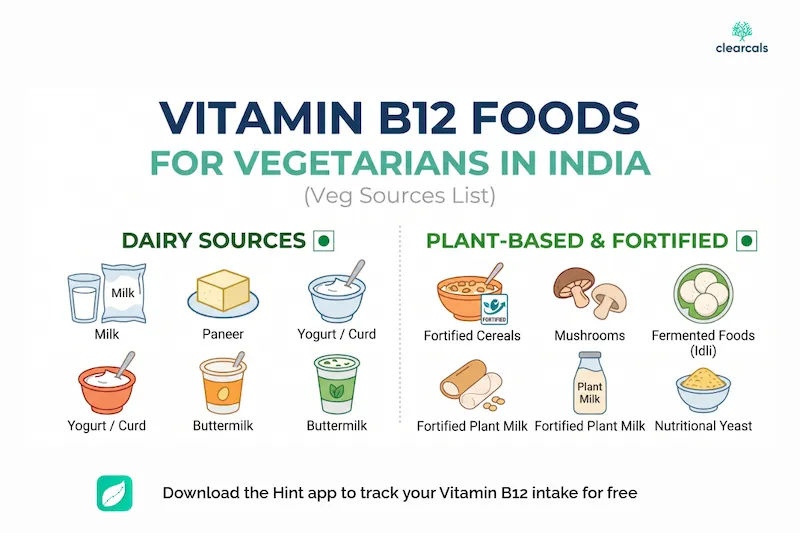
Vitamin B12 comes almost entirely from animal foods. For vegetarians in India, the reliable sources are milk, curd, paneer and cheese, plus eggs if you eat them, and B12-fortified foods. Most fruits, vegetables, sprouts, dals and grains have no useful B12, whatever social media says. If you are vegan, or you take metformin or acid-reducing medicines, a food-only approach often falls short, and your doctor may advise a supplement after a blood test.
- Best vegetarian foods: milk, curd, paneer, cheese, and fortified milk or cereals.
- If you eat eggs: they add a little, but not a lot.
- Not reliable: fruits, vegetables, sprouts, mushrooms, seaweed, spirulina, and fermented foods like idli or dosa.
- Higher risk of deficiency: vegans, people on long-term metformin or acid-reducing tablets, adults over 50, and people with gut or stomach conditions.
- Do not guess. If you have symptoms, get a blood test before starting a supplement.
Why vitamin B12 matters
B12 helps make red blood cells, keeps nerves healthy, and helps your body use folate. Adults need only a small amount, about 2.2 micrograms a day according to Indian guidance, but the body cannot make it, and it stores only limited reserves.
A shortage develops slowly, often over years. It is common in India, mostly because of vegetarian diets, and often goes unnoticed until symptoms appear.
Vegetarian foods that have vitamin B12
| Food | Notes |
|---|---|
| Milk | A glass (about 250 ml) gives roughly a third to half of a day's need. Full-fat, toned, and skimmed have similar B12. |
| Curd and buttermilk | Smaller amounts than milk, but useful if you have them daily. |
| Paneer and cheese | Contain some B12, though less than milk by weight. |
| Eggs (if you eat them) | One egg gives a small amount, mostly in the yolk. |
| Fortified foods | Some milks, cereals, and plant milks are fortified. Check the label for B12 per serving. |
| Supplements | Taken on a doctor's advice. Doses and forms vary, so do not self-prescribe. |
For non-vegetarians, fish, chicken, mutton and organ meats such as liver are the richest sources.
Variety helps. A realistic day for a vegetarian could include milk or curd with breakfast, buttermilk with lunch, paneer in one meal, and a fortified item, adding up to a decent share of your needs, though not always the whole amount.
Common myths: what does NOT give you reliable B12
Searches for "vitamin B12 fruits and vegetables" are very common, but the answer is that most plant foods do not provide usable B12.
- Fruits and vegetables: they contain no meaningful B12. They are healthy, but they will not correct a deficiency.
- Sprouts, dals and grains: good for protein and fibre, not for B12.
- Idli, dosa, dhokla and other fermented foods: fermentation may add trace amounts at best. Do not rely on it.
- Mushrooms: only tiny or unreliable amounts.
- Spirulina, seaweed and "superfood" powders: they contain compounds that look like B12 but may not work in the body. Do not use them as a B12 source.
- Unwashed vegetables or "soil B12": not a safe or dependable source.
Who is at higher risk of low B12?
- Vegans and people who eat very little dairy or egg.
- People on long-term metformin. It can lower B12 absorption over time. If you take it, see our guide to metformin and diet.
- People on acid-reducing medicines such as pantoprazole or omeprazole for a long time.
- Adults over 50, because the stomach absorbs B12 less well with age.
- People with stomach or gut conditions, or who have had weight-loss or gut surgery.
- Pregnant and breastfeeding women who eat little dairy or egg. Talk to your doctor early.
Symptoms of vitamin B12 deficiency
- Tiredness, weakness and breathlessness
- Pale or slightly yellow skin
- Tingling, numbness or burning in the hands and feet
- Poor balance, memory trouble, low mood
- Mouth ulcers or a sore, red tongue
These symptoms have many causes, so they do not prove a B12 deficiency. Untreated, a severe deficiency can cause lasting nerve damage, which is why testing early matters.
Getting tested
A blood test for serum vitamin B12 is the usual first step. If the result is borderline, your doctor may check other markers. Laboratories use different cut-offs, so discuss your result with your doctor rather than relying on the number alone. Do not start high-dose B12 or injections without advice.
How to get enough: a practical Indian plan
- Make dairy a daily habit if you eat it: milk or curd at least twice a day.
- Add a fortified food if your diet has little dairy, and check the label.
- Test, don't guess, if you have symptoms or belong to a high-risk group.
- Follow your doctor's plan if a supplement is prescribed, and keep taking it for the full period.
- Recheck levels as your doctor advises, particularly if you take metformin or acid-reducing medicines.
Track your vitamins with Hint
It is hard to know whether your usual meals add up to enough B12. Hint lets you log your Indian meals and track your intake of all the essential vitamins, including B12, for free, alongside calories and protein. After a week of logging, you can see which days have curd or milk and which have none. Hint estimates your intake from food, so it cannot replace a blood test, but it makes the conversation with your doctor or dietitian much more specific. You can also try our free Indian food calorie calculator.
Frequently asked questions
Which vegetarian food has the most vitamin B12? Milk, curd, paneer, and cheese are the main natural vegetarian sources, and fortified foods can add more.
Do fruits and vegetables have vitamin B12? No, not in a reliable or useful amount.
Does curd have vitamin B12? Yes, in a modest amount. Having it daily helps, but it may not be enough on its own.
Is vitamin B12 present in sprouts or dal? No, not in a meaningful amount.
Can vegetarians get enough B12 from food alone? Some can, if they eat dairy regularly. Strict vegetarians who eat little dairy, and vegans, usually need a fortified food or supplement.
How long does it take to correct a B12 deficiency? It depends on how low the level is and the treatment. Blood counts often improve within weeks, but nerve symptoms can take months. Your doctor guides the plan.
Should I take a B12 tablet or injection? That depends on your blood level, symptoms, and how well you absorb B12. It is a decision for your doctor.
Medical disclaimer. This article is for general education and is not medical advice. Do not start, stop, or change a vitamin supplement, tablet, or injection based on this article. If you have symptoms or a medical condition, or you are pregnant, speak to your doctor or a registered dietitian.
Related reading and tools
Start here: calorie tracking for Indian food if you are new to logging meals.
Other vitamin guides:
- Vitamin D foods and sunlight
- Vitamin A rich foods
- Vitamin C rich foods
- Vitamin E-rich foods
- Vitamin K-rich foods
- B-complex vitamin foods (B1, B2, B3, B5, B6, B7, B9)
Related reading:
- Metformin and diet (B12 and long-term metformin)
- Vegetarian protein sources in India
- Daily protein requirement in India
- High-protein Indian instant diet
Free tools:
- Indian food calorie calculator
- Protein calculator
- Hint, the Indian food, calorie and vitamin tracking app
About the author
Dr. Sumedha Verma is a Consultant Physician at Clearcals with extensive experience in clinical medicine and healthcare services.
She has significant expertise in managing chronic conditions such as diabetes, thyroid disorders, PCOS, infertility, and other gynecological health concerns.
Known for her patient-centered approach, Dr. Verma focuses on improving patient compliance and helping individuals achieve better health outcomes through personalized medical guidance and long-term care.
Connect with Dr. Sumedha on LinkedIn