Track your nutrition and health goals

Vitamin D Foods & Sunlight in India: Best Sources & Timing
Vitamin D Foods and Sunlight in India: How to Get Enough
By Dr. Sumedha Verma, Consultant Physician at Clearcals
The short answer
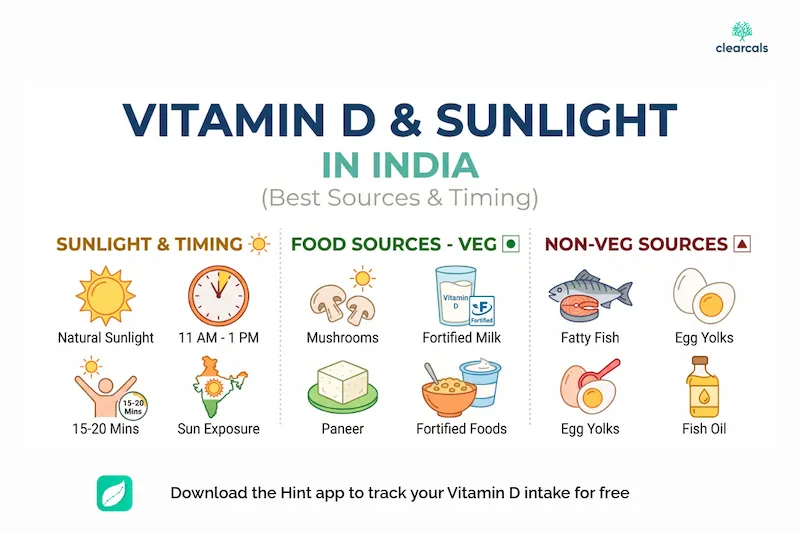
Few foods are rich in vitamin D, and in India most people cannot get enough from food alone. Your skin makes vitamin D when sunlight falls on it, and that is the main source for most people. Food helps, but it is a supporting source. The best food sources are fatty fish (mackerel, sardines, salmon), egg yolk, fortified milk, oil or cereals, and UV-exposed mushrooms. Deficiency is very common in India, so if you are tired, have bone or muscle aches, or live mostly indoors, a blood test is worth asking your doctor about.
- Best sources: sunlight, fatty fish, egg yolk, fortified foods, UV-exposed mushrooms.
- Vegetarians: fortified milk and oils, mushrooms, and sunlight do most of the work. Paneer, curd, and plain vegetables contribute little.
- Sunlight: a short, regular exposure of arms and legs around late morning to early afternoon is the usual advice. Do not burn.
- Supplements: only on your doctor's advice, because the dose depends on your blood level.
Why vitamin D matters
Vitamin D helps your body absorb calcium and keeps bones, teeth and muscles strong. A long-term shortage can cause bone pain, muscle weakness and, in children, rickets. Adults need roughly 600 IU (15 micrograms) a day according to Indian guidance, though your doctor may set a different target if you are low.
Foods with vitamin D
| Food | Notes |
|---|---|
| Fatty fish: mackerel (bangda), sardines (tarli), salmon, hilsa | The richest natural food sources. Even a small portion helps. |
| Egg yolk | A modest amount per egg, mostly in the yolk. |
| Liver | Contains some, but also lots of vitamin A, so avoid heavy use, especially in pregnancy. |
| Fortified milk and fortified oil | Check the label for vitamin D per serving. A very practical option for vegetarians. |
| Fortified cereals and atta | Varies by brand. Read the label. |
| Mushrooms exposed to UV light | Some packs are labelled UV-treated. Ordinary mushrooms have very little. |
| Cod liver oil | A concentrated source, not a casual one. Use only if your doctor suggests it. |
Foods people often expect to be rich but are not: plain milk and curd (small amounts unless fortified), paneer, most fruits and vegetables, dal, and grains.
Vegetarian vitamin D: what is realistic
If you are vegetarian, the food list is short, so it is a mix of three things:
- Sunlight, most days, within safe limits.
- Fortified foods, such as fortified milk or oil.
- Testing and, if needed, a supplement on your doctor's advice.
Sunlight: how much, and when?
Your skin makes vitamin D when UVB rays hit bare skin. In most of India, UVB is strong for much of the year, yet deficiency is still common.
Practical guidance (Dr. Verma may refine these ranges):
- Time of day: late morning to early afternoon, when UVB is strongest. Very early morning and late evening sun gives little.
- How long: roughly 15 to 30 minutes, a few times a week, with arms and legs exposed. Darker skin needs longer.
- Do not burn, and do not stay longer to "catch up." Skin damage is a real risk.
- What reduces vitamin D from sun: sunscreen, clothing that covers the skin, glass windows, heavy pollution, and being indoors most of the day.
You cannot make vitamin D through a window, so sitting by a closed window does not count.
How to increase vitamin D
- Get regular, safe sun as above.
- Add vitamin D foods you enjoy: fish, eggs, fortified milk or oil.
- Pair it with calcium from dairy, ragi, leafy greens, and sesame, so bones can use it.
- Test your level if you have symptoms or risk factors (limited sun, older age, darker skin, obesity, thyroid problems).
- Follow your doctor's plan if you are prescribed a supplement.
When and how to take a vitamin D supplement
Vitamin D is fat-soluble, so it is absorbed better with a meal that has some fat in it. The time of day matters less than taking it regularly. Many people take it with lunch or dinner. If your doctor prescribes a weekly or monthly schedule, follow that exactly. Very high doses over time can be harmful, so never self-prescribe or double up.
Symptoms of low vitamin D
- Tiredness and low energy
- Bone, back or muscle pain
- Muscle weakness or cramps
- Frequent illness and slow healing
- In children: delayed walking, bowed legs
Many people have no symptoms at all. These symptoms also have other causes, so a blood test is the way to know.
What is a normal vitamin D level?
Laboratories and doctors use slightly different cut-offs, and what counts as sufficient is debated. Many Indian labs treat about 30 ng/ml or higher as sufficient. Discuss your result with your doctor rather than relying on the number alone.
Track your vitamins with Hint
Vitamin D is hard to judge from memory. Hint lets you log your Indian meals and track your intake of all the essential vitamins for free, including vitamin D, alongside calories and protein.
You will quickly see how few days include fish, eggs, or fortified foods.
Hint: it cannot measure sun exposure or your blood level, so use it together with a test and your doctor's advice. You can also try our free Indian food calorie calculator.
Frequently asked questions
Which food has the most vitamin D? Fatty fish such as mackerel, sardines and salmon are the richest natural sources, followed by egg yolk and fortified foods.
Which vegetarian foods have vitamin D? Fortified milk, oil and cereals, UV-exposed mushrooms, and, in small amounts, egg yolk if you eat eggs. Sunlight remains the main source.
What is the best time for sunlight to get vitamin D? Late morning to early afternoon, when UVB is strongest. Early morning and evening sun gives much less.
How long should I stay in the sun? About 15 to 30 minutes, a few times a week, with arms and legs exposed, and darker skin needing more. Avoid sunburn.
Can I take vitamin D at night? The time matters less than taking it regularly with a meal that contains some fat. Follow your doctor's schedule.
Can I get vitamin D from food alone? Rarely in India. Most people need sunlight, and many need a supplement.
Medical disclaimer. This article is for general education and is not medical advice. Do not start, stop or change a vitamin supplement based on this article. If you have symptoms or a medical condition, or you are pregnant, speak to your doctor or a registered dietitian.
Related reading and tools
Start here: calorie tracking for Indian food if you are new to logging meals.
Other vitamin guides:
- Vitamin B12 foods for vegetarians
- Vitamin A rich foods
- Vitamin C-rich foods
- Vitamin E-rich foods
- Vitamin K rich foods
- B-complex vitamin foods (B1, B2, B3, B5, B6, B7, B9)
Related reading:
- Indian diet plan for hypothyroidism (vitamin D is often low)
- 2000-calorie Indian diet plan
- Daily protein requirement in India
- High-protein Indian instant diet
Free tools:
- Indian food calorie calculator
- Protein calculator
- Hint, the Indian food, calorie and vitamin tracking app
About the author
Dr. Sumedha Verma is a Consultant Physician at Clearcals with extensive experience in clinical medicine and healthcare services.
She has significant expertise in managing chronic conditions such as diabetes, thyroid disorders, PCOS, infertility, and other gynecological health concerns.
Known for her patient-centered approach, Dr. Verma focuses on improving patient compliance and helping individuals achieve better health outcomes through personalized medical guidance and long-term care.
Connect with Dr. Sumedha on LinkedIn