Track your nutrition and health goals

Magnesium Rich Foods in India: Veg List, Daily Need, Deficiency
Magnesium-Rich Foods in India: Seeds, Nuts, Millets, Pulses and Greens
By Dr. Sumedha Verma, Consultant Physician at Clearcals
The short answer
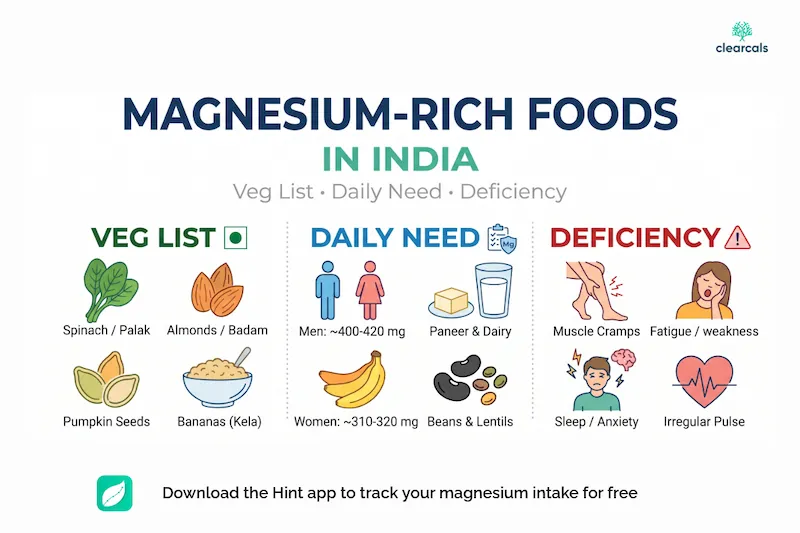
Magnesium comes mainly from seeds, nuts, whole grains, millets, pulses and green leafy vegetables. The best everyday Indian sources are pumpkin seeds, almonds, cashews, peanuts, sesame, ragi and other millets, whole wheat, oats, rajma, chana, soya, spinach and amaranth leaves. Refined foods like white rice, maida, and sugary snacks have little. Most healthy people can meet their needs with food, and a supplement should be a doctor's decision, particularly if you have kidney disease.
- Top sources: pumpkin seeds, almonds, cashews, peanuts, sesame, soya, ragi, bajra, jowar, whole wheat, rajma, chana, oats.
- Greens and fruit: cooked spinach and amaranth leaves are good sources. Banana adds a little.
- Refining removes magnesium, so whole grains and millets beat polished rice and maida.
- Supplements are rarely needed, and too much can cause diarrhoea. They can build up in people with kidney problems.
Why magnesium matters
Magnesium helps hundreds of reactions in your body. It supports muscles and nerves, a steady heartbeat, blood sugar and blood pressure control, bone strength, and energy production. It also works with vitamin D and calcium, as magnesium is needed to activate vitamin D. See our guides to calcium-rich foods and vitamin D foods and sunlight.
How much magnesium do you need?
Adult needs vary with age and sex, and guidelines differ. As per ICMR-NIN, adult men need around 440 mg a day and adult women around 370 mg or a little more, with pregnancy and breastfeeding raising the need. Your doctor or dietitian may advise a different target if you have a kidney, heart, or other condition. You don't need to count milligrams exactly, but a food log helps you see whether you're close.
Magnesium-rich foods: Indian list
The numbers below are rough amounts per typical serving. They vary by variety and preparation.
| Food | Typical serving | Roughly how much magnesium | Notes |
|---|---|---|---|
| Pumpkin seeds | 30 g (2 tablespoons) | about 150 mg | One of the richest sources. |
| Almonds | 10 to 12 | about 30 to 40 mg | A good everyday snack. |
| Cashews | 30 g | about 80 mg | Calorie-dense, so watch portions. |
| Peanuts | 30 g | about 50 mg | Also good protein. |
| Sesame seeds (til) | 1 tablespoon | about 35 mg | Chikki, chutney, salads. |
| Soya chunks | 30 g dry | about 70 to 80 mg | Also high in protein. |
| Ragi, bajra, jowar | 50 g flour | about 70 to 85 mg | Millets beat rice and maida. |
| Whole wheat roti | 2 rotis | about 60 to 80 mg | Choose whole wheat atta. |
| Oats | 40 g | about 55 mg | Porridge or chilla. |
| Rajma or chole (cooked) | 1 cup | about 70 to 80 mg | Good with rice and roti. |
| Chana dal or whole chana | 1 bowl | about 50 mg | Roasted chana is a handy snack. |
| Cooked spinach or amaranth | 1 cup | about 100 to 150 mg | Cooked greens pack more per cup. |
| Banana | 1 medium | about 30 to 35 mg | Modest but easy. |
| Dark chocolate | 20 g | about 40 mg | Occasional, because of sugar and fat. |
Magnesium-rich fruits
Fruits have modest magnesium compared with seeds and grains. Banana, guava, papaya and dried fruits such as figs and dates add small amounts. If you want more from this group, dried figs and bananas are the easiest.
Vegetarian and vegan magnesium
Magnesium is spread across plant foods, so vegetarians and vegans usually do well if they choose whole grains, millets, pulses, nuts and seeds. A plate with roti or millet, dal or rajma, a green vegetable and a handful of nuts covers a good share without effort.
What lowers your magnesium?
- Refined foods: polished rice, maida and processed snacks.
- Long-term acid-reducing tablets such as pantoprazole or omeprazole, which can lower magnesium over time.
- Diuretics ("water tablets") and some other medicines.
- Heavy alcohol use.
- Poorly controlled diabetes, which increases loss in urine.
- Long-term diarrhoea or gut conditions, which reduce absorption.
- Very high intake of zinc or calcium supplements, which can compete with magnesium.
Soaking, sprouting or fermenting grains and pulses reduces phytates that can block absorption a little.
Signs of low magnesium
- Muscle cramps, twitches or spasms
- Tingling or numbness
- Tiredness and weakness
- Poor sleep or irritability
- In severe cases: an irregular heartbeat, seizures, or low calcium and potassium
Many of these have other causes, and blood tests for magnesium don't always reflect your body's stores, because most magnesium is in bones and cells. If you have symptoms or take one of the medicines above, ask your doctor about testing instead of starting a tablet on a guess.
Does magnesium help sleep?
People search for this a lot. The honest answer is that evidence is limited. Magnesium plays a role in nerve and muscle relaxation, and some people who are low in magnesium may sleep better when their levels are corrected, but it is not a proven sleep aid for everyone. Start with food, regular sleep habits, and daylight. If you're considering a supplement, talk to your doctor first.
Magnesium supplements: a few cautions
Most healthy people who eat whole foods do not need a magnesium tablet. If your doctor suggests one:
- Follow the dose and form they gave you. Too much can cause diarrhoea, nausea and cramps.
- Tell your doctor if you have kidney disease, because magnesium can build up to harmful levels.
- Space it from some medicines: keep it about 4 hours away from thyroxine, and ask about certain antibiotics and osteoporosis tablets. See our guide to Thyronorm and diet.
- Do not exceed the prescribed amount.
A sample day of magnesium-rich Indian eating
This is an example, not a prescribed plan, and the amounts are approximate. Adjust to your needs and your doctor or dietitian's advice.
| Time | Example | Approx. magnesium |
|---|---|---|
| Breakfast | Oats or ragi porridge with a handful of almonds and pumpkin seeds | 120 to 180 mg |
| Mid-morning | A banana | 30 mg |
| Lunch | Whole wheat roti, rajma or chole, spinach sabzi, curd | 150 to 220 mg |
| Evening | Roasted chana or a small handful of cashews and peanuts, tea | 50 to 80 mg |
| Dinner | Millet roti or brown rice, dal, mixed vegetables, salad with sesame | 80 to 130 mg |
| Day total | roughly 430 to 640 mg |
Adjust portions to your calorie goals, because nuts and seeds are calorie-dense.
Track your magnesium with Hint
It's hard to tell whether your usual meals reach your magnesium needs. Hint lets you log your Indian meals and track your magnesium intake, along with calories, protein, calcium, and the essential vitamins, for free. After a week, you can see which days fall short and which foods, such as a handful of seeds or a bowl of rajma, would close the gap most easily. Hint estimates your intake from food and cannot replace a blood test or your doctor's advice. You can also try our free Indian food calorie calculator.
Frequently asked questions
Which food has the most magnesium? Pumpkin seeds are among the richest, followed by almonds, cashews, sesame, soya, millets, whole grains, pulses and cooked green leaves.
Which Indian foods are rich in magnesium? Pumpkin seeds, almonds, cashews, peanuts, sesame, ragi, bajra, jowar, whole wheat, oats, rajma, chana, soya, spinach and amaranth.
Which fruit is rich in magnesium? Fruits have modest amounts. Banana, guava, papaya, figs, and dates add a little.
How much magnesium do I need per day? Roughly 300 to 450 mg for most adults, depending on age and sex. Your doctor may advise differently.
What are the symptoms of low magnesium? Muscle cramps, tingling, tiredness, poor sleep, and, in severe cases, an irregular heartbeat.
Does magnesium help sleep? Evidence is limited. Food and good sleep habits come first, and a supplement should be your doctor's decision.
Can I take magnesium tablets daily? Only on a doctor's advice. Too much can cause diarrhoea, and it can build up if you have kidney disease.
Can acidity tablets lower magnesium? Long-term use of tablets such as pantoprazole or omeprazole can, so mention it to your doctor if you take them for months.
Medical disclaimer. This article is for general education and is not medical advice. Do not start, stop, or change a magnesium or other supplement based on this article. If you have symptoms, kidney disease, a heart condition, or you are pregnant or breastfeeding, speak to your doctor or a registered dietitian.
Related reading and tools
Start here: calorie tracking for Indian food if you are new to logging meals.
Other vitamin guides:
- Vitamin B12 foods for vegetarians
- Vitamin D foods and sunlight
- Vitamin A rich foods
- Vitamin C rich foods
- Vitamin E rich foods
- Vitamin K-rich foods
- Calcium-rich foods
- B-complex vitamin foods (B1, B2, B3, B5, B6, B7, B9)
Related reading:
- Thyronorm and diet (keep magnesium 4 hours apart)
- Metformin and diet
- Daily protein requirement in India
- High-protein Indian instant diet
Free tools:
- Indian food calorie calculator
- Protein calculator
- Hint, the Indian food, calorie and vitamin tracking app
About the author
Dr. Sumedha Verma is a Consultant Physician at Clearcals with extensive experience in clinical medicine and healthcare services.
She has significant expertise in managing chronic conditions such as diabetes, thyroid disorders, PCOS, infertility, and other gynecological health concerns.
Known for her patient-centered approach, Dr. Verma focuses on improving patient compliance and helping individuals achieve better health outcomes through personalized medical guidance and long-term care.
Connect with Dr. Sumedha on LinkedIn