Track your nutrition and health goals

Mediterranean Diet for Indians: Adapted Meal Plan, Recipes & BP Benefits
By Hafsaa Farooq | Medically Reviewed | Updated April 2026
The Mediterranean diet is consistently ranked as one of the two best dietary patterns for cardiovascular health, alongside DASH.
The landmark PREDIMED trial, which followed 7,447 adults at high cardiovascular risk for nearly 5 years, found that a Mediterranean diet supplemented with either extra-virgin olive oil or nuts reduced the risk of major cardiovascular events (heart attack, stroke, or cardiovascular death) by 30% compared with a low-fat control diet (Estruch et al., 2018, NEJM).
For blood pressure specifically, a meta-analysis of 17 trials found Mediterranean diet adherence reduced systolic BP by 1.44 mmHg and diastolic by 0.70 mmHg, with larger effects in people who also reduced their sodium intake (Schwingshackl et al., 2015, Public Health Nutrition).
For Indian adults, the Mediterranean diet is often dismissed as impractical: olive oil is expensive, salmon is not widely available, and the cuisine seems fundamentally incompatible with dal-roti cooking. This perception is largely wrong.
The principles of the Mediterranean diet, high in vegetables, legumes, whole grains, healthy fats, and fish, map closely onto the traditional Indian kitchen. What requires adaptation is not the cooking style but the specific ingredients.
What Is the Mediterranean Diet?
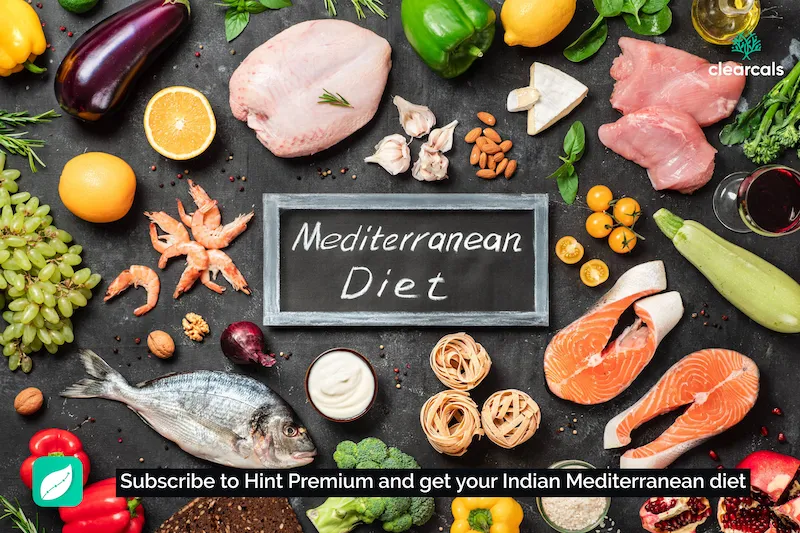
The Mediterranean diet is a dietary pattern traditionally followed in countries bordering the Mediterranean Sea, particularly Greece, Italy, and Spain.
It is not a strict calorie-controlled plan but a set of dietary principles built around whole, minimally processed foods.
The core principles are:
- Abundant vegetables, legumes, whole grains, fruits, nuts, and seeds at every meal
- Olive oil is the primary fat source, replacing butter and other cooking fats
- Moderate fish and seafood, at least 2 servings per week
- Moderate dairy (mainly fermented: yogurt and cheese) in small quantities
- Eggs in moderation (up to 4 per week)
- Limited red meat (a few times per month) and virtually no processed meat
- Herbs and spices for flavour instead of salt
- Red wine in moderation with meals (optional; skipped in this Indian adaptation)
Why it works for blood pressure: The Mediterranean diet delivers multiple antihypertensive mechanisms simultaneously. Polyphenols from olive oil and vegetables improve endothelial function.
Omega-3s from fish and walnuts reduce vascular inflammation. Potassium from legumes and vegetables counteracts sodium.
Magnesium from whole grains relaxes arterial smooth muscle. No single nutrient is responsible; the pattern as a whole is what produces the effect.
Mediterranean Diet vs DASH Diet: Which Is Better for Indians?
Both are evidence-based, both reduce blood pressure and cardiovascular risk, and both adapt well to Indian cooking. The key differences are in their emphasis:
| Feature | Mediterranean Diet | DASH Diet |
|---|---|---|
| Primary focus | Healthy fats (olive oil, nuts, fish) | Specific nutrient targets (potassium, calcium, sodium) |
| Fat approach | High in monounsaturated fat, olive oil is central | Low in all fat; emphasises low-fat dairy |
| Sodium guidance | Implicit (avoid processed food); no strict target | Explicit: <1,500 to 2,300 mg/day target |
| Dairy | Moderate; mainly yogurt and small amounts of cheese | 2 to 3 servings of low-fat dairy daily |
| Legumes | Daily, prominent | Counted within protein group; 2 or fewer meat servings |
| Red wine | Optional moderate inclusion in original pattern | No alcohol component |
| Evidence for BP | Systolic reduction ~1.4 mmHg (indirect via CVD risk) | Systolic reduction 6 to 11 mmHg (direct BP trials) |
| Best for Indians | Easier to adapt fat quality and cooking style | More prescriptive; useful when the BP target is specific |
For most Indian adults with high blood pressure, combining both approaches is ideal: use the Mediterranean diet's principle of healthy fats, abundant vegetables, and fish alongside the DASH diet's specific sodium and potassium targets.
This is often called a 'MedDASH' approach and is increasingly recommended in cardiology guidelines for South Asian populations.
Mediterranean Diet Indian Ingredient Swaps
The most important adaptation work for Indian followers is finding local equivalents for Mediterranean ingredients.
The following swaps preserve the nutritional function of each ingredient while using foods that are affordable and available across India.
| Mediterranean Ingredient | Indian Equivalent | Why It Works | Notes |
|---|---|---|---|
| Extra-virgin olive oil | Cold-pressed mustard oil or groundnut oil | Both are high in monounsaturated fatty acids (MUFA) and have low omega-6 to omega-3 ratios | Mustard oil is the closest MUFA match and is widely used in North and East India |
| Salmon/mackerel (oily fish) | Bangda (Indian mackerel), sardine (mathi/pedvey), rohu, hilsa (hilsa during season) | Indian mackerel and sardines are rich in EPA and DHA omega-3s, comparable to salmon | Bangda is especially affordable and widely available across coastal India |
| Lentils/chickpeas | Masoor dal, chana dal, rajma, chole, moong dal | Same protein, fibre, potassium, and folate profile | Dal is already a daily staple; no real adaptation needed |
| Whole-grain bread/pasta | Whole wheat roti, jowar roti, bajra roti, daliya, brown rice | Same whole grain fibre and mineral content | Indian flatbreads are actually lower GI than most commercial whole-grain breads |
| Greek yogurt | Plain hung curd (chakka dahi) or thick strained dahi | Higher protein, lower whey than regular dahi; same probiotic benefit | Strain plain dahi through a muslin cloth for 2 hours to make chakka dahi |
| Feta/parmesan | Small amount of home-made paneer (low-fat) | Similar protein and calcium; lower sodium than commercial cheese | Use sparingly; commercial paneer can be high in salt |
| Walnuts/almonds | Akhroti (walnuts) and badam (almonds) | Identical; already common in the Indian diet | Always unsalted; 30g (1 small handful) per day |
| Tomatoes, cucumbers, peppers | Available identically across India year-round | Direct equivalents | Use raw in salads more frequently than cooked |
| Leafy greens (spinach, kale) | Palak, methi, bathua, amaranth (chaulai), moringa | Higher potassium and nitrate content than most Mediterranean greens | Indian leafy greens are actually more nutrient-dense than kale in many nutrients |
| Herbs (oregano, basil, thyme) | Coriander, mint, curry leaves, tulsi, ajwain | Similar antioxidant and anti-inflammatory polyphenol profiles | Use fresh herbs generously to reduce salt requirement |
| Red wine (optional) | Omit entirely or use fresh grape juice (small amount) | No compelling reason to add alcohol for Indians who do not currently drink | Resveratrol from red wine is available from dark grapes and pomegranate |
Olive Oil vs Mustard Oil: The Most Important Substitution
The central fat in the Mediterranean diet is extra-virgin olive oil (EVOO), which provides oleocanthal (a natural anti-inflammatory), polyphenols, and a high MUFA (oleic acid) content of approximately 73%.
Cold-pressed mustard oil is 60 to 65% MUFA (erucic acid and oleic acid combined), has one of the most favourable omega-6 to omega-3 ratios of any Indian cooking oil (about 2:1), and contains allyl isothiocyanates that have antihypertensive and anti-inflammatory effects of their own.
A 2016 Indian study (Singh et al., Indian Heart Journal) found mustard oil consumption was associated with significantly lower rates of coronary artery disease compared with other cooking oils in a large observational study of Indian adults.
For most Indian households, cold-pressed mustard oil is the most accessible and cost-effective Mediterranean oil equivalent.
If you prefer to use olive oil for some preparations, light olive oil (not extra-virgin) has a higher smoke point and is suitable for Indian cooking.
Extra-virgin olive oil is best used cold (in salads, as a finishing drizzle) rather than for high-temperature cooking like tadka, where its polyphenols are destroyed by heat.
Practical oil guide for the Indian Mediterranean diet: Use cold-pressed mustard oil or groundnut oil for everyday cooking (tadka, sabzi, roti). Use extra-virgin olive oil as a finishing oil on salads or drizzled over dal.
Keep total oil to 3 to 4 tsp per day across all meals. Eliminate vanaspati/dalda and refined soybean oil.
Indian Fish for the Mediterranean Diet: Omega-3 Guide
The Mediterranean diet's cardiovascular benefit is partly driven by regular consumption of oily fish rich in EPA and DHA omega-3 fatty acids.
These reduce triglycerides, lower vascular inflammation, improve endothelial function, and modestly reduce blood pressure. India has excellent local equivalents to Mediterranean oily fish.
| Indian Fish | Omega-3 Content | Availability | Best Preparation for BP |
|---|---|---|---|
| Bangda (Indian mackerel) | High: ~1.8g EPA+DHA per 100g | Excellent: coastal India year-round; affordable | Grilled or shallow-fried in mustard oil with turmeric; avoid deep frying |
| Sardine (mathi / pedvey) | High: ~1.5g EPA+DHA per 100g | Excellent: coastal India, especially the South and West coast | Grilled, in light curry with tomatoes and kokum; minimal salt |
| Hilsa (ilish) | Very high: ~2.2g EPA+DHA per 100g | Seasonal; widely available in Bengal, Odisha | Steamed or in mustard gravy; the traditional preparations are ideal |
| Rohu / Catla | Moderate: ~0.5g omega-3 per 100g | Excellent: freshwater, widely available inland | Good protein source; pair with alsi (flaxseeds) to boost omega-3 total |
| Pomfret (paplet) | Moderate: ~0.7g omega-3 per 100g | Coastal and urban markets | Grilled or baked; avoid butter-based preparations |
| Tuna (canned, in water) | Moderate: ~0.6g omega-3 per 100g | Widely available in canned form | Use canned in water (not oil); check sodium on label |
For vegetarians and those who do not eat fish, ALA omega-3s from flaxseeds (alsi), walnuts (akhroti), and chia seeds partially compensate. The conversion of ALA to EPA and DHA is limited (roughly 5 to 10%), so vegetarians may benefit from algae-based DHA supplements, the same source from which fish obtain their omega-3s. Discuss this with your doctor or dietitian.
7-Day Indian Mediterranean Diet Meal Plan
This plan applies the Mediterranean diet's principles using Indian ingredients throughout. It includes both vegetarian and fish-based options. Red meat is excluded.
Sodium is kept under 1,800 mg/day, compatible with DASH targets. All cooking uses mustard oil or groundnut oil unless noted.
| Day | Breakfast | Lunch | Snack | Dinner |
|---|---|---|---|---|
| Mon | Oats with low-fat dahi, 1 banana, 5 akhroti, 1 tbsp ground alsi | 2 gehun roti + masoor dal + large palak-tomato salad (mustard oil dressing) | 1 amrood + a small handful of unsalted badam | Bangda curry (light tomato-based, mustard oil) + brown rice (½ cup) + salad |
| Tue | Moong dal chilla (2, with tomato + coriander) + 200g plain dahi + 1 orange | Brown rice (½ cup) + rajma + kachumber salad (olive oil drizzle if available) | Roasted unsalted chana + green tea | 2 jowar roti + chana dal + methi sabzi + sliced tomatoes |
| Wed | Vegetable daliya + 200g hung dahi (chakka dahi) + 1 kiwi | 2 ragi roti + sardine curry (light, tomato-kokum base) + cucumber salad | Mixed fruit: papaya, banana, mosambi | 2 gehun roti + mixed dal + roasted brinjal (baingan) sabzi + dahi |
| Thu | Ragi porridge (water-based) + 5 badam + 1 tbsp til + 1 banana | 2 bajra roti + chole (home-cooked) + large salad with lemon dressing | 1 cup unsalted makhana + hibiscus tea | Grilled rohu fillet + daliya with vegetables + palak salad |
| Fri | 2 scrambled eggs (mustard oil, herbs) + 1 gehun roti + 200g dahi | Brown rice (½ cup) + hilsa steamed in banana leaf (or mustard gravy) + salad | Handful akhroti + 1 amla | 2 gehun roti + masoor dal + broccoli / gobhi sabzi + dahi |
| Sat | Poha (minimal oil, peas, curry leaves) + 200g dahi + 1 orange | 2 jowar roti + grilled bangda (turmeric + mustard oil) + tomato-onion salad | Mixed nuts (akhroti + badam, unsalted, 30g) + green tea | Brown rice (½ cup) + rajma + palak sabzi + 200g dahi |
| Sun | Idli (2) + sambar (with drumstick) + 200g hung dahi with herbs | Dal-vegetable khichdi (brown rice + moong) + large kachumber | Sliced papaya + hibiscus tea | Sardine or bangda in light tomato curry + 2 gehun roti + cucumber raita |
Salad as a daily habit: The Mediterranean diet's most transferable habit for Indians is eating a large raw salad at lunch every day. A bowl of sliced tomato, cucumber, onion, and coriander dressed with lemon juice and a few drops of mustard oil or extra-virgin olive oil adds virtually no sodium and provides potassium, nitrates, and polyphenols. This single habit alone has a measurable effect on blood pressure over weeks.
Indian Vegetarian Mediterranean Diet: Full Adaptation
The Mediterranean diet is frequently portrayed as fish-dependent, but the traditional diets of inland Mediterranean populations (parts of southern Italy, Greece, and the Middle East) were largely plant-based, with fish eaten only 2 to 3 times per week. A vegetarian Indian Mediterranean diet is entirely viable.
The key substitutions for a vegetarian Indian Mediterranean approach:
- Replace fish omega-3s with: 1 tbsp ground alsi (flaxseeds) daily + 30g akhroti + algae-based DHA supplement if advised by doctor
- Replace fish protein with: moong dal, masoor dal, rajma, chole, eggs (if ovo-vegetarian), or tofu
- Keep dairy moderate: 200g plain dahi and 1 glass low-fat milk per day, similar to Mediterranean yogurt portions
- Use olive oil or mustard oil generously as the primary fat, replacing the saturated fat in ghee and butter
- Eat legumes twice daily: dal at lunch and either dal, rajma, or chole at dinner, as in traditional Mediterranean peasant diets
- Prioritise the salad habit: a large raw vegetable salad with lemon and mustard oil dressing at both lunch and dinner
How the Mediterranean Diet Lowers Blood Pressure: Key Mechanisms
| Mechanism | Mediterranean Component | Indian Source |
|---|---|---|
| Endothelial nitric oxide production | Olive oil polyphenols (oleocanthal, hydroxytyrosol) | Cold-pressed mustard oil, extra-virgin olive oil (finishing) |
| Vascular inflammation reduction | Omega-3 fatty acids (EPA, DHA) from oily fish | Bangda, sardine, hilsa; alsi + akhroti for vegetarians |
| Potassium-mediated sodium excretion | Legumes, vegetables, and fruits | Dal, rajma, palak, methi, kela, amrood, papita |
| Arterial stiffness reduction | Flavonoids from tomatoes, berries, grapes, and red wine | Tamatar, amla, pomegranate (anar), dark grapes, jamun |
| Insulin sensitivity improvement | Whole grains, legumes, low glycaemic index pattern | Jowar/bajra roti, brown rice, dal, ragi |
| Sympathetic nervous system modulation | Magnesium from whole grains and nuts | Bajra, jowar, akhroti, moong dal, palak |
| ACE inhibition (mild) | Bioactive peptides from fish, fermented dairy | Bangda, sardine, plain dahi, chaach |
10 Practical Tips to Start the Mediterranean Diet as an Indian
- Switch your daily cooking oil to cold-pressed mustard oil or groundnut oil. Discard vanaspati and refined soybean oil.
- Add a raw salad to both lunch and dinner every day. Tomato, cucumber, onion, coriander, lemon, and a few drops of oil take 3 minutes to prepare.
- Eat fish at least twice a week. If you are in a coastal city, bangda and sardines are among the most affordable and nutritious options available. If inland, frozen bangda or canned tuna (in water, low sodium) work well.
- Use dal as your primary protein at both meals. Masoor, moong, chana, and rajma are all Mediterranean-compatible legumes under a different name.
- Add 1 tablespoon of ground alsi (flaxseeds) to your morning oats, dahi, or roti dough every day for omega-3 ALA.
- Eat a small handful of unsalted walnuts and almonds 5 days per week as your primary snack, replacing namkeen and biscuits.
- Use fresh herbs generously: coriander, mint, curry leaves, tulsi, and ajwain all reduce the need for salt while adding flavour complexity.
- Make tomato a daily vegetable, not just an occasional ingredient. Tomatoes provide lycopene (a powerful antioxidant), potassium and are central to Mediterranean cooking.
- Reduce red meat to occasional: if you eat chicken or mutton, keep it to once or twice a week at most, and always choose lean cuts without processed sauces.
- Limit packaged and processed food of all kinds. The Mediterranean diet's single most consistent feature across all its traditional forms is that it is home-cooked from whole ingredients.
Build Your Indian Mediterranean Diet Plan with Hint
Hint Premium: Your Personal Dietitian
Adapting a dietary pattern designed for Southern Europe to an Indian kitchen requires more than a list of ingredient swaps.
It requires understanding which Indian ingredients genuinely replicate the nutritional function of their Mediterranean counterparts, how to balance the omega-3 gap if you do not eat fish, and how to maintain the diet's principles through Indian festivals, travel, and the realities of everyday home cooking.
- Personalised Mediterranean-Indian plan: Your Hint Premium dietitian designs your meal plan using the Mediterranean diet's principles within an Indian food context, whether you are vegetarian, non-vegetarian, or eat fish but not meat.
- Omega-3 gap assessment: For vegetarians, your dietitian calculates your current ALA intake and recommends whether an algae-based DHA supplement is warranted alongside food sources.
- Oil transition support: Many Indian households have used the same cooking oil for decades. Your dietitian guides you through switching to mustard or groundnut oil, adjusting recipes to work with the new flavour profile.
- Combined DASH and Mediterranean approach: For high blood pressure, the most effective dietary pattern combines both frameworks. Your dietitian integrates Mediterranean fat quality with DASH sodium and potassium targets in a single coherent plan.
- Progress tracking: Hint monitors your omega-3 food intake, daily vegetable servings, cooking oil usage, and sodium levels alongside your blood pressure trend.
The MedDASH combination: Research comparing DASH, Mediterranean, and combined approaches in South Asian populations consistently finds that the combination outperforms either diet alone for blood pressure reduction, cardiovascular risk reduction, and long-term dietary adherence.
Your Hint Premium dietitian builds this integrated approach for your specific profile.
All Hint Plans Include
- Personalised Mediterranean-Indian or MedDASH diet plan for blood pressure
- Daily tracking of omega-3 intake, healthy fat sources, and sodium
- 300+ Pro Workout routines: strength, yoga, and cardio for all fitness levels
- Guided exercise animations with in-app calorie and session tracking, no wearable needed
- BP and weight progress charts updated with each food log
Download Hint on iOS or Android and begin your Mediterranean-inspired Indian diet plan today.
Upgrade to Hint Premium to connect with a dedicated registered dietitian who will design your personalised plan, close the omega-3 and calcium gaps in your current diet, and combine the best of the Mediterranean and DASH approaches for your blood pressure management.
Summary: Mediterranean Diet for Indians
- The Mediterranean diet reduces cardiovascular risk by 30% (PREDIMED) and blood pressure by approximately 1.4 mmHg systolic through healthy fats, omega-3s, legumes, vegetables, and whole grains
- It adapts naturally to Indian cooking: mustard oil replaces olive oil, bangda and sardine replace salmon, dal and rajma replace lentils, and Indian flatbreads replace Mediterranean bread
- The most important single change is oil quality: switch to cold-pressed mustard oil or groundnut oil, eliminate vanaspati and refined oils
- Eat fish (bangda, sardine, hilsa) at least twice a week for EPA and DHA omega-3s; vegetarians should use 1 tbsp ground alsi daily plus akhroti
- The daily salad habit (raw vegetables with lemon and oil) is the easiest Mediterranean practice to adopt and has measurable effects on blood pressure over time
- For Indian adults with high BP, the MedDASH combination (Mediterranean fat quality + DASH sodium and potassium targets) is more effective than either diet alone
- Red wine has no equivalent in the Indian context and is not necessary for the cardiovascular benefits; dark grapes, pomegranate, and jamun provide similar polyphenols
The Mediterranean diet is sometimes presented as an exotic or Western dietary pattern that requires expensive imported ingredients.
In reality, its core principles, daily legumes, abundant vegetables, whole grains, fermented dairy, healthy fats, and minimal processed food, describe the traditional Indian home-cooked diet at its best.
The Mediterranean-Indian adaptation is less about adopting something foreign and more about returning to the most nutritionally sound version of the cooking your kitchen already knows.
References
- Estruch R et al. (2018). Primary prevention of cardiovascular disease with a Mediterranean diet supplemented with extra-virgin olive oil or nuts (PREDIMED). New England Journal of Medicine, 378(25), e34.
- Schwingshackl L & Hoffmann G (2015). Mediterranean dietary pattern, inflammation and endothelial function: a systematic review and meta-analysis of intervention trials. Nutrition, Metabolism and Cardiovascular Diseases, 24(9), 929-939.
- Sofi F et al. (2014). Accruing evidence on benefits of adherence to the Mediterranean diet on health: an updated systematic review and meta-analysis. American Journal of Clinical Nutrition, 92(5), 1189-1196.
- Kastorini CM et al. (2011). The effect of Mediterranean diet on metabolic syndrome and its components. Journal of the American College of Cardiology, 57(11), 1299-1313.
- Toledo E et al. (2013). Effect of the Mediterranean diet on blood pressure in the PREDIMED trial: results from a randomized controlled trial. BMC Medicine, 11, 207.
- de Lorgeril M et al. (1999). Mediterranean diet, traditional risk factors, and the rate of cardiovascular complications after myocardial infarction (Lyon Diet Heart Study). Circulation, 99(6), 779-785.
- Singh RB et al. (2002). Effect of an Indo-Mediterranean diet on the omega-6/omega-3 ratio and coronary artery disease in high-risk patients. Lancet, 360(9344), 1455-1461.
- Ros E (2010). Health benefits of nut consumption. Nutrients, 2(7), 652-682.
About the Author
Hafsaa Farooq is a Consultant Dietitian at Clearcals with a strong passion for nutrition, fitness, and evidence-based health practices.
She is deeply interested in clinical nutrition and enjoys helping individuals build healthier lifestyles through practical dietary guidance.
Beyond her professional work, Hafsaa enjoys developing healthy recipes, writing evidence-based nutrition blogs, and staying active through sports.
She is also expanding her expertise in the science of exercise and weight training to better support holistic health and fitness goals.
🔗 Connect with Hafsaa on LinkedIn