Track your nutrition and health goals

Momos Calories & Nutrition: Steamed vs. Fried vs. Kurkure (Are They Healthy?)
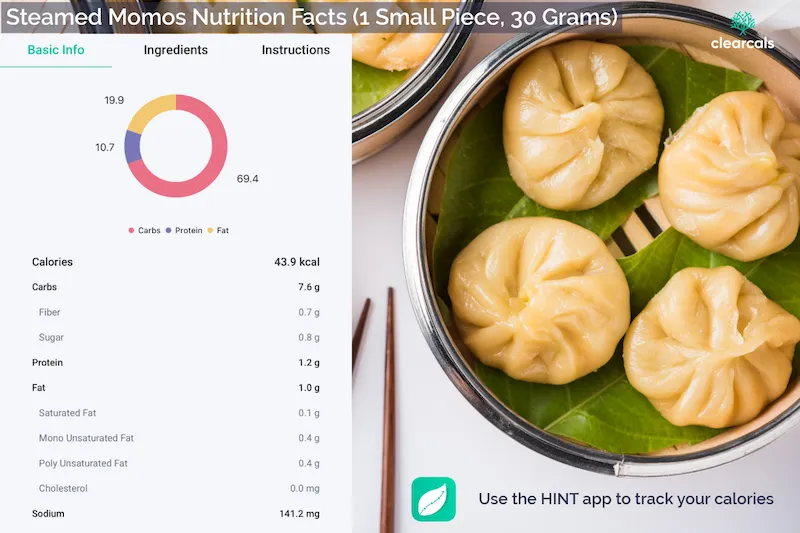
Momos Calories & Nutrition: Steamed vs. Fried vs. Kurkure (Are They Healthy?)
Are Momos Healthy? The Short Answer
It depends heavily on the style — more than almost any other street food covered on this site. A plate of steamed chicken or veg momos with a light chutney is a genuinely reasonable snack: modest calories, real protein from the filling, and no added frying oil. The same momos deep-fried, coated kurkure-style, or served swimming in a creamy gravy can easily carry 2-3x the calories of the steamed version. The dumpling itself isn't the issue — how it's cooked and what it's served with is.
Momos Calories by Style (Steamed, Fried, Kurkure, Tandoori, Jhol)
| Style | Calories (per small piece, 30 grams) | Notes |
|---|---|---|
| Steamed veg momo | 35 kcal | The lightest option — no added oil |
| Steamed chicken momo | 48 kcal | Slightly higher due to meat fat |
| Steamed paneer momo | 39 kcal | Paneer filling adds a bit more fat |
| Tandoori momo | 60 kcal | Grilled/roasted with a butter or oil baste — less oil than deep-frying, more than plain steaming |
| Afghani momo | 70 kcal | Steamed or fried momo tossed in a creamy or chilli-garlic sauce — the sauce is what adds the extra calories |
| Fried momo | 83 kcal | Roughly double the steamed version due to oil absorption during frying |
| Kurkure momo | ~90-110 kcal | Battered and deep-fried for a crispy coating — the most calorie-dense common style |
For a full plate (typically 6 pieces), that means the difference between a steamed plate (~210-270 kcal) and a kurkure plate (~540-660 kcal) can be more than double, before chutney or sauce is even added.
Momos Calories by Filling (Chicken vs. Veg vs. Paneer)
| Filling | Calories per Small Piece - 30 grams (Steamed) | Calories, Plate of 6 |
|---|---|---|
| Veg (cabbage/mixed vegetable) | 35 kcal | 210 kcal |
| Chicken | 48 kcal | 288 kcal |
| Paneer | 39 kcal | 234 kcal |
The filling makes a smaller difference than the cooking style — switching from veg to chicken momos changes the calorie count only modestly, while switching from steamed to kurkure roughly doubles it.
Full Nutrition Facts (1 Steamed Chicken Momo, and a Plate of 6)
| Nutrient | 1 Small Piece (30g) | Plate of 6 |
|---|---|---|
| Calories | 48 kcal | 288 kcal |
| Protein | 2.4g | 14.4g |
| Carbohydrates | 5.8g | 174g |
| Fat | 1.7g | 10.2g |
Is the Momo Wrapper Healthy?
Traditional momo wrappers are made from maida (refined white flour) — the same flour used in most Indian bakery items and many Chinese-style dishes. This isn't dangerous, but it means the wrapper itself contributes very little fibre and has a higher glycemic index than a whole wheat alternative, so momos digest more like a refined-flour food than a whole-grain one.
Some modern, health-conscious stalls and home recipes now use whole wheat or multigrain wrappers, which is a genuine, if modest, improvement — worth asking about if you're eating momos regularly.
On the MSG question that sometimes comes up with Chinese and Tibetan-style street food: monosodium glutamate has been extensively studied and is considered safe by major food safety authorities (including FSSAI in India), despite persistent popular concern — individual sensitivity varies, but it isn't the health hazard it's sometimes made out to be.
Momos and Protein
Momos are a reasonable, if not exceptional, protein source — a plate of 6 chicken momos carries roughly 15g of protein, driven mostly by the filling rather than the wrapper. Paneer momos run similarly, while purely vegetable-filled momos are noticeably lower in protein since cabbage and mixed vegetables don't contribute much on their own.
If protein is a priority, chicken or paneer filling, or a larger portion of filling relative to wrapper, makes more of a difference than any other single choice.
Jhol Momo: What Is It, and How Many Calories?
Jhol momo is a Nepali style where steamed momos are served in (or alongside) a warm, tangy, lightly spiced broth (jhol) made from tomatoes, sesame, and Sichuan pepper, rather than eaten dry with chutney. A plate of jhol momo (6 pieces plus broth) typically runs around 280-320 kcal — a modest addition over plain steamed momos, since the broth itself is usually more water and spice than oil, though this varies by how it's made at a given stall.
Kurkure Momos: The Crispy, Deep-Fried Version
Kurkure momos — momos coated in a seasoned batter or breadcrumb-style coating and deep-fried until crispy — have become one of the most popular street-food momo styles in India, and they're also the most calorie-dense common version by a clear margin, at roughly 90-110 kcal per piece versus 35-50 kcal for steamed.
The coating absorbs meaningfully more oil than a plain fry, on top of the oil the momo itself picks up during frying — worth knowing if you're ordering by taste alone without factoring in how different this is, calorie-wise, from the same filling steamed.
Tandoori and Afghani Momos
Tandoori momos are steamed or par-cooked momos marinated and then grilled or roasted in a tandoor, often basted with butter or oil — a middle-ground option calorie-wise, higher than steamed but meaningfully lower than deep-fried or kurkure styles. Afghani momos refers to momos (usually already steamed or lightly fried) tossed in a rich sauce — either a creamy, malai-style sauce or a chilli-garlic one, depending on the stall — where the sauce, not the momo itself, is what pushes the calorie count up.
Momos for Weight Loss
If you're managing your calorie intake, steamed veg or chicken momos with a light tomato-based chutney are a genuinely reasonable choice — a plate of 6 comes in around 210-288 kcal plus a small amount for chutney, comparable to many other common snacks.
Fried, kurkure, and gravy-style momos lose that advantage fast, easily running 500-700+ kcal for the same plate size once oil and sauce are factored in. See our weight-loss snacks guide for how steamed momos compare to other lower-calorie snack options.
Momos Chutney: Does the Dip Add Calories?
It depends on the chutney. The classic spicy tomato or tamarind-based chutney served with momos is genuinely low-calorie — roughly 15-20 kcal per tablespoon, since it's mostly tomato, chilli, and vinegar with little to no oil.
Creamier or mayo-based dips, which some stalls now offer, run closer to 40-50 kcal per tablespoon — still not the main calorie driver of the meal, but worth being aware of if you're having several spoonfuls with each piece.
How to Make Lower-Calorie Momos at Home
- Steam, don't fry — steaming is genuinely the lowest-calorie cooking method and doesn't require sacrificing much in texture or flavour if the filling is well-seasoned.
- Use a whole wheat or multigrain wrapper instead of plain maida for a fibre boost, with only a small change in texture.
- Load the filling with vegetables and lean protein (chicken breast, paneer, or extra vegetables) rather than fattier cuts or excess oil in the filling mixture.
- Stick to a tomato-based chutney rather than a mayo or creamy dip if you're watching calories closely.
Track Your Momos With Hint
Because the same "plate of momos" can mean anywhere from about 250 kcal (steamed) to 700+ kcal (kurkure with gravy), momos are one of the easier foods to significantly under-log if you're not specifying the style.
The Hint app lets you log momos by exact style and filling, so a steamed veg plate and a kurkure chicken plate aren't tracked as the same thing.
FAQs
How many calories are in momos? It depends heavily on style — roughly 35-50 kcal per piece steamed, versus 90-110 kcal per piece for kurkure (deep-fried, crispy-coated) momos.
How many calories are in a plate of chicken momos? Around 288 kcal for a plate of 6 steamed chicken momos; a fried or kurkure plate can run 500-660+ kcal for the same count.
Are momos healthy? Steamed momos with a light chutney are a reasonable snack choice; fried, kurkure, and gravy-style momos are considerably less so due to added oil and sauce. The wrapper is typically made from refined flour (maida), which is fine in moderation but low in fibre.
Do momos have protein? Yes, modestly — a plate of 6 chicken momos has roughly 15g of protein, mostly from the filling rather than the wrapper.
What is jhol momo? A Nepali style where steamed momos are served in a warm, tangy broth made from tomatoes, sesame, and Sichuan pepper, rather than eaten dry with chutney — a plate typically runs around 280-320 kcal.
Are kurkure momos unhealthy? They're the most calorie-dense common momo style, at roughly 90-110 kcal per piece due to a deep-fried, battered coating — reasonable as an occasional treat rather than a regular choice if you're watching calories.
Are momos good for weight loss? Steamed momos with light chutney can fit reasonably into a calorie-controlled diet; fried, kurkure, and gravy versions are considerably more calorie-dense and less suited to frequent weight-loss eating.
Does the chutney served with momos add many calories? The classic spicy tomato chutney is low-calorie (~15-20 kcal per tablespoon); creamier or mayo-based dips run higher (~40-50 kcal per tablespoon).
About the Author
Asfia Fatima is the Chief Dietitian at Clearcals, with a Master's Degree in Dietetics and Clinical Nutrition and over a decade of experience in clinical nutrition and lifestyle management. She specialises in evidence-based diet planning for weight loss, diabetes, and metabolic health, and leads the nutrition strategy behind the Hint app.
Connect with Asfia on LinkedIn