Track your nutrition and health goals

Swimming Calories Burned, Benefits & Strokes | Hint
Swimming Calories Burned, Benefits, and Strokes
How Many Calories Does Swimming Burn?
Swimming is one of the more efficient full-body calorie burners, and the exact number depends heavily on which stroke you're swimming and how hard you're working — more so than almost any other exercise, since the four competitive strokes place very different demands on your body. As a general reference for an average 70kg (154 lb) adult:
| Swimming Amount | Approx. Calories Burned |
|---|---|
| 30 min, leisurely swimming | ~200-240 kcal |
| 30 min, freestyle, moderate effort | ~290-320 kcal |
| 30 min, freestyle, vigorous effort | ~360-390 kcal |
| 30 min, breaststroke | ~370-390 kcal |
| 30 min, butterfly | ~500-520 kcal |
| 1 hour, freestyle, moderate effort | ~580-640 kcal |
| 1 hour, vigorous swimming | ~700-800 kcal |
Heavier swimmers burn more at the same pace and stroke, since moving more body mass through water takes more energy; lighter swimmers burn somewhat less. Plug in your own weight and session length with our Calories Burned Calculator for a personalised estimate.
Calories Burned by Swimming Stroke
Because the four main strokes use your muscles so differently, the stroke you choose changes your calorie burn more than almost any other single factor. Here's roughly how they compare per hour for a 70kg (154 lb) swimmer:
| Stroke | Approx. Calories Burned (per hour) |
|---|---|
| Backstroke (moderate effort) | ~350-420 kcal |
| Leisurely swimming (mixed/relaxed) | ~440-470 kcal |
| Freestyle (moderate effort) | ~600-630 kcal |
| Freestyle (vigorous effort) | ~720-750 kcal |
| Breaststroke | ~740-770 kcal |
| Butterfly | ~980-1,050 kcal |
Butterfly burns the most by a clear margin — it requires your arms, core, and legs to all work in a demanding, coordinated full-body motion simultaneously, which is also why it's the hardest stroke to sustain for long distances. Breaststroke burns nearly as much despite feeling more controlled, because of the sustained resistance from its wide arm and leg pull. Backstroke and relaxed freestyle are comparatively gentler, which makes them good choices for longer, more sustainable swim sessions.
Calories Burned Swimming Laps or by Time
If you track your swimming by laps rather than stroke type, the math is straightforward once you know your pace: a standard 25m pool lap swum at a steady freestyle pace takes most swimmers roughly 30-45 seconds, so a 30-minute freestyle session covers somewhere around 40-60 laps for an average recreational swimmer — though pace varies a lot by skill level. Calorie burn scales roughly linearly with time at a steady pace, so doubling your swim duration roughly doubles your calorie burn, all else being equal.
Is Swimming Good for Weight Loss?
Yes — swimming is a genuinely effective form of cardio for weight loss, and it has one advantage most land-based exercise doesn't: it's essentially zero-impact, since the water supports your body weight. That makes it a strong option for people who find running or high-impact exercise hard on their joints, and it lets many people sustain longer or more frequent sessions than they could otherwise manage. Like any exercise, swimming contributes to weight loss primarily by adding to your total calorie burn — it works best as part of an overall calorie deficit rather than as a standalone fix, but 3-4 sessions a week of 30-45 minutes is a realistic, sustainable way to build one.
Does Swimming Build Muscle?
Swimming builds and tones muscle to a meaningful degree, though it's generally better described as building muscular endurance than significant muscle mass, since water resistance — while constant — is lower than the resistance used in dedicated strength training. That said, regular swimming, especially with more demanding strokes like butterfly and breaststroke, does build real strength and definition over time, particularly in the shoulders, back, and core.
What Muscles Does Swimming Work?
Swimming is one of the most complete full-body exercises, engaging nearly every major muscle group:
- Shoulders and back (lats, deltoids) — drive the arm pull in every stroke
- Chest — contributes to the arm's pulling and recovery motion
- Core muscles — stabilize your body position and enable the rotation used in freestyle and backstroke
- Glutes and hip muscles — power the kick and help maintain body position
- Quadriceps and hamstrings — drive the leg kick, especially in freestyle and backstroke
- Calves and ankles — contribute to kick propulsion, particularly in flutter and dolphin kicks
Because nearly every stroke uses your upper body, core, and legs together, swimming is a genuinely efficient way to work your whole body in a single session.
Does Swimming Reduce Belly Fat?
Not directly. Like any exercise, swimming can't target fat loss from one specific area of your body — spot reduction isn't how fat loss works. What swimming can do is contribute to the overall calorie deficit needed for fat loss throughout your body, belly fat included, over time. As a low-impact, full-body cardio option, it's a genuinely useful tool for that goal as part of a broader approach that includes a calorie-appropriate diet and consistent activity.
Does Swimming Increase Height?
No — swimming doesn't increase height, at any age. Height is determined primarily by genetics and, during childhood and adolescence, by growth plates in the bones that close after puberty; no exercise, including swimming, can extend a bone that has already stopped growing. What swimming can genuinely do is support good posture, healthy joint development, and overall fitness during growing years — a solid reason to swim even though it won't change your height.
The 4 Main Swimming Strokes
Freestyle (front crawl) is the fastest of the four strokes and the one most swimmers learn first — it's swum face-down with alternating overhead arm strokes and a continuous flutter kick, and it's the default stroke for most fitness and lap swimming.
Backstroke is swum face-up with alternating overhead arm strokes and a flutter kick. It's generally considered the easiest stroke to breathe in, since your face stays out of the water, which makes it a comfortable option for longer, steadier sessions.
Breaststroke uses a simultaneous, symmetrical arm pull and a distinctive whip-like frog kick, with a glide phase between strokes. It's slower than freestyle but has a lower, gentler tempo that many beginners find easier to control.
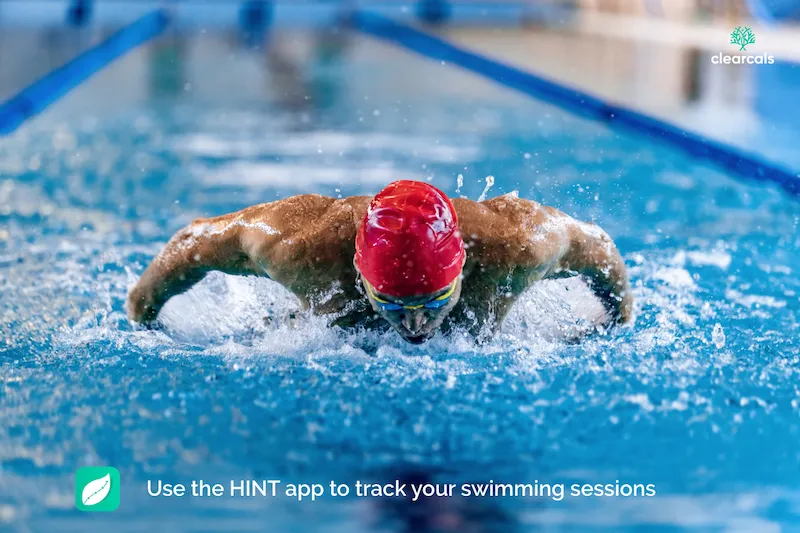
Butterfly is the most physically demanding stroke, using a simultaneous, symmetrical overhead arm recovery paired with a dolphin kick, where both legs move together. It's the second-fastest stroke after freestyle, but it requires significant upper-body strength, core coordination, and timing, which is why it's usually the last stroke swimmers learn.
Swimming vs. Running vs. Cycling: Which Burns More?
| Activity | Approx. Calories per Hour (70kg adult, moderate-vigorous effort) |
|---|---|
| Walking (brisk) | ~300-400 kcal |
| Cycling (moderate) | ~500-600 kcal |
| Swimming (freestyle, moderate) | ~580-640 kcal |
| Running (jogging pace) | ~600-700 kcal |
| Swimming (vigorous/butterfly) | ~700-1,050 kcal |
Swimming and moderate cycling burn calories at a similar rate, while vigorous swimming — particularly breaststroke or butterfly — can outpace even running. Swimming's biggest advantage is that it's zero-impact, so it puts essentially no stress on your joints, unlike running's repeated impact or even cycling's saddle and knee strain over long distances. If you also run or cycle, our running calorie calculator and cycling calorie guide break down calorie burn the same way this page does for swimming. There's no single "best" choice — the right one is whichever you can do consistently, and swimming is a particularly good option if you're managing a joint issue that makes higher-impact exercise uncomfortable.
Beginner Swimming Tips
- Start with freestyle. It's the most intuitive stroke to learn and the most efficient for building fitness, so most beginners should focus here before adding other strokes.
- Focus on breathing rhythm before speed. Comfortable, consistent breathing (exhaling underwater, turning to inhale) solves more beginner struggles than any other single technique fix.
- Use short, frequent sessions to start. 20-30 minutes, 2-3 times a week, builds comfort and basic endurance before attempting longer or more intense swims.
- Consider a few lessons even as an adult. Technique corrections from an instructor — body position, kick technique, arm entry — tend to improve efficiency (and reduce fatigue) faster than self-teaching alone.
- Use basic gear properly. Well-fitted goggles and a cap (if you have longer hair) remove two of the most common early frustrations with lap swimming.
- Build up gradually. Add distance or time by no more than about 10% per week, and don't be discouraged if your pace feels slow at first — swimming efficiency improves faster with practice than raw fitness alone.
Track Your Swims With Hint
Because swimming's calorie burn varies so much by stroke, pace, and effort, a generic "I swam today" log can be well off the mark. The Hint app's free Pro Workouts feature tracks calorie burn from your swims directly, with free AI-generated insights on the session. If you use a fitness tracker or swim-capable smartwatch, you can also connect it to Hint through Apple Health or Google Health Connect for free AI insights on your post-swim nutrition.
FAQs
How many calories does swimming burn per hour? Roughly 580-640 kcal for moderate freestyle, or up to 700-1,050 kcal for vigorous swimming or butterfly, for an average 70kg adult.
Which swimming stroke burns the most calories? Butterfly, by a clear margin, followed closely by breaststroke — both are more demanding than freestyle or backstroke.
Which swimming stroke is the fastest? Freestyle (front crawl) is the fastest of the four strokes, followed by butterfly, backstroke, and breaststroke.
Is swimming good for weight loss? Yes — it's a zero-impact, full-body form of cardio that contributes meaningfully to the calorie deficit needed for weight loss.
Does swimming build muscle? It builds muscular endurance and noticeable tone, especially in the shoulders, back, and core, though it's generally less effective than dedicated strength training for building significant muscle mass.
Does swimming reduce belly fat? Not directly — no exercise targets fat loss from one area. Swimming helps by contributing to overall calorie burn, which supports fat loss throughout the body.
Does swimming increase height? No, at any age. Height is determined by genetics and growth plates that close after puberty.
Can I track calorie burn from swimming automatically? Yes — the Hint app's free Pro Workouts feature tracks calorie burn from swimming with free AI insights on the session, and can connect to a fitness tracker or swim-capable smartwatch via Apple Health or Google Health Connect for free AI insights on post-swim nutrition.
About the Author
Dr. Krishna Athmakuri is the Co-Founder and CEO of Clearcals, where he leads the development of data-driven health technology for India. With a Ph.D. in Chemical Engineering from Rensselaer Polytechnic Institute, New York, his expertise spans protein analytics, bioprocess engineering, and health data systems. Earlier in his career, he developed biotherapeutics for diabetes and metabolic diseases at companies including Dr. Reddy's and Aurobindo Pharma. At Clearcals, he now applies that scientific rigour to build personalised fitness tools — including the Hint app — grounded in Indian nutritional science and clinical evidence. Connect with Dr. Krishna on LinkedIn