Track your nutrition and health goals

Vada Pav Calories & Nutrition: Regular vs. Cheese vs. Jumbo (Is It Healthy?)
Vada Pav Calories & Nutrition: Regular vs. Cheese vs. Jumbo (Is It Healthy?)
Is Vada Pav Healthy? The Short Answer
Mumbai's most iconic street food is, nutritionally, exactly what it looks like: a deep-fried potato fritter (the vada) stuffed into a soft white bread bun (the pav), served with chutneys and often a fried green chilli.
That combination — refined-flour bread plus deep-fried filling — makes it a calorie-dense, carbohydrate-heavy snack with modest protein and very little fibre.
It isn't "unhealthy" in any dramatic sense, and it's genuinely lighter than several other fried street snacks, but it's best treated as an occasional indulgence rather than an everyday meal if you're watching your calories.
Vada Pav Calories: Quick Reference
| Version | Approx. Calories Per 100 g |
|---|---|
| Regular vada pav (plain, dry chutneys) | 300 kcal |
| Vada pav with butter | ~290-330 kcal |
| Cheese vada pav | ~330-380 kcal |
| Schezwan vada pav | ~280-320 kcal |
| Jumbo/double vada pav | ~380-450 kcal |
| 2 regular vada pav | ~500-600 kcal |
These are reasonable estimates for a typical roadside or restaurant-style vada pav — actual numbers vary by vendor depending on the size of the vada, how much oil it absorbs, and how generously chutney and butter are used.
Full Nutrition Facts (1 Regular Vada Pav)
| Nutrient | Approx. Amount Per 100g |
|---|---|
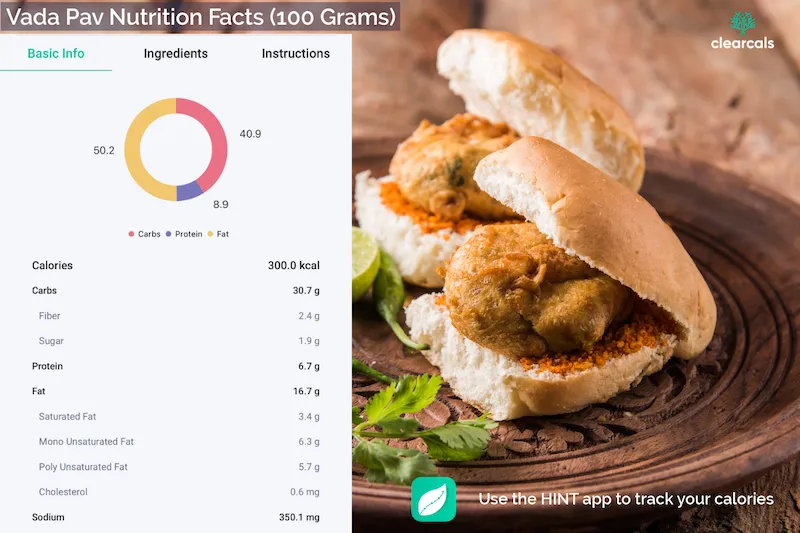
| Calories | 300 kcal |
| Protein | 6.7g |
| Carbohydrates | 30.7 g |
| Fat | 16.7 g |
| Fibre | 2.4 g |
Roughly speaking, the pav (bun) contributes about 120-150 kcal, the deep-fried potato vada another 130-160 kcal, and the chutneys and fried chilli add a smaller but real 10-25 kcal on top — the fried vada and the refined-flour bun are doing most of the work, not the chutney.
Does Vada Pav Have Protein?
A fair amount of search interest is around whether vada pav is a decent protein source, and the honest answer is: not really.
A regular vada pav has roughly 6 to 7 g of protein — mostly from the potato filling and the small amount of gram flour (besan) used in the vada's batter, with a little more from the wheat in the bun.
That's a modest amount for ~300 kcal, and nowhere close to what you'd get from an equivalent-calorie serving of dal, eggs, or paneer. Vada pav is best thought of as a carbohydrate-and-fat-forward snack rather than a protein one.
Cheese, Schezwan, Jumbo, and Other Vada Pav Variants
Vada pav has picked up several popular variations over the years, and they don't all carry the same calorie cost:
- Cheese vada pav — a slice or spread of processed cheese added to the bun. The cheese alone typically adds 60-90 kcal, pushing a cheese vada pav to roughly 330-380 kcal.
- Schezwan vada pav — the classic vada pav with a spoon of Indo-Chinese schezwan sauce or mayo-based schezwan spread in place of (or alongside) the usual chutneys. The sauce adds modestly more than plain chutney, typically landing around 280-320 kcal.
- Jumbo or double vada pav — a larger bun with two vadas, or one oversized vada. This roughly scales up the calorie count of the whole snack, often to 380-450 kcal for a single serving.
- Golden/extra-crispy vada — a deep-fried vada with a thicker batter coating, which absorbs more oil than a standard one and runs somewhat higher than the regular version.
- Butter vada pav — the pav is toasted with a smear of butter before assembly, adding roughly 30-50 kcal depending on how much butter is used.
None of these variants are dramatically "unhealthy" compared to the original — they're incremental additions on top of a fried snack that's already calorie-dense, so the difference between the lightest and heaviest version is usually 100-150 kcal, not several times over.
Vada Pav vs. Pav Bhaji vs. Burger
A natural comparison, since all three are bread-based, calorie-dense, and commonly eaten as a quick meal or snack in India:
| Item | Approx. Calories | Notes |
|---|---|---|
| Vada pav, 1 piece | ~250-290 kcal | Single fried potato fritter in a small bun |
| Pav bhaji, 1 plate (2 pav) | ~450-550 kcal | More buttered bread, plus a rich mixed-vegetable curry |
| Regular veg burger | ~300-400 kcal | Varies widely by chain and how the patty is cooked |
| Regular chicken burger | ~350-450 kcal | Similar range, depending on sauces and cheese |
Per piece, a single vada pav is usually lighter than a typical burger or a full plate of pav bhaji — the catch is portion size and frequency. Two vada pav (a common single-sitting order) puts you in a similar calorie range to a burger meal, and vada pav's small size and low cost make it easy to eat two or three without registering it as "a full meal" the way a burger visually does.
Vada Pav Chutneys: Do They Add Many Calories?
Vada pav is typically served with a combination of a dry garlic-chilli chutney (lasun chutney), a wet green coriander-mint chutney, and sometimes a sweet tamarind chutney, plus a whole or slit fried green chilli on the side.
| Chutney/Add-on | Approx. Calories (typical serving) |
|---|---|
| Dry garlic chutney, 1 tsp | ~10-15 kcal |
| Green chutney, 1 tbsp | ~5-10 kcal |
| Sweet tamarind chutney, 1 tbsp | ~15-20 kcal |
| Fried green chilli, 1 | ~5-10 kcal |
Even with all of them together, the chutneys typically add up to only 25-40 kcal — a small fraction of the total, since the real calorie cost of vada pav sits in the fried vada and the bun, not the condiments.
Is Vada Pav Good for Weight Loss or Diabetes?
Vada pav isn't an ideal everyday choice if you're actively trying to lose weight or manage blood sugar, but it doesn't need to be avoided entirely either. The combination of deep-fried potato and a refined-flour bun means it digests quickly and delivers a fair amount of carbohydrate and fat for its size — for weight loss, that means it's easy to underestimate how much a couple of vada pav add up to across a day.
For diabetes specifically, the potato-and-refined-bread combination can contribute to a faster rise in blood sugar than a meal built around whole grains, vegetables, and protein, so portion size and frequency matter more here than with most other foods — if you're managing diabetes, it's worth discussing how foods like this fit your specific plan with your doctor or dietitian rather than relying on general rules.
How to Make a Lower-Calorie Vada Pav at Home
If you want the flavour without the full calorie cost of deep-frying, a few swaps make a real difference:
- Air-fry or shallow-fry the vada instead of deep-frying — this alone can cut 40-60 kcal per piece by reducing the oil absorbed into the batter coating.
- Use a whole wheat or multigrain pav if available, which adds fibre without changing the calorie count much.
- Go easy on butter — skip toasting the pav in butter, or use a light scrape instead of a generous smear.
- Lean on the green and tamarind chutneys rather than extra butter or cheese for flavour, since they add far fewer calories per spoon.
A homemade vada pav made this way can come in closer to 180-220 kcal per piece — a meaningful cut from the deep-fried, buttered restaurant version.
Where Did Vada Pav Come From?
Vada pav is widely credited to Ashok Vaidya, a street vendor who is said to have started selling it near Dadar station in Mumbai in 1966 as an affordable, filling snack for mill workers and commuters. It has since become one of the most recognisable street foods associated with Mumbai, with countless stalls across the city — and now well beyond it — built around their own version of the recipe.
Track Your Vada Pav With Hint
Because vada pav is small, cheap, and often eaten two or three at a time without much thought, it's an easy food to under-log — "I had a vada pav" can mean anywhere from 250 to 500+ kcal depending on how many and which version.
The Hint app lets you log vada pav by count and variant (plain, cheese, jumbo, and more), so your tracking reflects what you actually ate rather than a rough guess.
FAQs
How many calories are in one vada pav? A regular vada pav is roughly 250-290 kcal, depending on the size of the vada and how it's prepared.
How many calories are in 2 vada pav? Two regular vada pav add up to roughly 500-580 kcal — a meaningful amount if eaten as a snack alongside other food that day.
Does vada pav have protein? Only modestly — around 5- 6 g per piece, mostly from the potato and gram flour in the vada. It's not a meaningful protein source relative to its calorie count.
Is vada pav healthy? It's a fried, refined-carbohydrate snack — fine occasionally, but not an everyday choice if you're managing calories, weight, or blood sugar closely.
How many calories are in a cheese vada pav? Roughly 330-380 kcal — the added cheese typically contributes 60-90 kcal on top of a regular vada pav.
Is vada pav good for weight loss? It can fit occasionally into a calorie-controlled diet, but its combination of deep-fried potato and refined bread makes it easy to underestimate — better as an occasional treat than a regular snack while actively losing weight.
Which has more calories, vada pav or a burger? Per piece, a single vada pav (~250-290 kcal) is usually lighter than a typical burger (~300-450 kcal), but two vada pav — a common single serving — lands in a similar range.
Can diabetics eat vada pav? It's best approached carefully — the potato-and-refined-flour combination can raise blood sugar faster than whole-grain, higher-fibre options. Talk to your doctor or dietitian about how it fits your specific diabetes management plan.
About the Author
Asfia Fatima is the Chief Dietitian at Clearcals, with a Master's Degree in Dietetics and Clinical Nutrition and over a decade of experience in clinical nutrition and lifestyle management. She specialises in evidence-based diet planning for weight loss, diabetes, and metabolic health, and leads the nutrition strategy behind the Hint app.
Connect with Asfia on LinkedIn