Track your nutrition and health goals

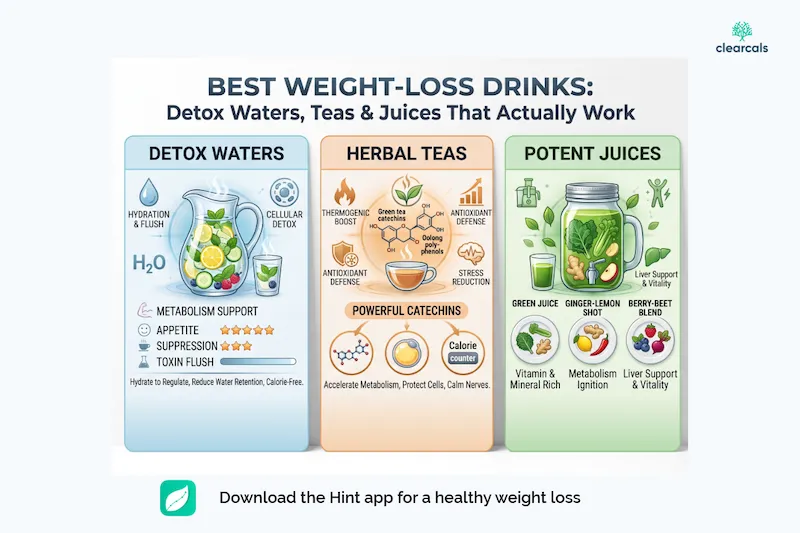
Best Weight-Loss Drinks: Detox Waters, Teas & Juices That Actually Work
By Asfia Fatima, Chief Dietitian at Clearcals
Searches for "weight loss drinks" usually lead to long lists of detox waters and juice recipes with vague promises. This guide is the opposite — a straight comparison of the most popular options, what the evidence actually shows for each, and which ones we've covered in full depth elsewhere on Clearcals.
No drink burns fat on its own. What these drinks can genuinely do is replace higher-calorie beverages, support hydration, and in a few cases modestly help with appetite or blood sugar — which is a real, if limited, contribution to a weight-loss plan.
TL;DR
- No drink is a substitute for a calorie deficit — every option below works at best as a small supporting habit
- Best evidence: Green tea (catechins + caffeine) and apple cider vinegar (appetite, blood sugar) have the most research behind them
- Best for hydration + zero calories: Plain detox water (cucumber, mint, lemon) and black coffee
- Worst "health halo": Bottled fruit/vegetable juices and smoothies often carry more sugar and calories than people expect
- Track every drink, not just meals, with the Hint app
Weight-Loss Drinks Compared
| Drink | Calories (per serving) | What the Evidence Shows | Deep Dive |
|---|---|---|---|
| Plain detox water (cucumber/mint/lemon) | ~0-5 kcal | Mostly a flavoured-water hydration aid; no direct fat-loss evidence | — |
| Green tea | ~0-2 kcal | Catechins + caffeine show a small metabolic boost in studies | Best Green Tea for Weight Loss |
| Black coffee | ~0-2 kcal | Caffeine modestly raises metabolic rate and can reduce appetite short-term | Black Coffee for Weight Loss |
| Jeera (cumin) water | ~14 kcal/glass | Supports digestion, modestly improves metabolism and blood sugar | Jeera Water for Weight Loss |
| Apple cider vinegar (diluted) | ~3 kcal | Small, consistent effect on appetite and post-meal blood sugar | ACV for Weight Loss |
| Fresh vegetable juice (unsweetened) | ~40-80 kcal/glass | Loses fibre compared to whole vegetables; nutrients retained, satiety reduced | Juicing for Weight Loss |
| Fruit juice (bottled/packaged) | ~110-150 kcal/glass | Often as much sugar as a soft drink, with little to no fibre | — |
| Smoothies (fruit + milk/yoghurt) | ~200-350 kcal/glass | Can be a balanced meal/snack if portioned and unsweetened, or a hidden calorie bomb if not | — |
| Rice water | ~20-30 kcal/glass | Traditional digestive drink; limited direct weight-loss evidence | Rice Water for Weight Loss |
| Cortisol cocktail (social-media trend) | Varies by recipe | No clinical evidence supports lowering cortisol via a drink combination; effects are largely anecdotal | Cortisol Cocktail for Weight Loss |
What Actually Matters About "Weight-Loss Drinks"
1. The Calories You Don't Drink Matter More Than the Ones You Do
The single biggest lever any drink has on weight loss is what it replaces. Swapping a sugary soft drink, sweetened tea/coffee, or a fruit juice for water, black coffee, or green tea removes real calories from your day — often more impactful than any "fat-burning" property of the new drink itself.
2. A Few Drinks Have Genuine, Modest Evidence
Green tea catechins, caffeine (coffee), and apple cider vinegar each have repeated studies showing small but real effects on metabolism, appetite, or blood sugar. These are worth including as habits — with realistic expectations of a supporting role, not a primary driver.
3. Juicing Removes Fibre
Juicing extracts liquid and sugar while leaving most of the fibre behind in the pulp. This means a glass of juice digests faster and is less filling than eating the same fruits or vegetables whole — often leading to higher total sugar intake for less satiety.
4. "Detox" Claims Are Mostly Marketing
The liver and kidneys handle detoxification continuously; no drink accelerates this process in a clinically meaningful way. Detox waters' real value is flavoured, zero-calorie hydration — a genuinely useful but modest benefit, not literal detoxification.
Building a Simple Weight-Loss Drink Routine
- Default to water for most of your daily fluid intake.
- Pick one or two evidence-backed habits — green tea or black coffee in the morning, diluted ACV before a meal — rather than trying every trending drink at once.
- Treat juices and smoothies as food, not water — log their calories like a meal/snack, not as a "zero-calorie" drink.
- Avoid drinks promising rapid or dramatic results — the trend cycle (cortisol cocktails, "weight loss coffee loopholes," miracle teas) almost never holds up to the evidence behind the basics above.
How the Hint App Supports Drink Tracking
Drinks are one of the most commonly under-logged calorie sources. The Hint app helps close that gap:
- Full drink database: Log detox waters, juices, smoothies, and traditional Indian drinks with accurate calories
- Habit tracking: Build a consistent green tea, black coffee, or ACV routine and see it alongside your full diet
- Personalised diet plans: Hint Pro factors your drink habits into your overall calorie and macro targets
- Dietitian consultations: Hint Premium for a complete weight loss diet plan, drinks included
Frequently Asked Questions
What is the best drink for weight loss?
There's no single best drink — water should be your default, with green tea, black coffee, or diluted apple cider vinegar as reasonable, evidence-backed additions. The "best" choice depends on what it's replacing in your current routine.
Do detox waters really help you lose weight?
Not directly. They're a flavoured, zero-calorie way to stay hydrated and can help if they replace sugary drinks, but they have no special fat-burning property beyond that substitution effect.
Is juicing better than eating whole fruits and vegetables for weight loss?
Generally no — juicing removes fibre, which reduces satiety and can lead to consuming more sugar in less time than eating the same produce whole. Whole fruits and vegetables are usually the better choice for weight loss.
Are "fat-burning" teas and drinks marketed online legitimate?
Most have no strong clinical evidence behind their specific claims. Green tea and properly diluted apple cider vinegar are the closest to evidence-backed "extra" support; most trending drinks (cortisol cocktails, miracle detox blends) are not well supported by research.
Can I drink multiple weight-loss drinks in one day?
You can, but more isn't necessarily better — each has a recommended safe quantity (for example, 1-2 glasses of jeera water or 1-2 tablespoons of diluted ACV daily). Stacking several at maximum amounts increases side-effect risk without proportionally increasing benefit.
How many calories do smoothies usually have?
A typical fruit-and-dairy smoothie ranges from 200-350 kcal depending on size and ingredients — closer to a meal or substantial snack than a "drink," and should be logged accordingly.
References
- Hursel R, Westerterp-Plantenga MS. Catechin- and caffeine-rich teas for control of body weight in humans. Am J Clin Nutr. 2013;98(6 Suppl):1682S-1693S. DOI: 10.3945/ajcn.113.058396
- Tabrizi R, et al. The effects of caffeine intake on weight loss: a systematic review and dose-response meta-analysis. Crit Rev Food Sci Nutr. 2019;59(16):2688-2696. DOI: 10.1080/10408398.2018.1507996
- Kondo T, et al. Vinegar intake reduces body weight, body fat mass, and serum triglyceride levels in obese Japanese subjects. Biosci Biotechnol Biochem. 2009;73(8):1837-43. DOI: 10.1271/bbb.90231
Explore More
- Best Green Tea for Weight Loss
- Black Coffee for Weight Loss
- Apple Cider Vinegar for Weight Loss
- Weight Loss Diet Plan — India
About the Author
Asfia Fatima is the Chief Dietitian at Clearcals, with a Master's Degree in Dietetics and Clinical Nutrition and over a decade of experience in clinical nutrition and lifestyle management.
She specialises in evidence-based diet planning for weight loss, diabetes, and metabolic health. At Clearcals, she leads the nutrition strategy behind the Hint app, helping users achieve their goals with science-backed guidance.
🔗 Connect with Asfia on LinkedIn