Track your nutrition and health goals

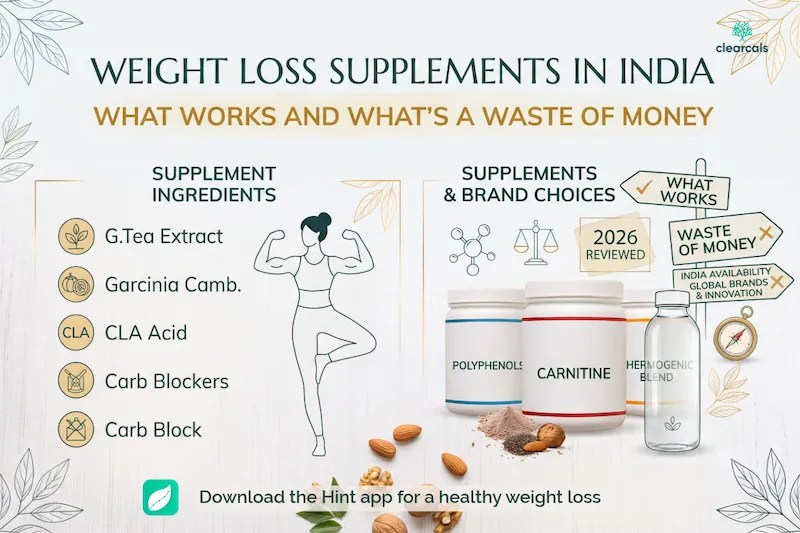
Weight Loss Supplements in India: What Works and What's a Waste of Money
By Asfia Fatima, Chief Dietitian at Clearcals
The Indian weight-loss supplement market is large and largely unregulated for efficacy claims. Some ingredients have genuine, if modest, evidence behind them; many popular products are backed by marketing rather than research. This guide grades the most common categories honestly, so you can spend money on something with real evidence if you choose to supplement at all.
TL;DR
- No supplement produces significant weight loss without diet and exercise — at best, the better-evidenced ones offer a small additional edge
- Reasonable evidence: Caffeine, green tea extract (EGCG), soluble fibre supplements (glucomannan, psyllium), protein supplements
- Weak/mixed evidence: Garcinia cambogia, CLA (conjugated linoleic acid), raspberry ketones
- Buyer-beware category: Proprietary "fat burner" blends and gummy-format weight-loss products, which often combine small doses of multiple ingredients with limited regulatory oversight on actual content
- Track supplements alongside your diet with the Hint app to see the full picture, not an isolated "hack"
Supplement Evidence Grade
| Supplement | Evidence Level | What It Actually Does |
|---|---|---|
| Caffeine | Moderate | Modestly increases metabolic rate and reduces short-term appetite |
| Green tea extract (EGCG) | Moderate | Small thermogenic effect, more reliable in studies than most other "fat burner" ingredients |
| Soluble fibre (glucomannan, psyllium) | Moderate | Increases satiety by adding bulk and slowing digestion — works mechanically, not metabolically |
| Protein supplements (whey/plant) | Moderate-Strong | Supports satiety and muscle preservation during a calorie deficit — one of the better-evidenced "supplements" for weight loss indirectly |
| CLA (conjugated linoleic acid) | Weak/Mixed | Small effects in some studies, often not replicated; GI side effects common |
| Garcinia cambogia (HCA) | Weak | Most rigorous trials show no significant weight-loss benefit over placebo |
| Raspberry ketones | Very Weak | Evidence is almost entirely from animal/cell studies, not confirmed in humans at typical supplement doses |
| Proprietary "fat burner" blends | Variable/Unverified | Often combine sub-clinical doses of multiple ingredients; actual content not always independently verified |
| Weight-loss gummies (general) | Variable | Effectiveness depends entirely on actual active ingredient dose, which is often lower than the equivalent tablet/capsule form and not always disclosed clearly |
What's Worth Considering
1. A Quality Protein Supplement
If your diet is genuinely short on protein, a whey or plant-based protein supplement is one of the more defensible additions — not because protein powder itself "burns fat," but because hitting your protein target supports satiety and muscle retention, both of which make a calorie deficit easier to sustain. See our whey protein buying guide for how to choose one.
2. Caffeine or Green Tea Extract (in Moderation)
Both have real, if modest, evidence for a small metabolic and appetite effect. They work best as a habit (a cup of green tea, moderate coffee intake) rather than a high-dose concentrated supplement, which increases side-effect risk (anxiety, elevated heart rate, sleep disruption) without proportional extra benefit.
3. Fibre Supplements, If Your Diet Is Genuinely Low in Fibre
Glucomannan and psyllium husk can support satiety mechanically. They're a reasonable option if your diet structurally lacks fibre, but they're not superior to simply eating more vegetables, fruits, and whole grains, which provide the same mechanism plus actual nutrition.
What to Be Skeptical Of
- Dramatic before/after claims with no information on the actual diet/exercise changes made during the period shown.
- "Proprietary blend" labelling that hides the actual dose of each ingredient — without a dose, you can't judge whether a study's results would even apply.
- Products claiming to work "without diet or exercise changes" — this contradicts how every well-evidenced ingredient in this category actually works.
- Heavily discounted "limited time" pricing and aggressive influencer marketing, which are marketing signals, not efficacy signals.
- Side effects downplayed or omitted — even reasonably well-evidenced stimulant ingredients carry real side-effect profiles at higher doses.
A Sensible Approach to Supplements
- Fix the diet and activity level first — supplements work, at best, as a small multiplier on a foundation that's already in place, not a substitute for one.
- If you choose to supplement, pick from the moderate-or-better evidence category above, and check the actual dose against the studies that produced positive results.
- Discuss with a doctor or dietitian if you take any medication — several common supplement ingredients (including some "natural" ones) can interact with medications, including those for diabetes, blood pressure, or thyroid conditions.
- Track the full picture rather than expecting a single product to be a stand-alone explanation for results.
How the Hint App Supports an Evidence-Based Approach
The Hint app is designed around what actually drives results — your diet, not supplement marketing:
- Full diet tracking: See whether your protein and fibre targets are genuinely being met through food, before adding a supplement
- Personalised diet plans: Hint Pro builds a plan where supplements are a small addition to a solid foundation, not a replacement for one
- Dietitian consultations: Hint Premium for an honest, individualised opinion on whether a specific supplement is worth it for you
Frequently Asked Questions
Do fat burner supplements actually work?
Most have weak or inconsistent evidence. The ingredients with the best (still modest) evidence — caffeine, green tea extract — are present at low, often sub-clinical doses in many commercial "fat burner" blends.
Is it safe to take multiple weight-loss supplements together?
Not necessarily — stacking multiple stimulant-containing products can push combined caffeine/stimulant intake to unsafe levels without your realising it. Check total stimulant content across everything you take, including tea/coffee.
Are weight-loss gummies as effective as tablets?
Often less so — gummies frequently contain a lower active-ingredient dose than the equivalent tablet or capsule, partly due to taste and stability constraints. Check the actual dose on the label rather than assuming equivalence.
Should I take a protein supplement to lose weight?
If your diet is genuinely short on protein, a quality protein supplement can help you hit your target and support satiety. It is not necessary if you can meet your protein needs through food alone.
Are Ayurvedic weight-loss supplements safer than Western ones?
"Natural" or "Ayurvedic" labelling doesn't automatically mean safer or more effective — quality, dose, and actual evidence vary widely by specific product and ingredient. See our Ayurvedic home remedies for weight loss guide for an evidence-based look at specific traditional ingredients.
Can supplements replace a calorie deficit?
No. Every well-evidenced supplement in this category works as a small support to an existing calorie deficit and active lifestyle — none have been shown to produce significant weight loss on their own.
References
- Onakpoya I, Hung SK, Perry R, Wider B, Ernst E. The use of garcinia extract (hydroxycitric acid) as a weight loss supplement: a systematic review and meta-analysis of randomised clinical trials. J Obes. 2011;2011:509038. DOI: 10.1155/2011/509038
- Onakpoya I, Posadzki P, Ernst E. The efficacy of glucomannan supplementation in overweight and obesity: a systematic review and meta-analysis of randomized clinical trials. J Am Coll Nutr. 2014;33(1):70-8. DOI: 10.1080/07315724.2014.870013
- Tabrizi R, et al. The effects of caffeine intake on weight loss: a systematic review and dose-response meta-analysis. Crit Rev Food Sci Nutr. 2019;59(16):2688-2696. DOI: 10.1080/10408398.2018.1507996
Explore More
- Plix Weight Loss Gummies: Review
- Whey Protein in India: Complete Buying Guide
- Weight Loss Medications in India
- Weight Loss Diet Plan — India
About the Author
Asfia Fatima is the Chief Dietitian at Clearcals, with a Master's Degree in Dietetics and Clinical Nutrition and over a decade of experience in clinical nutrition and lifestyle management.
She specialises in evidence-based diet planning for weight loss, diabetes, and metabolic health. At Clearcals, she leads the nutrition strategy behind the Hint app, helping users achieve their goals with science-backed guidance.
🔗 Connect with Asfia on LinkedIn