Track your nutrition and health goals

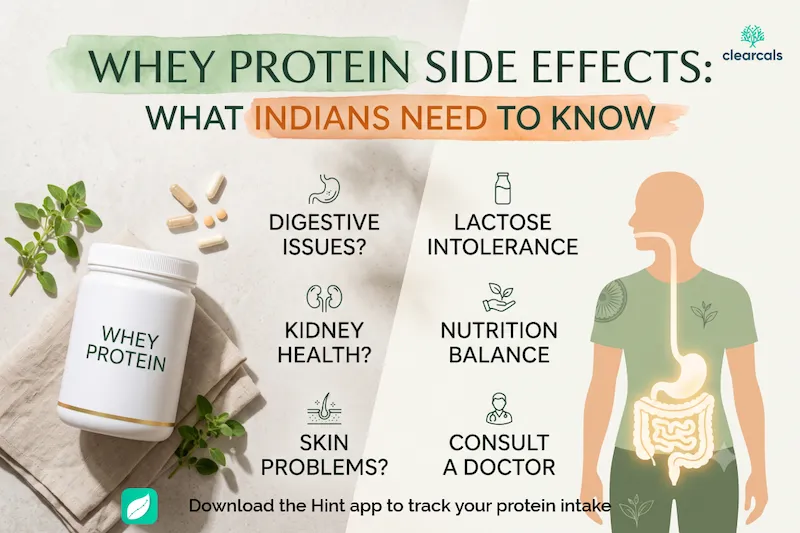
Whey Protein Side Effects: What Indians Need to Know
By Asfia Fatima, Chief Dietitian at Clearcals
Whey protein is safe for most healthy adults at normal doses — this is the scientific consensus. However, that doesn't mean it's free of side effects for everyone. This guide covers the real risks, who should be cautious, and how to minimise problems if you choose to use whey.
Is Whey Protein Safe?
Yes, for most healthy adults consuming 1–2 scoops (30–60g) per day alongside an otherwise balanced diet. Whey protein is a derivative of food (cow's milk), not a pharmaceutical compound, and decades of research in healthy populations confirm its safety profile.
The nuances arise with: pre-existing health conditions, very high doses, poor product quality, and specific individual sensitivities.
Common Whey Protein Side Effects
1. Digestive Discomfort and Bloating
How common: Very common, particularly with whey concentrate.
Why it happens: Whey concentrate contains lactose — the natural milk sugar that approximately 60–70% of South Asians have some difficulty digesting (lactase deficiency). Undigested lactose ferments in the colon, producing gas and bloating.
What to do:
- Switch to whey isolate — it has minimal lactose removed during processing
- Try ATOM Whey with Enzymes (from AS-IT-IS) — the added digestive enzymes (protease, amylase) significantly reduce bloating
- Start with half a scoop and gradually increase to identify your tolerance level
- Mix with water rather than milk — milk adds additional lactose
2. Acne
How common: Affects a subset of users, particularly teenagers and those with pre-existing acne-prone skin.
Why it happens: Whey protein stimulates insulin and IGF-1 (insulin-like growth factor 1) — both of which can increase sebum production and promote the growth of acne-causing bacteria. Multiple studies have documented this association.
What to do:
- Monitor your skin for the first 4–6 weeks on whey
- If acne worsens noticeably, switch to plant protein (pea protein has no documented acne association)
- Ensure adequate hydration and a diet low in processed sugar, which independently exacerbates acne
3. Kidney Stress
How common: Rare in healthy individuals at normal doses. A concern primarily for those with pre-existing kidney disease.
The evidence: Research does not support that normal protein intake (up to 2g/kg body weight) harms kidney function in healthy adults. The concern arises with chronically excessive intake (above 3g/kg/day) or in individuals with compromised kidney function.
Who should be cautious: If you have chronic kidney disease (CKD), diabetes with kidney complications, or a family history of kidney problems, consult your doctor before using any protein supplement. High-protein diets increase the filtration load on kidneys, which healthy kidneys manage easily but compromised kidneys may not.
Urine protein creatinine ratio: Some users track this via urine tests to monitor kidney health during high-protein supplementation. Consult your doctor if you have concerns.
4. Liver Concerns
How common: Not relevant for healthy individuals at normal doses.
The evidence: Acute liver injury from whey protein is extremely rare and typically associated with herbal additives in supplement products rather than whey itself. Pure whey protein in normal amounts does not stress liver function in healthy people.
Who should be cautious: Individuals with fatty liver disease, hepatitis, or elevated liver enzymes should consult a doctor before supplementing with protein powder.
5. Weight Gain (Unintended)
How common: Occurs when protein powder is added on top of an already adequate diet without adjusting other food intake.
Why it happens: Whey protein is a calorie-dense food (~130 kcal per scoop). If you're already meeting your calorie target and you add two scoops of whey on top, you're adding 260 extra calories per day — roughly 1.8 kg of fat gain per month if not compensated elsewhere.
What to do: Track your total daily calories (food + supplements) with the Hint app and adjust food intake if you're adding whey to your routine.
6. Hormonal Concerns (Particularly for Women)
Whey protein is derived from dairy, which contains trace amounts of bovine hormones. However, the concentrations in standard whey protein are not clinically significant for human hormonal health at normal supplement doses.
Soy-based protein, not whey, is more commonly discussed in the context of phytoestrogens — and the clinical evidence even for soy's hormonal effects at food doses is not conclusive.
Who Should Avoid Whey Protein?
| Condition | Recommendation |
|---|---|
| Dairy allergy | Avoid whey completely — switch to pea, rice, or hemp protein |
| Severe lactose intolerance | Use whey isolate or plant protein |
| Chronic kidney disease | Consult nephrologist before any protein supplementation |
| Active liver disease | Consult hepatologist before supplementing |
| Acne-prone skin | Monitor closely; switch to plant protein if acne worsens |
| Pregnancy / breastfeeding | Consult doctor — standard whey is generally safe but products with added herbs (e.g. OZiva) need medical review |
How to Choose a Safer Whey Protein
1. Buy third-party certified products. Labdoor USA (ATOM, Nakpro) and Informed Sport (MuscleBlaze select variants, OZiva) certification verifies purity and label accuracy. Uncertified cheap products may contain contaminants or undisclosed additives.
2. Avoid products with long lists of herbal additives. Some Indian brands add unregulated herbal extracts at undefined doses — the main risk of supplement-related liver injury is usually from herb combinations, not whey itself.
3. Read the sweetener list. Maltitol (a sugar alcohol used in some protein bars and powders) causes significant GI distress at doses above 20–30g. Sucralose and stevia are generally well-tolerated.
4. Don't exceed 2 scoops per day unless you're a large athlete with very high protein requirements calculated by a dietitian.
Signs You Should Stop Taking Whey Protein
- Persistent bloating or digestive distress even after switching to isolate
- Significant acne flare-up within 4–6 weeks of starting
- Unusual fatigue or jaundice (see a doctor immediately)
- Elevated creatinine or urine protein on a blood/urine test
The Bottom Line
Whey protein is safe for most healthy Indian adults at 1–2 scoops per day. The most common real issues — bloating and acne — are manageable by switching to isolate or plant protein. Serious risks (kidney/liver) are relevant only for those with pre-existing conditions at high doses.
If you have any health condition, consult a doctor or dietitian before supplementing. Hint Premium gives you access to qualified Indian dietitians who can personalise your protein intake for your specific health profile.
References
- Investigating the Health Implications of Whey Protein Consumption: A Narrative Review of Risks, Adverse Effects, and Associated Health Issues — PMC / Healthcare, 2024
- Whey Protein Supplementation and Its Potentially Adverse Effects on Health: A Systematic Review — Applied Physiology, Nutrition, and Metabolism
- The Effect of Whey Protein Supplements on Acne Vulgaris among Male Adolescents and Young Adults: A Case-Control Study — Dermatology Research and Practice, 2024
- Whey Protein Precipitating Moderate to Severe Acne Flares in 5 Teenaged Athletes — Researchgate
- Whey Protein Supplementation Combined with Exercise on Muscle Protein Synthesis: A Systematic Review and Meta-Analysis — Nutrients, 2025
🎁 Free Hint with Every Watch Purchase
Garmin watches: Purchase any Garmin watch from the Clearcals Store and receive 1 month of Hint Premium (worth ₹1,999) free.
Apple Watch: Purchase any Apple Watch from the Clearcals Store and receive a free Hint Pro subscription.
About the Author
Asfia Fatima is the Chief Dietitian at Clearcals, with a Master's Degree in Dietetics and Clinical Nutrition and over a decade of experience in clinical nutrition and lifestyle management.
🔗 Connect with Asfia on LinkedIn