Track your nutrition and health goals

Body Fat Percentage: How to Measure It, What's Healthy & How to Calculate Yours
Body Fat Percentage: How to Measure It, What's Healthy & How to Calculate Yours
By Dr. Krishna Athmakuri, Co-Founder & CEO, Clearcals
Table of Contents
- What Is Body Fat Percentage?
- Body Fat Percentage vs. BMI
- How to Measure Body Fat Percentage
- Healthy & Ideal Body Fat Percentage Chart
- What Does X% Body Fat Look Like?
- Essential Body Fat
- Skinny Fat
- How to Reduce Body Fat Percentage
- Calculate Yours
- FAQs
What Is Body Fat Percentage?
Body fat percentage is the proportion of your total body weight that's made up of fat, as opposed to lean mass — muscle, bone, organs, and water. Someone weighing 70 kg at 20% body fat is carrying 14 kg of fat and 56 kg of lean mass; someone the same weight at 30% body fat is carrying 21 kg of fat and only 49 kg of lean mass. Same scale weight, very different bodies.
That's exactly why body fat percentage is a more direct answer than body weight or BMI to the question "how much fat am I actually carrying" — it separates the two components that a bathroom scale lumps together.
Body Fat Percentage vs. BMI
These get compared constantly, so here's the distinction: BMI estimates whether your weight is reasonable for your height using only those two numbers. Body fat percentage measures what proportion of your weight is actually fat. BMI can't tell muscle from fat, which is why a muscular, lean person can register as "overweight" on BMI while having a very healthy — even low — body fat percentage.
If your real question is about body composition rather than just weight-for-height, body fat percentage is the more useful number.
For the full breakdown of BMI itself, including why standard BMI charts understate risk for Indian bodies, see our BMI guide.
A related but different number is waist-to-hip ratio, which tells you where your fat is concentrated rather than how much of it there is — useful alongside body fat percentage, not instead of it.
How to Measure Body Fat Percentage
There's no single "correct" way to measure body fat — every method is an estimate, and they trade off accuracy against cost and convenience.
Navy Method (tape measurement). Uses your neck, waist, and (for women) hip circumference in a formula to estimate body fat. It's free, requires only a measuring tape, and is reasonably accurate for most people — this is the method our Body Fat Percentage Calculator uses, and it's also the standard the US Army and Navy use for fitness assessments, which is why "army body fat calculator" and "navy body fat calculator" are searched so heavily.
Skinfold calipers. A technician (or you, with practice) pinches skinfold thickness at several body sites and plugs the measurements into a formula. Reasonably accurate when done consistently by the same person, but technique-dependent.
Bioelectrical impedance (BIA) — smart scales. These send a tiny, harmless electrical current through your body and estimate fat based on how much resistance it meets (fat conducts differently than muscle and water). Convenient for tracking trends over time, but readings shift with hydration, food intake, and time of day — don't be alarmed by a 2-3% swing between one morning and the next; look at the trend over weeks, not single readings.
DEXA scan. A full-body X-ray scan that's considered the clinical gold standard, since it separately measures fat, lean mass, and bone density with high precision. It's the most accurate option by a meaningful margin, but requires a clinic visit and isn't something most people do more than occasionally.
Visual estimation. Comparing your physique to reference photos at known body fat percentages. It's free and instant, but the least precise method — useful as a rough sanity check, not a number to track progress against.
For most people, the Navy method or a consistent BIA scale gives a good enough estimate to track progress over time — DEXA is worth it occasionally if you want a precise baseline, but isn't necessary for everyday use.
Healthy & Ideal Body Fat Percentage Chart
Healthy ranges differ meaningfully between men and women, because women's bodies carry more essential fat by biological necessity (more on this below).
| Category | Men | Women |
|---|---|---|
| Essential fat | 2-5% | 10-13% |
| Athletes | 6-13% | 14-20% |
| Fitness | 14-17% | 21-24% |
| Average | 18-24% | 25-31% |
| Obese | 25%+ | 32%+ |
These ranges (based on the widely used American Council on Exercise classification) are a reference point, not a target everyone should aim for — where you sit on this chart should factor in your goals, training history, and how you feel, not just the category label.
What Does X% Body Fat Look Like?
Because body fat percentage is hard to picture from a number alone, here's roughly what different levels look like in practice — this varies by individual, but as a general guide:
- 10-12% (men) / 18-20% (women): Visible abdominal muscle definition ("abs") in most people, vascularity visible in several areas. This is the range most people mean when they search "what body fat percentage to see abs."
- 15% (men) / 22-25% (women): Athletic, defined look without maximum visible separation; a common, sustainable range for people who train regularly.
- 20-24% (men) / 28-31% (women): Average build for an active adult — some softness, no strong muscle definition, generally still a healthy range.
- 25%+ (men) / 32%+ (women): Higher body fat, associated with increased health risk if sustained long-term.
Getting to the lower end of these ranges and staying there sustainably is genuinely difficult for most people and isn't necessary for good health — the "fitness" and "average" categories above already represent healthy bodies for the large majority of people.
Essential Body Fat: Why You Can't Go to Zero
Essential fat is the minimum amount of fat your body needs to function — it's stored around organs and is involved in hormone production, temperature regulation, and (for women) reproductive function. This is why the healthy minimum is meaningfully different by sex: roughly 2-5% for men versus 10-13% for women. Going below essential fat levels isn't a fitness achievement — it's associated with hormonal disruption, weakened immunity, and in women, loss of menstrual cycles. Elite bodybuilders sometimes dip near these floors briefly for a competition, but it isn't a sustainable or healthy place to live.
Skinny Fat: What It Means and How to Check For It
"Skinny fat" describes someone who looks slim by weight and BMI but actually carries a higher-than-ideal body fat percentage and relatively little muscle — the opposite problem BMI is bad at catching. It typically comes from a combination of low muscle mass (often from little or no strength training) and a higher proportion of body fat relative to that low weight.
Because it doesn't show up on a scale or even always on BMI, body fat percentage is the metric that actually reveals it. If your weight and BMI look "normal" but you suspect you're skinny fat, checking your body fat percentage — and tracking it over a few months of consistent strength training — is the more useful signal than watching the scale.
How to Reduce Body Fat Percentage
Reducing body fat percentage comes down to the same fundamentals as fat loss generally — a consistent calorie deficit, adequate protein to preserve muscle, and strength training to make sure the weight you lose comes primarily from fat rather than muscle. We cover the full protocol — how big a deficit to run, sample Indian meal plans, and common mistakes — in our Calorie Deficit Diet guide.
If your goal is less about the scale and more about improving your fat-to-muscle ratio specifically, it's also worth reading about building muscle at maintenance calories — body recomposition (losing fat while gaining muscle) is often a better fit than a pure cut for people who are "skinny fat" or newer to strength training.
Body Fat Percentage of Athletes and Public Figures
Searches for the body fat percentage of specific athletes and celebrities — Virat Kohli, Cristiano Ronaldo, and others — are common, and it's worth being upfront about why we won't cite a specific number for any of them here: these figures are almost always estimates from fitness commentators or visual assessment, not officially published medical measurements, so they vary widely depending on the source and often aren't reliable. What is reliably true is that elite athletes in these sports typically sit well below the general population average — often in the "athlete" range from the chart above — as a byproduct of their training volume and dietary discipline, not a specific target number worth chasing on its own.
Calculate Your Body Fat Percentage
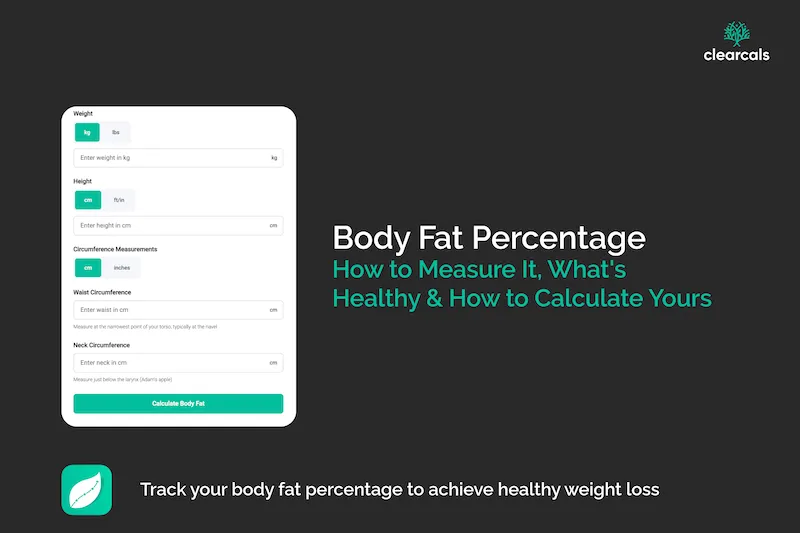
Use the free Body Fat Percentage Calculator — enter your height, waist, neck (and hip, if you're a woman) measurements, and it estimates your body fat percentage using the Navy method.
Your body fat percentage is also useful beyond the number itself: it's the input the Katch-McArdle formula uses to calculate a more personalized BMR, since that formula accounts for lean body mass directly rather than relying on population averages.
If you strength train regularly or have an athletic build, calculating your body fat percentage first and then using it for your BMR/maintenance calories will generally give you a more accurate number than the standard formulas alone.
FAQs
What is a healthy body fat percentage? For men, roughly 14-24% is considered a fitness-to-average healthy range; for women, roughly 21-31%. The exact "ideal" depends on your goals — athletes typically sit lower, and the general population average is healthy too, not just the athletic range.
How do I calculate my body fat percentage? The most accessible accurate method is the Navy method, which uses your neck, waist, and (for women) hip measurements in a formula. Use our Body Fat Percentage Calculator to get the number instantly.
What's the most accurate way to measure body fat? A DEXA scan is considered the clinical gold standard, measuring fat, lean mass, and bone density precisely via a full-body scan. For everyday tracking, the Navy method or a consistent bioelectrical impedance scale is accurate enough to follow your trend over time.
What body fat percentage do you need to see abs? Roughly 10-12% for men and 18-20% for women is where ab definition typically becomes clearly visible, though this varies by individual based on where you naturally carry fat.
What is essential body fat? It's the minimum fat your body needs for normal hormone production, organ protection, and temperature regulation — about 2-5% for men and 10-13% for women, higher in women due to reproductive function. Going below this range isn't healthy or sustainable.
What does "skinny fat" mean? It describes someone who appears slim by weight or BMI but has a higher-than-ideal body fat percentage and low muscle mass. It's typically addressed with strength training and adequate protein rather than more weight loss.
Are body fat scales accurate? Bioelectrical impedance scales are reasonably good for tracking trends over time, but individual readings can shift 2-3% based on hydration, recent food intake, and time of day. Weigh in under consistent conditions and track the trend rather than any single reading.
Is body fat percentage more important than BMI? They measure different things — BMI is a quick weight-for-height screen, while body fat percentage measures actual body composition. Body fat percentage is more informative if you strength train or have a build BMI tends to mislabel; for a general population screen, BMI remains useful and easier to track.
How is body fat percentage different for men and women? Women naturally carry more essential fat than men (10-13% vs. 2-5%) due to reproductive function, so healthy ranges across every category are higher for women than men at every fitness level.
Does Hint use body fat percentage? No. Body fat percentage feeds into the Katch-McArdle formula for a more personalized BMR calculation, particularly useful if you're lean or strength train regularly. Calculate yours with the free tool above, then use it alongside your BMR and maintenance calories.
About the Author
Dr. Krishna Athmakuri is the Co-Founder and CEO of Clearcals, where he leads the development of data-driven health technology for India. With a Ph.D. in Chemical Engineering from Rensselaer Polytechnic Institute, New York, his expertise spans protein analytics, bioprocess engineering, and health data systems. Earlier in his career, he developed biotherapeutics for diabetes and metabolic diseases at companies including Dr. Reddy's and Aurobindo Pharma. At Clearcals, he now applies that scientific rigour to build personalised fitness tools — including the Hint app — grounded in Indian nutritional science and clinical evidence. Connect with Dr. Krishna on LinkedIn