Track your nutrition and health goals

Maintenance Calories (TDEE): What It Is & How to Calculate Yours
Maintenance Calories (TDEE): What It Is & How to Calculate Yours
By Dr. Krishna Athmakuri, Co-Founder & CEO, Clearcals | Updated: August, 2026
Table of Contents
- What Are Maintenance Calories?
- Maintenance Calories vs. BMR
- How to Calculate Your Maintenance Calories (TDEE)
- Maintenance Calories by Body Weight
- What Happens Above or Below Maintenance?
- Can You Build Muscle at Maintenance Calories?
- How Many Calories to Gain a Pound?
- Calculate Your Maintenance Calories With Hint
- Common Mistakes
- FAQs
What Are Maintenance Calories?
Maintenance calories — also called TDEE, or Total Daily Energy Expenditure — are the number of calories your body burns in a day, and therefore the number of calories you'd need to eat to keep your weight exactly where it is.
TDEE stands for Total Daily Energy Expenditure. It covers everything your body does with energy in 24 hours: your BMR (Basal Metabolic Rate) — the calories burned just staying alive — plus digestion, walking around, your job, exercise, and even fidgeting. Add all of that up, and you get your maintenance calories.
Eat at that number consistently, and your weight holds steady. Eat above it, and you gain weight over time. Eat below it, and you lose weight over time. That's why maintenance calories is the single most useful number in nutrition — it's the zero point every weight-loss or weight-gain plan measures itself against.
"Maintenance calories" and "TDEE" mean the same thing and are used interchangeably throughout this guide, since both terms are searched heavily — TDEE tends to show up more in fitness and calculator contexts, while "maintenance calories" is more common in everyday conversation.
Maintenance Calories vs. BMR
These two numbers get confused constantly, so here's the short version: BMR is the calories you'd burn lying in bed all day doing nothing. Maintenance calories (TDEE) are BMR plus everything else you actually do — walking, working, exercising, even digesting your food.
BMR is always the smaller number. For most people, TDEE runs 20-80% higher than BMR depending on how active they are — a sedentary office worker might be 20-30% above their BMR, while someone who trains hard six days a week could be 70-90% above it. If you want the full breakdown of how BMR itself is calculated, see our BMR guide. This page focuses on the complete TDEE/maintenance number — the one you actually use to plan your diet.
How to Calculate Your Maintenance Calories (TDEE)
TDEE is calculated in two steps: first find your BMR, then multiply it by an activity factor that accounts for how much you move in a typical day.
Want the number without the maths? Our free maintenance calories calculator works out your TDEE and your daily calorie target to lose, maintain or gain weight at a safe rate.
Step 1: Calculate your BMR. The most widely used and accurate formula for most adults is the Mifflin-St Jeor equation:
- Men: BMR = (10 × weight in kg) + (6.25 × height in cm) − (5 × age in years) + 5
- Women: BMR = (10 × weight in kg) + (6.25 × height in cm) − (5 × age in years) − 161 Example: A 30-year-old woman who weighs 65 kg and is 160 cm tall has a BMR of (10 × 65) + (6.25 × 160) − (5 × 30) − 161 = 650 + 1,000 − 150 − 161 = 1,339 kcal/day.
Step 2: Multiply your BMR by your activity multiplier (see the table below) to get your maintenance calories.
Continuing the example: if she's lightly active (multiplier 1.375), her TDEE is 1,339 × 1.375 ≈ 1,841 kcal/day. That's her maintenance number — the amount she'd eat daily to hold her current weight.
You'll also see the older Harris-Benedict equation used on some calculators. It follows the same two-step logic but tends to run slightly higher than Mifflin-St Jeor, especially for people with more body fat, which is why most modern tools — including Hint — have moved to Mifflin-St Jeor as the default.
Doing this by hand works fine as a one-time exercise, but your weight, activity level, and even age keep changing — which is exactly what the TDEE Calculator or the Hint app handle automatically every time you update your profile.
TDEE Activity Multiplier Table
Your activity multiplier is the single biggest lever in the TDEE formula, and it's worth getting right — a lot of people default to "moderately active" when they're actually closer to sedentary or lightly active, which quietly inflates their maintenance number.
| Activity Level | Multiplier | Description |
|---|---|---|
| Sedentary | 1.2 | Little to no exercise, desk job, minimal walking |
| Lightly Active | 1.375 | Light exercise or sports 1-3 days/week |
| Moderately Active | 1.55 | Moderate exercise or sports 3-5 days/week |
| Very Active | 1.725 | Hard exercise or sports 6-7 days/week |
| Extra Active | 1.9 | Very hard daily exercise, physical job, or training twice a day |
These are the standard multipliers used across most TDEE and maintenance calorie calculators, and they're the same ones the Mifflin-St Jeor formula was designed to pair with. If your day-to-day movement varies a lot — some weeks training hard, others barely moving — it's more accurate to pick the multiplier that matches your typical week rather than your best week, or to track your actual intake against your real weight trend for 2-3 weeks and adjust from there (more on this in Common Mistakes below).
Maintenance Calories by Body Weight
A lot of people search for their maintenance calories by body weight directly — "70 kg maintenance calories," "maintenance calories for 60kg male," and similar. There's no single correct answer for a given weight alone, because age, height, sex, and activity level all move the number — but here's a rough, illustrative range for a moderately active adult (multiplier 1.55) to show how it scales:
| Body Weight | Approx. Maintenance Calories (moderately active) |
|---|---|
| 50 kg | ~1,750-1,900 kcal |
| 60 kg | ~1,950-2,150 kcal |
| 70 kg | ~2,150-2,400 kcal |
| 80 kg | ~2,350-2,600 kcal |
| 90 kg | ~2,550-2,850 kcal |
| 100 kg | ~2,750-3,050 kcal |
These ranges assume average height for the given weight and an age between 25 and 45; the lower end applies more to women, the higher end more to men. They're meant to show the general pattern, not to replace a personal calculation — use the TDEE Calculator or the Hint app for a number based on your actual height, age, and activity level.
What Happens Above or Below Maintenance?
- Eat above maintenance (a calorie surplus) and, over time, you gain weight — some muscle if you're training and eating enough protein, but excess beyond what your body can use gets stored as fat.
- Eat below maintenance (a calorie deficit) and, over time, you lose weight, primarily from stored body fat, along with some water weight early on.
- Eat at maintenance, and your weight stays roughly stable, though it will still fluctuate day to day from water, food volume, and hormones.
If you're specifically trying to lose weight, our Calorie Deficit Diet guide covers exactly how big a deficit to run, sample Indian meal plans, and the mistakes that stall weight loss even when you think you're in a deficit.
Can You Build Muscle at Maintenance Calories?
Yes — this is often called body recomposition, and it's realistic for two groups in particular: people newer to strength training, and people carrying some extra body fat. At maintenance calories, your body has enough energy available to build a modest amount of muscle while using stored fat to cover the rest of your energy needs, provided you're strength training consistently and eating enough protein (roughly 1.6- 2.2 g per kg of body weight).
It's slower than a dedicated bulk, and progress is harder to see on the scale since muscle gain and fat loss can roughly cancel out — tracking measurements or progress photos alongside weight is more useful here. For a structured approach, see our guide on where to start with muscle gain and daily protein requirements.
How Many Calories to Gain a Pound?
The commonly cited rule of thumb is that roughly 3,500 kcal above maintenance, accumulated over time, equals about one pound (0.45 kg) of body weight gained — and the same math applies in reverse for weight loss. It's a useful mental model, not a precise law: the real number varies with how much of that gain is muscle versus fat, water retention, and individual metabolic differences, and it becomes less accurate as a single-day calculation.
In practice, a surplus of 250-500 kcal/day above maintenance (roughly 0.25-0.5 kg gained per week) is a reasonable range for most people trying to gain weight without adding excess fat too quickly. For a full weight-gain approach on an Indian diet, see our vegetarian weight gain diet guide.
Calculate Your Maintenance Calories With Hint
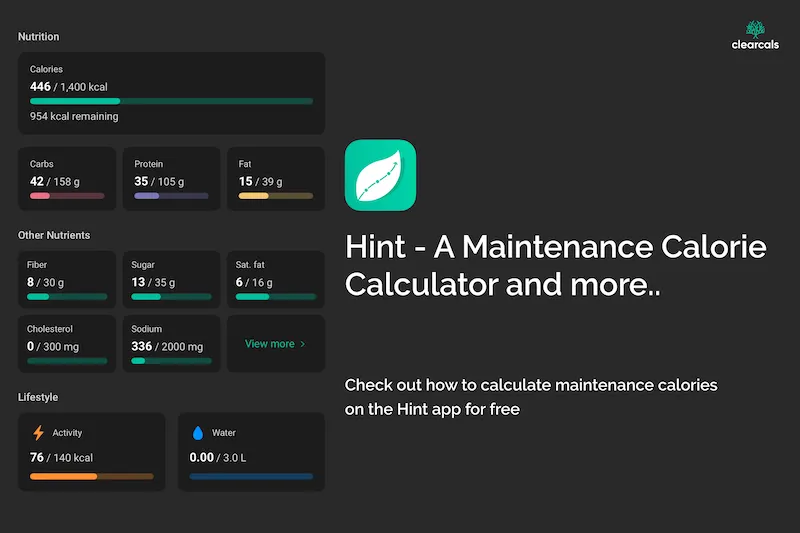
Rather than working through the formula by hand, the Hint app calculates your maintenance calories automatically as part of onboarding — you enter your age, height, current weight, and activity level, and Hint computes your number and shows it right on your home screen.
For example, a user who is 82 kg with a target weight of 70 kg sees a calculated maintenance of roughly 2,152 kcal/day during onboarding. From there, Hint offers three deficit paces — Easy, Moderate, and Fast — each subtracting a different amount from that maintenance number to set the daily calorie goal (see our Calorie Deficit Diet guide for exactly how those paces work).
If your goals change later — say you decide to target a different weight, or your activity level shifts — updating your profile on the Goals screen automatically recalculates your maintenance calories and adjusts your daily target to match, so you're never working off a stale number. As a safety guardrail, Hint won't suggest you set a deficit deeper than 25% below your calculated maintenance, since larger cuts are harder to sustain and more likely to cause muscle loss or nutrient shortfalls.
If your weight has changed by more than 4-6 kg since you last checked, it's worth revisiting your number — maintenance calories drop as body weight drops (and rise as it rises), so the same intake that once held you steady can quietly become a surplus or deficit over time.
Common Mistakes with Maintenance Calories
- Guessing your activity level too high. Most people who don't track steps or workouts overestimate — "moderately active" is a specific, fairly demanding category, not a default.
- Not recalculating after a weight change. Your maintenance number isn't fixed for life; it moves with your body weight, so a 5-6 kg change is worth a fresh calculation.
- Confusing BMR with maintenance calories. BMR is the resting number; eating at your BMR instead of your TDEE means eating in a large, often unsustainable deficit without realizing it.
- Treating one day's fluctuation as the real trend. Day-to-day weight swings from water and food volume are normal — judge your actual maintenance level from a weekly average, not a single morning.
- Ignoring NEAT (non-exercise activity). A more sedentary week — less walking, more sitting — lowers your real TDEE even if your workouts stay the same.
FAQs
What does TDEE stand for? TDEE stands for Total Daily Energy Expenditure — the total number of calories your body burns in a day, including your BMR plus all activity, digestion, and movement.
What is TDEE in simple terms? It's the number of calories you burn — and therefore need to eat — to maintain your current body weight. It's the same thing as "maintenance calories."
Is a TDEE calculator accurate? It's a close estimate, typically within 10-15% of your true number, since it's based on population-average formulas (like Mifflin-St Jeor) rather than a direct measurement of your metabolism. It's an excellent starting point — the more precise approach is to use the calculator's number as a baseline, then adjust up or down based on your actual weight trend over 2-3 weeks.
What's the difference between BMR and TDEE? BMR is the calories you'd burn completely at rest. TDEE (maintenance calories) is BMR plus everything you do on top of that — walking, working, exercising. TDEE is always the larger number.
How do I calculate my maintenance calories manually? Calculate your BMR using the Mifflin-St Jeor formula, then multiply it by your activity multiplier (1.2 for sedentary up to 1.9 for extra active). See the step-by-step example above, or use the TDEE Calculator to skip the math.
Do maintenance calories change over time? Yes. They shift with changes in body weight, age, muscle mass, and activity level. It's worth recalculating every few months, or any time your weight changes by more than 4-6 kg.
Can I build muscle while eating at maintenance calories? Yes, especially if you're newer to strength training or carrying some extra body fat — this is called body recomposition. Progress is slower than with a dedicated calorie surplus and is better tracked with measurements or photos than the scale alone.
How many calories over maintenance do I need to gain weight? A surplus of 250-500 kcal/day above maintenance is a reasonable range for steady weight gain without excess fat gain. The rough rule of thumb is about 3,500 surplus calories per pound (0.45 kg) gained, though this varies by individual.
Does Hint calculate maintenance calories automatically? Yes. Enter your age, height, weight, and activity level during onboarding, and Hint calculates your maintenance calories and shows it on your home screen. Updating your target weight or profile later automatically recalculates the number.
Read Next
- Try the Free TDEE Calculator →
- Setting Realistic Calorie Goals for Weight Loss with Hint →
- Understanding Calories: How to Track and Manage Your Intake →
- How Hint's Free AI Insights Work →
- Hint Pro →
- Calorie Tracking Guide for Indians →
About the Author
Dr. Krishna Athmakuri is the Co-Founder and CEO of Clearcals, where he leads the development of data-driven health technology for India. With a Ph.D. in Chemical Engineering from Rensselaer Polytechnic Institute, New York, his expertise spans protein analytics, bioprocess engineering, and health data systems. At Clearcals, he applies that scientific rigour to build personalised fitness tools — including the Hint app — grounded in Indian nutritional science and clinical evidence.
Connect with Dr. Krishna on LinkedIn