Track your nutrition and health goals

Idli Calories: 1 Idli = 61 kcal | 2, 3, 4, 5, 6 Idli Table + Sambar, Rava & Ragi
Written by Asfia Fatima, Chief Dietitian at Clearcals
TL;DR
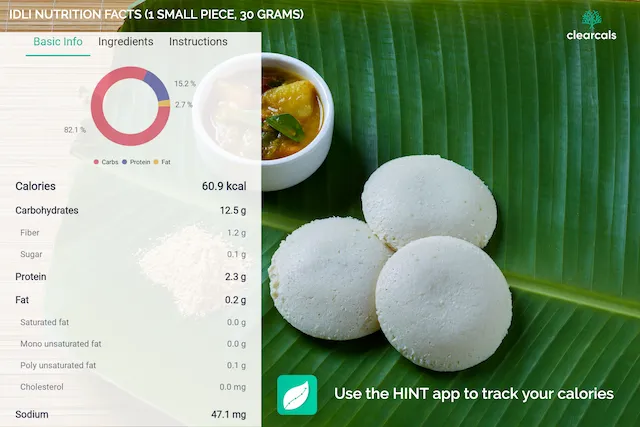
- 1 small idli (30g) has 61 kcal, 2.3g protein, and 12.4g carbohydrates
- 2 idli = 122 kcal | 3 idli = 183 kcal | 4 idli = 244 kcal | 6 idli = 366 kcal (all small, 30g each)
- 4 idli with sambar = ~315 kcal | 4 idli + sambar + chutney = ~365 kcal
- Idlis are steamed, oil-free, and one of the lowest-fat breakfast options in Indian cuisine
- Moong dal idli (44 kcal per piece) and oats idli (50 kcal) are the healthiest low-calorie varieties
- Track your exact serving size in the Hint app, which has all idli varieties and sizes in its database
How Many Calories Are in 1–10 Idlis? (Quick Reference)
1 idli calories: 61 kcal | Protein: 2.3g | Carbs: 12.4g | Fat: 0.2g (small, 30g)
| Number of Idlis | Small (30g each) | Medium (40g each) | Large (50g each) |
|---|---|---|---|
| 1 idli | 61 kcal | 81 kcal | 102 kcal |
| 2 idli | 122 kcal | 162 kcal | 203 kcal |
| 3 idli | 183 kcal | 244 kcal | 305 kcal |
| 4 idli | 244 kcal | 325 kcal | 406 kcal |
| 5 idli | 305 kcal | 406 kcal | 508 kcal |
| 6 idli | 366 kcal | 487 kcal | 609 kcal |
| 7 idli | 427 kcal | 568 kcal | 711 kcal |
| 8 idli | 488 kcal | 650 kcal | 813 kcal |
| 10 idli | 610 kcal | 813 kcal | 1,016 kcal |
Track your exact serving in the Hint app, which has all three idli sizes in its database.
How Many Calories in 1 Idli?
One idli calories: 61 kcal (small, 30g) | 81 kcal (medium, 40g) | 102 kcal (large, 50g)
One small idli (30g) has 61 kcal. One medium idli (40g) has 81 kcal, and one large idli (50g) has 102 kcal.
The calorie count depends entirely on the size. A typical South Indian breakfast idli weighs 30–40g. Restaurant or thatte idlis are often larger (60–70g) and contain 120–140 kcal each.
| 1 Idli Size | Weight | Calories |
|---|---|---|
| Small | 30g | 61 kcal |
| Medium | 40g | 81 kcal |
| Large | 50g | 102 kcal |
| Thatte/Restaurant | 60–70g | 120–140 kcal |
One idli is very low in calories on its own — 61 kcal is less than a single biscuit. The full breakfast calorie count comes from the sambar and chutney served alongside it.
2 Idli Calories
2 idli calories: 122 kcal (small) | 162 kcal (medium) | 2 idli + sambar: ~195 kcal | 2 idli + sambar + chutney: ~240 kcal
Two small idlis (30g each) have 122 kcal. Two medium idlis have 162 kcal. Two large idlis have 203 kcal.
A two-idli serving is a common light snack or half a breakfast. On its own, 2 small idlis is very low in calories — the sambar and chutney make the biggest difference to the total.
- 2 small idli + coconut chutney (2 tbsp): ~165 kcal
- 2 small idli + sambar (1 cup): ~195 kcal
- 2 small idli + sambar + coconut chutney: ~240 kcal
- 2 small idli + peanut chutney: ~195 kcal
3 Idli Calories
3 idli calories: 183 kcal (small) | 244 kcal (medium) | 3 idli + sambar: ~255 kcal | 3 idli + sambar + chutney: ~300 kcal
Three small idlis (30g each) have 183 kcal. Three medium idlis have 244 kcal. Three large idlis have 305 kcal.
A typical Indian breakfast is 3–4 idlis with sambar and chutney. Three small idlis alone is only 183 kcal — an excellent light, low-calorie breakfast for weight loss or calorie-controlled diets.
- 3 small idli + sambar: ~255 kcal
- 3 small idli + coconut chutney: ~225 kcal
- 3 small idli + sambar + coconut chutney: ~300 kcal
- 3 small idli + peanut chutney: ~260 kcal
4 Idli Calories
4 idli calories: 244 kcal (small) | 325 kcal (medium) | 4 idli + sambar: ~315 kcal | 4 idli + sambar + chutney: ~365 kcal
Four small idlis (30g each) have 244 kcal. Four medium idlis have 325 kcal. Four large idlis have 406 kcal.
Four idlis are the most common full breakfast serving in South India. Paired with sambar and coconut chutney, a 4-idli breakfast is nutritionally balanced and calorie-controlled.
| 4 Idli Meal Combination | Approx. Calories |
|---|---|
| 4 small idli only | 244 kcal |
| 4 medium idli only | 325 kcal |
| 4 small idli + coconut chutney (2 tbsp) | ~290 kcal |
| 4 small idli + sambar (1 cup) | ~315 kcal |
| 4 small idli + sambar + coconut chutney | ~365 kcal |
| 4 small idli + peanut chutney | ~330 kcal |
| 4 small idli + sambar + peanut chutney | ~400 kcal |
5 Idli Calories
5 idli calories: 305 kcal (small) | 406 kcal (medium) | 5 idli + sambar: ~375 kcal | 5 idli + peanut chutney: ~385 kcal
Five small idlis (30g each) have 305 kcal. Five medium idlis have 406 kcal. Five large idlis have 508 kcal.
Five idlis is a larger meal and starts to add up. With sambar and chutney, a 5-idli meal can reach 450–500 kcal. For individuals on a high-calorie or weight-gain plan, 5 medium idlis with full accompaniments can be a very satisfying breakfast.
- 5 small idli + sambar: ~375 kcal
- 5 small idli + coconut chutney: ~350 kcal
- 5 small idli + peanut chutney: ~385 kcal
- 5 small idli + sambar + coconut chutney: ~420 kcal
6 Idli Calories
6 idli calories: 366 kcal (small) | 487 kcal (medium) | 6 idli + sambar: ~435 kcal | 6 idli + sambar + chutney: ~480 kcal
Six small idlis (30g each) have 366 kcal. Six medium idlis have 487 kcal. Six large idlis have 609 kcal.
A 6-idli serving is typically for active individuals or those with higher calorie needs. With sambar and two chutneys, 6 medium idlis can reach 600–650 kcal — a complete, macro-balanced breakfast for gym-goers.
7 Idli Calories
7 idli calories: 427 kcal (small) | 568 kcal (medium) | 7 idli + sambar: ~495 kcal
Seven small idlis (30g each) have 427 kcal. Seven medium idlis have 568 kcal. Seven large idlis have 711 kcal.
A 7-idli meal is a sizeable breakfast, typically paired with sambar for added protein and satiety. At 427–568 kcal, it fits a moderate-to-active daily calorie plan without exceeding the breakfast calorie budget for most adults.
- 7 small idli + sambar: ~495 kcal
- 7 small idli + sambar + coconut chutney: ~540 kcal
- 7 medium idli + sambar: ~635 kcal
8 Idli Calories
8 idli calories: 488 kcal (small) | 650 kcal (medium) | 8 idli + sambar: ~555 kcal
Eight small idlis (30g each) have 488 kcal. Eight medium idlis have 650 kcal. Eight large idlis have 813 kcal.
An 8-idli serving is a high-volume, high-carbohydrate meal suited for athletes, very active individuals, or those in a muscle-building phase. Even at 8 medium idlis with sambar (~715 kcal), the meal is extremely low in fat — a significant advantage over most other high-calorie breakfast options.
10 Idli Calories
10 idli calories: 610 kcal (small) | 813 kcal (medium) | 10 idli + sambar: ~675 kcal
Ten small idlis (30g each) have 610 kcal. Ten medium idlis have 813 kcal. Ten large idlis have 1,016 kcal.
Ten idlis is a very large serving. This is an uncommon everyday quantity but is sometimes seen in active athletes or individuals with very high calorie targets. Even at this quantity, the fat content remains remarkably low (~6g for 10 small idlis), making it one of the few high-calorie breakfast options that is simultaneously very low in fat.
Idli Calories per 100g
Idli calories per 100g: 203 kcal | Protein: 7.7g | Carbs: 41g | Fat: 0.6g | Fiber: ~1g
Per 100g, plain rice idlis have 203 kcal, 7.7g protein, 41g carbohydrates, and 0.6g fat.
This makes idlis one of the lowest-calorie foods per 100g in Indian cuisine. For comparison, rice has 130 kcal per 100g (cooked), and chapati has approximately 300 kcal per 100g.
| Idli Variety | Calories per 100g | Protein per 100g |
|---|---|---|
| Moong Dal Idli | 147 kcal | 14.7g |
| Foxtail Millet Idli | 150 kcal | — |
| Oats & Dalia Idli | 167 kcal | 10g |
| Ragi Idli | 173 kcal | — |
| Rava / Sooji Idli | 193 kcal | — |
| Plain Rice Idli | 203 kcal | 7.7g |
| Rava Oats Idli | 243 kcal | — |
Idli Sambar Calories
Idli sambar calories: 2 idli + sambar = ~195 kcal | 4 idli + sambar = ~315 kcal | 4 idli + sambar + chutney = ~365 kcal
A standard serving of idli sambar — 2 idlis with 1 cup sambar (150ml) — has approximately 190–200 kcal.
Sambar adds roughly 65–70 kcal per cup (150ml), making it a calorie-efficient side dish that also contributes protein, fiber, and micronutrients. A full plate of idli sambar (typically 4 idli + 1 cup sambar) comes to approximately 315 kcal — making it one of the most nutritious low-calorie meals in Indian cuisine.
| Idli Sambar Combination | Approx. Calories |
|---|---|
| 1 idli + sambar | ~130 kcal |
| 2 idli + sambar | ~195 kcal |
| 3 idli + sambar | ~255 kcal |
| 4 idli + sambar | ~315 kcal |
| 5 idli + sambar | ~375 kcal |
| 6 idli + sambar | ~435 kcal |
| 2 idli + sambar + coconut chutney | ~240 kcal |
| 3 idli + sambar + coconut chutney | ~300 kcal |
| 4 idli + sambar + coconut chutney | ~365 kcal |
| 4 idli + sambar + peanut chutney | ~400 kcal |
| 1 idli + sambar + coconut chutney | ~175 kcal |
| 2 idli + sambar + peanut chutney | ~270 kcal |
These values use small idlis (30g each) with sambar at approximately 65–70 kcal per cup and coconut chutney at 45 kcal per 2-tbsp serving.
Idli with Chutney Calories
| Idli + Chutney Combination | Approx. Calories |
|---|---|
| 2 idli + coconut chutney | ~165 kcal |
| 2 idli + peanut chutney | ~195 kcal |
| 3 idli + peanut chutney | ~260 kcal |
| 4 idli + coconut chutney | ~285 kcal |
| 4 idli + peanut chutney | ~325 kcal |
| 5 idli + coconut chutney | ~350 kcal |
| 5 idli + peanut chutney | ~385 kcal |
Peanut chutney adds approximately 80 kcal per 2-tbsp serving. Coconut chutney adds approximately 45 kcal per 2-tbsp serving. If you are tracking calories carefully, peanut chutney is the highest-calorie accompaniment — but also the highest in protein (~4g per 2 tbsp).
Idli Protein
Protein in 1 idli: 2.3g (small, 30g) | 2 idli: 4.6g | 4 idli: 9.2g | 4 idli + sambar: ~15g total protein Idli protein per 100g: 7.7g (plain rice) | Oats idli: 10g | Moong dal idli: 14.7g
How Much Protein in 1 Idli?
One small idli (30g) has 2.3g of protein. Per 100g, plain rice idlis have 7.7g of protein.
| Idli Servings | Protein (small, 30g each) | Protein (medium, 40g each) |
|---|---|---|
| 1 idli | 2.3g | 3.1g |
| 2 idli | 4.6g | 6.2g |
| 3 idli | 6.9g | 9.2g |
| 4 idli | 9.2g | 12.3g |
| 5 idli | 11.6g | 15.4g |
| 6 idli | 13.9g | 18.5g |
Does Idli Have Protein?
Yes — but only in moderate amounts. Plain rice idli is primarily a carbohydrate food (82% of calories from carbs) with only modest protein per piece. One small idli provides 2.3g of protein — comparable to about one-third of an egg.
The protein content improves significantly with accompaniments and variety choices:
- 4 idli with sambar (protein ~6g from sambar) = approximately 15g protein total — this is a meaningful contribution to daily protein needs
- Moong dal idli has 14.7g protein per 100g (vs 7.7g for plain rice idli) — nearly double the protein
- Oats idli has 10g protein per 100g
- Peanut chutney adds ~4g protein per 2-tbsp serving For those targeting higher protein intake, choosing moong dal or oats idli, pairing with sambar, and adding peanut chutney significantly increases the protein quality of an idli breakfast.
Idli Protein by Variety
| Idli Variety | Protein per 100g | Protein per 30g piece |
|---|---|---|
| Moong Dal Idli | 14.7g | 4.4g |
| Oats & Dalia Idli | 10g | 3.0g |
| Plain Rice Idli | 7.7g | 2.3g |
| Rava / Sooji Idli | ~7.5g | 2.3g |
| Ragi Idli | ~6.5g | 2.0g |
The Hint app tracks all 31 essential nutrients, including protein, so you can see exactly how your idli breakfast measures up against your daily protein target.
Idli Carbs
One small idli (30g) has approximately 12.4g of carbohydrates. Per 100g, idlis have about 41g of carbohydrates — making it a high-carb food by percentage but low in absolute terms per piece.
| Idli Servings | Carbs (small, 30g each) |
|---|---|
| 1 idli | 12.4g |
| 2 idli | 24.8g |
| 3 idli | 37.2g |
| 4 idli | 49.6g |
For individuals managing diabetes or PCOS, this high carbohydrate content is worth monitoring. Pairing idlis with sambar (fiber and protein from lentils) and limiting portion size to 2–3 idlis helps slow glucose absorption and manage post-meal blood sugar response. Ragi idli and moong dal idli are significantly lower on the glycemic index than plain rice idli.
Idli Nutrition Facts per 100g
| Nutrient | Per 100g (Plain Rice Idli) | % Indian RDA (2,000 kcal diet) |
|---|---|---|
| Calories | 203 kcal | 10% |
| Protein | 7.7g | 14% |
| Carbohydrates | 41g | 14% |
| Fat | 0.6g | 1% |
| Fiber | ~1g | 4% |
| Iron | ~0.8mg | 5% |
| Phosphorus | ~60mg | 10% |
| Selenium | ~20mcg | 50% |
| Sodium | Low (~180mg) | 9% |
Idli is 82% carbohydrates, 15% protein, and 3% fat by calorie contribution. It is low in fat and sodium, and notably high in selenium — a mineral important for thyroid function and antioxidant defence. The primary nutritional limitation of plain rice idli is its low fiber (~1g per 100g) and moderate protein, which is why accompaniments like sambar and moong dal variety swaps significantly improve its nutritional profile.

Rava Idli Calories (Sooji / Suji Idli)
Rava idli calories (1 small, 30g): 58 kcal | 5 rava idli: 290 kcal (small) | Per 100g: 193 kcal
One small rava idli (30g) has 58 kcal. One medium rava idli (40g) has 78 kcal. Per 100g, rava idli has 193 kcal.
Rava idli is very slightly lower in calories than plain rice idli (58 vs 61 kcal per 30g piece) and is a good source of dietary fiber, copper, selenium, thiamin, and manganese. It is slightly denser than rice idli.
| Rava Idli Servings | Small (30g) | Medium (40g) | Large (50g) |
|---|---|---|---|
| 1 rava idli | 58 kcal | 78 kcal | 97 kcal |
| 2 rava idli | 116 kcal | 155 kcal | 194 kcal |
| 3 rava idli | 175 kcal | 233 kcal | 291 kcal |
| 4 rava idli | 233 kcal | 311 kcal | 388 kcal |
| 5 rava idli | 290 kcal | 388 kcal | 485 kcal |
Ragi Idli Calories
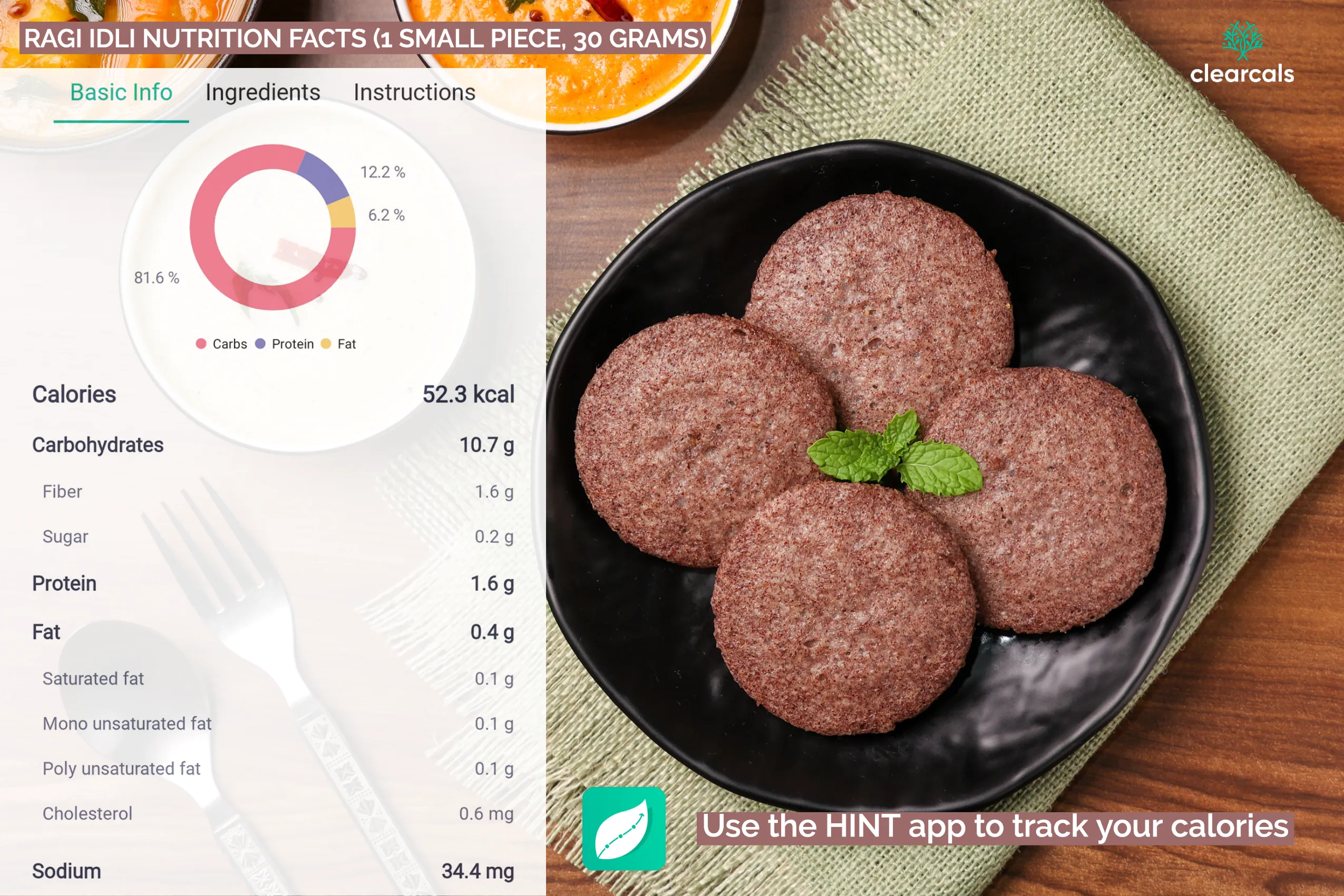
Ragi idli calories (1 small, 30g): 52 kcal | 4 ragi idli: 209 kcal (small) | Per 100g: 173 kcal
One small ragi idli (30g) has 52 kcal. One medium ragi idli (40g) has 70 kcal. Per 100g, ragi idli has 173 kcal.
Ragi idli is one of the lowest-calorie idli varieties and is richer in calcium than plain rice idli. Ragi idlis help lower blood cholesterol and support blood sugar control. It is a particularly good choice for diabetics, those with high cholesterol, or anyone looking to add more calcium to their diet.
| Ragi Idli Servings | Small (30g) | Medium (40g) | Large (50g) |
|---|---|---|---|
| 1 ragi idli | 52 kcal | 70 kcal | 87 kcal |
| 2 ragi idli | 105 kcal | 140 kcal | 174 kcal |
| 3 ragi idli | 157 kcal | 209 kcal | 262 kcal |
| 4 ragi idli | 209 kcal | 279 kcal | 349 kcal |

Oats Idli Calories
Oats idli calories (1 small, 30g): 50 kcal | Per 100g: 167 kcal, 10g protein — highest protein among common varieties
One small oats idli (30g) has 50 kcal. Per 100g: 167 kcal, 10g protein.
Oats and dalia idlis are the highest in fiber and protein among the common idli varieties and one of the best choices for weight loss and diabetes management. At 50 kcal per small piece with 3g protein, it is significantly more nutritious than plain rice idli for those tracking protein.
| Oats Idli Servings | Small (30g) | Medium (40g) | Large (50g) |
|---|---|---|---|
| 1 oats idli | 50 kcal | 66 kcal | 83 kcal |
| 2 oats idli | 100 kcal | 133 kcal | 166 kcal |
| 3 oats idli | 150 kcal | 199 kcal | 249 kcal |
| 4 oats idli | 200 kcal | 266 kcal | 332 kcal |

Moong Dal Idli Calories
Moong dal idli calories (1 small, 30g): 44 kcal — lowest calorie count of all common idli varieties | Protein: 4.4g per piece
One small moong dal idli (30g) has 44 kcal — the lowest calorie count of all common idli varieties. It is also the highest in protein: 14.7g per 100g, or approximately 4.4g per small piece.
| Moong Dal Idli Servings | Small (30g) | Medium (40g) |
|---|---|---|
| 1 moong dal idli | 44 kcal | 59 kcal |
| 2 moong dal idli | 89 kcal | 118 kcal |
| 3 moong dal idli | 133 kcal | 177 kcal |
| 4 moong dal idli | 177 kcal | 236 kcal |
Moong dal idlis are the healthiest variety for those managing blood sugar, cholesterol, or PCOS, and the best idli choice for high-protein diet plans.
All Idli Varieties: Calorie Comparison
| Idli Variety | Calories per 30g (1 small piece) | Calories per 100g |
|---|---|---|
| Green Moong Dal Idli | 44 | 147 |
| Foxtail Millet Idli | 45 | 150 |
| Bajra / Pearl Millet Idli | 45 | 150 |
| Kodo Millet Idli | 46 | 153 |
| Oats and Dalia Idli | 50 | 167 |
| Ragi Idli | 52 | 173 |
| Rava / Sooji Idli | 58 | 193 |
| Plain Rice Idli | 61 | 203 |
| Jowar Idli | 63 | 210 |
| Poha Idli | 65 | 217 |
| Vermicelli Idli | 67 | 223 |
| Red Rice Idli | 69 | 230 |
Download the Hint app for nutrition facts on all these varieties.
Is Idli Good for Weight Loss?
Yes — idlis are well-suited for weight loss. They are steamed (not fried), low in fat, and have only 61 kcal per small piece.
The key consideration is quantity. Eating 2–3 small idlis with sambar and chutney (190–250 kcal total) is an excellent, filling, low-calorie breakfast. Eating 6–8 medium idlis with full accompaniments can push breakfast to 650–800 kcal.
For weight loss, pair idlis with sambar (high in protein and fiber) rather than coconut chutney alone, choose moong dal or oats idlis when possible, and limit the total serving to 3–4 idlis per meal. The Hint app can track your exact idli serving size and help you see whether your breakfast fits your daily calorie target.
Is Idli Good for Diabetes?
Idlis have a high glycemic index (GI of approximately 85), which can cause blood sugar spikes when eaten in large quantities on an empty stomach.
Ragi idli and moong dal idli are significantly better options for diabetics than plain rice idli — both have a substantially lower GI and higher fiber content. Pairing any idli variety with sambar (lentil-based, high-fiber) helps slow glucose absorption and reduce post-meal blood sugar spikes.
Is Idli Healthy?
Yes, when eaten in moderation. Idli is:
- Low in fat (only 3% of calories)
- Low in sodium
- Easy to digest (fermented)
- A good source of selenium, phosphorus, and B vitamins
- Gut-friendly due to the fermentation process, which increases bioavailability of nutrients The primary limitation is that plain rice idlis are low in fiber and protein. Opting for moong dal, oats, or ragi idlis significantly improves both these parameters and makes idli a more complete nutritional choice.
Is Idli Better than Chapati?
For weight loss: Both are similar in calories, but idlis are lower in fat. Chapati (1 medium, 30g) has approximately 80 kcal and 0.4g fat — very similar to a medium idli (81 kcal, 0.2g fat).
For blood sugar control: Chapati is better — it is made from whole wheat with higher fiber and a lower glycemic index (~55) compared to plain rice idli (~85).
For digestibility and post-illness recovery: Idli is better — the fermentation makes it easier on the gut and increases the bioavailability of B vitamins and minerals.
Is Idli Good for Weight Gain?
Idlis alone are too low in calories to drive weight gain. To use idlis as part of a weight-gain diet, eat 6–8 medium or large idlis with full accompaniments (sambar, both chutneys, and ghee if desired), which can bring a single breakfast to 700–900 kcal. Adding a glass of milk or a protein shake alongside further increases the calorie and protein contribution of the meal.
FAQs
Can I eat idlis every day? Yes. Idlis are one of the safest daily breakfast options available in Indian cuisine. Rotate varieties (rice, rava, ragi, moong dal) to cover a broader nutritional range and avoid monotony. The fermentation process means daily idli consumption supports gut health over the long term.
How many idlis should I eat for weight loss? 2–4 small idlis with sambar is an ideal weight-loss breakfast (190–315 kcal). Avoid eating more than 4 medium idlis in a single sitting if you are calorie-tracking for weight loss, as the addition of sambar and chutney can bring the total close to 400–450 kcal quickly.
Does idli have protein? Yes — but in moderate amounts. One small idli (30g) has 2.3g of protein. Four idlis provide 9.2g, and 4 idlis with sambar provide approximately 15g of total protein. Moong dal idli is the highest-protein variety at 14.7g per 100g (approximately 4.4g per small piece). For a higher-protein idli breakfast, choose moong dal or oats idli and pair with sambar and peanut chutney.
What are the disadvantages of idlis? Plain rice idlis are low in fiber (~1g per 100g) and protein (7.7g per 100g). They have a high glycemic index (~85) and can spike blood sugar if eaten in large quantities. They are also bland without accompaniments, and sambar and chutney significantly increase the total calorie and sodium count.
Is idli high in carbs? Yes. Idlis get 82% of their calories from carbohydrates. Per 100g, it has approximately 41g of carbs. However, at 61 kcal per small piece, the absolute carbohydrate load per idli is modest — 12.4g per small piece, equivalent to about one-quarter slice of bread.
How much fiber is in idli? Plain rice idli has approximately 1g of fiber per 100g — making it a low-fiber food. Oats idli and ragi idli are significantly higher in fiber and are better choices for those needing more dietary fiber.
What is the fat content of idli? One small idli (30g) has only 0.2g of fat. Per 100g, plain rice idli has 0.6g of fat — making it one of the lowest-fat foods in Indian cuisine. Idli is steamed rather than fried, which is why its fat content is negligible.
Final Thoughts
Idli is one of India's best breakfast foods from a calorie and health perspective — steamed, low-fat, gut-friendly, and genuinely versatile. One small idli has just 61 kcal, and even a full 4-idli breakfast with sambar and chutney stays under 365 kcal.
For a more accurate picture of your idli intake, use the Hint app to track each component — idli size, sambar portion, and chutney type — and see exactly how your idli breakfast fits your daily calorie and protein targets.
🎁 Free Hint with Every Watch Purchase
Garmin watches: Purchase any Garmin watch from the Clearcals Store and receive 1 month of Hint Premium (worth ₹1,999) free. With Hint version 2.0, if your Garmin watch syncs to Garmin Connect and Garmin Connect is connected to Apple Health, your workouts flow automatically into Hint — no manual logging needed.
Apple Watch: Purchase any Apple Watch from the Clearcals Store and receive a free Hint Pro subscription — including access to all Pro features for 1 month. With Hint version 2.0, any workout recorded on your Apple Watch syncs automatically into Hint — no manual logging needed.
Scientific References
- Jenkins DJ, Wolever TM, Taylor RH, et al. Glycemic index of foods: a physiological basis for carbohydrate exchange. Am J Clin Nutr. 1981;34(3):362–366. PMID: 6259925
- Marco ML, Heeney D, Binda S, et al. Health benefits of fermented foods: microbiota and beyond. Curr Opin Biotechnol. 2017;44:94–102. PMID: 28216260
- Nkhata SG, Ayua E, Kamau EH, Shingiro JB. Fermentation and germination improve nutritional value of cereals and legumes through activation of endogenous enzymes. Food Sci Nutr. 2018;6(8):2446–2458. PMID: 30510749
- Devi PB, Vijayabharathi R, Sathyabama S, Malleshi NG, Priyadarisini VB. Health benefits of finger millet (Eleusine coracana L.) polyphenols and dietary fiber: a review. J Food Sci Technol. 2014;51(6):1021–1040. PMID: 24876633
- Mudryj AN, Yu N, Aukema HM. Nutritional and health benefits of pulses. Appl Physiol Nutr Metab. 2014;39(11):1197–1204. PMID: 25061763
- Rayman MP. The importance of selenium to human health. Lancet. 2000;356(9225):233–241. PMID: 10963212
- Rolls BJ. The relationship between dietary energy density and energy intake. Physiol Behav. 2009;97(5):609–615. PMID: 19303887
- Mohan V, Radhika G, Vijayalakshmi P, Sudha V. Can the diabetes/cardiovascular disease epidemic in India be explained, at least in part, by excess refined grain (rice) intake? Indian J Med Res. 2010;131:369–372. PMID: 20418546
About the Author
Asfia Fatima is the Chief Dietitian at Clearcals, with a Master's Degree in Dietetics and Clinical Nutrition and over a decade of experience in clinical nutrition and lifestyle management. She specialises in therapeutic nutrition for diabetes, PCOS, thyroid disorders, and weight management, and leads the nutrition content and diet planning programs at Clearcals.
Connect with Asfia on LinkedIn
Related Reading
- Calorie Tracking Guide for Indians
- Indian Food Calorie Calculator
- Jumping Jacks Calories Burned: How Effective Are They?
- Maggi Calories, Nutrition Facts & Health Benefits
- Makhana Calories, Nutrition, and Health Benefits