Track your nutrition and health goals

Chia Seeds for Weight Gain: Do They Help and How Much to Eat?
By Hafsaa Farooq, Consultant Dietitian, Clearcals | Updated: May 2026
Yes — but with an important caveat. Chia seeds are frequently marketed as a weight-loss food, which creates confusion about whether they are appropriate for people trying to gain weight.
The reality is that chia seeds are calorie-dense, nutrient-rich, and compatible with both goals depending on how they are used and in what dietary context.
Nutritional profile of chia seeds (per 30g serving, approximately 2 tablespoons):
- Calories: 138 kcal
- Fat: 9g (of which 5g is ALA omega-3)
- Carbohydrates: 12g (of which 10g is fibre)
- Protein: 5g
- Calcium: 18% of the daily recommended intake
- Magnesium: 23% of the daily recommended intake
- Phosphorus: 27% of the daily recommended intake
At 138 kcal per 30g, chia seeds are significantly more calorie-dense than most fruits and vegetables, making them a useful calorie-adding ingredient when incorporated into smoothies, curd, oatmeal, and other dishes.
Why Chia Seeds Are Often Called a Weight Loss Food
Chia seeds are promoted for weight loss primarily because of their extraordinary water-absorption capacity — they can absorb 10–12 times their weight in water, forming a gel. This gel expands in the stomach, creating satiety (fullness) and slowing gastric emptying. When eaten plain or in large amounts, this full-feeling effect can reduce overall food intake, which supports weight loss.
For weight gain, this same property is manageable with the right preparation strategy: blend chia seeds into smoothies rather than eating them whole, or soak them in milk rather than water. When soaked in whole milk and added to a calorie-dense shake, the satiety effect is far less pronounced and the calorie contribution is additive.
How Chia Seeds Support Weight Gain
Calorie density without food volume: 30g of chia seeds adds 138 calories with very little bulk when blended — unlike adding 138 calories of rice or bread, which adds significant volume. This makes chia seeds one of the most efficient calorie-per-stomach-space options for people who struggle to eat large volumes.
Omega-3 fatty acids: Chia seeds are one of the richest plant sources of ALA (alpha-linolenic acid), a precursor to EPA and DHA. ALA has anti-inflammatory properties that support muscle recovery — relevant for people combining weight gain with resistance training. For vegetarians who do not eat fish, chia seeds and walnuts are the most practical omega-3 sources.
Complete micronutrient support: Calcium (supporting bone density, which improves with weight training), magnesium (supporting sleep quality and muscle function), and phosphorus (supporting energy metabolism). Underweight individuals are at risk of these deficiencies; chia seeds address multiple gaps simultaneously.
Blood sugar stability: The soluble fibre in chia seeds slows carbohydrate digestion, preventing blood sugar spikes and crashes that cause energy dips and appetite suppression. Stable blood sugar supports consistent appetite and energy for exercise throughout the day.
How Many Chia Seeds to Eat for Weight Gain?
A practical daily amount for weight gain is 20–30g (approximately 1.5–2 tablespoons) per day. This contributes 90–138 calories while providing meaningful omega-3, fibre, and micronutrient content. Eating more than 30–40g per day can cause digestive discomfort (bloating, loose stools) in some people and the incremental calorie benefit does not justify increasing beyond this.
Important: Always consume chia seeds soaked or blended — never eat dry chia seeds without adequate fluid. Dry chia seeds can expand in the oesophagus or digestive tract, causing blockage in rare cases.
Best Ways to Use Chia Seeds for Weight Gain
In a high-calorie smoothie (most effective for weight gain): Add 1–1.5 tbsp chia seeds to a banana peanut butter shake or mango lassi. Blend well — the seeds disappear into the smoothie, adding 70–100 calories without any detectable texture or taste change.
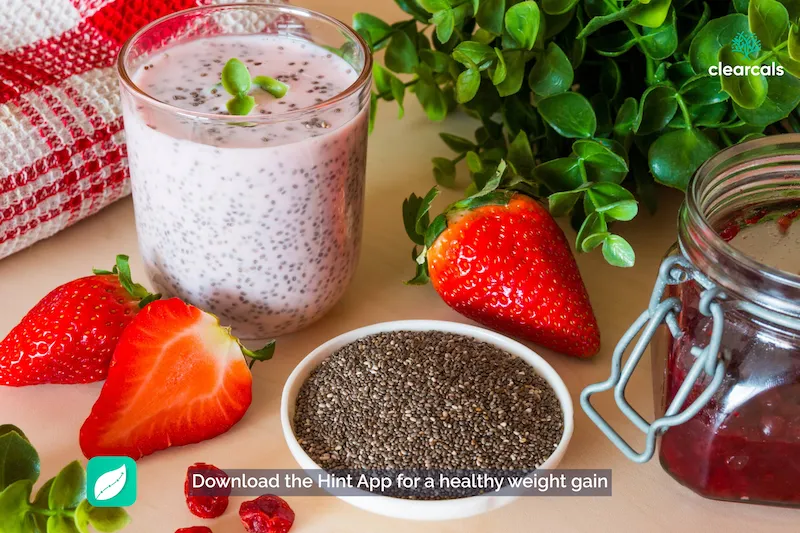
Chia pudding with whole milk: 3 tbsp chia seeds + 250ml whole milk + 1 tbsp honey + a handful of chopped mango or banana. Mix and refrigerate overnight. In the morning, the pudding will have set into a thick, creamy texture. Serves as a high-calorie breakfast or snack (~380–420 kcal). Top with nuts for extra calories.
In overnight oats: Add 1 tbsp chia seeds to your overnight oats along with whole milk, banana, and peanut butter. The chia seeds blend into the texture without noticeable change.
Sprinkled on curd: Add 1 tbsp chia seeds on top of full-fat curd with honey or fruit. A simple way to boost the calorie content of a daily curd serving by approximately 70 calories.
In roti or paratha dough: Mix 1–2 tsp ground chia seeds into whole wheat flour when making rotis or parathas. Largely undetectable in taste while adding omega-3 and calories to a staple food.
Does Eating Chia Seeds Cause Weight Loss or Weight Gain?
Chia seeds themselves are calorie-neutral — they contribute to whichever direction your overall diet is heading. In a person with a calorie surplus, they contribute to weight gain. In a person with a calorie deficit, they support satiety and weight loss. The fibre content means that on its own, chia seeds slightly suppress appetite — but this effect is relatively minor compared to the calorie contribution when used in milk-based preparations.
The bottom line: Chia seeds are a useful supporting ingredient for weight gain, not a primary strategy. Add them to smoothies, overnight oats, or curd to extract their calorie and micronutrient benefits without letting their satiety properties work against your goals.
Chia Seeds vs Other Seeds for Weight Gain
| Seed | Calories per 30g | Protein | Key Benefit |
|---|---|---|---|
| Chia seeds | 138 kcal | 5g | Omega-3, calcium, best for smoothies |
| Flaxseeds | 150 kcal | 5g | Highest ALA, best ground |
| Pumpkin seeds | 170 kcal | 9g | Highest protein among seeds |
| Sesame seeds | 173 kcal | 5g | Excellent calcium source |
| Sunflower seeds | 164 kcal | 6g | Vitamin E, easy snack |
All seeds are calorie-dense and appropriate for weight gain. Rotate between them for nutritional variety.
References
- Ayaz A, et al. Chia seed (Salvia hispanica L.) added yogurt reduces short-term food intake and increases satiety. Journal of Food Science and Technology. 2017;54(6):1736–1743.
- Vuksan V, et al. Supplementation of conventional therapy with the novel grain Salba (Salvia hispanica L.) improves major and emerging cardiovascular risk factors in type 2 diabetes. Diabetes Care. 2007;30(11):2804–2810.
- Hall KD, et al. Energy balance and its components: implications for body weight regulation. American Journal of Clinical Nutrition. 2012;95(4):989–994.
About the Author
Hafsaa Farooq is a Consultant Dietitian at Clearcals with a strong passion for nutrition, fitness, and evidence-based health practices.
She is deeply interested in clinical nutrition and enjoys helping individuals build healthier lifestyles through practical dietary guidance. Beyond her professional work, Hafsaa enjoys developing healthy recipes, writing evidence-based nutrition blogs, and staying active through sports. She is also expanding her expertise in the science of exercise and weight training to better support holistic health and fitness goals.
🔗 Connect with Hafsaa on LinkedIn
👉 Back to the pillar page: Healthy Weight Gain: Complete Indian Guide 👉 Related: Dry Fruits for Weight Gain | Weight Gain Smoothies and Shakes | Best Foods for Weight Gain