Track your nutrition and health goals

Garmin Instinct 3 AMOLED vs Solar: Full Comparison for India 2026
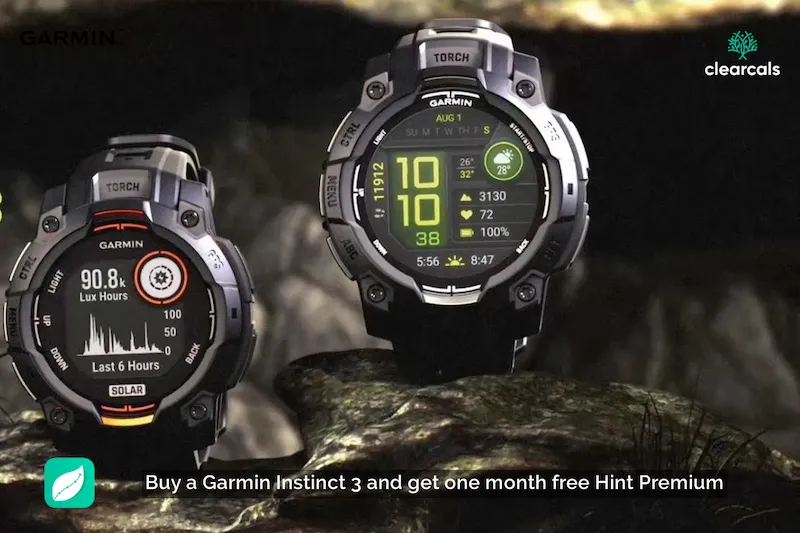
By Dr. Krishna Athmakuri, Co-Founder & CEO, Clearcals | Updated May 2026
The Garmin Instinct 3 is available in two variants that share the same rugged chassis, multi-band GPS, and full health tracking suite — but differ fundamentally in display technology and battery life.
The choice between AMOLED and Solar is not about one being "better" in every way; it is about which trade-off fits your lifestyle.
This guide breaks down every meaningful difference between the two so you can make the right decision.
Garmin Instinct 3 AMOLED vs Solar: Quick Comparison
| Feature | Instinct 3 Solar | Instinct 3 AMOLED |
|---|---|---|
| Display | Transflective MIP + Solar panel | AMOLED |
| Sizes | 45mm, 50mm | 45mm, 50mm |
| Price — 45mm (India) | ₹48,990 | ₹55,990 |
| Price — 50mm (India) | ₹55,990 | ₹61,990 |
| Battery (smartwatch) — 45mm | Up to 28 days (unlimited with sun) | Up to 18 days |
| Battery (smartwatch) — 50mm | Up to 40 days (unlimited with sun) | Up to 24 days |
| Battery (GPS mode) | Up to 30 hours + solar extension | Up to 30 hours |
| Solar charging | ✅ Yes | ❌ No |
| Multi-band GPS + SatIQ | ✅ Yes | ✅ Yes |
| Built-in flashlight | ✅ Yes | ✅ Yes |
| HRV Status, Body Battery, VO2 Max | ✅ Yes | ✅ Yes |
| Garmin Pay | ✅ Yes | ✅ Yes |
| MIL-STD-810 / 10 ATM | ✅ Yes | ✅ Yes |
1. Display Technology
This is the defining difference between the two models.
Instinct 3 Solar uses a transflective MIP (memory-in-pixel) display — an always-on screen designed for maximum outdoor readability. In direct sunlight, it is exceptionally clear, requiring no backlight to be visible. The solar panel layer sits beneath a portion of the display and charges the battery continuously when exposed to light. The trade-off: the MIP display has lower pixel density and less colour vibrancy than AMOLED, particularly indoors and at night.
Instinct 3 AMOLED uses Garmin's AMOLED display — the same technology found in flagship smartphones. Each pixel produces its own light, delivering vivid colours, high contrast, and excellent readability in low-light conditions and indoors. Watch faces, health dashboards, and navigation data look significantly sharper. The trade-off: AMOLED consumes more power, which reduces battery life.
Which display suits you: If your primary use is outdoor adventure — trekking, trail running, mountaineering — the Solar's transflective display is purpose-built for that environment and performs better in direct sunlight. If you spend significant time indoors, at the office, or in mixed settings where you want a modern, vibrant smartwatch display, the AMOLED is noticeably superior in those conditions.
2. Battery Life
Battery is the most significant performance difference between the two variants.
| Model | Size | Smartwatch Mode | GPS Mode |
|---|---|---|---|
| Instinct 3 Solar | 45mm | Up to 28 days (unlimited with sufficient sun) | Up to 30 hours |
| Instinct 3 Solar | 50mm | Up to 40 days (unlimited with sufficient sun) | Higher with a larger battery |
| Instinct 3 AMOLED | 45mm | Up to 18 days | Up to 30 hours |
| Instinct 3 AMOLED | 50mm | Up to 24 days | Higher with a larger battery |
The Solar model's battery advantage is substantial in smartwatch mode — 28 days vs 18 days for the 45mm. More importantly, with adequate sunlight exposure (typically 3 hours of direct outdoor light per day), the Solar can extend indefinitely without needing a charge. This makes it uniquely suited to multi-day expeditions and outdoor use where charging access is limited.
The AMOLED's 18-day battery is still excellent compared to most smartwatches — it significantly outperforms the Apple Watch and the Samsung Galaxy Watch. But for users who go weeks between charges or regularly head into the backcountry, the Solar's advantage is decisive.
In GPS mode, both watches offer comparable performance — approximately 30 hours for the 45mm. Solar's solar panels can extend the GPS battery in outdoor conditions.
3. Outdoor Usability
Both models carry MIL-STD-810 durability certification and 10 ATM water resistance. Both have a built-in LED flashlight with red light mode for emergency and night use. Both include multi-band GPS with SatIQ technology, ABC sensors (altimeter, barometer, compass), and TracBack routing. In terms of outdoor capability, these watches are peers.
The key difference in outdoor use is the Solar's battery endurance. For day hikes and weekend trips, both watches are equally capable. For multi-week expeditions, the Solar's battery advantage becomes a genuine operational necessity.
The Solar's MIP display also has an inherent advantage in bright sunlight — it is glare-resistant and requires no adjustment to remain readable, even at extreme angles or in harsh midday conditions.
4. Weight and Size
Both models are available in 45mm and 50mm. The 45mm size is generally better suited for Indian users, particularly those with smaller wrists, and delivers all the features of the larger model in a more compact form.
The Solar variant is marginally lighter than the AMOLED — the difference is minimal (approximately 1–2g) and unlikely to affect day-to-day comfort for most users.
5. GPS and Navigation
Both the AMOLED and Solar models feature the same multi-band GPS with SatIQ technology — Garmin's system that automatically selects the optimal satellite signal combination to balance accuracy and battery life. Both support TracBack navigation, altimeter/barometer/compass sensors, and Garmin Explore app integration.
GPS performance is identical between the two variants. If GPS accuracy is driving your decision, it is not a differentiating factor.
6. Health and Fitness Features
Both models are identical in health tracking capabilities:
- Continuous wrist-based heart rate monitoring
- HRV Status (rolling 5-week baseline)
- Body Battery (real-time energy monitoring)
- Pulse Ox (SpO2)
- Stress tracking
- Advanced sleep insights (light, deep, REM, sleep score)
- VO2 Max and Training Readiness
- Women's health and menstrual cycle tracking
- Incident detection and assistance
There is no difference in health sensors or tracking depth between the AMOLED and Solar variants. If health monitoring is your primary reason for buying either watch, your choice should be driven entirely by display and battery preferences.
7. Smart Features
Both models support smart notifications, Garmin Pay, music controls (not music storage), and Garmin Connect integration. The feature set is identical. The AMOLED's brighter, higher-resolution display makes interacting with notifications and dashboards more enjoyable in everyday settings.
8. Price
| Model | Size | Price (India) |
|---|---|---|
| Instinct 3 Solar | 45mm | ₹48,990 |
| Instinct 3 Solar | 50mm | ₹55,990 |
| Instinct 3 AMOLED | 45mm | ₹55,990 |
| Instinct 3 AMOLED | 50mm | ₹61,990 |
The AMOLED commands a ₹6,000 premium over the Solar in both sizes — reflecting the cost of the brighter, higher-resolution display. Both models are available at Clearcals.
Which Should You Buy?
Choose the Instinct 3 Solar if:
- Battery life is your top priority — you want weeks of charge-free use or the option of indefinite solar charging
- You spend significant time outdoors in sunlight — trekking, trail running, hiking, cycling — where the MIP display shines, and solar charging is most effective
- You go on multi-day or multi-week expeditions where charging access is limited or unavailable
- You want to save ₹6,000 and prioritise endurance over display quality
Choose the Instinct 3 AMOLED if:
- Display quality matters — you want a vivid, high-contrast screen for daily use, indoors, at the gym, and in low-light conditions
- You work in an office or mixed environment and want a rugged watch that also looks premium as an everyday smartwatch
- 18–24 days of battery is sufficient for your lifestyle (it is for most users)
- You're willing to pay ₹6,000 more for a significantly better visual experience
The most common choice in India: For users who mix gym workouts, city running, and occasional outdoor adventures, the AMOLED at ₹55,990 delivers a better everyday experience. For serious outdoor athletes, trail runners, and trekkers, the Solar's battery endurance at ₹48,990 is the decisive advantage.
Buy a Garmin Instinct 3 with Free Hint Premium at Clearcals
Every Garmin watch from Clearcals comes with a free Hint Premium subscription (worth ₹1,999) — registered dietitian consultations, personalised meal plans, and 300+ guided workout routines.
Buy Garmin Instinct 3 Solar — ₹48,990 Buy Garmin Instinct 3 AMOLED — ₹55,990
Garmin users: Buy a Garmin watch and get Hint Premium free for 1 month (worth ₹1,999) — including unlimited dietitian consultations.
Frequently Asked Questions
What is the difference between the Garmin Instinct 3 AMOLED and Solar? The Instinct 3 Solar has a transflective MIP display with solar charging, offering up to 28 days (45mm) or 40 days (50mm) of battery, potentially unlimited with sufficient sunlight. The Instinct 3 AMOLED has a vivid, high-contrast AMOLED screen with up to 18 days (45mm) or 24 days (50mm) of battery. GPS, health tracking, flashlight, and multi-band satellite navigation are identical on both models.
Which is better — Garmin Instinct 3 Solar or AMOLED? Neither is objectively better — they are designed for different use cases. The Solar is better for long outdoor expeditions and users who prioritise battery endurance. The AMOLED is better for daily wear, indoor use, and users who want a high-quality display. If you regularly go on multi-day treks, choose Solar. If you use your watch primarily at the gym, in the office, and on city runs, choose AMOLED.
Is the Garmin Instinct 3 AMOLED worth the extra ₹6,000 over Solar? Yes, if display quality matters to you. The AMOLED screen is significantly sharper, more vibrant, and more readable indoors and at night than the Solar's MIP display. If you spend most of your time in everyday settings — office, gym, city — the AMOLED's visual experience is noticeably better. If you primarily use your watch outdoors in sunlight and on expeditions, the Solar's battery endurance offers more practical value for the lower price.
Does Garmin Instinct 3 Solar have an AMOLED display? No. The Instinct 3 Solar uses a transflective MIP display with an integrated solar panel. This display is excellent in direct sunlight but does not offer the colour vibrancy or indoor readability of AMOLED. Only the Instinct 3 AMOLED variant has an AMOLED screen.
Does Garmin Instinct 3 AMOLED have solar charging? No. The Instinct 3 AMOLED does not have solar charging. Solar charging is exclusive to the Instinct 3 Solar variant. The AMOLED charges via USB-C cable and offers up to 18 days (45mm) or 24 days (50mm) per charge.
What is the battery life of Garmin Instinct 3 AMOLED vs Solar? Instinct 3 Solar (45mm): up to 28 days in smartwatch mode, potentially unlimited with sufficient sunlight. Instinct 3 AMOLED (45mm): up to 18 days in smartwatch mode. The 50mm versions offer more: Solar up to 40 days, AMOLED up to 24 days. Both deliver approximately 30 hours in standard GPS mode.
What is the price of the Garmin Instinct 3 AMOLED and Solar in India? At Clearcals, Instinct 3 Solar 45mm is ₹48,990, and the 50mm is ₹55,990. Instinct 3 AMOLED 45mm is ₹55,990, and the 50mm is ₹61,990.
About the Author
Dr. Krishna Athmakuri is the Co-Founder and CEO of Clearcals, where he leads the development of data-driven health technology through the Hint app.
With a Ph.D. in Chemical Engineering from Rensselaer Polytechnic Institute, New York, his expertise spans analytics, protein chemistry, and biotechnology.
Earlier in his career, he developed biotherapeutics for diabetes and metabolic diseases at companies like Aurobindo Pharma and Dr. Reddy's Laboratories.
At Clearcals, he now applies that scientific rigour to build personalised fitness tools — including Hint Pro Workouts, nutrition tracking, and real-time metabolic insights — helping users make smarter health decisions through technology.
Connect with Dr. Krishna on LinkedIn
Also Read
- The Best Garmin Watches in India: Ultimate Buyer's Guide 2026
- Garmin Instinct 3 vs Instinct E: Which Rugged Watch to Buy in India?
- Garmin Instinct 2 vs 3: What's Changed and What's Better?
- Garmin vs Samsung Watch: Which Should You Buy in India?
- Garmin Body Battery Explained: How It Works & What Each Score Means
- Garmin Watches for Trekking & Hiking: Top GPS Watches for Outdoor Enthusiasts
- Shop All Garmin Watches at Clearcals