Track your nutrition and health goals

50+ Indian Foods for Weight Loss: The Complete Good vs. Bad List
By Asfia Fatima, Chief Dietitian at Clearcals
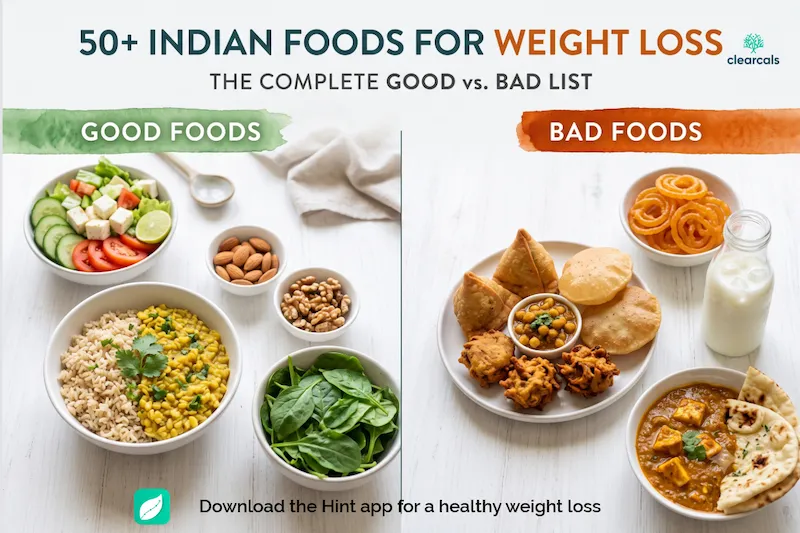
A huge share of weight-loss searches in India are some version of "is [food] good for weight loss?" — for dozens of everyday staples like rice, paneer, dosa, roti, and curd. Rather than writing one thin page per food, this is a single, properly detailed reference covering the most commonly asked foods, with real calorie numbers and an honest verdict for each.
If you're looking for a deep-dive on a specific food we've covered separately — like oats, sweet potato, or banana — follow the link in that section.
TL;DR
- No single Indian food is inherently "fattening" or "fat-burning" — portion size and preparation method decide the outcome
- Carbohydrate staples (rice, roti, dosa, idli) are fine for weight loss in measured portions; the oil, ghee, and accompaniments are usually the bigger calorie lever
- Dairy (milk, curd, cheese, paneer) supports protein intake — choose low-fat where possible and watch added sugar/cream
- Dried fruit and natural sweeteners (dates, honey) are better than refined sugar, but still calorie-dense — they are not "free" foods
- Track every one of these foods by exact preparation with the Hint app
Grains & Carbohydrate Staples
Is Rice Good for Weight Loss?
Plain cooked rice is ~130 kcal/100g (white) or ~123 kcal/100g (brown). Brown rice has more fibre and a lower glycaemic impact. Rice itself isn't fattening — the portion size and what's mixed into it (ghee rice, biryani, fried rice) usually drive the calorie problem.
Is Roti Good for Weight Loss?
A plain wheat roti (without ghee/oil) is roughly 70-80 kcal each. Whole wheat (atta) roti has more fibre than maida-based options. Two to three plain rotis fit comfortably into most meal plans.
Is Dosa Good for Weight Loss?
A plain dosa (no oil-soaked tawa) is around 90-120 kcal depending on size; with ghee/oil or stuffed (masala dosa with potato filling), it can reach 250-350 kcal. Choose plain or vegetable-stuffed dosas over ghee roast for a lighter option.
Is Idli Good for Weight Loss?
Steamed idli is one of the lighter South Indian staples at ~35-40 kcal per piece, since it's steamed rather than fried. Watch the accompanying sambar oil tempering and coconut chutney quantity, which can add up across a typical 3-4 idli meal.
Is Upma Good for Weight Loss?
A bowl of vegetable upma (semolina/rava) is roughly 150-200 kcal depending on oil and vegetable content — a reasonably light breakfast if made with modest oil.
Is Dalia (Broken Wheat) Good for Weight Loss?
Dalia porridge is similar in profile to oats — high fibre, moderate calorie (~340 kcal/100g dry, ~120-150 kcal per cooked bowl), and a good rice substitute for a lighter dinner.
Is Ragi Good for Weight Loss?
Ragi (finger millet) is naturally gluten-free, high in calcium and fibre, at around 328 kcal/100g dry — similar to other whole grains. Ragi mudde, dosa, or porridge are traditional, fibre-rich choices.
Is Millet Good for Weight Loss?
Millets (jowar, bajra, ragi, foxtail) generally offer more fibre and micronutrients than refined wheat or rice at a similar calorie density (~340-360 kcal/100g dry), and are increasingly recommended as a rotation grain in Indian weight-loss diets.
Is Brown Rice Good for Weight Loss?
Yes, modestly more so than white rice — more fibre (1.8g vs ~0.4g per 100g cooked) and a lower glycaemic index, supporting better satiety at a similar calorie count (123 vs ~130 kcal/100g cooked).
Is Bread Good for Weight Loss?
Depends heavily on the type. Whole wheat/multigrain bread (~70-80 kcal/slice) with real whole-grain content is reasonable in moderation. White bread offers less fibre for the same calories. Check the ingredient list — "brown bread" is sometimes just coloured white bread.
Is Potato Good for Weight Loss?
Boiled potato is ~87 kcal/100g — not inherently fattening. Fried preparations (fries, chips, vada) change the calorie profile dramatically. Boiled, baked, or lightly sautéed potato in a measured portion fits a weight-loss diet.
Dairy & Protein Foods
Is Paneer Good for Weight Loss?
Paneer is roughly 265 kcal/100g and a good source of protein (~18g/100g), supporting satiety and muscle maintenance during a deficit. Choose grilled, sautéed-in-minimal-oil, or curry-based paneer over deep-fried paneer pakora.
Is Milk Good for Weight Loss?
Toned/low-fat milk (58-70 kcal/100ml) provides protein and calcium without excess calories. Full-fat milk (80+ kcal/100ml) and sweetened/flavoured milk are the versions more likely to work against a calorie deficit.
Is Curd (Yoghurt) Good for Weight Loss?
Yes — plain curd, especially low-fat, is roughly 60-98 kcal/100g depending on fat content, with meaningful protein and probiotics that support gut health and satiety. Avoid sweetened curd or shrikhand-style preparations if weight loss is the goal.
Is Cheese Good for Weight Loss?
Cheese is calorie-dense (~350-400 kcal/100g for most Indian processed cheese) due to its fat content. A small, measured portion (a slice or a tablespoon, grated) fits into a diet; treating cheese as a generous topping does not.
Is Soya Chunks Good for Weight Loss?
Yes — soya chunks are very high in protein (52g/100g dry) and fibre at a moderate calorie count (345 kcal/100g dry, much less once rehydrated and cooked into a curry), making them an efficient vegetarian protein source for a weight-loss diet.
Fruits
Is Papaya Good for Weight Loss?
Papaya is low-calorie (~43 kcal/100g) and contains papain, an enzyme that supports digestion. A good low-calorie fruit choice for a weight-loss diet.
Is Pineapple Good for Weight Loss?
Pineapple is ~50 kcal/100g, with bromelain (a digestive enzyme) often cited for digestive support. Like all fruit, the calories are real — pineapple is not a "negative calorie" food, but it is a reasonably light fruit choice.
Is Dates Good for Weight Loss?
Dates are calorie-dense for their size (~280 kcal/100g, roughly 23 kcal per date) due to concentrated natural sugar. They're a better choice than refined sugar for a sweet craving, in small quantities (1-2 dates), but should not be treated as a "diet food" to eat freely.
General Fruit Guidance
Fresh, whole fruit in reasonable portions (1-2 servings per meal/snack) supports a weight-loss diet through fibre, water content, and micronutrients. Fruit juice, dried fruit, and fruit-based desserts concentrate the sugar and calories considerably compared to the whole fruit.
Drinks & Sweeteners
Is Coffee Good for Weight Loss?
Black coffee is nearly calorie-free and may modestly boost metabolism via caffeine — see our dedicated black coffee for weight loss guide. Adding sugar, cream, or condensed milk changes this significantly.
Is Honey Good for Weight Loss?
Honey (~64 kcal/tablespoon) is a natural sweetener, marginally more nutrient-dense than refined sugar, but it is not a low-calorie food. Using honey instead of sugar in small amounts is a reasonable swap — not a weight-loss food in its own right.
Is Dark Chocolate Good for Weight Loss?
A small portion (1-2 squares, ~70% cocoa or higher) at around 50-70 kcal can satisfy a sweet craving with less sugar than milk chocolate, and some research links dark chocolate's flavonoids to modest metabolic benefits. Portion control remains essential — a full bar is 500+ kcal.
How the Hint App Helps with Everyday Indian Foods
Rather than memorising calorie counts for dozens of staples, the Hint app gives you:
- An Indian food database covering rice, roti, dosa, paneer, curd, and the rest of this list with accurate, preparation-specific calories
- Recipe-level tracking for mixed dishes (biryani, masala dosa, paneer curry) rather than just raw ingredients
- Personalised diet plans via Hint Pro, built around the Indian foods you already eat
- Dietitian consultations via Hint Premium for a complete weight loss diet plan
Frequently Asked Questions
Which Indian foods should I completely avoid for weight loss?
No single food needs to be eliminated entirely for most people. Deep-fried snacks, sugary beverages, and large portions of ghee/oil-heavy dishes are the highest-impact items to moderate, rather than any one "banned" food.
Is rice or roti better for weight loss?
Calorie-for-calorie they're similar; roti has slightly more fibre per typical serving. The bigger factor is usually portion size and what accompanies each (ghee, curry richness) rather than rice vs. roti itself.
Are all these foods safe for diabetics too?
Most are reasonable in moderation, but glycaemic impact varies (millets and whole grains generally lower than refined white rice or maida). Check our diabetes diet guides or consult your dietitian for personalised advice.
How do I know my actual portion size for foods like rice or dosa?
A kitchen scale for a week or two is the most reliable way to learn your real portions — most people underestimate by 30-50% when eyeballing. The Hint app makes ongoing logging much faster once you know your typical portions.
Why isn't my specific food on this list?
This page covers the highest-search-volume Indian foods for weight loss. If you don't see a food you're looking for, check our dedicated single-food guides (oats, sweet potato, banana, peanut butter, and more) or use the Hint app's food database, which covers a much larger list.
References
- USDA FoodData Central — Indian staple food entries (rice, potato, paneer, milk, curd).
- Indian Council of Medical Research (ICMR) — National Institute of Nutrition, Nutritive Value of Indian Foods.
- Augustin LS, et al. Glycemic index, glycemic load and glycemic response: An International Scientific Consensus Summary. Nutr Metab Cardiovasc Dis. 2015;25(9):795-815. DOI: 10.1016/j.numecd.2015.05.005
Explore More
- Is Oats Good for Weight Loss?
- Is Sweet Potato Good for Weight Loss?
- Weight Loss Diet Plan — India
- South Indian Diet Plan for Weight Loss
About the Author
Asfia Fatima is the Chief Dietitian at Clearcals, with a Master's Degree in Dietetics and Clinical Nutrition and over a decade of experience in clinical nutrition and lifestyle management.
She specialises in evidence-based diet planning for weight loss, diabetes, and metabolic health. At Clearcals, she leads the nutrition strategy behind the Hint app, helping users achieve their goals with science-backed guidance.
🔗 Connect with Asfia on LinkedIn