Track your nutrition and health goals

Low-Calorie Drinks: Coffee Shop Orders, Alcohol & Everyday Swaps (With Calorie Counts)
Low-Calorie Drinks: Coffee Shop Orders, Alcohol & Everyday Swaps (With Calorie Counts)
Note: For functional weight-loss drinks like green tea, ACV, and detox water, see our separate best weight-loss drinks guide. This page covers the lower-calorie version of drinks you already enjoy — coffee shop orders, alcohol, and everyday beverages.
Why Drink Calories Are Easy to Miss
Liquid calories don't register the same way food does — a syrupy coffee-shop drink or a couple of cocktails can add 300-600 kcal to your day without touching your appetite at all, which makes them one of the easiest places to accidentally blow a calorie budget you're otherwise managing well.
Low-Calorie Coffee Shop Orders
Coffee shop drinks vary enormously in calories depending on size, milk type, and syrup — often 5-10x difference between the lightest and heaviest version of a similar drink:
- Black coffee or espresso — under 10 kcal, the lowest-calorie option by far
- Americano — under 15 kcal, essentially espresso with hot water
- Coffee with skimmed/low-fat milk, no sugar — 30-60 kcal depending on size
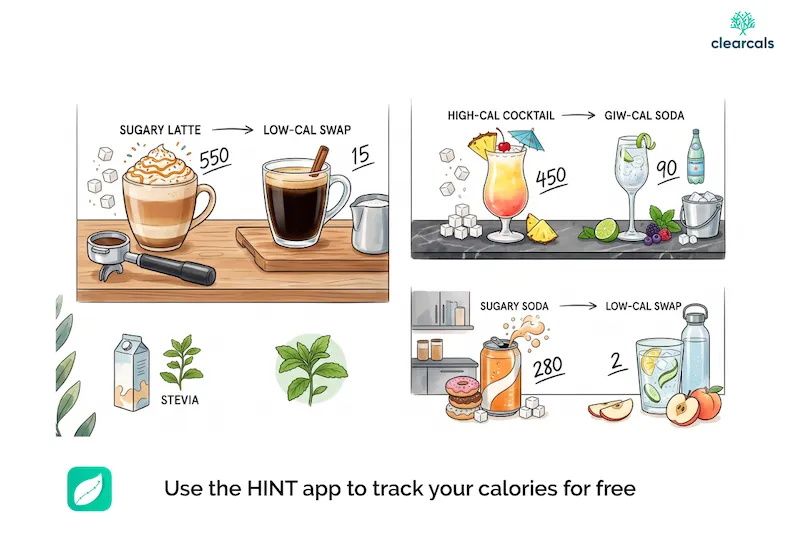
- Cappuccino or latte with skimmed milk, no syrup — 80-120 kcal, versus 250-400+ kcal for the same drink with whole milk and flavoured syrup
- Iced coffee/cold coffee, no sugar or cream — 20-50 kcal
The single biggest lever isn't the coffee itself — it's the milk type and syrup. Switching from whole milk to skimmed and skipping syrup typically cuts 150-250 kcal from a standard-sized drink without changing the flavour dramatically.
How to Order Low-Calorie at Starbucks
Starbucks' menu changes seasonally, so exact calorie counts for specific drinks go stale fast — but the ordering principles that keep any Starbucks drink lower-calorie stay the same regardless of what's currently on the menu:
- Ask for nonfat (skimmed) milk instead of whole or 2% — this alone typically saves 40-100+ kcal depending on drink size, with almost no difference in a latte or cappuccino's taste.
- Order it "skinny" — Starbucks' own term for nonfat milk, no whipped cream, and sugar-free syrup where available. A "skinny vanilla latte" can run less than half the calories of a regular vanilla latte in the same size.
- Say "no whip" — whipped cream alone adds roughly 50-100 kcal on top of the drink, purely for texture, not flavour depth.
- Choose sugar-free syrup where it's offered, or ask for half the usual number of pumps rather than cutting syrup entirely if you don't want to lose the flavour completely.
- Pick espresso-based drinks or Cold Brew over Frappuccinos and Refreshers as your default — Frappuccinos are blended with a sweet base and typically run 2-4x the calories of an espresso drink in the same size, even before syrup and whipped cream.
- Go a size down if you're getting a milk- or syrup-heavy drink — a Tall instead of a Grande or Venti scales the calories down proportionally, which matters more the sweeter the drink is.
These same principles carry over reasonably well to other coffee chains (Dunkin, Dutch Bros, and similar) — nonfat milk, no whip, sugar-free or reduced syrup, and choosing an espresso-based drink over a blended one are the levers that matter regardless of which chain you're ordering from.
Low-Calorie Everyday Drinks
- Buttermilk (chaas), plain, 1 glass — ~40-60 kcal, hydrating and light
- Nimbu pani (lemon water), no added sugar — under 10 kcal
- Coconut water, 1 glass — ~45-60 kcal; refreshing, but note it does have real calories, unlike plain water
- Green tea or black tea, no sugar — under 5 kcal
- Infused water (cucumber, mint, lemon) — effectively 0 kcal, a good default when you want flavour without calories
Fruit Juice Calories (Sugarcane, Mosambi, and More)
Fruit juice has a reputation as a "healthy" drink, but most fruit juices are far from low-calorie — juicing removes the fibre that would otherwise slow down how quickly you absorb the sugar, so a glass of juice can carry as much sugar and as many calories as the whole fruit (or more, if sugar is added), without the fullness that eating the fruit whole would give you.
| Juice | Approx. Calories | Notes |
|---|---|---|
| Sugarcane juice, 1 glass (250ml) | ~180-250 kcal | One of the higher-calorie "healthy" juices — mostly natural sugar; ask for no added sugar and go easy on ice-diluted large servings |
| Mosambi (sweet lime) juice, 1 glass | ~90-120 kcal | Lower than sugarcane, still has real sugar content |
| Watermelon juice, 1 glass | ~60-90 kcal | One of the lighter fruit juices due to watermelon's high water content |
| Orange juice, 1 glass (250ml) | ~110-130 kcal | Comparable to eating 2 oranges, minus the fibre |
| Pineapple juice, 1 glass | ~130-150 kcal | |
| Pomegranate juice, 1 glass | ~140-160 kcal | |
| Lemon juice (nimbu pani-style, no sugar) | under 10 kcal | The exception — genuinely low-calorie when unsweetened |
| Amla (Indian gooseberry) juice, small shot (30ml) | ~10-20 kcal | Typically consumed in small shots, not full glasses |
| Carrot or beetroot juice, 1 glass | ~70-100 kcal |
Values assume no added sugar — many street and packaged versions add sugar or jaggery, which can push these numbers considerably higher. Log your actual glass in the Hint app for a precise number.
Is fruit juice good for weight loss? Not particularly, despite the health halo — a glass of juice is easy to drink quickly and doesn't fill you up the way eating the same fruit would, which makes it easy to take in more calories than you'd realize from something that "feels" light. If you enjoy juice, unsweetened versions in a moderate glass (200-250ml) fit reasonably into most calorie budgets; treating juice as a substitute for actual fruit or vegetables in your diet isn't the same thing nutritionally.
Low-Calorie and Weight-Loss Smoothies
Smoothies can go either way — a well-built one is a filling, protein-inclusive drink that fits a calorie deficit easily; a badly-built one (multiple fruits, honey, full-fat milk or ice cream, a large glass) can quietly run 500-700+ kcal, more than some full meals. A few practical guidelines:
- Build around protein — yogurt, milk, paneer, or a scoop of protein powder makes a smoothie genuinely filling rather than just a sweet drink; see our breakfast smoothie section for specific combinations.
- Limit it to one or two fruits rather than a mix of four or five — each additional fruit adds sugar and calories without necessarily adding much fullness.
- Skip added honey, sugar, or syrup — ripe fruit is usually sweet enough on its own; this is one of the easiest places a "healthy" smoothie quietly becomes a high-calorie one.
- Watch portion size — a smoothie in a large takeaway cup can easily be double a sensible glass-sized portion.
- Green smoothies (spinach or other leafy greens blended in) are a good way to add volume and micronutrients without meaningfully increasing the calorie count, if you want to bulk up a smoothie without bulking up the calories.
Are smoothies good for weight loss? They can be, as a meal or snack replacement, if they're protein-forward and portion-controlled — but a smoothie isn't automatically "diet food" just because it's a fruit and vegetable-based drink. The same calorie-counting principles that apply to any food apply here.
Do Juice Cleanses Help With Weight Loss?
Juice cleanses (replacing meals with juice for several days) are a popular weight-loss trend, but the evidence for them doesn't support the claims usually made — any weight lost during a short cleanse is mostly water and some muscle, not fat, and it typically returns once you resume eating normally. Juice cleanses are also often low in protein and fibre for the calories they provide, which is the opposite of what actually helps with sustained weight loss and hunger management. If you enjoy juice, there's no harm in having it as part of a normal, balanced diet — but it's worth being skeptical of cleanse programs specifically marketed as a weight-loss shortcut.
Low-Calorie Electrolyte and Sports Drinks
If you're exercising regularly or live somewhere hot, an electrolyte drink can be genuinely useful for hydration — but many popular sports drinks carry meaningful added sugar and calories per serving. Most major brands now offer a "zero" or "low-calorie" version (typically under 10-25 kcal per serving, sweetened with non-caloric sweeteners instead of sugar) alongside their regular line, which gets you the electrolyte replacement without the sugar load. If you're not exercising intensely or for a long duration, plain water with a pinch of salt and a squeeze of lemon is a genuinely low-calorie alternative that covers basic hydration needs for most everyday situations.
Low-Calorie Alcohol (If You Drink)
If you drink alcohol, some choices cost fewer calories than others meaningfully for a similar serving:
| Drink | Approx. Calories | Notes |
|---|---|---|
| Spirits (vodka, whiskey, gin) with soda water, no sugar | ~65-100 kcal per serving | Lowest-calorie alcoholic option per standard serving |
| Light beer | ~100-110 kcal per 330 ml | Roughly 30-40% fewer calories than regular beer |
| Regular beer | ~150-180 kcal per 330ml | |
| Wine (red or white), 150ml | ~120-130 kcal | |
| Cocktails with sugary mixers (margarita, pina colada) | ~250-400+ kcal | The mixer, not the alcohol, usually drives the calorie count here |
The general pattern: plain spirits with a non-caloric mixer are the lowest-calorie option, and most of the "extra" calories in cocktails and mixed drinks come from sugary mixers and juices rather than the alcohol itself. Alcohol also has no nutritional value beyond calories (about 7 kcal per gram), so it's worth treating as a deliberate choice within your daily budget rather than something to drink without accounting for it.
Building a Lower-Calorie Drink Habit
- Default to water, tea, or black coffee when you're not specifically choosing a treat — save the calorie budget for when a drink is genuinely worth it to you.
- Ask for less syrup/sugar rather than none if a full swap feels like too much — even a half-portion of syrup cuts a meaningful chunk of calories.
- Track drinks the same way you track food — it's easy to mentally "not count" a drink, which is exactly why they're an easy place for calories to slip past unnoticed.
Track Your Drinks With Hint
Coffee shop drinks, juices, and smoothies are notoriously easy to under-log, since they don't feel like "a meal." The Hint app makes it just as quick to log a latte, a glass of juice, or a smoothie as any other food, so your calorie total actually reflects what you drank, not just what you ate. (Note: alcohol logging isn't currently supported in Hint — for alcoholic drinks, use the calorie counts on this page to factor them into your day manually.)
FAQs
What's the lowest-calorie coffee shop drink? Black coffee, espresso, or an Americano — all under 15 kcal. If you want milk, skimmed milk with no syrup keeps most drinks under 100-120 kcal.
What is the lowest-calorie alcoholic drink? Plain spirits (vodka, whiskey, gin) with soda water and no sugary mixer, typically 65-100 kcal per serving — considerably lower than most beers, wines, or mixed cocktails.
Is beer or wine lower calorie? Per standard serving, light beer and wine are fairly similar (100-130 kcal), while regular beer runs somewhat higher (150-180 kcal per 330ml).
Are cocktails high in calories? Often yes — not because of the alcohol itself, but because of sugary mixers, juices, and cream used in many cocktails. A cocktail with a sugary mixer can run 250-400+ kcal, several times more than the same amount of alcohol with a plain mixer.
Does coconut water have a lot of calories? It has more than plain water — roughly 45-60 kcal per glass — so while it's a reasonable hydration choice, it isn't calorie-free the way water or unsweetened tea is.
How many calories are in a glass of sugarcane juice? Roughly 180-250 kcal for a 250ml glass with no added sugar — one of the higher-calorie "healthy" juices, since it's essentially concentrated natural sugar.
How do I order low-calorie at Starbucks? Ask for nonfat milk, no whipped cream, and sugar-free syrup (or "skinny"), and choose an espresso-based drink or Cold Brew over a Frappuccino or Refresher, which typically run several times more calories in the same size.
Are smoothies good for weight loss? They can be, if they're protein-forward, limited to one or two fruits, and portion-controlled — but a smoothie with multiple fruits, honey, and a large portion can easily run 500-700+ kcal.
Do juice cleanses actually help you lose weight? Not in a lasting way — any weight lost during a short cleanse is mostly water, not fat, and tends to return once you resume eating normally. Cleanses are also typically low in protein and fibre for the calories they provide.
About the Author
Asfia Fatima is the Chief Dietitian at Clearcals, with a Master's Degree in Dietetics and Clinical Nutrition and over a decade of experience in clinical nutrition and lifestyle management. She specialises in evidence-based diet planning for weight loss, diabetes, and metabolic health, and leads the nutrition strategy behind the Hint app.
Connect with Asfia on LinkedIn