Track your nutrition and health goals

Lunges: How to Do Them Correctly, Variations, and Muscles Worked
Lunges: How to Do Them Correctly, Variations, and Muscles Worked
What Are Lunges?
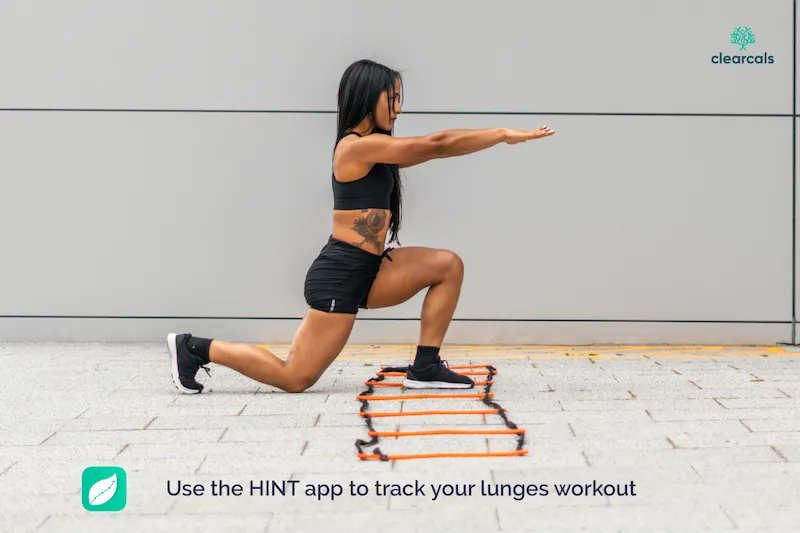
A lunge is a single-leg strength exercise where you step forward, backward, or sideways into a position with one knee bent in front of you and the other bent behind, then return to standing.
Unlike a squat, which loads both legs evenly, a lunge works one leg at a time — which makes it especially useful for building balanced leg strength, since it's common for one leg to be slightly stronger than the other and a two-legged exercise can let that imbalance hide.
How to Do a Basic Lunge (Step by Step)
- Stand tall with your feet hip-width apart.
- Step forward with one leg, landing on your heel first.
- Lower your body by bending both knees until your front thigh is roughly parallel to the floor and your back knee hovers just above the ground.
- Keep your front knee aligned over your ankle — not pushed out past your toes.
- Push through your front heel to return to standing.
- Repeat on the other leg, alternating or completing all reps on one side before switching.
Common Lunge Mistakes to Avoid
- Letting the front knee cave inward or shoot past the toes — keep it tracking in line with your foot throughout the movement.
- Taking too short a step, which puts excess strain on the front knee — a longer stride shifts more of the work to your glutes and hamstrings.
- Leaning too far forward, which shifts the exercise away from your legs and onto your lower back.
- Rushing the movement — a controlled lunge with a brief pause at the bottom builds more strength than a fast, bouncy one.
Lunge Variations (Bodyweight)
| Variation | What It Changes | Good For |
|---|---|---|
| Forward lunge (standard) | Step forward into the lunge | The basic version most people learn first |
| Reverse lunge | Step backward instead of forward | Generally easier on the knees; a common recommendation for beginners |
| Walking lunges | Step continuously forward, alternating legs as you move | Adds a balance and coordination challenge on top of the strength work |
| Side (lateral) lunges | Step out to the side instead of forward/back | Targets the inner and outer thigh differently than a forward lunge |
| Curtsy lunges | Step one leg diagonally behind and across the other | Emphasizes the glutes and outer hip |
| Bulgarian split lunge | Rear foot elevated on a bench behind you | A more advanced, single-leg-dominant strength move |
| Jumping (plyo) lunges | Explosively switch legs mid-air between reps | Adds a cardio/power element |
| Skater lunges | A lateral, jumping bound from one leg to the other | Combines lateral movement with plyometric power |
| Static (stationary) lunges | Feet stay in place for all reps on one side before switching | Removes the stepping/balance component, isolating the strength work |
| Deficit lunges | Front or back foot elevated on a small platform | Increases the range of motion for a more advanced stretch and strength challenge |
Lunge Variations (With Added Weight)
| Variation | Equipment | Notes |
|---|---|---|
| Dumbbell lunges | Dumbbells held at your sides | The most common way to add resistance |
| Barbell lunges | Barbell across the upper back | Allows heavier loading than dumbbells; needs more balance and experience |
| Kettlebell lunges | One or two kettlebells held at chest or sides | A flexible loading option, popular in functional training |
| Smith machine lunges | Performed under a Smith machine bar | The fixed bar path adds stability, useful if balance is limiting how much weight you can otherwise use |
If you're new to lunges, master the bodyweight forward and reverse versions with good form before adding weight—the balance demands of a lunge make it easy to compromise form when you add weight too early.
What Muscles Do Lunges Work?
Lunges are primarily a quad and glute exercise, with a significant contribution from the hamstrings and inner/outer thigh muscles depending on the variation.
Reverse lunges tend to emphasize the glutes slightly more than forward lunges do, while side lunges shift more of the work to the inner and outer thigh (adductors and abductors) than a forward or reverse lunge. Across all variations, your core also works throughout to keep you balanced and upright on one leg at a time.
Lunges vs. Squats: What's the Difference?
Both are excellent lower-body exercises, but they train movement differently. A squat loads both legs symmetrically and is generally easier to load heavier, since you have a wider base of support. A lunge works one leg at a time, which builds more balance, coordination, and unilateral strength — useful for correcting side-to-side imbalances and for sports and everyday movements that rarely happen on two feet at once. Neither replaces the other; many well-rounded leg workouts include both.
Lunges Benefits
Beyond building leg strength, lunges improve balance and coordination in a way two-legged exercises don't, since every rep requires you to stabilize on one leg. They're also a practical, functional movement pattern—stepping, climbing stairs, and getting up from the floor all resemble a lunge more than a squat—which is part of why lunges are commonly included in both general fitness and sports-specific training programs.
How Many Calories Do Lunges Burn?
Lunges burn a moderate amount of calories for a strength exercise — roughly similar to bodyweight squats, though the exact number depends heavily on your body weight, pace, and whether you're adding weight. For a personalised estimate, use our Calories Burned Calculator.
Search interest specifically around "lunges calories burned" is fairly small compared to how often people search for lunge form and variations, which reflects that lunges are used more for building strength and muscle definition than as a calorie-burning cardio tool — if calorie burn from bodyweight training is your main goal, exercises like squats, push-ups, or burpees burn more per minute.
How Many Lunges Should You Do?
A common starting point is 2-3 sets of 8-12 reps per leg, adjusting the count based on your fitness level and whether you're adding weight.
As with any single-leg exercise, it's worth paying attention to whether one leg feels noticeably weaker or less stable than the other — that's common, and lunges are one of the better exercises for gradually evening it out over time.
Track Your Leg Workout With Hint
Lunges are usually one part of a broader leg or full-body workout rather than a standalone session. The Hint app's free Pro Workouts feature lets you track calorie burn from your workouts directly, with free AI-generated insights on the session. If you use a fitness tracker or smartwatch, you can also connect it to Hint through Apple Health or Google Health Connect for free AI insights on your post-workout nutrition.
FAQs
How do you do a lunge correctly? Step forward, lower until your front thigh is roughly parallel to the floor with your knee tracking over your ankle, then push through your front heel to stand back up.
What's the difference between a lunge and a reverse lunge? A standard lunge steps forward; a reverse lunge steps backward instead, which is generally easier on the knees and often recommended for beginners.
What muscles do lunges work? Primarily the quads and glutes, with real contribution from the hamstrings and inner/outer thigh depending on the variation (side lunges shift more toward the inner/outer thigh, for example).
Are lunges better than squats? Neither is strictly better — squats load both legs at once and are easier to load heavier, while lunges build single-leg balance and coordination that squats don't. Many programs include both.
How many calories do lunges burn? A moderate amount, roughly similar to bodyweight squats, though lunges are generally used more for strength and balance than as a calorie-burning exercise.
What are walking lunges? A variation where you step continuously forward, alternating legs as you move, rather than returning to a fixed starting position between reps — it adds a balance and coordination challenge.
Are curtsy lunges effective? Yes — stepping one leg diagonally behind and across the other shifts more of the work to the glutes and outer hip than a standard forward lunge.
Do I need weights to do lunges? No — bodyweight lunges are effective on their own, especially for beginners. Dumbbells, a barbell, or a kettlebell can be added once your form is solid and you want more resistance.
About the Author
Dr. Krishna Athmakuri is the Co-Founder and CEO of Clearcals, where he leads the development of data-driven health technology for India. With a Ph.D. in Chemical Engineering from Rensselaer Polytechnic Institute, New York, his expertise spans protein analytics, bioprocess engineering, and health data systems. Earlier in his career, he developed biotherapeutics for diabetes and metabolic diseases at companies including Dr. Reddy's and Aurobindo Pharma. At Clearcals, he now applies that scientific rigour to build personalised fitness tools — including the Hint app — grounded in Indian nutritional science and clinical evidence. Connect with Dr. Krishna on LinkedIn