Track your nutrition and health goals

Plank Exercise: How to Do It Correctly, Benefits, and Calories Burned
Plank Exercise: How to Do It Correctly, Benefits, and Calories Burned
What Is a Plank, and Why Is It So Popular?
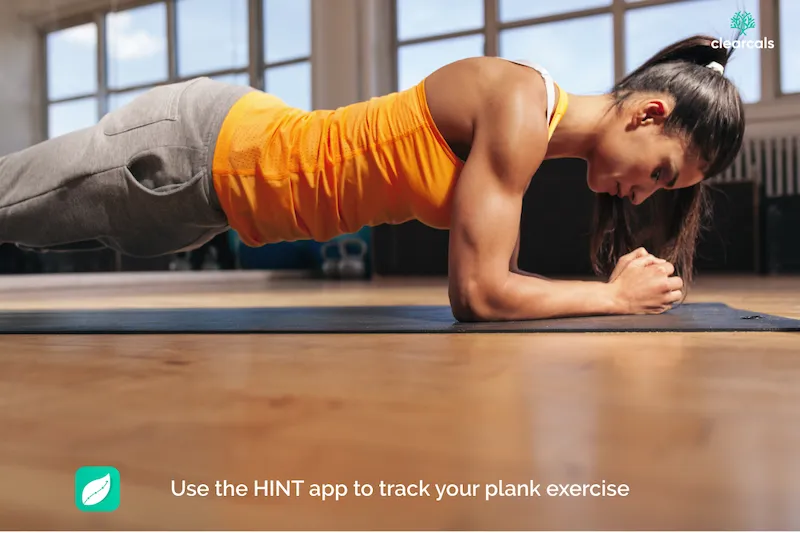
The plank is a static, isometric hold — you get into a position resembling the top of a push-up (or resting on your forearms) and simply hold it, without moving. Despite looking simple, it's one of the most effective core exercises around, because it trains your abs, lower back, shoulders, and glutes to work together to keep your body rigid — a more functional kind of core strength than an exercise like a crunch, which only moves your spine in one direction. It needs no equipment and almost no space, which is a big part of why "how to do a plank" is one of the most searched exercise questions in India.
How to Do a Plank Correctly (Step by Step)
- Start face down on the floor or a mat, then prop yourself up on your forearms (elbows directly under your shoulders) or your hands (arms straight, like the top of a push-up).
- Extend your legs back, resting on your toes, so your body forms a straight line from head to heels.
- Squeeze your core and glutes — imagine pulling your belly button in toward your spine, and don't let your hips sag toward the floor.
- Keep your neck neutral by looking slightly ahead of your hands rather than straight down or up.
- Hold the position, breathing normally, for your target time — then rest and repeat.
Common Plank Mistakes to Avoid
- Letting your hips sag — this is the single most common plank mistake, and it shifts the load onto your lower back instead of your core.
- Raising your hips too high — turns the plank into something closer to downward dog, reducing how much your core actually has to work.
- Holding your breath — breathe normally throughout; holding your breath doesn't make the hold easier and increases unnecessary strain.
- Letting your head drop or crane upward — keep your neck in a neutral line with your spine.
- Chasing time over form — a strict 30-second plank with good form builds more real core strength than a sagging, wobbling 2-minute one.
Plank Variations (With What Each One Trains)
| Variation | What It Changes | Good For |
|---|---|---|
| Forearm plank (standard) | Rests on forearms rather than hands | The classic version — most beginner-friendly on the wrists |
| High plank | Arms straight, like the top of a push-up | Adds more shoulder and tricep engagement |
| Knee plank | Knees on the floor instead of toes | A genuine beginner regression — not "cheating" |
| Side plank | Balanced on one forearm/hand, body turned sideways | Targets the obliques (side core muscles) more directly |
| Reverse plank | Facing upward, supported on hands and heels | Works the posterior chain — glutes, hamstrings, lower back |
| Plank jacks | Jumping the feet in and out while holding a high plank | Adds a cardio element to the static hold |
| Plank with shoulder taps | Alternately tapping each hand to the opposite shoulder | Adds an anti-rotation core challenge |
| Copenhagen plank | A side plank variation with the top leg supported on a bench | A more advanced move borrowed from sports injury-prevention programs, targeting the inner thigh (adductors) — especially popular with soccer/football strength and conditioning coaches |
| Bear plank | A high plank with the knees hovering just above the floor | Adds extra quad and hip engagement on top of the standard core work |
| Plank crawl | Alternating stepping the hands and feet forward and back from a plank position | A more dynamic, cardio-leaning take on the static hold |
| Plank twist | Rotating the hips toward the floor and back up from a forearm plank | Adds an oblique-focused rotational element |
If you're just starting, a knee (or "modified") plank, or a shorter forearm plank hold, is a legitimate starting point — progressing to a full plank, then to side planks and shoulder taps, is a reasonable path rather than jumping straight to the hardest variation. The Copenhagen plank in particular is worth calling out as genuinely more advanced — it's a favorite in professional and collegiate sports conditioning specifically because it isolates the adductors in a way most core exercises don't, so it's best added once you're comfortable with standard side planks rather than attempted first.
Plank Benefits: What It Actually Trains
A plank's biggest benefit is core stability — the ability of your midsection to resist movement, which matters for almost every other exercise and for everyday activities like lifting and carrying.
Beyond the core, a proper plank also engages your shoulders, glutes, and even your quads, since your whole body has to stay rigid to hold the position. It's also a low-impact way to build core endurance without putting stress on your spine the way weighted ab exercises can.
What it doesn't do on its own is build visible, defined abs — that comes down to overall body fat percentage, which is primarily a function of your diet and total calorie balance, not any single ab exercise.
Does a Plank Reduce Belly Fat?
Not directly, and it's worth being clear about this rather than repeating the common claim. A plank strengthens the muscles under your belly, but it doesn't specifically burn the fat covering them — this is the well-established "spot reduction" myth, and it applies to planks the same way it applies to crunches or any other ab exercise.
Losing belly fat specifically requires an overall calorie deficit (burning more calories than you eat, sustained over time), which reduces fat across your whole body, including your midsection. A strong core built with planks is still genuinely useful once that fat comes down — it's just not the mechanism that removes the fat itself. To see how much your workouts contribute to that deficit, estimate them with our Calories Burned Calculator.
How Many Calories Does a Plank Burn?
| Plank Duration | Approx. Calories Burned |
|---|---|
| 30 seconds | ~2-3 kcal |
| 1 minute | ~4-6 kcal |
| 2 minutes | ~8-12 kcal |
| 3 minutes | ~12-18 kcal |
| 5 minutes (across multiple sets) | ~20-30 kcal |
These are rough estimates for an average adult and vary with body weight — a heavier person burns more per minute than a lighter one for the same hold.
A plank burns calories at a moderate rate for its duration since it's a full-body isometric hold, but because most people can only hold one for 30-90 seconds at a time, it burns fewer total calories per workout than a longer, more dynamic exercise like push-ups or squats — a plank is best thought of as a core-strengthening tool first and a calorie-burning tool second.
How Long Should You Hold a Plank?
For most people, a well-formed 30-60 second hold, repeated for 3-4 sets, is a genuinely effective core workout — you don't need to chase multi-minute holds to get real benefit. If you're a beginner, starting with 15-20 second holds (or a knee plank) and building up gradually is a more sustainable approach than trying to force a long hold with poor form on day one. Beyond a few minutes, a plank starts to test muscular endurance and mental toughness more than it adds meaningfully more strength benefit.
Plank World Records
Competitive plank-holding has become its own niche pursuit — the longest verified plank holds have exceeded 9 hours, an extreme outlier of endurance training that has essentially nothing to do with the core-strength benefits a normal person gets from a 30-90 second daily plank. It's an interesting fact, not a benchmark worth chasing.
Track Your Core Workout With Hint
Plank sessions are usually part of a broader routine rather than a full workout on their own — pair them with other bodyweight moves like push-ups and squats, and log your overall activity in the Hint app to see how your core work fits into your total daily calorie picture.
Hint's Pro Workouts feature is free to use and tracks calorie burn from your workouts directly, with free AI-generated insights on the session. If you use a fitness tracker or smartwatch, you can also connect it to Hint through Apple Health or Google Health Connect for free AI insights on your post-workout nutrition.
FAQs
How do you do a plank correctly? Prop yourself on your forearms or hands with your body in a straight line from head to heels, engage your core and glutes, and hold without letting your hips sag or rise.
How long should a beginner hold a plank? 15-30 seconds with good form is a reasonable starting point — building up gradually is better than forcing a longer hold with poor technique.
Does plank reduce belly fat? Not directly — it strengthens your core muscles, but losing belly fat specifically requires an overall calorie deficit, not any single ab exercise.
How many calories does a 1-minute plank burn? Roughly 4-6 kcal for an average adult, though it varies with body weight.
What's the difference between a plank and a side plank? A standard plank faces the floor and works the whole core; a side plank is turned sideways and targets the obliques (side core muscles) more specifically.
Is a knee plank a real exercise, or is it cheating? It's a legitimate beginner regression, not cheating — a well-held knee plank builds more real core strength than a full plank held with sagging hips.
What muscles does a plank work? Primarily the core (abs and lower back), plus the shoulders, glutes, and quads, since your whole body has to stay rigid to hold the position.
Can a plank give you visible abs? Not on its own — it strengthens the muscles, but visible abs depend on overall body fat percentage, which comes down to diet and calorie balance more than any single exercise.
About the Author
Dr. Krishna Athmakuri is the Co-Founder and CEO of Clearcals, where he leads the development of data-driven health technology for India. With a Ph.D. in Chemical Engineering from Rensselaer Polytechnic Institute, New York, his expertise spans protein analytics, bioprocess engineering, and health data systems. Earlier in his career, he developed biotherapeutics for diabetes and metabolic diseases at companies including Dr. Reddy's and Aurobindo Pharma. At Clearcals, he now applies that scientific rigour to build personalised fitness tools — including the Hint app — grounded in Indian nutritional science and clinical evidence. Connect with Dr. Krishna on LinkedIn