Track your nutrition and health goals

Popcorn Calories & Nutrition: Is It Healthy? (Air-Popped vs. Movie Theater)
Popcorn Calories & Nutrition: Is It Healthy? (Air-Popped vs. Movie Theater)
Is Popcorn Healthy? The Short Answer
Yes — plain popcorn is a whole grain, genuinely high in fibre for a snack food, and low in calories in its simplest form.
But almost nothing about popcorn's healthiness is fixed: how it's made changes the calorie count more than almost any other common snack, ranging from about 31 kcal a cup (around 15 grams) air-popped to well over 100 kcal a cup once oil, butter, caramel, or cheese coating gets involved. The corn itself is the healthy part; what you do to it determines almost everything else.
Popcorn Calories: It Depends Entirely on How It's Made
| Type | Approx. Calories | Notes |
|---|---|---|
| Air-popped, 1 cup | 31 kcal | Some added fat — the baseline, healthiest version |
| Oil-popped (stovetop), 1 cup | 55 kcal | Still reasonable in a measured amount of oil |
| Microwave popcorn (butter-flavour), 1 cup popped | ~40-50 kcal | Varies meaningfully by brand |
| Microwave popcorn ("light"/low-fat), 1 cup popped | ~20 kcal | A genuine lower-calorie microwave option |
| Kettle corn, 1 cup | ~60-65 kcal | Lightly sweetened, still air/oil-popped rather than deep-coated |
| Cheese popcorn (white cheddar-style), 1 cup | ~150-160 kcal | Cheese powder is calorie-dense — closer to a fried snack than plain popcorn |
| Caramel popcorn, 1 cup | ~150 kcal | Sugar and butter coating add up fast |
| Chocolate-drizzled popcorn, 1 cup | ~180-200 kcal | One of the most calorie-dense common variants |
| Movie theatre popcorn, small (unbuttered) | ~300-400 kcal | Popped in oil (often coconut oil), no butter added |
| Movie theatre popcorn, large (unbuttered) | ~900-1,200 kcal | A large bucket can be 20+ cups |
| Movie theatre popcorn, large (with butter topping) | ~1,000-1,500+ kcal | Well-documented independent analyses have found this can exceed several fast-food meals combined |
Full Nutrition Facts (Air-Popped, Per 100g and Per Cup)
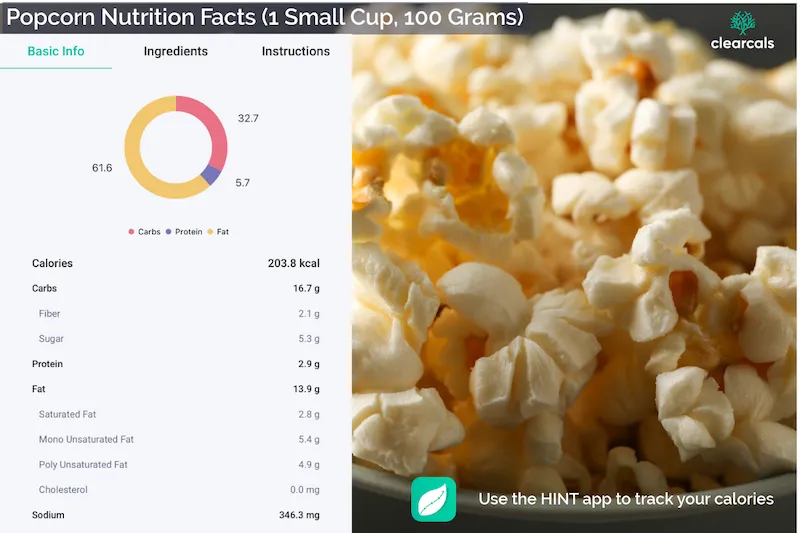
| Nutrient | Per 100g | Per Cup (~15g) |
|---|---|---|
| Calories | 204 kcal | ~31 kcal |
| Protein | 2.9g | 0.4g |
| Fat | 13.9g | 2.1g |
| Carbohydrates | 16.7g | 2.5g |
| Fibre | 2.1g | 0.3g |
| Sugar | 5.3g | 0.8g |
The per-100g figure looks dramatic, but 100g of air-popped popcorn is a genuinely huge volume — over 12 cups — since it's mostly air. The per-cup number is the more useful one for everyday portions.
Is Popcorn Healthy? Whole Grain and Antioxidants
Plain popcorn is a 100% whole grain — unlike most crunchy snack foods, which are made from refined flour. It's also a good fibre source: about 2.1g per 100g adds up faster than most people expect across a typical bowl.
There's a well-known nutrition finding worth knowing here too — research from the University of Scranton found that popcorn hulls (the tough, chewy bits that tend to get stuck in your teeth) are unusually concentrated in polyphenol antioxidants, comparable to or higher than many fruits and vegetables per serving.
None of this changes the fact that toppings can turn popcorn into a genuinely unhealthy snack — but the base food itself has real nutritional merit that most crunchy snacks don't.
Popcorn Carbs, Fibre & Protein
Popcorn is a moderate-carb whole grain — roughly 2.5g of total carbs per cup air-popped, of which about 0.3g is fibre (so around 2.2g net carbs per cup). It's a genuine, if modest, source of protein too, at about 0.4g per cup — not a protein snack by any means, but not negligible either when eaten in the larger volumes popcorn is typically consumed in.
Is Popcorn Keto-Friendly?
Not particularly, despite sometimes appearing on "keto snack" lists. Corn is a grain, and popcorn's carb content, while lower than many snacks by weight, adds up over a full bowl — 100g air-popped is already roughly 17g of total carbs. It can fit into a more flexible low-carb approach in a small, measured portion, but it's not a free food on a strict ketogenic diet the way, say, cucumber is.
Is Popcorn Gluten-Free?
Plain corn is naturally gluten-free, and plain air-popped or oil-popped popcorn with just salt is a safe gluten-free snack for most people.
Where it gets more complicated is flavoured and seasoned popcorn — some seasoning blends and artificial butter flavourings can include gluten-containing additives, and popcorn popped or served on shared equipment (movie theatre poppers, for instance) can carry a cross-contamination risk that matters if you have coeliac disease specifically.
Checking the label, or asking about prep at a theatre or restaurant, is worth doing if you're strictly avoiding gluten.
"Popcorn Lung": Does Eating Popcorn Actually Cause It?
This is one of the most-searched popcorn-related questions, and it deserves a clear, accurate answer: no, eating popcorn — even butter-flavoured popcorn — does not cause popcorn lung.
"Popcorn lung" (medically, bronchiolitis obliterans) is a serious, real lung condition, but it comes from inhaling concentrated fumes of diacetyl, a chemical once widely used in artificial butter flavouring — not from eating food containing it.
The name comes from cases among factory workers at microwave popcorn plants who developed the condition after years of breathing in concentrated flavouring fumes in industrial settings, a level of airborne exposure nothing like opening a bag at home or eating popcorn at the movies.
Diacetyl was substantially reduced or removed from consumer microwave popcorn products following those findings. More recently, the same chemical (used in some flavoured e-cigarette liquids) has raised similar concerns for people who vape, again through inhalation, not eating. If you're eating popcorn — any flavour — through your mouth in the ordinary way, this isn't a risk that applies to you.
Movie Theatre Popcorn: Why It's So Calorie-Dense
Movie theatre popcorn earns its reputation as one of the most calorie-dense common snacks for three compounding reasons: it's traditionally popped in oil (often coconut oil, which is higher in saturated fat), butter or a butter-flavoured topping is added on top of that oil, and portion sizes are large — a "large" bucket can hold 20+ cups.
Each factor alone would be manageable; stacked together, they're why a large buttered portion can run past 1,000-1,500 kcal, more than several fast-food meals combined, in one sitting during a movie. If you're watching your intake, sharing a smaller size, skipping or going light on butter, or choosing the smallest available size makes a real difference here — more than with almost any other single snack decision.
How to Make Lower-Calorie Popcorn at Home
- Air-popped (using an air popper, or a paper bag in the microwave with no oil) is the lowest-calorie method by a wide margin — no added fat at all.
- Air fryer popcorn is a popular, genuinely effective option — you get a satisfying texture with little to no oil, closer to air-popped than stovetop.
- Stovetop with measured oil (1-2 tablespoons for a full batch, rather than free-pouring) keeps calories reasonable while still giving you that classic popped-in-oil flavour and texture.
- Season after popping, not before — a light spray of oil plus a measured amount of seasoning (nutritional yeast, a pinch of salt, chilli powder) adds flavour for very few extra calories, compared to store-bought flavoured bags that often carry meaningful added sugar or sodium.
Popcorn Kernels: Buying and Storing
Dried popcorn kernels keep well — stored in a cool, dry, airtight container, they generally stay good for a year or more. Over time, kernels do lose moisture, which is what actually makes popcorn pop (the trapped moisture turns to steam and bursts the kernel), so older kernels tend to produce more unpopped "duds" rather than spoiling in a way that's unsafe to eat. If a bag of kernels is popping poorly, moisture loss from age or improper storage is the most likely reason.
Popcorn for Weight Loss
Air-popped popcorn is a genuinely good high-volume, high-fibre snack for anyone managing a calorie budget — 3 cups is only around 93 kcal, and the fibre and volume together make it more filling than its calorie count alone would suggest.
The catch is that this only holds for the plain, minimally-prepared version; caramel, cheese, and movie theatre popcorn lose that advantage entirely once oil, butter, and sugar are added. See our weight-loss snacks guide for how air-popped popcorn compares to other smart snack choices.
Track Your Popcorn With Hint
Because the calorie difference between plain air-popped popcorn and a butter-and-cheese movie theatre serving is so large, it's one of the easiest foods to badly under-log by assuming "popcorn" means the same thing every time.
The Hint app lets you log the specific type and portion you actually ate, so a bowl of air-popped snack popcorn and a large theatre tub don't get treated as the same entry.
FAQs
How many calories are in popcorn? It depends entirely on preparation — about 31 kcal per cup air-popped, versus 150+ kcal per cup for caramel or cheese popcorn.
How many calories are in movie theatre popcorn? A small unbuttered portion runs roughly 300-400 kcal, while a large buttered portion can exceed 1,000-1,500 kcal, based on well-documented independent analyses of major theatre chains over the years.
Is popcorn healthy? Plain popcorn is a whole grain, genuinely high in fibre, and a source of antioxidant compounds — a healthy base food. Toppings like butter, caramel, and cheese are what typically make it unhealthy, not the popcorn itself.
Does eating popcorn cause "popcorn lung"? No. Popcorn lung is caused by inhaling concentrated diacetyl fumes (historically an occupational risk for factory workers, more recently linked to vaping), not by eating popcorn.
Is popcorn keto-friendly? Not particularly — it's a grain with a real carb count (~6g per cup air-popped) that adds up over a full bowl, so it's better treated as a small, measured portion than a free keto snack.
Is popcorn gluten-free? Plain popcorn is naturally gluten-free, since corn contains no gluten. Some flavoured seasonings and shared popping equipment can introduce gluten or cross-contamination, worth checking if you're strictly avoiding it.
Does popcorn have fibre and protein? Yes to both, modestly — about 1.2g of fibre and 1g of protein per cup air-popped, which adds up meaningfully across a full bowl.
What's the lowest-calorie way to eat popcorn? Air-popped with no added oil or butter, seasoned lightly after popping — roughly 31 kcal per cup, versus 150+ kcal per cup for caramel, cheese, or chocolate variants.
Popcorn khane ke fayde kya hain? Plain popcorn ek whole grain hai, fibre aur antioxidants deta hai, aur calories mein kaafi kam hota hai — lekin caramel, cheese ya movie theatre-style popcorn mein yeh fayda khatam ho jaata hai zyada oil, butter aur sugar ki wajah se.
About the Author
Asfia Fatima is the Chief Dietitian at Clearcals, with a Master's Degree in Dietetics and Clinical Nutrition and over a decade of experience in clinical nutrition and lifestyle management. She specialises in evidence-based diet planning for weight loss, diabetes, and metabolic health, and leads the nutrition strategy behind the Hint app.
Connect with Asfia on LinkedIn