Track your nutrition and health goals

Cucumber (Kheera) Calories, Nutrition & Benefits: Is Cucumber Water Good for You?
Cucumber (Kheera) Calories, Nutrition & Benefits: Is Cucumber Water Good for You?
Is Cucumber Good for You? The Short Answer
Yes, genuinely — cucumber is about 95% water, extremely low in calories, and one of the easiest foods to eat a large, filling portion of without denting a calorie budget at all. It's not a nutrient powerhouse in the way spinach or broccoli is, but it's a real source of hydration, vitamin K, and potassium, and its main practical value is exactly what it sounds like: volume and crunch for almost no calorie cost.
Cucumber Calories: Quick Reference
| Serving | Calories Per Serving |
|---|---|
| 100g | 16 kcal |
| 1 medium cucumber (~300g) | 48 kcal |
| 1/2 medium cucumber (~150g) | 24 kcal |
| 1 kheera (Indian cucumber, ~150-200g) | 24-30 kcal |
| 1 mini cucumber (~50g) | 8 kcal |
| 1 Persian cucumber (~100g) | 15 kcal |
| 1 English/hothouse cucumber, whole (~300-350g) | 48-56 kcal |
Cucumber is genuinely one of the lowest-calorie common vegetables by weight — see our low-calorie fruits and vegetables guide, where cucumber is the reference example for calorie density.
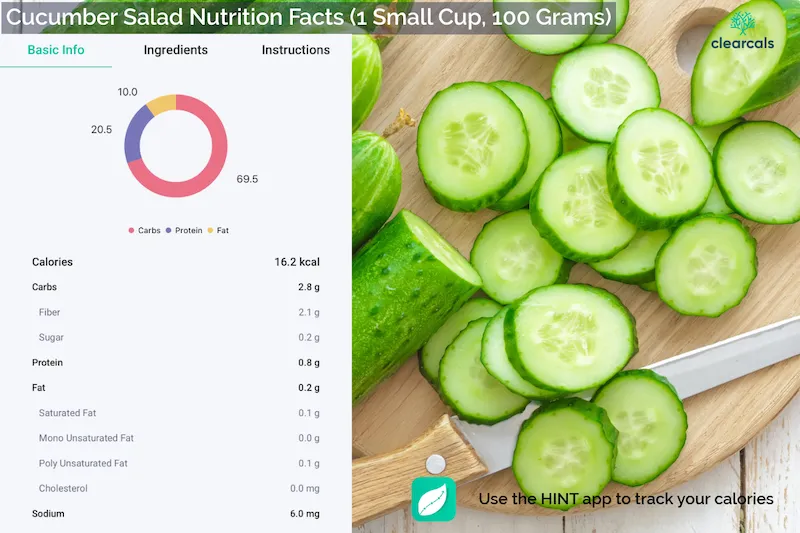
Full Nutrition Facts (Per 100g)
| Nutrient | Per 100g |
|---|---|
| Calories | 16 kcal |
| Water | ~95% |
| Protein | 0.8g |
| Fat | 0.2g |
| Carbohydrates | 2.8g |
| Sugar | 0.2g |
| Fibre | 2.1g |
| Potassium | 147mg |
| Vitamin K | 16 mcg (~14% of a typical daily target) |
| Vitamin C | 3mg |
Cucumber Carbs — Is It Keto-Friendly?
Cucumber is about as carb-light as vegetables get — roughly 2.8g of total carbs per 100g, most of which is fibre, so it's genuinely low in net carbs too (around 0.7g net carbs per 100g). It fits comfortably into keto, low-carb, and virtually any other carb-restricted diet without needing to think about portion much, which is part of why it shows up so often in low-carb salads and snacks.
Mini, English & Persian Cucumbers: Do Calories Differ?
Not meaningfully — nearly all common cucumber varieties (regular slicing cucumbers, English/hothouse, Persian, and mini/cocktail cucumbers) land in the same 14-16 kcal per 100g range. The calorie differences you'll see quoted (a mini cucumber at ~8 kcal vs. a whole English cucumber at ~50 kcal) come almost entirely from size, not from one variety being more calorie-dense than another. English cucumbers are typically thinner-skinned and less seedy, and Persian and mini cucumbers are simply smaller and often less bitter — genuine differences in texture and taste, not calories.
Is Cucumber Water Actually Good for You?
This is one of the most-searched cucumber questions, and it deserves an honest answer: cucumber water is mostly just water. A few cucumber slices left in a jug of water add negligible calories (typically under 10 kcal per glass) and only trace amounts of nutrients or flavour compounds — nowhere near enough cucumber to meaningfully "detox" anything, despite how it's often marketed.
What cucumber water genuinely does well is make plain water more appealing, which for many people means drinking more water than they otherwise would — and better hydration is a real, if indirect, benefit. Adding lemon (a very common combination, "cucumber and lemon water") contributes a small amount of vitamin C and a flavour boost, but the calorie and nutrient contribution from either ingredient stays minimal unless you're using a genuinely large amount of fruit. Worth drinking if you enjoy it and it helps you hydrate more consistently — not worth expecting a specific health effect beyond that.
Cucumber Juice: How Is It Different From Cucumber Water?
Cucumber juice is a meaningfully different thing from cucumber water — it's made by blending or pressing the cucumber itself, so you're consuming the actual vegetable (usually several cucumbers per glass) rather than just infusing water with a few slices. That means real calories (though still low, around 16 kcal per 100ml, similar to the whole vegetable) and real nutrient content, but with most of the fibre removed compared to eating the cucumber whole. It's also commonly used topically — applied to skin or under the eyes — where the cooling, hydrating effect is genuine, even though claims about dramatically reducing puffiness or dark circles are more folk remedy than clinically proven.
Cucumber Health Benefits
- Hydration — at ~95% water, cucumber is one of the most effective foods for adding fluid volume to your diet, relevant on hot days or for anyone who struggles to drink enough water directly.
- Vitamin K — a meaningful contributor to daily vitamin K intake, relevant for bone health and blood clotting function, largely concentrated in and near the skin.
- Very low calorie density — cucumber lets you eat a large, crunchy portion for almost no calorie cost, which is genuinely useful for managing hunger within a calorie deficit.
- Potassium — a reasonable contributor to daily potassium intake, relevant for blood pressure and muscle function as part of an overall diet.
- Antioxidant compounds — cucumbers contain flavonoids and cucurbitacins, plant compounds with some antioxidant and anti-inflammatory activity, though the evidence for specific health outcomes from eating cucumber alone is limited rather than dramatic.
Kheera ke fayde: hydration, vitamin K aur potassium milta hai, aur calories itni kam hoti hain ki bina kisi diet ke asar ke ek bada portion khaya ja sakta hai.
Is Cucumber Good for Diabetics?
Yes, generally — cucumber is low in carbohydrates, has a low glycemic index, and its fibre and water content mean it doesn't cause a meaningful blood sugar spike. It's a reasonable, low-risk vegetable for most people managing diabetes to eat freely as part of an overall diet, though as always, individual dietary plans should be discussed with your doctor or dietitian rather than based on any single food.
Cucumber for Weight Loss
Cucumber is a textbook example of a high-volume, low-calorie food — you can eat a large amount for very few calories, which helps with fullness and makes it easy to bulk up a salad, a raita, or a snack plate without adding meaningful calories. It's rarely a "weight loss food" on its own in any special sense — no food burns fat by itself — but as a way to add volume, crunch, and hydration inside a calorie deficit, it's genuinely useful. See our low-calorie fruits and vegetables guide for how cucumber fits alongside other high-volume options.
Is It Bad to Eat Cucumber at Night?
There's a common belief, especially in India, that eating cucumber at night is harmful or causes colds — this isn't well-supported by evidence. Cucumber's main practical consideration at night is the same as any water-rich, fibrous vegetable eaten close to bedtime: it can cause mild bloating or an extra trip to the bathroom for some people simply due to volume and water content, not because of anything specifically harmful in the cucumber itself. If it doesn't bother you personally, there's no strong reason to avoid it at night.
How to Tell If a Cucumber Has Gone Bad
- Soft or mushy spots — fresh cucumber should be firm throughout; any give when pressed, especially at the ends, is an early sign it's turning.
- Wrinkled or shrivelled skin — a sign of moisture loss; the cucumber is still often edible at this early stage but is past its best.
- Sliminess — a slippery film on the skin is a clear sign of spoilage and a reason to discard it.
- Yellowing — cucumbers turning yellow (rather than their usual green) have typically gone past ripe into overripe or spoiled.
- An off or sour smell, or visible mould — discard immediately; this is unambiguous spoilage.
A fresh, unwashed cucumber typically keeps around 1 week refrigerated; once cut, it's best used within 2-3 days.
Track Your Cucumber With Hint
Cucumber is one of the few foods where under-logging genuinely doesn't matter much — a serving adds so few calories that skipping it in your log barely changes your total. Still, if you're adding cucumber to raita, salads, or sandwiches regularly, the Hint app makes it easy to log the full dish accurately rather than guessing at the combined total.
FAQs
How many calories are in a cucumber? Roughly 48 kcal for a medium cucumber (~300g), or about 16 kcal per 100g.
How many calories are in a mini cucumber? Around 8 kcal for a typical mini/cocktail cucumber (~50g) — the same calorie density as a regular cucumber, just a smaller size.
Is cucumber good for you? Yes — it's very low in calories, about 95% water, and a genuine source of vitamin K and potassium, making it a useful food for hydration and low-calorie volume eating.
Is cucumber water actually good for you? It's mostly just water with negligible added calories or nutrients from a few slices — the real benefit is that it can make you drink more water than you otherwise would, not any special "detox" effect.
How many carbs are in a cucumber? About 3.6g of total carbs per 100g, most of it not fibre — genuinely low-carb and keto-friendly in typical portions.
Is cucumber good for diabetics? Yes, generally — it's low in carbs, has a low glycemic index, and doesn't cause a meaningful blood sugar spike, making it a reasonable vegetable to eat freely as part of a diabetes-friendly diet.
Is it bad to eat cucumber at night? No strong evidence supports this common belief. Some people may experience mild bloating from any water-rich, fibrous food close to bedtime, but there's nothing specifically harmful about cucumber at night.
How can I tell if a cucumber has gone bad? Look for soft or mushy spots, wrinkled skin, sliminess, yellowing, or an off smell — any of these mean it's time to discard it.
Kheera khane ke fayde kya hain? Kheera mein 95% paani hota hai, vitamin K aur potassium milta hai, aur calories bahut kam hoti hain — isse hydration aur weight management dono mein madad milti hai.
About the Author
Asfia Fatima is the Chief Dietitian at Clearcals, with a Master's Degree in Dietetics and Clinical Nutrition and over a decade of experience in clinical nutrition and lifestyle management. She specialises in evidence-based diet planning for weight loss, diabetes, and metabolic health, and leads the nutrition strategy behind the Hint app.
Connect with Asfia on LinkedIn