Track your nutrition and health goals

Protein Powder for Weight Gain: Which Type to Choose and How to Use It
By Hafsaa Farooq, Consultant Dietitian, Clearcals | Updated: May 2026
Do You Need Protein Powder to Gain Weight?
No — protein powder is a supplement, not a requirement. Every calorie and gram of protein provided by a supplement can also be obtained from whole food sources.
A person who consistently eats whole milk, eggs, paneer, dal, rajma, and soya chunks can meet protein targets for weight gain without any supplement whatsoever.
That said, protein powder is genuinely useful in specific situations: when appetite is too low to eat sufficient whole food protein, when meal preparation time is limited, when post-workout protein is needed quickly, or when total daily protein targets are consistently falling short despite good dietary effort.
In these cases, a well-chosen supplement adds convenience rather than replacing anything nutritionally irreplaceable.
The most important principle: protein powder only works for weight gain when total daily calories are in a surplus. Protein powder consumed while eating at or below maintenance calories will not produce weight gain, regardless of the type or timing.
Calories come first; protein powder is a tool to support hitting protein targets within that calorie surplus.
Types of Protein Powder: What Is Available in India
Whey Protein Concentrate (WPC)
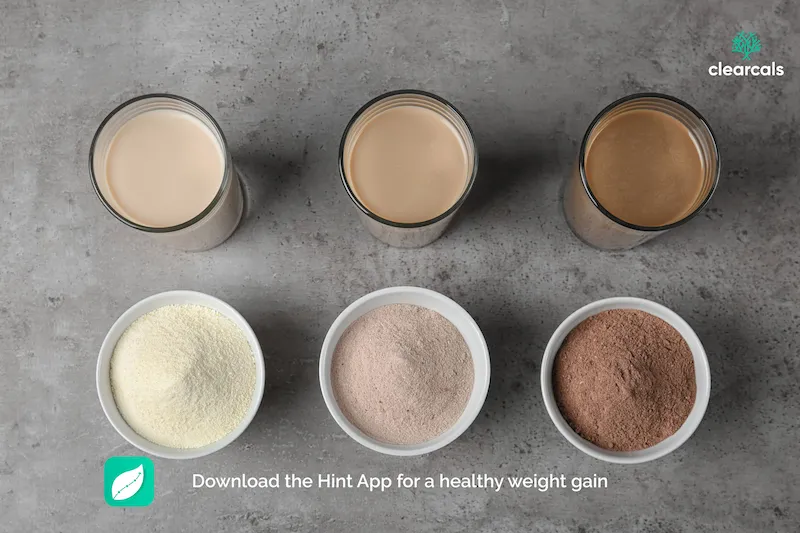
Whey is derived from milk during the cheese-making process. Whey protein concentrate is the least processed form of whey — it typically contains 70–80% protein by weight, with the remainder being carbohydrates and fat (primarily lactose).
This makes it slightly higher in calories per serving than whey isolate, which is an advantage for weight gain. It is also the most affordable form of whey protein, widely available in India under many brands.
Whey concentrate is digested and absorbed rapidly — peak amino acid levels appear in the blood within 60–90 minutes of ingestion. This rapid absorption profile makes it well-suited to post-workout consumption, when muscles are most receptive to protein for repair and growth.
Whey Protein Isolate (WPI)
Whey isolate undergoes further processing to remove most of the fat and lactose, producing a product that is 90%+ protein by weight, lower in calories per gram, and easier to digest for people who are lactose intolerant.
For weight gain, the lower calorie content is a minor disadvantage — whey concentrate delivers approximately 120 kcal per 30g serving versus 110 kcal for isolate, a negligible difference when building a high-calorie shake.
Whey isolate is more expensive, and its advantages (lactose-free, higher purity) are meaningful only for specific populations.
Casein Protein
Casein is the other major protein found in milk. Unlike whey, casein forms a gel in the stomach that digests slowly — amino acid levels rise gradually over 5–7 hours rather than peaking rapidly.
This slow-release property makes casein particularly well-suited to a pre-bedtime serving, providing a sustained amino acid supply during overnight fasting when the body continues muscle repair.
One serving (30g) of casein before bed, combined with a calorie-dense snack (warm milk, peanut butter), is a well-supported strategy for maximising overnight muscle protein synthesis.
Mass Gainers (Weight Gainer Powders)
Mass gainers are specifically marketed for weight gain and typically contain 50–80g of carbohydrates and 20–30g of protein per serving, delivering 400–600+ calories per scoop. They seem ideal for weight gain on paper — high calories, convenient, protein included.
In practice, the calorie content of most mass gainers comes primarily from maltodextrin (a refined carbohydrate with a very high glycaemic index) and simple sugars.
This is nutritionally inferior to the same calories obtained from whole milk, oats, bananas, nuts, and peanut butter, which provide fibre, micronutrients, and a healthier carbohydrate profile.
Mass gainers are best viewed as a last-resort option for people who genuinely cannot meet calorie targets through any other means — particularly underweight individuals with very small appetites who are struggling to gain weight despite consistent effort.
For most people, home-made high-calorie shakes using whole milk and food ingredients provide better nutrition at a lower cost.
Plant-Based Protein Powders
Plant-based proteins — soy, pea, rice, hemp — are suitable for vegetarians, vegans, and those with dairy intolerance.
Of these, soy protein isolate is nutritionally closest to whey — it is a complete protein (containing all nine essential amino acids) with good bioavailability and leucine content sufficient to stimulate muscle protein synthesis effectively.
Pea protein is high in most essential amino acids but low in methionine; combining pea and rice protein (often sold as a blend) produces a more complete amino acid profile.
Plant proteins are generally 15–30% less efficiently utilised than whey for muscle building, which means plant-protein users should target 10–20% more total daily protein than whey users eating the same food.
For weight gain purposes, plant protein powders work well — the difference compared to whey in real-world outcomes is modest when total protein targets are met.
Which Protein Powder Is Best for Weight Gain?
For most Indian women and men trying to gain weight:
First choice — Whey protein concentrate: Best combination of calorie density, protein quality, absorption speed, availability, and cost. A 30g serving with 250ml whole milk provides approximately 300 kcal and 35–40g protein. Easily added to smoothies, mixed with fruit and peanut butter, or blended into oats.
For vegetarians/vegans — Soy protein isolate or a pea+rice blend: Nutritionally effective, widely available, and well-tolerated. Mix with whole milk or fortified plant milk to boost calorie content.
For people who want extra overnight support — Casein protein: One scoop before bed in warm milk is a well-evidenced strategy. More expensive and less essential than whey, but a useful addition if progress is slow.
What to avoid for weight gain: Whey isolate (unnecessarily expensive, slightly fewer calories), fat-free or "lean" protein blends marketed for weight loss (designed to minimise calorie delivery), and flavoured mass gainers with high sugar content as a primary calorie source.
How Much Protein Powder Should You Take?
Protein powder is a supplement to dietary protein, not a replacement for it. The daily protein target for weight gain is 1.4–2.0g per kilogram of body weight. For a 55 kg woman, this is 77–110g of protein per day.
If your daily food intake provides 60–70g of protein from whole sources (eggs, dairy, dal, paneer, soya), one serving of protein powder (25–30g protein) bridges the gap without displacing nutritious food. Taking more than one serving per day is generally unnecessary unless whole food protein intake is very low, and it replaces food calories that would provide more diverse nutrients.
Serving size: 25–30g of protein per serving (typically one scoop of most commercial products). Each meal should ideally contain 20–30g of protein to maximise muscle protein synthesis per meal. Consuming all your protein in one or two large servings is significantly less effective than spreading it across 4–5 meals throughout the day.
When to Take Protein Powder
Post-workout (best timing for muscle gain): Within 60–90 minutes after resistance training, muscle cells are most responsive to protein for repair and synthesis. A post-workout shake of whey concentrate + banana + whole milk + peanut butter provides 400–500 calories and 35–40g of protein at the optimal time.
Between meals (for appetite support): People with small appetites often find liquid protein easier to consume than solid food. A mid-morning or mid-afternoon shake can add 300–400 calories without the fullness of a solid meal.
Before bed (casein or slow-release protein): A pre-sleep protein serving supports overnight muscle repair, particularly if dinner was more than 4 hours before bedtime. One scoop of casein in warm whole milk is the most practical option; alternatively, cottage cheese (paneer) or curd is a natural, whole-food slow-release protein that works similarly.
What to avoid: Taking protein powder as a meal replacement for solid food. Liquid protein is a supplement to food, not a substitute — it lacks the fibre, fat-soluble vitamins, and satiety that meals provide.
High-Calorie Protein Shake Recipes for Weight Gain
Banana peanut butter protein shake (~550 kcal, 38g protein): 1 scoop whey concentrate + 2 ripe bananas + 2 tbsp peanut butter + 300ml whole milk + 1 tbsp honey. Blend and drink post-workout or as a between-meal addition.
Mango protein smoothie (~480 kcal, 33g protein): 1 scoop whey concentrate (vanilla or unflavoured) + 150g ripe mango + 200ml whole milk + 100ml full-fat curd + 1 tbsp honey. Particularly practical during mango season in India.
Oats and protein shake (~600 kcal, 40g protein): 1 scoop whey concentrate + 50g rolled oats (dry) blended in + 250ml whole milk + 1 banana + 1 tbsp peanut butter. Blend until smooth. This is essentially a complete meal in liquid form — useful for days when preparing solid food is impractical.
Bedtime casein shake (~380 kcal, 30g protein): 1 scoop casein protein + 250ml warm whole milk + 1 tbsp peanut butter + a pinch of cinnamon. Mix or blend. Drink 30–60 minutes before sleep.
Buying Protein Powder in India: What to Check
The Indian supplement market contains a significant number of adulterated or underdosed products, particularly at lower price points. Before purchasing, check the following:
FSSAI certification: All protein powders sold legally in India must carry an FSSAI (Food Safety and Standards Authority of India) registration number on the label. Products without this should be avoided.
Informed Sport or NSF certification: These international third-party testing programmes verify that the protein content matches the label and that no banned substances are present. Relevant primarily for competitive athletes, but it is a useful quality indicator for anyone.
Protein per serving vs per 100g: Some brands inflate serving sizes to make the per-serving protein number look impressive. Always check the protein per 100g for a fair comparison. A good whey concentrate should provide 70–80g of protein per 100g of powder.
Ingredient list: Protein source should be listed first. Avoid products with an unusually long ingredient list featuring multiple sugars, artificial colours, or non-protein fillers in prominent positions.
Reputable brands available in India: MuscleBlaze, Optimum Nutrition, MyProtein, Nakpro, and AS-IT-IS are among the brands with established quality reputations. AS-IT-IS and Nakpro are particularly cost-effective options for unflavoured whey concentrate.
Home-Made Alternatives to Protein Powder
If protein powder is unavailable, too expensive, or simply not preferred, the following whole food combinations provide equivalent protein content:
- 200g low-fat paneer: 36g protein, ~300 kcal
- 3 whole eggs + 200ml whole milk: 30g protein, ~300 kcal
- 100g soya chunks (dry): 52g protein, 345 kcal (the most protein-dense plant food available)
- 300ml whole milk + 1 tbsp peanut butter + 1 banana: 18–20g protein, 430 kcal
A smoothie made with whole milk, peanut butter, banana, and curd can provide 20–25g of protein without any powder — nutritionally comparable to a protein shake for weight gain purposes, at a fraction of the cost.
References
- Morton RW, et al. A systematic review, meta-analysis and meta-regression of the effect of protein supplementation on resistance training-induced gains in muscle mass and strength in healthy adults. British Journal of Sports Medicine. 2018;52(6):376–384.
- Res PT, et al. Protein ingestion before sleep improves post-exercise overnight recovery. Medicine and Science in Sports and Exercise. 2012;44(8):1560–1569.
- Tang JE, et al. Ingestion of whey hydrolysate, casein, or soy protein isolate: effects on mixed muscle protein synthesis at rest and following resistance exercise in young men. Journal of Applied Physiology. 2009;107(3):987–992.
- van Vliet S, et al. The skeletal muscle anabolic response to plant- versus animal-based protein consumption. Journal of Nutrition. 2015;145(9):1981–1991.
- Churchward-Venne TA, et al. Supplementation of a suboptimal protein dose with leucine or essential amino acids: effects on myofibrillar protein synthesis at rest and following resistance exercise in men. Journal of Physiology. 2012;590(11):2751–2765.
About the Author
Hafsaa Farooq is a Consultant Dietitian at Clearcals with a strong passion for nutrition, fitness, and evidence-based health practices.
She is deeply interested in clinical nutrition and enjoys helping individuals build healthier lifestyles through practical dietary guidance. Beyond her professional work, Hafsaa enjoys developing healthy recipes, writing evidence-based nutrition blogs, and staying active through sports. She is also expanding her expertise in the science of exercise and weight training to better support holistic health and fitness goals.
🔗 Connect with Hafsaa on LinkedIn
👉 Back to the pillar page: Healthy Weight Gain: Complete Indian Guide 👉 Related: Weight Gain Smoothies and Shakes | Weight Gain Medicine and Supplements | Best Foods for Weight Gain