Track your nutrition and health goals

Can Lack of Sleep Cause High Blood Pressure? The Evidence Explained
By Dr. Krishna Athmakuri, Co-Founder & CEO, Clearcals | Updated: July 2026
Can Lack of Sleep Cause High Blood Pressure?
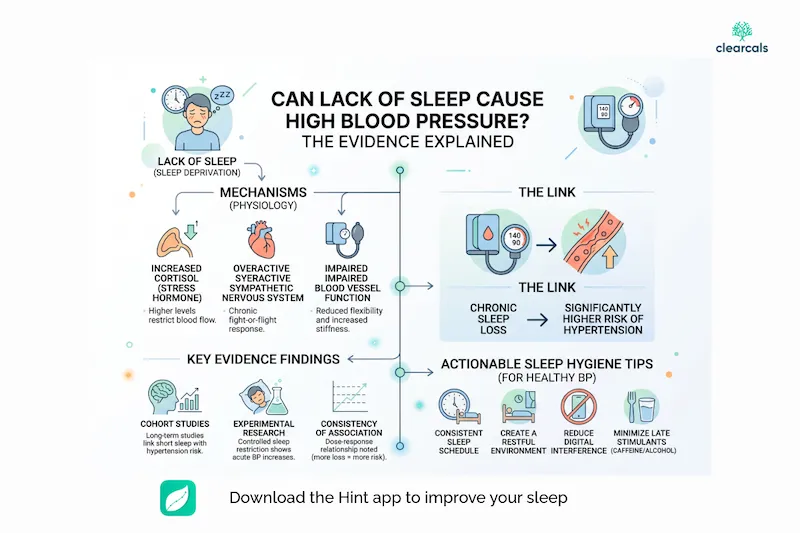
Yes — and the evidence for this is now substantial enough that sleep assessment is considered a standard part of hypertension evaluation in cardiology guidelines.
Multiple large prospective cohort studies, experimental sleep restriction studies, and meta-analyses confirm that both short sleep duration and poor sleep quality independently predict incident hypertension and worsen blood pressure control in people already diagnosed.
The relationship is not trivial in magnitude. A meta-analysis of 13 prospective cohort studies found that short sleep duration (typically defined as less than 6 hours per night) was associated with a 21% increased risk of developing hypertension compared to the 7–8 hour reference group, after adjusting for BMI, physical activity, alcohol, and other confounders.
A separate 2017 review found that each hour of sleep loss was associated with a 37% increased risk of hypertension in cross-sectional studies.
The Nocturnal Blood Pressure Dip
In healthy individuals, blood pressure falls by 10–20% during sleep compared to daytime values. This pattern — called the nocturnal dip — is driven by the dominant parasympathetic (vagal) tone of deep sleep, reduced sympathetic outflow, lower cardiac output, and decreased systemic vascular resistance during the night.
The nocturnal dip is not merely a marker — it is mechanistically important. This nightly pressure reduction allows the arterial walls, cardiac muscle, and kidneys to recover from the sustained mechanical load of daytime blood pressure. People who do not achieve the nocturnal dip — termed "non-dippers" — have significantly higher rates of cardiovascular events, including myocardial infarction, stroke, and heart failure, independent of their daytime blood pressure levels.
Non-dipping is strongly associated with poor sleep quality. When sleep is fragmented — by obstructive sleep apnoea, insomnia, stress arousal, or alcohol — the sustained parasympathetic dominance necessary for the BP dip is disrupted by repeated sympathetic activations. The blood pressure never fully descends to its restorative nocturnal nadir.
Mechanisms: How Poor Sleep Raises Blood Pressure
Sympathetic Nervous System Activation
Sleep deprivation maintains sympathetic nervous system activation — the "fight or flight" state — during periods when the body should be parasympathetically dominant. Elevated sympathetic tone constricts peripheral blood vessels, increases cardiac output, and raises blood pressure. With chronic sleep loss, this sympathetic excess extends into waking hours, producing a sustained blood pressure elevation that accumulates over time.
Cortisol and the HPA Axis
Deep sleep suppresses the hypothalamic-pituitary-adrenal axis, keeping overnight cortisol appropriately low. Insufficient deep sleep allows cortisol to remain elevated overnight. Cortisol promotes sodium retention in the kidney (via aldosterone-like effects), increases cardiac contractility, and causes peripheral vasoconstriction — all of which raise blood pressure. The cortisol from poor sleep also amplifies inflammatory processes that damage endothelial function and reduce arterial compliance.
Endothelial Dysfunction
The vascular endothelium — the inner lining of blood vessels — produces nitric oxide, which causes vasodilation and is essential for blood pressure regulation. Sleep deprivation reduces nitric oxide bioavailability through oxidative stress and inflammatory pathways, impairing vasodilation and raising vascular resistance. Even short-term (one week) sleep restriction has been shown to reduce flow-mediated dilation — a measure of endothelial function — in healthy adults.
Fluid and Sodium Retention
Sleep deprivation alters the renal handling of sodium and water. Reduced nocturnal dipping means the kidney does not experience the normal overnight reduction in perfusion pressure that promotes sodium excretion (pressure natriuresis). Fluid and sodium accumulate, increasing blood volume and therefore blood pressure.
Inflammation
CRP, IL-6, and TNF-α — markers of chronic low-grade inflammation — are elevated with sleep deprivation. These inflammatory mediators damage endothelial function, promote arterial stiffness, and activate the renin-angiotensin system, all of which contribute to sustained blood pressure elevation.
Obstructive Sleep Apnoea: The Strongest Sleep-Hypertension Link
Obstructive sleep apnoea (OSA) is the most potent and clinically important sleep disorder driving hypertension. In OSA, the upper airway repeatedly collapses during sleep, causing breathing pauses (apnoeas) that last 10–60 seconds before the person partially arouses to restore airway patency.
Each apnoea triggers a cascade: acute hypoxia → massive sympathetic activation → cortisol and catecholamine surge → blood pressure spike. In moderate-to-severe OSA, this happens 20–100+ times per hour across the night. The cumulative sympathetic load from hundreds of overnight BP spikes produces sustained daytime hypertension — and because each apnoea is sub-threshold for conscious waking, most people with OSA have no idea it is occurring.
OSA is present in approximately 30–40% of patients with hypertension, rising to 80–85% in patients with treatment-resistant hypertension — hypertension that fails to respond adequately to three or more antihypertensive medications. In many of these cases, treating the OSA (typically with CPAP therapy) produces blood pressure reductions equivalent to adding an antihypertensive drug. Screening for OSA in hypertensive patients — particularly those with resistant hypertension, daytime sleepiness, or loud snoring — is now a standard clinical recommendation.
Sleep Duration, Sleep Quality, and Blood Pressure: What the Numbers Show
Short sleep (under 6 hours): Consistently associated with higher daytime systolic and diastolic blood pressure in cross-sectional studies. In experimental sleep restriction to 4–5 hours for 1–2 weeks, systolic BP rises by 4–9 mmHg — clinically meaningful, as a 5 mmHg chronic systolic BP reduction is associated with approximately a 20% reduction in stroke risk.
Long sleep (over 9 hours): Also associated with higher blood pressure in observational studies, though the relationship here is more complex — long sleep in adults often reflects underlying illness, depression, or undiagnosed sleep-disordered breathing rather than voluntary extended sleep.
Sleep quality independent of duration: People with insomnia — defined by difficulty initiating or maintaining sleep — have higher blood pressure and higher rates of hypertension than good sleepers matched for total sleep duration. The 24-hour blood pressure profile is worse in insomnia patients, with blunted nocturnal dipping as the key mechanism.
Who Is Most at Risk?
The sleep-hypertension link is stronger in younger people (under 65) than older adults — in older adults, hypertension is so prevalent from other causes that the additional sleep-related contribution is harder to detect statistically. In middle-aged adults, sleep quality is estimated to account for a meaningful independent fraction of hypertension risk.
The risk is also amplified in people with:
- Obesity and central adiposity (which increases OSA risk and worsens sympathetic dysregulation)
- Chronic psychological stress (which compounds overnight HPA activation)
- Diabetes or insulin resistance (which independently impairs autonomic function and worsens the BP response to sleep deprivation)
- High alcohol consumption (which disrupts sleep architecture and independently raises BP)
What to Do: Sleep Interventions for Blood Pressure
Treat obstructive sleep apnoea. If you snore, feel unrefreshed despite adequate sleep duration, have been observed to stop breathing during sleep, or have treatment-resistant hypertension — sleep apnoea assessment is essential. CPAP therapy in people with confirmed OSA produces 2–10 mmHg reductions in 24-hour blood pressure, with larger effects in people with more severe OSA and worse daytime sleepiness.
Target 7–8 hours consistently. Extending sleep duration in short sleepers produces measurable BP improvement. A randomised trial by Haack et al. showed that extending sleep from 6.2 to 7.7 hours over 6 weeks in habitually short sleepers significantly reduced ambulatory systolic blood pressure.
Improve sleep quality directly. Strategies that improve deep sleep percentage — consistent sleep timing, cooler bedroom, alcohol elimination, stress management — each independently contribute to restoring the nocturnal BP dip. See How to Get More Deep Sleep for the full evidence-based protocol.
Address the cortisol pathway. Evening resonance frequency breathing (6 breaths per minute for 15 minutes before sleep) reduces overnight cortisol, improves HRV, and has been shown in small trials to reduce blood pressure in hypertensive individuals. Stress management practices that lower chronic cortisol produce secondary blood pressure benefits.
Monitor overnight HRV as a proxy. Overnight HRV is the wearable metric most directly linked to nocturnal BP dipping. A consistently low overnight HRV — or a declining HRV trend — is a reliable indicator of impaired autonomic regulation during sleep, which correlates with blunted nocturnal BP dipping. Improving overnight HRV through sleep and lifestyle interventions directly supports blood pressure recovery.
For comprehensive guidance on managing hypertension through diet and lifestyle, see our Hypertension guide.
References
- Gangwisch JE, et al. Short sleep duration as a risk factor for hypertension: analyses of the first National Health and Nutrition Examination Survey. Hypertension. 2006;47(5):833–839.
- Javaheri S, Redline S. Insomnia and risk of cardiovascular disease. Chest. 2017;152(2):435–444.
- Logan AG, et al. High prevalence of unrecognized sleep apnoea in drug-resistant hypertension. Journal of Hypertension. 2001;19(12):2271–2277.
- Haack M, et al. Sleep deficiency and deprivation leading to cardiovascular disease. Sleep Medicine Clinics. 2020;15(1):61–74.
- Calhoun DA, Harding SM. Sleep and hypertension. Chest. 2010;138(2):434–443.
About the Author
Dr. Krishna Athmakuri is the Co-Founder and CEO of Clearcals, where he leads the development of data-driven health technology through the Hint app. With a Ph.D. in Chemical Engineering from Rensselaer Polytechnic Institute, New York, his expertise spans analytics, protein chemistry, and biotechnology. Earlier in his career, he developed biotherapeutics for diabetes and metabolic diseases at companies like Aurobindo Pharma and Dr. Reddy's Laboratories. At Clearcals, he now applies that scientific rigour to build personalised fitness tools — including Hint Pro Workouts, nutrition tracking, and real-time metabolic insights — helping users make smarter health decisions through technology. Connect with Dr. Krishna on LinkedIn
👉 Back to the pillar page: Sleep and Metabolism: Complete Guide 👉 Related: How to Get More Deep Sleep | Sleep Stages Explained | Hypertension Guide