Track your nutrition and health goals

How to Get More Deep Sleep: Evidence-Based Strategies That Work
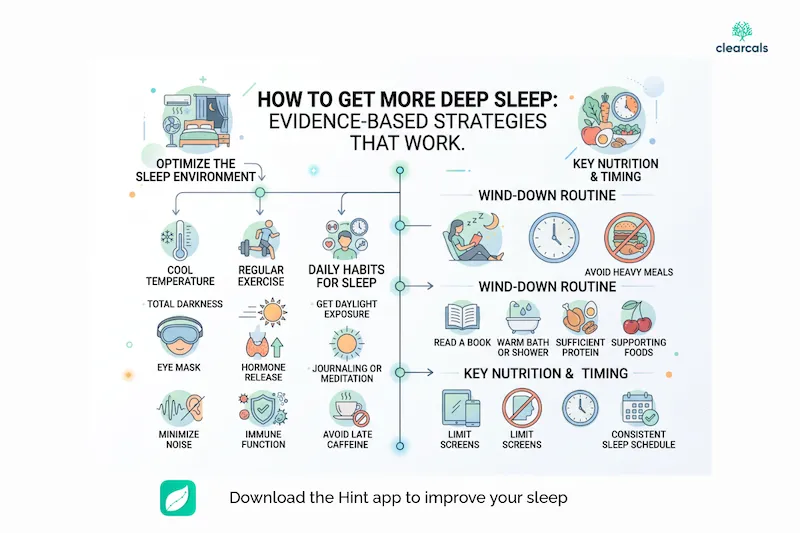
By Dr. Krishna Athmakuri, Co-Founder & CEO, Clearcals | Updated: July 2026
Why Deep Sleep Is the Most Important Sleep Stage
Of the four sleep stages, slow-wave sleep — commonly called deep sleep — is the one your metabolism depends on most. It is during this stage that growth hormone is secreted, glucose regulation is restored, the brain clears metabolic waste via the glymphatic system, the immune system performs its most intensive restorative work, and the parasympathetic nervous system reaches its peak activity.
The consequences of insufficient deep sleep are not limited to fatigue.
Studies consistently show that selective deep sleep deprivation — even with total sleep time held constant — produces insulin resistance comparable to gaining 10 kg of body weight, impairs immune function, elevates cortisol, disrupts appetite hormones, and reduces muscle protein synthesis. This is why how much deep sleep you get matters as much as how long you sleep overall.
How Much Deep Sleep Do You Need?
Adults should spend approximately 15–20% of total sleep time in deep sleep. For someone sleeping 8 hours, that is approximately 72–96 minutes of deep sleep per night.
Deep sleep is not distributed evenly across the night. The majority of slow-wave sleep occurs in the first two sleep cycles — in the first 3–4 hours after sleep onset. This front-loading is why going to bed at a consistent time matters: skipping the early part of your night disproportionately cuts deep sleep.
Deep sleep naturally declines with age. Children spend up to 25% of sleep in slow-wave stages; this falls progressively through adulthood, and adults over 60 commonly spend less than 10% of sleep in deep sleep — one of the primary mechanisms behind age-related metabolic deterioration. This makes protecting deep sleep an increasingly important health priority with age.
On wearables: Garmin, Oura, and WHOOP estimate sleep stages via heart rate variability and movement. The estimates are reliable for trending over time, though not perfectly accurate on any given night. Consistent deep sleep below 10% of total sleep time over multiple weeks is a meaningful signal, regardless of device-level variation.
What Reduces Deep Sleep
Understanding what suppresses slow-wave sleep is the starting point for increasing it:
Alcohol: The single most common and potent acute deep sleep disruptor. Alcohol accelerates sleep onset (which is why many people use it as a sleep aid) but suppresses REM sleep in the first half of the night and causes sleep fragmentation and reduced slow-wave sleep in the second half. Even 1–2 standard drinks reduce deep sleep proportion measurably. The effect is dose-dependent and lasts up to 3 nights with heavier drinking.
Room temperature above 20°C: Core body temperature must fall by approximately 1–2°C to initiate and maintain deep sleep. A warm bedroom prevents this thermoregulatory drop, directly suppressing slow-wave sleep. This is one of the most consistent and underappreciated deep sleep disruptors.
Late and heavy meals: Eating a large meal within 2–3 hours of sleep onset activates digestive processes and raises core temperature, both of which impair deep sleep quality. The effect is amplified with high-fat, high-calorie meals.
Blue light and screen exposure in the evening: Light — particularly in the blue spectrum (450–490nm) — suppresses melatonin production via the retinohypothalamic tract. Melatonin does not cause sleep directly but signals the circadian system that night has arrived and facilitates the core temperature drop that enables deep sleep. Screen exposure in the 90 minutes before bed delays and reduces deep sleep.
Caffeine: With a half-life of 5–7 hours, caffeine consumed after 2–3 pm is pharmacologically active at sleep time in most people. Caffeine blocks adenosine receptors — adenosine is the primary sleep pressure signal that drives slow-wave sleep. Blocking it reduces both sleep onset efficiency and deep sleep proportion.
Stress and elevated evening cortisol: Cortisol is physiologically lowest during the early sleep period — the window of peak deep sleep. Psychological stress, work pressure, or emotionally activating content before bed elevates evening cortisol, directly suppressing the slow-wave sleep of the first half of the night.
Obstructive sleep apnoea: Repeated apnoeic episodes during sleep produce cortisol and catecholamine surges that fragment slow-wave sleep and prevent the sustained deep sleep periods that drive metabolic restoration. Many people with OSA have little to no deep sleep despite appearing to sleep adequate hours.
Irregular sleep timing: Deep sleep is partially anchored to the circadian system as well as sleep pressure. Variable bedtimes disrupt this anchoring and reduce slow-wave sleep efficiency — the amount of deep sleep achieved per hour of total sleep.
Evidence-Based Strategies to Increase Deep Sleep
1. Keep a Consistent Sleep Schedule
Going to bed and waking at the same time every day — including weekends — is the most impactful single intervention for deep sleep quality. Consistency aligns sleep architecture with the circadian system, maximising the slow-wave sleep obtained in the early cycles. "Sleeping in" on weekends produces social jetlag that reduces deep sleep efficiency for several subsequent nights.
Target: Variation of no more than 30 minutes in sleep and wake times across the week.
2. Cool Your Bedroom to 18–20°C
Set your bedroom temperature to 18–20°C (64–68°F) before sleep. If air conditioning is not available, a fan directed at the body, lightweight breathable bedding, and cooling the room through open windows in the evening (then closing before sleep) are practical alternatives. Cooling the feet — which has a large surface area for heat dissipation — using breathable socks or uncovering the feet is another effective strategy.
3. Cut Alcohol, Especially Within 3 Hours of Sleep
The evidence here is unambiguous. Alcohol is physiologically incompatible with quality deep sleep. Reducing or eliminating evening alcohol is one of the fastest interventions to increase deep sleep proportion — users tracking sleep on wearables consistently see deep sleep percentage rise within the first alcohol-free week.
4. Move Your Last Meal Earlier
Aim to finish eating at least 2–3 hours before bed. This is particularly important for people with insulin resistance, metabolic syndrome, or GERD — all of which are worsened by late eating and themselves impair sleep quality. If eating late is unavoidable, choose lighter, lower-fat meals.
5. Regular Aerobic Exercise — Ideally in the Morning
Aerobic exercise is the most reliable chronic intervention for increasing slow-wave sleep. The mechanism involves both increased adenosine accumulation during exercise (which builds sleep pressure and drives deep sleep) and long-term cardiac autonomic adaptation that increases overnight HRV and parasympathetic dominance during sleep.
A meta-analysis of randomised controlled trials found that regular aerobic exercise increases deep sleep duration and percentage, with the effect appearing after 4–8 weeks of consistent training and growing over months. Zone 2 training (moderate intensity, conversational pace) four to five times per week is the most evidence-supported approach.
Timing note: High-intensity exercise within 2–3 hours of sleep can delay sleep onset and reduce deep sleep in some individuals by elevating core temperature and cortisol. Morning or early afternoon is preferable for maximising deep sleep benefit.
6. Protect the Pre-Sleep Window
The 60–90 minutes before bed are the most influential for deep sleep quality. In this window:
- Dim the lights (or use warm, low-lux lighting)
- Avoid emotionally activating content (news, conflict, stressful work)
- Avoid screens or use blue-light filtering glasses
- Avoid caffeine and alcohol
- Consider a brief resonance frequency breathing practice (5 seconds inhale, 5 seconds exhale, 15 minutes) — this reliably elevates parasympathetic tone and facilitates the autonomic shift to deep sleep
7. Manage Psychological Stress
Chronic psychological stress is one of the most sustained deep sleep suppressors because its mechanism — HPA activation and elevated cortisol — persists overnight unless actively addressed.
Structured stress management approaches (mindfulness-based stress reduction, regular nature exposure, resolving identifiable stressors) produce measurable deep sleep improvement in people with high baseline stress.
Acute stress on a particular evening — an argument, anxious work deadline, difficult news — can be partially mitigated by the pre-sleep winding down practices above.
8. Get a Sleep Apnoea Assessment If Indicated
Obstructive sleep apnoea is dramatically underdiagnosed in India and is one of the most potent suppressors of deep sleep. If you snore, feel unrefreshed despite sleeping 7+ hours, have been told you stop breathing during sleep, or are overweight with a large neck circumference — assessment is strongly warranted. CPAP treatment for OSA produces some of the most dramatic deep sleep improvements of any single intervention.
9. Consider Targeted Supplementation
Several supplements have meaningful evidence for deep sleep improvement:
Magnesium glycinate (200–400mg before bed): Magnesium activates GABA receptors (the primary inhibitory neurotransmitter involved in sleep onset and slow-wave sleep), reduces cortisol, and relaxes muscles. Multiple randomised trials show improvements in sleep quality, deep sleep duration, and morning cortisol with supplementation, particularly in people who are magnesium-deficient (common in people with insulin resistance, stress, and poor dietary variety).
Glycine (3g before bed): An amino acid with direct sleep-promoting properties via hypothalamic temperature regulation. Supplementation lowers core body temperature, facilitates sleep onset, and in randomised trials increases slow-wave sleep proportion and next-day alertness.
Ashwagandha (300–600mg KSM-66 extract): An adaptogen with evidence for cortisol reduction and sleep quality improvement. Multiple trials show reduced cortisol, improved sleep efficiency, and higher sleep quality scores with 8–12 weeks of supplementation. Most relevant for stress-driven poor sleep.
Note that supplements support but do not replace the foundational interventions above. Start with sleep timing, temperature, alcohol, and exercise before adding supplementation.
Tracking Your Deep Sleep Progress with Hint
The Hint app (version 2.0) connects your wearable sleep data to your nutrition — something no standalone sleep tracker does. On iOS, Hint syncs automatically with Apple Health, pulling in your sleep stages, overnight HRV, and workout data without manual entry.
Google Health Connect sync for Android is launching July 2026, enabling the same automatic import from Garmin Connect, Samsung Health, or any other connected app.
Once sleep is in Hint, the AI surfaces daily insights that account for your overnight recovery: after a night low in deep sleep, Hint notes that elevated hunger and cravings are physiological rather than behavioural — and adjusts its nutrition guidance accordingly. Hint Pro users get sleep trend charts tracking deep sleep percentage and sleep stage distribution week over week, so you can see whether the interventions above are actually working over time.
Download Hint (free) → | See all sleep tracking options →
Deep Sleep vs. Core Sleep: What's the Difference?
Apple Watch introduced the term "core sleep" — which refers to NREM Stage 2 sleep, not deep sleep (slow-wave sleep). This creates confusion because "core sleep" on Apple Watch is not the same as deep sleep. Deep sleep (slow-wave/Stage 3) is the metabolically critical stage; core sleep (Stage 2) is lighter and less metabolically significant, though still important.
When Apple Watch reports your "deep sleep", it typically underestimates slow-wave sleep compared to polysomnography (clinical sleep study). Garmin, Oura Ring, and WHOOP tend to provide better deep sleep estimates than Apple Watch due to higher HRV sampling rates during sleep, though all consumer device estimates carry uncertainty.
References
- Tasali E, et al. Slow-wave sleep and the risk of type 2 diabetes in humans. PNAS. 2008;105(3):1044–1049.
- Kredlow MA, et al. The effects of physical activity on sleep: a meta-analytic review. Journal of Behavioral Medicine. 2015;38(3):427–449.
- Mah CD, et al. The effects of sleep extension on the athletic performance of collegiate basketball players. Sleep. 2011;34(7):943–950.
- Bent S, et al. Valerian for sleep: a systematic review and meta-analysis. American Journal of Medicine. 2006;119(12):1005–1012.
- Bannai M, Kawai N. New therapeutic strategy for amino acid medicine: glycine improves the quality of sleep. Journal of Pharmacological Sciences. 2012;118(2):145–148.
About the Author
Dr. Krishna Athmakuri is the Co-Founder and CEO of Clearcals, where he leads the development of data-driven health technology through the Hint app. With a Ph.D. in Chemical Engineering from Rensselaer Polytechnic Institute, New York, his expertise spans analytics, protein chemistry, and biotechnology. Earlier in his career, he developed biotherapeutics for diabetes and metabolic diseases at companies like Aurobindo Pharma and Dr. Reddy's Laboratories. At Clearcals, he now applies that scientific rigour to build personalised fitness tools — including Hint Pro Workouts, nutrition tracking, and real-time metabolic insights — helping users make smarter health decisions through technology. Connect with Dr. Krishna on LinkedIn
👉 Back to the pillar page: Sleep and Metabolism: Complete Guide 👉 Related: Sleep Stages Explained | HRV and Sleep | How to Improve HRV