Track your nutrition and health goals

Sleep Tracking: Garmin, Apple Watch and Hint App — Metrics, Accuracy and How to Use Them
By Dr. Krishna Athmakuri, Co-Founder & CEO, Clearcals | Updated: July 2026
Why Sleep Tracking on a Wearable Is Worth Taking Seriously
Sleep quality is one of the most impactful and modifiable determinants of metabolic health — yet it is almost entirely invisible to subjective assessment. Most people are poor judges of their own sleep quality: those with obstructive sleep apnoea typically feel they are sleeping adequately; people with chronically poor deep sleep often attribute their fatigue to other causes; and the cumulative effects of months of sub-optimal sleep accumulate invisibly until metabolic markers begin to deteriorate.
Wearable sleep tracking changes this. Modern devices provide objective, longitudinal data on sleep duration, sleep stage composition, overnight heart rate variability, resting heart rate during sleep, and restlessness — data that is not available from self-report and that can reveal meaningful health signals weeks before they become symptomatic.
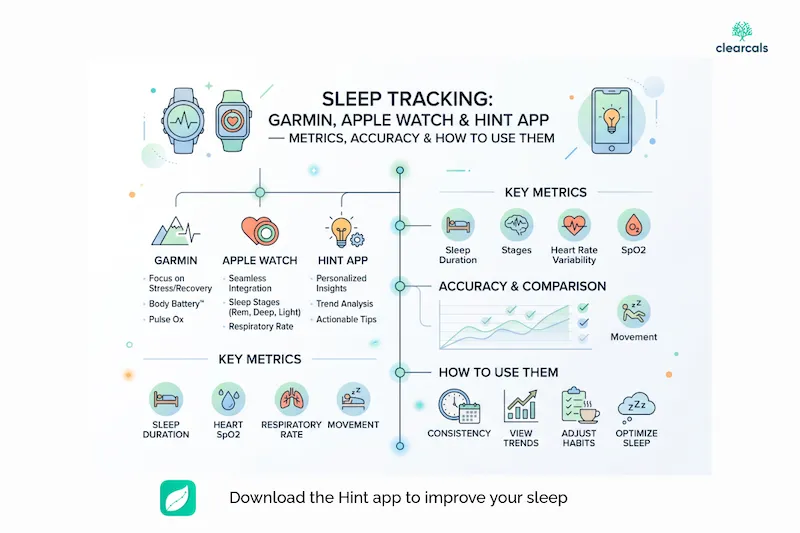
This guide covers the three tools most relevant to Clearcals users: Garmin, Apple Watch, and the Hint app. All three now connect to each other — Hint 2.0 syncs sleep data directly from Apple Health (iOS, live now) and Google Health Connect (Android, launching July 2026), turning raw wearable sleep data into actionable nutrition and recovery insights.
How Garmin Tracks Sleep
Garmin uses a combination of optical heart rate monitoring (to measure heart rate and HRV continuously throughout the night), accelerometer data (to detect movement), and pulse oximetry (SpO2, available on compatible devices) to estimate sleep stages and generate sleep metrics.
Garmin Sleep Metrics
Sleep Score (0–100): A composite metric that aggregates sleep duration, sleep stage proportions, overnight HRV, restlessness (movement during sleep), and, on compatible devices, blood oxygen saturation. It provides a single readiness-oriented number.
- 90–100: Excellent
- 80–89: Good
- 60–79: Fair
- Below 60: Poor
Sleep Stages: Garmin estimates time in Light Sleep (Stages 1–2 combined), Deep Sleep (Stage 3 / slow-wave sleep), and REM Sleep. These are reported in both duration (minutes) and percentage of total sleep.
Overnight HRV (RMSSD): The most metabolically valuable Garmin sleep metric. Garmin continuously records RMSSD (Root Mean Square of Successive Differences) throughout the night and uses the overnight average to feed into the HRV Status calculation (Balanced, Unbalanced, Low, or Poor). See HRV and Sleep for a full breakdown.
Body Battery: Garmin's composite recovery score (0–100) is significantly influenced by overnight HRV and sleep quality. After a night of good sleep with high HRV, Body Battery typically restores to 80–100. After poor sleep or alcohol, it may only partially restore. Body Battery is one of the most practically useful metrics Garmin offers for day-to-day readiness assessment.
SpO2 (Pulse Oximetry): Available on mid-to-high tier Garmin devices. Overnight SpO2 monitoring can detect blood oxygen desaturations associated with obstructive sleep apnoea. A pattern of repeated overnight SpO2 drops below 90% is clinically significant and warrants medical evaluation. Note that wrist-based SpO2 is less accurate than finger-clip oximetry, but consistent patterns over multiple nights are meaningful.
Resting Heart Rate: Garmin reports your resting heart rate as the average of your lowest 30-minute period during sleep. An acute resting HR elevation of 5+ bpm above your recent average — without an identified cause — is a reliable early warning signal for illness onset or overtraining.
Stress During Sleep: Garmin estimates autonomic stress during sleep from HRV patterns. High stress during sleep — particularly across multiple nights — is visible in the Garmin Connect stress graph and reflects disrupted autonomic regulation during the night.
Garmin Sleep Tracking: Compatible Devices
Sleep stage tracking with HRV Status is available on most current Garmin fitness watches, including the Forerunner, Vivoactive, Venu, Instinct, and Fenix series. SpO2 overnight monitoring requires compatible hardware (Pulse Ox sensor). Check device specifications for the features available on your specific model.
For a complete guide to all Garmin health metrics including Body Battery, HRV Status, Stress Score, and VO2 Max, see Garmin Health Metrics Explained.
How Apple Watch Tracks Sleep
Apple Watch uses a different approach. Rather than continuous HRV monitoring throughout the night, Apple Watch relies primarily on accelerometer data (wrist movement) for sleep stage detection, supplemented by heart rate data from the optical sensor.
Apple Watch Sleep Metrics
Sleep Stages: Apple Watch reports time in REM, Core Sleep (Stage 2), Deep Sleep (Stage 3), and Awake. The terminology is Apple-specific: "Core Sleep" refers to NREM Stage 2, not slow-wave sleep. Deep Sleep is Stage 3 slow-wave sleep.
Apple Watch tends to underestimate deep sleep compared to Garmin and polysomnography (clinical sleep study). This is partly a consequence of the lower HRV sampling rate — Apple Watch takes periodic HRV spot measurements rather than continuous recording, reducing the resolution of autonomic data available for sleep staging.
HRV (SDNN): Apple Watch reports SDNN (Standard Deviation of Normal-to-Normal intervals), not RMSSD. SDNN captures both sympathetic and parasympathetic activity and produces numerically higher values than RMSSD in the same person — typically 30–50% higher. Apple Watch captures HRV during sleep through periodic measurements, not continuous overnight recording. These values appear in the Apple Health app.
Important: Apple Watch SDNN values and Garmin RMSSD values are not directly comparable. See HRV Normal Range by Age for a full explanation of RMSSD vs SDNN.
Sleep Duration and Schedule: Apple Watch integrates with the iPhone Sleep app to track sleep schedule consistency, time in bed vs. time asleep, and sleep duration. It also provides a sleep schedule reminder feature.
Retroactive Sleep Detection: Apple Watch automatically detects sleep from movement and heart rate data. In the Health app, sleep data appears under "Sleep" with stage breakdown available on Apple Watch Series 9, Ultra 2, and later models.
How to Track Sleep on Apple Watch
- Set up Sleep Focus in the iPhone Health app → Sleep
- Set your sleep goal (7–8 hours recommended)
- Wear your Apple Watch to bed (it must be charged above 30%)
- Sleep data appears in the Health app under Browse → Sleep the next morning
- HRV data recorded during sleep appears under Browse → Heart → Heart Rate Variability
Garmin vs. Apple Watch for Sleep Tracking: Key Differences
| Feature | Garmin | Apple Watch |
|---|---|---|
| HRV metric | RMSSD (continuous overnight) | SDNN (periodic spot measurements) |
| Sleep stage accuracy | Generally better, especially deep sleep | Tends to underestimate deep sleep |
| Body Battery | Yes — composite recovery score | No direct equivalent |
| HRV Status | Yes — Balanced/Unbalanced/Low/Poor | No — only raw HRV values |
| SpO2 overnight | Yes (compatible devices) | Yes (Series 6+) |
| Resting heart rate | Overnight lowest 30-min average | Overnight average |
| Sleep score | Yes (0–100) | No composite score |
| Battery consideration | Most models last 7+ days | Must be charged daily |
For metabolic health monitoring, Garmin's continuous overnight HRV recording, HRV Status integration, and Body Battery system provide a richer picture of how sleep is affecting autonomic and metabolic recovery. The overnight RMSSD trend is the single most actionable metabolic sleep metric available on a consumer wearable.
For iPhone ecosystem integration and simplicity, Apple Watch is seamless — sleep data feeds directly into the Health app alongside all other Apple health data, and the automatic sleep detection requires no manual input.
How Accurate Is Wearable Sleep Tracking?
Consumer wearables estimate sleep stages from peripheral physiological signals (heart rate, HRV, movement). They do not measure brain electrical activity (EEG), which is the gold standard. Compared to overnight polysomnography, consumer wearables are reasonably accurate for:
- Detecting total sleep time (±15–20 minutes on average)
- Distinguishing NREM from REM sleep
- Identifying periods of wakefulness
They are less accurate for:
- Precise deep sleep duration (typically underestimated on both devices, more so on Apple Watch)
- Distinguishing Stage 1 from Stage 2 sleep
- Individual night accuracy (variability is higher than the average error suggests)
The practical implication: Use wearable sleep data for trending over weeks and months, not for precise individual night assessment. A consistently low deep sleep percentage over 3–4 weeks is more meaningful than a single low reading. Overnight HRV trend over time is the most reliable and directly measurable sleep quality signal available from consumer wearables.
What Good Sleep Looks Like on Your Device
On Garmin:
- Sleep Score 80+
- Deep Sleep 15–20% of total (approximately 65–90 minutes for 7.5 hours of sleep)
- REM Sleep 20–25%
- HRV Status: Balanced
- Body Battery restored to 70–100 after sleep
- Overnight SpO2 consistently above 95% (if monitored)
On Apple Watch:
- Deep Sleep at least 1 hour (approximately 13–15% of total)
- REM Sleep 1.5–2 hours
- Minimal Awake time (under 20 minutes)
- HRV (SDNN) within normal range for your age group (typically 10–30% higher than equivalent RMSSD values)
Hint 2.0: Connecting Your Sleep Data to Nutrition
The missing piece in most sleep tracking setups is the connection between sleep quality and what you eat. Hint 2.0 — Clearcals' free nutrition tracking app — now closes this loop directly.
Apple Health sync (iOS — live now): Hint connects to Apple Health on iPhone and automatically imports your sleep and workout data. Any sleep recorded by your Apple Watch, Garmin (via Apple Health), or any other connected app flows into Hint without manual entry. This means that after a night of poor sleep, Hint's AI already knows — and factors it into the nutrition insights it surfaces for your next meal.
Google Health Connect sync (Android — launching July 2026): The same automatic import is coming to Android this month. Any fitness app connected to Google Health Connect on your device — including Garmin Connect, Samsung Health, or Fitbit — will automatically share sleep and workout data with Hint.
What Hint does with your sleep data:
After your sleep syncs, Hint's free AI insights incorporate your overnight recovery context when analysing the rest of your day. If you had a short or fragmented night, Hint notes that your elevated hunger and carbohydrate cravings are a predictable physiological consequence of sleep deprivation — driven by the ghrelin-leptin imbalance described in the Sleep and Metabolism guide — rather than a dietary failure.
Sleep trend charts (Hint Pro and Premium): Hint Pro users get visual trend charts for sleep alongside nutrition and workout data — tracking deep sleep percentage, sleep stage distribution, and overnight HRV trends week over week. This makes it possible to see whether sleep quality is genuinely improving in response to lifestyle changes, not just on individual good nights.
Hint is free to download on iOS and Android. Learn more about the Hint app →
Best Sleep Tracking Apps for Extra Insight
Beyond the built-in metrics on Garmin Connect and Apple Health, these apps add useful sleep tracking capabilities:
Garmin Connect: The native app for all Garmin sleep data. The HRV Status trend graph in Garmin Connect is one of the most practically useful features for metabolic health monitoring — showing the relationship between sleep quality and autonomic recovery over weeks.
WHOOP: Not a watch but a dedicated recovery-focused wearable. Uses continuous RMSSD measurement (like Garmin) and provides a daily Recovery Score (0–100) that is heavily weighted by overnight HRV and sleep performance. The most sophisticated sleep and recovery analytics of any consumer device.
Oura Ring: A ring-form wearable with continuous overnight HRV, detailed sleep stage tracking, and a Readiness Score. Oura's sleep staging is generally considered among the most accurate of consumer devices due to the ring placement over digital arteries, which provides a cleaner HRV signal than wrist-based devices.
AutoSleep (iPhone/Apple Watch): A third-party app that significantly extends Apple Watch sleep analysis, providing daily sleep quality scores, HRV analysis, and trend graphs that the native Health app does not offer.
References
- Beattie Z, et al. Estimation of sleep stages in a healthy adult population from optical plethysmography and accelerometry. Physiological Measurement. 2017;38(11):1968–1979.
- de Zambotti M, et al. Wearable sleep technology in clinical and research settings. Medicine and Science in Sports and Exercise. 2019;51(7):1538–1557.
- Haghayegh S, et al. Performance of wrist-worn Actiwatch 2 and Fitbit Charge 3 devices in estimating sleep. Chronobiology International. 2020;37(1):1–14.
- Plews DJ, et al. Training adaptation and heart rate variability in elite endurance athletes: opening the door to effective monitoring. Sports Medicine. 2013;43(9):773–781.
- Grandner MA, et al. Problems associated with short sleep: bridging the gap between laboratory and epidemiological studies. Sleep Medicine Reviews. 2010;14(4):239–247.
About the Author
Dr. Krishna Athmakuri is the Co-Founder and CEO of Clearcals, where he leads the development of data-driven health technology through the Hint app. With a Ph.D. in Chemical Engineering from Rensselaer Polytechnic Institute, New York, his expertise spans analytics, protein chemistry, and biotechnology. Earlier in his career, he developed biotherapeutics for diabetes and metabolic diseases at companies like Aurobindo Pharma and Dr. Reddy's Laboratories. At Clearcals, he now applies that scientific rigour to build personalised fitness tools — including Hint Pro Workouts, nutrition tracking, and real-time metabolic insights — helping users make smarter health decisions through technology. Connect with Dr. Krishna on LinkedIn
👉 Back to the pillar page: Sleep and Metabolism: Complete Guide 👉 Related: Garmin Health Metrics Explained | HRV and Sleep | Sleep Stages Explained