Track your nutrition and health goals

HRV and Sleep: What Your Overnight HRV Tells You About Sleep Quality
By Dr. Krishna Athmakuri, Co-Founder & CEO, Clearcals | Updated: May 2026
Why HRV Is Highest When You're Sleeping
The connection between HRV and sleep is not coincidental — it is deeply physiological. The autonomic nervous system undergoes profound changes during sleep that make overnight HRV the most reliable and reproducible HRV reading available.
During waking hours, HRV is influenced by a constant stream of variables: posture, activity, food intake, ambient temperature, cognitive demands, and emotional state. These produce HRV readings that fluctuate widely over the course of a day and are difficult to compare across days.
During sleep, particularly during the deeper stages, these confounding variables are largely removed. The body is still, metabolic rate is low, and the autonomic nervous system settles into patterns that reflect its underlying functional state with remarkable clarity.
This is why consumer wearables like Garmin, WHOOP, and Oura Ring specifically measure overnight HRV rather than daytime HRV for health monitoring purposes. The overnight reading is not just convenient — it is physiologically superior for tracking autonomic health trends.
How HRV Changes Across the Sleep Stages
HRV does not remain constant across the night. It follows a pattern closely linked to sleep architecture:
NREM Stage 1 (Light sleep): HRV increases modestly from waking levels as sympathetic activity begins to reduce. This transition period produces variable HRV as the autonomic system shifts mode.
NREM Stage 2 (Light-to-moderate sleep): Parasympathetic tone increases further. HRV rises and becomes more stable. Heart rate slows as vagal activity increases.
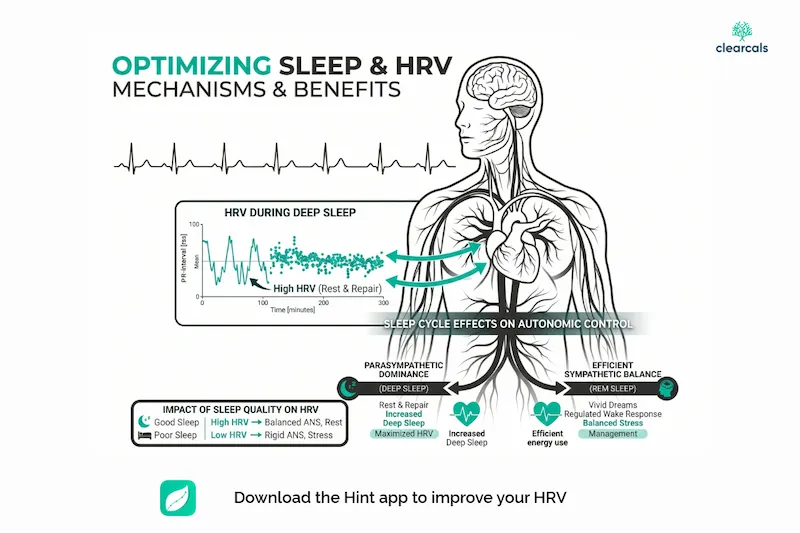
NREM Stage 3 (Deep sleep / Slow-wave sleep): This is the stage of peak HRV. Parasympathetic activity reaches its maximum, heart rate is at its lowest, and the heart beats with its greatest variability. Slow-wave sleep is the primary restorative window for the autonomic nervous system — every minute of deep sleep is a minute of maximum vagal dominance.
REM sleep: HRV during REM is characteristically lower and more variable than during deep sleep. During REM, the autonomic nervous system is in an unusual state: the brain is highly active (producing the vivid dreams associated with REM), and both sympathetic and parasympathetic activity fluctuate rapidly. HRV patterns during REM are distinctively erratic, with periods of low HRV interspersed with brief high-variability bursts.
Practical implication: The amount of deep sleep in your night is the strongest single predictor of your overnight HRV reading. Two nights with the same total sleep duration but different proportions of deep sleep will produce meaningfully different HRV values — the night with more deep sleep will show higher overnight HRV.
How Garmin Measures Overnight HRV
Garmin records HRV continuously throughout the night using optical heart rate sensors on compatible devices. Rather than a single spot measurement, Garmin calculates RMSSD (Root Mean Square of Successive Differences) across multiple 5-minute windows during sleep and aggregates these into an overnight average.
This overnight RMSSD average is the value used to calculate your HRV Status (Balanced, Unbalanced, Low, or Poor), which Garmin then compares against your personal baseline — a rolling 25-night weighted average that updates daily.
Garmin's HRV Status in the app shows:
- Your current 5-night average HRV
- Your personal baseline range (upper and lower bounds)
- A trend graph of your overnight HRV over time
For a detailed breakdown of what each HRV Status category means and how to act on it, see Garmin Health Metrics Explained.
A note on Apple Watch: Apple Watch reports SDNN rather than RMSSD, and its overnight HRV data is captured through spot measurements during sleep rather than continuous overnight recording. SDNN values are typically 30–50% higher than RMSSD in the same person — the two metrics are not directly comparable.
What "HRV Sleep" and "Overnight HRV" Mean on Your Device
Terms like "HRV sleep", "sleep HRV", and "overnight HRV" refer to the same measurement: HRV values recorded during sleep hours. The slight terminology differences across devices and apps reflect different reporting conventions, not different metrics.
On Garmin Connect, this is displayed as the HRV During Sleep graph and contributes to your HRV Status calculation.
On WHOOP, overnight HRV is the primary input into the daily Recovery Score — a 0–100 composite metric that includes overnight HRV, resting heart rate, and sleep performance.
On Oura Ring, HRV is measured each night and contributes to the Readiness Score alongside sleep stages, resting heart rate, and temperature deviation.
All three use RMSSD as the underlying metric and measure overnight (sleep) HRV as the primary signal. This makes their values comparable to each other and to the RMSSD reference ranges by age, though device-level accuracy differences exist (optical vs chest-strap sensor methods differ in absolute accuracy, particularly during poor skin contact).
The Bidirectional Relationship: Sleep Affects HRV, and HRV Predicts Sleep Quality
The relationship between sleep and HRV runs in both directions:
Sleep affects HRV: Poor sleep quality — whether from insufficient duration, frequent waking, reduced deep sleep, or obstructive sleep apnoea — produces lower overnight HRV the same night and the following night. The causal mechanism is clear: deep sleep deficit reduces the peak parasympathetic activity available during sleep, and sympathetic activity from the stress of fragmented sleep carries over.
HRV predicts sleep quality: Individuals with chronically low baseline HRV have more fragmented sleep, less deep sleep, and worse subjective sleep quality than those with higher HRV — even when controlling for age, BMI, and known sleep disorders. Low HRV signals a sympathetically-dominant autonomic state that makes it harder to fall asleep, harder to maintain deep sleep, and easier to rouse from sleep in response to mild stimuli.
This bidirectionality creates cycles — in both directions:
The negative cycle: Poor sleep → lower overnight HRV → sympathetic dominance → harder to fall asleep and maintain deep sleep → worse sleep → lower HRV. Insomnia, chronic stress, and obstructive sleep apnoea each set up and sustain this cycle.
The positive cycle: Exercise → improved aerobic fitness → higher resting HRV → easier sleep onset → more deep sleep → higher overnight HRV → better recovery → more effective exercise.
What Lowers Your Overnight HRV
Alcohol: The most consistent acute overnight HRV suppressor in consumer wearable data. Even 1–2 drinks reduces overnight HRV by 15–25%. The mechanism involves direct sympathetic activation by acetaldehyde (the primary alcohol metabolite), disruption of sleep architecture (alcohol suppresses REM sleep and increases waking in the second half of the night), and impaired temperature regulation. The HRV-suppressing effect of alcohol is measurable up to 72 hours after heavy drinking.
Late-night eating: Digestion activates the enteric nervous system and requires increased splanchnic blood flow, which can modestly elevate heart rate and reduce HRV during sleep, particularly in the first sleep cycle. This effect is most pronounced with large, high-fat meals consumed within 2–3 hours of sleep.
Psychological stress: Unresolved psychological stress maintains elevated evening cortisol that delays sleep onset and suppresses deep sleep. Both effects reduce overnight HRV, and the HRV reading the following morning reflects the combined impact of stress-induced sleep disruption and direct autonomic suppression.
Obstructive sleep apnoea: Repeated apnoeic episodes during sleep trigger arousal responses that massively spike sympathetic activity. Each apnoea produces a cortisol and catecholamine surge that further disrupts the subsequent sleep cycle. Overnight HRV in untreated moderate-to-severe OSA patients is dramatically suppressed, and HRV readings during apnoeic episodes show near-complete loss of normal parasympathetic modulation.
Room temperature extremes: Sleeping in a hot environment (above 22–23°C) activates thermoregulatory sympathetic pathways, increasing heart rate and reducing HRV. The optimal sleep temperature for HRV and deep sleep is 18–20°C.
Caffeine (late intake): Caffeine's half-life is approximately 5–7 hours. Caffeine consumed after 2–3 pm will be active during sleep onset, delaying sleep and suppressing deep sleep — both of which reduce overnight HRV.
Overtraining: The autonomic suppression of overtraining is most visible in overnight HRV readings. Athletes in overtraining show persistently suppressed overnight HRV that does not recover between training sessions, a pattern clearly distinguishable from the normal 1–2 day suppression following a hard training session.
What Raises Your Overnight HRV
Consistent sleep timing: Aligning sleep and wake times consistently regulates the circadian system, optimising the proportion of sleep spent in deep sleep and reducing the cortisol irregularities associated with variable sleep timing.
Aerobic exercise (in the longer term): While exercise acutely suppresses next-night HRV, consistent aerobic training over weeks produces structural cardiac autonomic adaptation that raises baseline overnight HRV. The long-term effect is opposite in direction to the short-term effect.
Resonance frequency breathing before sleep: 10–15 minutes of slow, paced breathing (6 breaths per minute) as a pre-sleep practice activates the parasympathetic nervous system and facilitates sleep onset. This can be measured directly: HRV during a resonance breathing session is elevated, and this elevated tone can carry into the first sleep cycles.
Optimal sleep environment: Cool room (18–20°C), darkness, and minimal noise promote deep sleep architecture, which directly raises overnight HRV.
Alcohol avoidance: The HRV improvement from reducing or eliminating alcohol is one of the most immediate and reproducible lifestyle changes visible in wearable data. Users who stop drinking for 2–4 weeks consistently see overnight HRV rise by 10–25%.
Interpreting Low Overnight HRV on Your Device
A low overnight HRV reading needs context to be meaningful:
Single low reading: Almost always explained by the previous day's events — exercise, alcohol, poor sleep from external disruption, illness onset, stressful day. Check these before concluding anything.
3–5 consecutive days below baseline: Review the previous week for accumulated stressors. Consider reducing training load and prioritising sleep. Common causes: cumulative training load, subacute illness (HRV often drops 12–24 hours before symptoms become obvious), sustained psychological stress, accumulated sleep debt.
Persistently below baseline for 2+ weeks: Investigate contributing factors systematically. Alcohol intake, sleep quality, training load, stress, and metabolic health are the primary domains to review. If no lifestyle explanation is apparent, consider whether an underlying medical condition (thyroid dysfunction, developing metabolic syndrome, sleep apnoea, subclinical infection) may be contributing.
Trending downward over months: A slow downward trend in overnight HRV over several months signals progressive autonomic deterioration. This is the pattern most worth taking seriously — it suggests that lifestyle or metabolic factors are cumulatively worsening autonomic function and warrants active intervention.
HRV, Sleep, and Metabolic Health
The connection between overnight HRV, sleep quality, and metabolic health is tightly interwoven. Poor metabolic health reduces both HRV and sleep quality simultaneously — insulin resistance impairs autonomic function and disrupts sleep architecture; excess visceral fat increases the risk of obstructive sleep apnoea; elevated evening cortisol from chronic stress both suppresses HRV and reduces deep sleep. This creates a triangle of mutual reinforcement between poor metabolic health, poor sleep, and low HRV.
Conversely, improving any one of these three improves the other two. Aerobic exercise improves HRV, sleep quality, and insulin sensitivity simultaneously. Weight loss improves sleep apnoea severity, overnight HRV, and metabolic markers together. This is why overnight HRV is particularly valuable as a health monitoring metric: it sits at the intersection of multiple health systems and captures cumulative changes across all of them.
For a comprehensive overview of how HRV connects to the full range of metabolic conditions, see Heart Rate Variability: Complete Guide.
References
- Brandenberger G, et al. Effect of sleep deprivation on overall 24h growth hormone secretion. Lancet. 2000;356(9234):984.
- Ako I, et al. Overnight changes in heart rate variability with sleep architecture. Psychiatry and Clinical Neurosciences. 2003;57(3):255–261.
- Tobaldini E, et al. Heart rate variability in normal and pathological sleep. Frontiers in Physiology. 2013;4:294.
- Tsuji H, et al. Impact of reduced heart rate variability on risk for cardiac events: the Framingham Heart Study. Circulation. 1996;94(11):2850–2855.
- Stein PK, Pu Y. Heart rate variability, sleep and sleep disorders. Sleep Medicine Reviews. 2012;16(1):47–66.
About the Author
Dr. Krishna Athmakuri is the Co-Founder and CEO of Clearcals, where he leads the development of data-driven health technology through the Hint app.
With a Ph.D. in Chemical Engineering from Rensselaer Polytechnic Institute, New York, his expertise spans analytics, protein chemistry, and biotechnology.
Earlier in his career, he developed biotherapeutics for diabetes and metabolic diseases at companies like Aurobindo Pharma and Dr. Reddy's Laboratories.
At Clearcals, he now applies that scientific rigour to build personalised fitness tools — including Hint Pro Workouts, nutrition tracking, and real-time metabolic insights — helping users make smarter health decisions through technology.
Connect with Dr. Krishna on LinkedIn
👉 Back to the pillar page: Heart Rate Variability (HRV): Complete Guide 👉 Related: HRV Normal Range by Age | Low HRV: Causes and What to Do | How to Improve HRV | Garmin Health Metrics Explained