Track your nutrition and health goals

How to Improve HRV: Evidence-Based Strategies That Actually Work
By Dr. Krishna Athmakuri, Co-Founder & CEO, Clearcals | Updated: May 2026
Can You Actually Improve HRV?
Yes — but the mechanisms and timelines matter. HRV improvement is not like improving a skill through practice.
It reflects genuine physiological changes in autonomic nervous system function, specifically increases in parasympathetic (vagal) tone, reductions in chronic sympathetic activation, and improvements in cardiovascular and metabolic health that underpin autonomic regulation.
The evidence base for HRV improvement is now extensive.
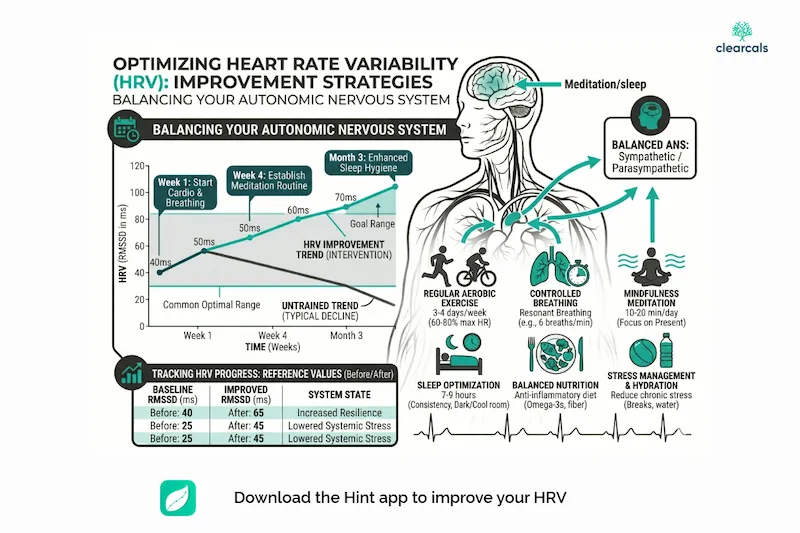
Multiple randomised controlled trials, large observational cohorts, and meta-analyses confirm that specific, sustained lifestyle interventions reliably raise HRV — and that these improvements correlate with meaningful changes in underlying health markers, not just better numbers on a wearable.
Two important expectations to set upfront:
HRV improvement takes weeks to months, not days. The physiological adaptations underlying real HRV improvement — cardiac remodelling, improved insulin sensitivity, reduced systemic inflammation, enhanced vagal tone — develop over 6–12 weeks of consistent intervention. Anything that raises your HRV overnight is likely a reflection of reduced acute stress, not genuine autonomic improvement.
Your personal baseline is the benchmark. A 40-year-old with an RMSSD of 32ms who raises it to 44ms over 3 months has made a clinically meaningful improvement — even though 44ms is still in the "Below Average" population range. The percentage improvement relative to your own baseline, not the absolute number, is the relevant metric.
1. Aerobic Exercise: The Most Potent HRV Intervention
Regular aerobic exercise is the single most effective modifiable factor for raising HRV. Multiple meta-analyses confirm this, with effect sizes among the largest of any lifestyle intervention studied in controlled trials.
Why it works: Aerobic training produces cardiac autonomic adaptation — the heart and autonomic nervous system remodel to handle the demand of repeated aerobic stress. The primary adaptations include increased vagal tone at rest, increased cardiac parasympathetic sensitivity, reduced resting heart rate, and improved baroreceptor sensitivity. These changes are evident in 6–8 weeks and continue accumulating for months to years.
The dose that works: The evidence points consistently to moderate-intensity continuous training (MICT) — 30–45 minutes at 60–75% of maximum heart rate, 4–5 times per week. Zone 2 training (the intensity at which you can still hold a conversation) is the sweet spot for HRV improvement. High-intensity interval training (HIIT) also improves HRV but is better used to complement, not replace, regular moderate aerobic exercise.
Important nuance: Exercise acutely suppresses HRV for 12–48 hours after hard sessions. This is expected and healthy — it reflects the physiological stress of training, which your body recovers from above baseline (supercompensation). Monitor your HRV over weeks and months, not day-to-day swings following training.
Practical starting point: If you are currently sedentary, begin with 20–25 minutes of brisk walking 4 times per week. Within 4–6 weeks, extend the duration to 35–40 minutes and add one day. Add gentle jogging progressively once fitness allows. Consistency over 3–4 months will produce measurable HRV improvement.
2. Sleep Optimisation: Restoring the Parasympathetic Window
HRV is highest during slow-wave (deep) sleep, when the parasympathetic nervous system reaches its maximum activity. Sleep quality improvement is not just correlated with HRV improvement — it is mechanistically central to it. Restoring adequate deep sleep is equivalent to extending the daily window of parasympathetic restoration.
Duration: Aim for 7–9 hours of sleep opportunity. Research shows that even one week of sleep restriction to 6 hours produces measurable HRV suppression, and that restoration of normal sleep duration reverses this within 2–3 nights.
Consistency: Going to sleep and waking at the same time daily — including weekends — is one of the most underrated HRV interventions. Circadian alignment optimises the proportion of night spent in deep sleep and reduces cortisol dysregulation that suppresses parasympathetic tone.
Sleep architecture: Deep sleep and REM sleep are both important for HRV recovery. Behaviours that fragment sleep or suppress deep sleep — alcohol, late-evening meals, high room temperature, blue light exposure in the hour before sleep, and late caffeine — each independently reduce overnight HRV.
Obstructive sleep apnoea: If you snore, feel unrefreshed despite adequate sleep duration, or have a bed partner who reports breathing pauses during your sleep, obstructive sleep apnoea is a strong possibility and a significant HRV suppressor. CPAP treatment for obstructive sleep apnoea produces some of the most dramatic HRV improvements of any single intervention — in controlled trials, treated patients show 15–25% overnight HRV improvement within weeks of starting therapy.
Practical targets:
- Consistent sleep/wake timing (within 30 minutes daily)
- Bedroom temperature 18–20°C
- No alcohol within 3 hours of sleep
- No caffeine after 2 pm
- Dim lighting and limited screen exposure in the final hour before bed
3. Resonance Frequency Breathing: The Fastest Reliable HRV Tool
Slow, paced breathing at approximately 6 breaths per minute — called resonance frequency breathing or HRV biofeedback — is the most evidence-supported technique for rapidly and reliably raising HRV. Multiple randomised controlled trials confirm that resonance frequency breathing practice produces both acute HRV increases (during the practice session itself) and chronic HRV improvement with regular practice over weeks.
Why it works: At approximately 6 breaths per minute (5 seconds inhale, 5 seconds exhale), breathing rate enters resonance with the heart's natural baroreflex frequency. This produces a state of maximal respiratory sinus arrhythmia — the HRV pattern driven by normal breathing — and trains the baroreflex to operate with greater amplitude. With regular practice, the enhanced baroreflex sensitivity persists outside of practice sessions, raising resting HRV.
The evidence: A 2017 meta-analysis of HRV biofeedback randomised controlled trials found significant improvements in HRV, anxiety, and stress measures. Effect sizes for chronic HRV improvement after 4–8 weeks of daily practice (15–20 minutes per day) are comparable to those seen with exercise interventions in several comparisons.
Protocol:
- Inhale through the nose for 5 seconds
- Exhale through the mouth (or nose) for 5 seconds
- Maintain this rhythm for 15–20 minutes
- Practice once daily, ideally at the same time each day — early morning before checking devices works well
- Expect acute HRV elevation during and immediately after practice; chronic HRV improvement develops over 3–6 weeks of consistent daily practice
Free apps that guide resonance frequency breathing and allow HRV monitoring during sessions include Welltory, Elite HRV, and the Garmin Breathwork activity.
4. Managing Chronic Psychological Stress
Chronic psychological stress maintains cortisol elevation and sympathetic dominance — both of which directly suppress HRV. Stress management is not a soft intervention; it produces measurable autonomic change.
What works:
Structured mindfulness-based stress reduction (MBSR): The 8-week MBSR protocol developed by Jon Kabat-Zinn has been assessed in multiple RCTs and consistently produces HRV improvement, particularly in individuals with high baseline stress. The mechanism involves both reduced HPA axis activation (lower cortisol) and direct sympathovagal balance improvement.
Regular nature exposure: Time spent in natural environments (parks, forests, outdoor spaces) reliably reduces cortisol and improves HRV measures. The effect is present even with 20–30 minutes of exposure and does not require wilderness — urban green spaces produce measurable effects.
Social connection: Chronically isolated individuals have consistently lower HRV than socially connected people of the same age and health status. The vagus nerve innervates facial muscles and the auditory system in ways that connect social engagement directly to parasympathetic function (the polyvagal framework). This is not merely correlation — interventions that improve social connection produce HRV improvement.
Identifying and reducing modifiable stressors: This is obvious but frequently under-acted on. Chronic work overload, relationship conflict, financial stress, and unmanaged anxiety each maintain the autonomic state that suppresses HRV. Addressing root causes — not just practising relaxation techniques on top of unresolved stressors — produces more sustained HRV improvement.
5. Dietary Interventions
Diet affects HRV primarily through its downstream effects on metabolic health, systemic inflammation, and gut microbiome composition. There is no HRV-specific "diet", but several evidence-supported dietary patterns and specific nutrients have direct effects:
Mediterranean and plant-rich dietary patterns: Higher fruit, vegetable, legume, whole grain, and olive oil intake is consistently associated with higher HRV in observational studies. The mechanism is multi-pathway: reduced systemic inflammation, improved insulin sensitivity, and favourable effects on the gut-vagus axis.
Omega-3 fatty acids: Among the most consistently evidence-supported dietary HRV interventions. Multiple randomised trials of omega-3 supplementation (EPA + DHA combined, 2–4g/day) have demonstrated significant RMSSD improvement over 8–16 weeks. The mechanism involves anti-inflammatory effects on cardiac autonomic ganglia and direct modulation of ion channels governing cardiac electrical activity. Fish oil (EPA + DHA) is the most studied form; algal omega-3 is the plant-based equivalent.
Reducing ultra-processed food intake: Diets high in ultra-processed foods are associated with lower HRV independently of overall caloric intake, body weight, and conventional cardiometabolic markers. The mechanism likely involves gut microbiome disruption, increased endotoxin load, and systemic inflammatory signalling.
Avoiding alcohol: The HRV-suppressing effect of alcohol is one of the most consistent and dose-dependent findings in consumer HRV data. Even a moderate reduction in alcohol intake — from, say, 5 drinks per week to 2 — produces meaningful HRV improvement in regular drinkers.
Reducing refined carbohydrate and added sugar: In people with insulin resistance, reducing the glycaemic load of the diet improves insulin sensitivity, reduces visceral fat, and produces secondary HRV improvement. The effect is particularly pronounced in individuals with metabolic syndrome or prediabetes.
6. Weight Loss and Metabolic Improvement
In individuals who are overweight or have metabolic dysfunction, fat mass reduction is one of the most reliable routes to HRV improvement. Clinical studies show that even modest weight loss (5–10% of body weight) produces significant HRV improvement, and that the improvement is proportional to the amount of fat mass lost — particularly visceral (abdominal) fat.
Visceral adiposity suppresses HRV through chronic low-grade inflammation, adipokine-mediated autonomic dysregulation, and the accompanying insulin resistance and dyslipidaemia. Reducing it reverses all three mechanisms.
Exercise-based weight loss produces the most HRV improvement per kilogram lost (due to the combined exercise and fat loss effects), but caloric restriction without exercise also improves HRV — confirming that the fat mass reduction itself, not just the activity, is contributing.
7. Treating Underlying Medical Conditions
Several common medical conditions independently suppress HRV through specific mechanisms. Where these are present, treating the underlying condition produces HRV improvement as a secondary benefit:
Hypertension: Antihypertensive treatment — particularly with ACE inhibitors and ARBs, which have direct autonomic modulating effects — improves HRV beyond blood pressure reduction alone.
Hypothyroidism: Thyroid hormone replacement in hypothyroid individuals restores cardiac autonomic modulation and raises HRV, often substantially.
Obstructive sleep apnoea: As mentioned above, CPAP treatment reliably and substantially improves HRV.
Type 2 diabetes and insulin resistance: Glycaemic optimisation and insulin-sensitising treatments (metformin, GLP-1 agonists) improve HRV through reduction of the autonomic neuropathic processes that accompany chronic hyperglycaemia.
Depression and anxiety disorders: Effective treatment — whether pharmacological, psychological, or both — improves HRV by reducing the chronic sympathetic activation that accompanies untreated mood disorders.
What HRV Improvement Actually Looks Like
For a sedentary, metabolically healthy adult who implements regular aerobic exercise and sleep improvements, realistic HRV improvement over 3–6 months might be 20–35% above baseline. For individuals starting with significant metabolic dysfunction (obesity, insulin resistance, poor sleep, high chronic stress), addressing all contributing factors can produce 40–60% improvement — though this requires sustained, multi-modal intervention.
Day-to-day fluctuations of 10–20% are normal and should not be interpreted as success or failure. The meaningful signal is in the 4-week or longer rolling trend on your wearable device.
On Garmin devices: The HRV Status graph in the Garmin Connect app shows your 5-night rolling average alongside your personal baseline range. The upward movement of this rolling average over weeks is the primary indicator of genuine HRV improvement.
References
- Lehrer PM, Gevirtz R. Heart rate variability biofeedback: how and why does it work? Frontiers in Psychology. 2014;5:756.
- Giallauria F, et al. Effects of cardiac rehabilitation on heart rate variability. Monaldi Archives for Chest Disease. 2008;70(1):27–32.
- Routledge FS, et al. Regular moderate-intensity aerobic exercise and its effect on heart rate variability. Canadian Journal of Cardiology. 2010;26(6):e161–e165.
- Balzarotti S, et al. Resonance frequency breathing as a method to improve HRV. Complementary Therapies in Medicine. 2017;30:108–113.
- Dıaz Mıquel Rodes M, et al. Omega-3 fatty acids and heart rate variability. Journal of Clinical Lipidology. 2017;11(3):672–679.
About the Author
Dr. Krishna Athmakuri is the Co-Founder and CEO of Clearcals, where he leads the development of data-driven health technology through the Hint app.
With a Ph.D. in Chemical Engineering from Rensselaer Polytechnic Institute, New York, his expertise spans analytics, protein chemistry, and biotechnology.
Earlier in his career, he developed biotherapeutics for diabetes and metabolic diseases at companies like Aurobindo Pharma and Dr. Reddy's Laboratories.
At Clearcals, he now applies that scientific rigour to build personalised fitness tools — including Hint Pro Workouts, nutrition tracking, and real-time metabolic insights — helping users make smarter health decisions through technology.
Connect with Dr. Krishna on LinkedIn
👉 Back to the pillar page: Heart Rate Variability (HRV): Complete Guide 👉 Related: Low HRV: Causes and What to Do | HRV Normal Range by Age | HRV and Sleep