Track your nutrition and health goals

Sleep Stages Explained: REM, Deep Sleep, Core Sleep and What Each One Does
By Dr. Krishna Athmakuri, Co-Founder & CEO, Clearcals | Updated: July 2026
Sleep Is Not One Thing
One of the most widespread misconceptions about sleep is that it is a uniform resting state — the brain simply switching off until morning.
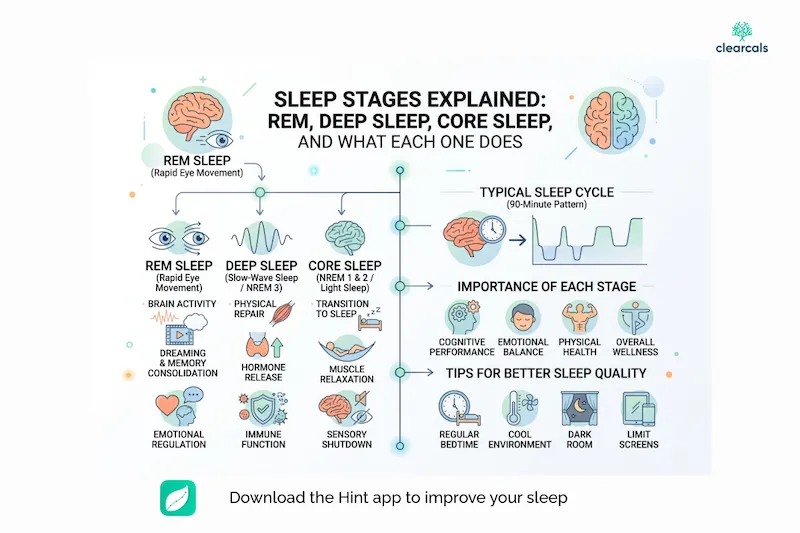
In reality, sleep is a highly organised, biologically active process that cycles through four distinct stages across the night, each governed by different neurological mechanisms and each producing different restorative effects.
Understanding these stages is practically useful. When your wearable shows you had low deep sleep last night, or when you wake at 3 am and can't return to sleep, or when your sleep score is low despite sleeping 8 hours — knowing what each stage does and what disrupts it allows you to interpret and improve your sleep intelligently.
The Sleep Cycle
A full sleep cycle takes approximately 90 minutes and is repeated 4–6 times across a normal night. The cycle is not identical each time — the composition shifts across the night. Deep sleep (slow-wave sleep) dominates the first two cycles of the night (the first 3–4 hours), while REM sleep dominates the final cycles (the hours before waking). This front-loading of deep sleep and back-loading of REM has important practical implications: disrupting early sleep preferentially costs deep sleep; disrupting later sleep preferentially costs REM.
NREM Stage 1: Light Sleep (Transition)
Duration: 1–7 minutes per cycle. Represents approximately 5% of total sleep.
Stage 1 is the threshold between wakefulness and sleep — a light, easily disrupted state in which the brain shifts from waking alpha waves to slower theta waves. Heart rate begins to slow, muscles relax, and the brain begins to disengage from sensory processing.
Stage 1 is where hypnic jerks occur — the sudden muscle contractions many people experience as they fall asleep, often accompanied by a brief sensation of falling. These are a normal feature of the wakefulness-to-sleep transition.
What happens when it's disrupted: Frequent awakenings that return you to Stage 1 throughout the night indicate fragmented sleep. This is a hallmark of obstructive sleep apnoea, where each apnoeic event causes a micro-arousal that resets the sleep stage back to Stage 1 or full waking.
NREM Stage 2: Core Sleep
Duration: 10–25 minutes in early cycles, longer in later cycles. Represents approximately 45–50% of total sleep — the largest single stage.
Stage 2 is characterised by sleep spindles and K-complexes — brief bursts of neural oscillations that play a role in memory consolidation and protecting the sleeping brain from environmental arousal. Heart rate and breathing slow further, body temperature continues to fall, and the brain becomes progressively less responsive to external stimuli.
Apple Watch terminology note: Apple Watch labels Stage 2 as "Core Sleep" in the Health app. This terminology is Apple-specific and does not reflect a broader clinical convention. Core sleep on Apple Watch is Stage 2, not deep sleep — an important distinction because Stage 2, while occupying the largest portion of the night, is metabolically less significant than Stage 3 (deep/slow-wave sleep).
What it does: Sleep spindle activity during Stage 2 is strongly linked to declarative memory consolidation — converting short-term experiences from the previous day into longer-term memories. Procedural and motor memory consolidation also occurs primarily during Stage 2.
NREM Stage 3: Deep Sleep (Slow-Wave Sleep)
Duration: 20–40 minutes in the first two cycles of the night; very little in later cycles. Represents approximately 15–20% of total sleep in healthy young adults, declining with age.
Stage 3 is the deepest, most physiologically restorative sleep stage. Brain activity slows to delta waves (0.5–4 Hz) — the slowest brain waves recorded during sleep. It is the hardest stage to wake from; being roused from deep sleep produces significant grogginess (sleep inertia) that can persist for 20–30 minutes.
What it does — metabolically and physiologically:
The majority of daily growth hormone secretion occurs during the first slow-wave sleep episode of the night. Growth hormone drives muscle protein synthesis, fat oxidation, tissue repair, and IGF-1 production. Without adequate deep sleep, recovery from exercise is impaired, and body composition progressively worsens.
Insulin sensitivity is restored during deep sleep. Slow-wave sleep suppresses hepatic glucose output, stabilises blood glucose, and allows peripheral tissues to restore insulin receptor sensitivity. Deep sleep deprivation — even with total sleep time maintained — produces measurable insulin resistance within 3 nights.
The brain clears metabolic waste through the glymphatic system — a cerebrospinal fluid drainage system that is most active during slow-wave sleep. This system removes beta-amyloid, tau protein, and other metabolic byproducts that accumulate during waking neural activity. Impaired glymphatic clearance during insufficient deep sleep is a proposed mechanism in the long-term connection between poor sleep and neurodegenerative risk.
Immune restoration — particularly production of cytotoxic T-cells and NK cells — peaks during deep sleep. Illness, infections, and vaccinations all elicit increased slow-wave sleep as the immune system uses the restorative window for its most intensive work.
The autonomic nervous system is at peak parasympathetic dominance during deep sleep. HRV is highest, heart rate lowest, blood pressure reaches its nocturnal dip, and stress hormone levels are minimised. This is the physiological basis of the strong correlation between deep sleep quality and overnight HRV on wearable devices.
What disrupts it most: Alcohol, warm room temperature, irregular sleep timing, obstructive sleep apnoea, high evening cortisol from stress, caffeine, and large late-night meals are the primary suppressors. Deep sleep also declines naturally with age, falling from ~20–25% in early adulthood to under 10% in many people over 60.
REM Sleep: Rapid Eye Movement
Duration: 10 minutes in the first cycle, extending to 30–60 minutes in the final cycles. Represents approximately 20–25% of total sleep.
REM sleep is the stage associated with vivid dreaming. Brain activity is paradoxically high — nearly indistinguishable from waking on EEG — but the body is in a state of voluntary muscle atonia (paralysis), preventing the acting-out of dreams. Breathing and heart rate become irregular; HRV is lower and more variable than during deep sleep.
What it does:
REM sleep is critical for emotional memory processing and regulation. During REM, the brain replays emotionally charged experiences and integrates them with existing memory networks, reducing their emotional salience. This is the mechanism behind the well-described effect of "sleeping on it" — emotional problems genuinely feel less acute after REM sleep. REM deprivation produces heightened emotional reactivity, increased anxiety, and reduced stress tolerance.
Associative memory consolidation — linking disparate concepts, creative insight, and problem-solving — occurs predominantly during REM. Studies show that REM sleep improves performance on tasks requiring novel cognitive connections, explaining the subjective experience of waking with a solution to a problem worked on the previous day.
REM sleep maintains brain metabolic regulation — the brain's own glucose consumption is near-waking levels during REM, and REM sleep appears necessary for maintaining the metabolic efficiency of brain circuits used in emotional regulation and executive function.
What disrupts it most: Alcohol (which strongly suppresses REM in the first half of the night), antidepressants (SSRIs and SNRIs reduce REM in many people), very early waking (which cuts the final REM-rich cycles), and fragmented sleep from any cause.
REM vs. Deep Sleep: Which Is More Important?
Both are essential — they perform different and non-substitutable functions. A useful analogy: deep sleep is physical repair and metabolic restoration; REM sleep is emotional and cognitive processing.
People who are physically active, dealing with metabolic health challenges, or recovering from illness need deep sleep most urgently. People managing high emotional load, learning new skills, or dealing with psychological stress need adequate REM most urgently. In practice, both are needed, and chronic deficiency in either produces specific, recognisable consequences.
| Deep Sleep (Stage 3) | REM Sleep | |
|---|---|---|
| Timing in night | Mostly first half | Mostly second half |
| Brain activity | Delta waves (slowest) | Near-waking activity |
| Body state | Muscle relaxed, low movement | Voluntary muscle atonia |
| Primary function | Physical repair, metabolic restoration, immune function | Emotional processing, memory integration, creative cognition |
| HRV | Highest of all stages | Lower, more variable |
| Growth hormone | Peak secretion | Minimal |
| Suppressed by | Alcohol, heat, stress, apnoea | Alcohol, SSRIs, early waking |
| % of total sleep | 15–20% | 20–25% |
Core Sleep vs. Deep Sleep on Apple Watch
This distinction causes significant confusion. On Apple Watch:
- "Core Sleep" = NREM Stage 2 (light-to-moderate sleep, ~45% of night)
- "Deep Sleep" = NREM Stage 3 (slow-wave sleep, ~15–20% of night)
Apple Watch introduced "Core Sleep" as a label to describe Stage 2, which is not standard clinical terminology. When comparing sleep data across Apple Watch, Garmin, WHOOP, and Oura Ring, note that all devices should report "Deep Sleep" as Stage 3 slow-wave sleep — but Apple Watch's "Core Sleep" is Apple-specific.
If your Apple Watch shows very low "Deep Sleep" (below 10% of total sleep consistently), that is a meaningful signal. If your "Core Sleep" appears low, this is less concerning as Stage 2 is rarely deficient in isolation.
How Wearables Measure Sleep Stages
Consumer wearables estimate sleep stages using a combination of heart rate, heart rate variability, and accelerometer (movement) data. They do not measure brain electrical activity (EEG), which is the gold-standard method used in clinical sleep studies (polysomnography).
The practical accuracy of consumer wearables for sleep staging is reasonable at the population level — they reliably distinguish deep sleep from light sleep and REM from NREM. However, on any individual night, stage estimates carry uncertainty of 20–30 minutes. The most valuable use of wearable sleep data is trending over weeks and months, not interpreting individual nights precisely.
Overnight HRV — which is directly measured rather than estimated — is the most reliable metabolic signal from wearable sleep monitoring. See HRV and Sleep for a detailed explanation of how overnight HRV reflects sleep quality.
Connecting sleep stages to your nutrition: The Hint app (version 2.0) syncs automatically with Apple Health on iOS — importing your sleep stage data and overnight HRV from your Apple Watch or Garmin without manual entry. Google Health Connect sync for Android launches July 2026. Hint's AI insights factor your sleep-stage data into next-day nutrition guidance, and Hint Pro users get trend charts showing how deep sleep and REM percentages change over time, alongside calorie and protein tracking. Learn more about the Hint app →
References
- Diekelmann S, Born J. The memory function of sleep. Nature Reviews Neuroscience. 2010;11(2):114–126.
- Walker MP, van der Helm E. Overnight therapy? The role of sleep in emotional brain processing. Psychological Bulletin. 2009;135(5):731–748.
- Tasali E, et al. Slow-wave sleep and the risk of type 2 diabetes in humans. PNAS. 2008;105(3):1044–1049.
- Xie L, et al. Sleep drives metabolite clearance from the adult brain. Science. 2013;342(6156):373–377.
- Leproult R, Van Cauter E. Role of sleep and sleep loss in hormonal release and metabolism. Endocrine Development. 2010;17:11–21.
About the Author
Dr. Krishna Athmakuri is the Co-Founder and CEO of Clearcals, where he leads the development of data-driven health technology through the Hint app. With a Ph.D. in Chemical Engineering from Rensselaer Polytechnic Institute, New York, his expertise spans analytics, protein chemistry, and biotechnology. Earlier in his career, he developed biotherapeutics for diabetes and metabolic diseases at companies like Aurobindo Pharma and Dr. Reddy's Laboratories. At Clearcals, he now applies that scientific rigour to build personalised fitness tools — including Hint Pro Workouts, nutrition tracking, and real-time metabolic insights — helping users make smarter health decisions through technology. Connect with Dr. Krishna on LinkedIn
👉 Back to the pillar page: Sleep and Metabolism: Complete Guide 👉 Related: How to Get More Deep Sleep | HRV and Sleep | Sleep Tracking: Garmin and Apple Watch