Track your nutrition and health goals

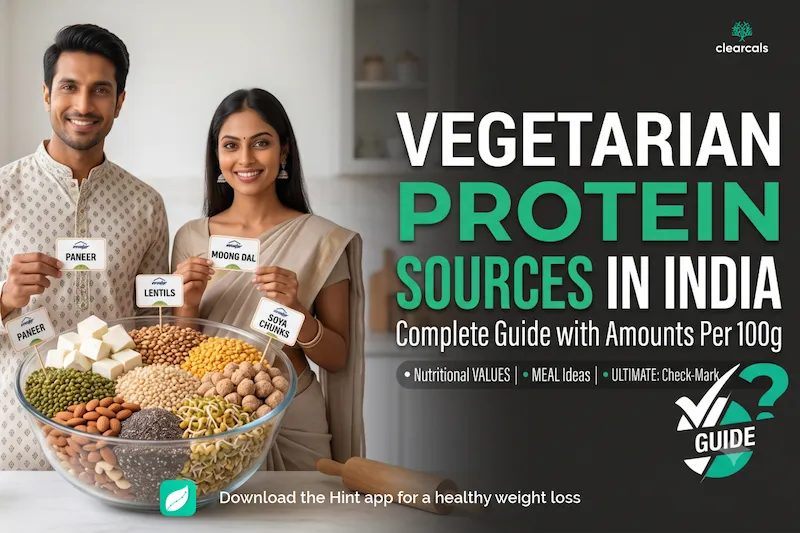
Vegetarian Protein Sources in India: Complete Guide with Amounts Per 100g
By Asfia Fatima, Chief Dietitian at Clearcals
India has one of the world's largest vegetarian populations — and one of the world's highest rates of protein deficiency. The two are related but not inevitable. A well-planned Indian vegetarian diet can meet daily protein requirements; the challenge is knowing which foods deliver meaningful amounts.
This complete guide covers every major vegetarian protein source available in India, with exact protein values per 100g, per katori, and per common serving.
How Much Protein Do You Need Per Day?
Before looking at sources, establish your target:
| Goal | Daily Protein (g per kg body weight) | Example: 60kg person |
|---|---|---|
| General health | 0.8g/kg | 48g/day |
| Weight loss | 1.2–1.5g/kg | 72–90g/day |
| Muscle gain | 1.6–2.2g/kg | 96–132g/day |
| Active lifestyle | 1.2–1.6g/kg | 72–96g/day |
Most Indian vegetarians consume 40–50g protein per day — meeting the minimum but not enough for active individuals or those trying to build muscle.
Track your daily protein easily with the Hint app, built specifically for Indian food with the NIN-ICMR database.
Top Vegetarian Protein Sources in India: Complete List
1. Soya Chunks (Meal Maker)
Soya chunks are the single highest-protein vegetarian food commonly eaten in India — and one of the most underrated.
| Metric | Value |
|---|---|
| Protein per 100g (raw) | ~52g |
| Protein per 100g (cooked/boiled) | ~14–17g |
| Calories per 100g (raw) | ~345 kcal |
| Protein per 1 katori cooked (~100g) | ~14–17g |
The raw protein content (52g/100g) shrinks significantly after boiling because soya chunks absorb water and expand. Still, a katori of cooked soya chunks delivers 14–17g protein — more than most other vegetarian foods at the same serving size.
How to eat: Soya chunks curry, pulao, dry fry, or added to keema-style dishes.
2. Paneer
Paneer is the most popular high-protein dairy food in an Indian vegetarian diet.
| Metric | Value |
|---|---|
| Protein per 100g | ~18.9g |
| Calories per 100g | ~258 kcal |
| Protein per 1 katori (~75g) | ~14.2g |
| Protein per 150g serving | ~28.4g |
Full-fat paneer provides almost 19g protein per 100g with zero carbohydrates — one of the cleanest protein sources for low-carb and keto diets.
How to eat: Paneer bhurji, palak paneer, paneer tikka, grilled paneer.
3. Moong Dal
Moong dal is the most protein-dense legume commonly consumed in Indian households, and one of the most digestible.
| Metric | Value |
|---|---|
| Protein per 100g (raw) | ~24g |
| Protein per 100g (cooked) | ~7–9g |
| Calories per 100g (cooked) | ~105 kcal |
| Protein per 1 katori cooked (~150g) | ~10–13g |
Whole moong (sprouted) offers slightly more protein and better bioavailability than split moong dal. Sprouting also reduces anti-nutrients.
How to eat: Dal tadka, moong dal khichdi, moong chilla, sprouted moong salad.
4. Chana (Chickpeas / Bengal Gram)
Chana — both kabuli (white chickpeas) and kala chana (black chickpeas) — is a protein and fibre powerhouse widely used in Indian cooking.
| Metric | Value |
|---|---|
| Protein per 100g (raw) | ~19–21g |
| Protein per 100g (cooked) | ~8–9g |
| Calories per 100g (cooked) | ~164 kcal |
| Protein per 1 katori cooked (~150g) | ~12–13g |
How to eat: Chhole masala, chana dal, roasted chana (a high-protein snack), sundal, hummus.
5. Rajma (Kidney Beans)
Rajma is a northern Indian staple that delivers a meaningful combination of protein and complex carbohydrates.
| Metric | Value |
|---|---|
| Protein per 100g (raw) | ~22–24g |
| Protein per 100g (cooked) | ~8–9g |
| Calories per 100g (cooked) | ~127 kcal |
| Protein per 1 katori cooked | ~12g |
How to eat: Rajma chawal, rajma soup, rajma paratha filling.
6. Urad Dal (Black Gram)
Urad dal is the protein-rich base of many South Indian dishes and North Indian preparations like dal makhani.
| Metric | Value |
|---|---|
| Protein per 100g (raw) | ~24–25g |
| Protein per 100g (cooked) | ~8–9g |
| Calories per 100g (cooked) | ~105 kcal |
How to eat: Dal makhani, idli batter (urad + rice), medu vada, dosa batter.
7. Toor Dal (Arhar Dal)
The most commonly consumed dal in India, toor dal is a moderate protein source that forms the base of everyday nutrition for millions.
| Metric | Value |
|---|---|
| Protein per 100g (raw) | ~22g |
| Protein per 100g (cooked) | ~7–8g |
| Calories per 100g (cooked) | ~116 kcal |
How to eat: Sambar, plain dal tadka, dal fry.
8. Tofu
Tofu is made from soy milk and delivers solid protein with a neutral taste that absorbs Indian spices well.
| Metric | Value |
|---|---|
| Protein per 100g | ~8–10g (firm tofu) |
| Calories per 100g | ~76–100 kcal |
| Protein per 1 katori (~100g) | ~8–10g |
Tofu has less protein than paneer per 100g but fewer calories and no saturated fat — better for weight loss and lactose-intolerant individuals.
How to eat: Tofu bhurji, tofu tikka, tofu stir-fry, tofu in curry instead of paneer.
9. Curd / Dahi
Curd is a fermented dairy product that provides protein alongside probiotics for gut health.
| Metric | Value |
|---|---|
| Protein per 100g | ~3.5–4g |
| Protein per 1 katori (~150g) | ~5–6g |
| Calories per 100g | ~60–65 kcal |
Greek dahi/yogurt has roughly double the protein of regular curd (~7–8g per 100g). If protein is a priority, switch to Greek yogurt.
10. Milk
Milk provides quality complete protein at a low cost — a staple in Indian vegetarian diets.
| Metric | Value |
|---|---|
| Protein per 100ml (whole milk) | ~3.2–3.4g |
| Protein per 250ml glass | ~8g |
| Calories per 100ml | ~61 kcal |
Amul High Protein Milk (a fortified variant) delivers approximately 6–7g protein per 100ml — nearly double standard milk.
11. Oats
Plain rolled oats are underrated as a protein source in the Indian context.
| Metric | Value |
|---|---|
| Protein per 100g (raw) | ~13–17g |
| Protein per 50g serving | ~7–8.5g |
| Calories per 100g | ~370 kcal |
High-protein fortified oats (Pintola, Alpino, Doctor's Choice) deliver 25–27g protein per 100g.
12. Peanuts / Groundnuts
Peanuts are the most affordable high-protein food in India per rupee.
| Metric | Value |
|---|---|
| Protein per 100g | ~25–26g |
| Calories per 100g | ~567 kcal |
| Protein per 30g handful | ~7.5–8g |
High in calories — use as a protein supplement within calorie limits, not in unlimited quantities.
How to eat: Roasted peanuts as a snack, peanut butter, peanut chutney, peanut-based curries.
13. Quinoa
Quinoa is a complete protein grain — one of the few plant foods containing all nine essential amino acids.
| Metric | Value |
|---|---|
| Protein per 100g (raw) | ~14g |
| Protein per 100g (cooked) | ~4.4g |
| Calories per 100g (cooked) | ~120 kcal |
How to eat: Quinoa khichdi, quinoa pulao, quinoa salad.
All Sources Compared: Protein Per 100g
| Food | Protein per 100g (raw/dry) | Protein per 100g (cooked) | Calories per 100g (cooked) |
|---|---|---|---|
| Soya chunks | ~52g | ~14–17g | ~98 kcal |
| Peanuts | ~25–26g | N/A (dry snack) | ~567 kcal |
| Urad dal | ~24–25g | ~8–9g | ~105 kcal |
| Moong dal | ~24g | ~7–9g | ~105 kcal |
| Rajma | ~22–24g | ~8–9g | ~127 kcal |
| Toor dal | ~22g | ~7–8g | ~116 kcal |
| Chana | ~19–21g | ~8–9g | ~164 kcal |
| Paneer | ~18.9g | N/A (dairy, eaten as is) | ~258 kcal |
| Quinoa | ~14g | ~4.4g | ~120 kcal |
| Oats | ~13–17g | ~7–9g (per 50g raw serving) | ~370 kcal |
| Tofu | ~8–10g | ~8–10g | ~76–100 kcal |
| Curd (dahi) | ~3.5–4g | ~3.5–4g | ~60 kcal |
| Milk | ~3.2–3.4g per 100ml | ~3.2–3.4g | ~61 kcal |
Sample High-Protein Vegetarian Meal Plan (Indian)
| Meal | Foods | Approx Protein |
|---|---|---|
| Breakfast | 50g rolled oats + 250ml milk + 1 tbsp peanut butter | ~18g |
| Mid-morning | 1 katori sprouted moong salad | ~10g |
| Lunch | 2 rotis + 1 katori rajma curry + 1 katori curd | ~20g |
| Snack | Handful of roasted chana (50g) | ~10g |
| Dinner | 150g paneer sabji + 1 katori dal + 2 rotis | ~35g |
| Total | ~93g |
This plan achieves ~93g protein — appropriate for a 60–65kg person targeting 1.4–1.5g/kg for weight loss or moderate muscle gain.
Can Vegetarians Get Enough Protein?
Yes — but it requires intention. Unlike a non-vegetarian diet where a single serving of chicken breast can deliver 50–65g protein, vegetarian protein sources typically deliver 7–18g per cooked serving. You need multiple protein-containing foods across multiple meals.
Key strategies for vegetarians:
- Include a protein source at every meal
- Combine legumes and dairy for complete amino acid profiles
- Use tofu and soya chunks as higher-protein alternatives to vegetable dishes
- Consider a whey or plant protein supplement if you're active and struggling to reach targets
FAQs
Which vegetarian food has the most protein in India? Soya chunks are the highest-protein plant food at ~52g protein per 100g dry weight. After cooking, paneer and cooked dal are the most practical everyday sources.
Can vegetarians build muscle? Yes, absolutely. Hitting 1.6–2.2g protein per kg body weight from vegetarian sources — through soya chunks, paneer, dal, legumes, and possibly whey protein — is entirely achievable.
What vegetarian food has more protein than eggs? Soya chunks (52g/100g dry) and peanuts (25g/100g) exceed eggs (13g/100g boiled) per 100g. Per calorie, paneer is comparable to eggs.
Final Thoughts
A well-structured Indian vegetarian diet can meet daily protein requirements — soya chunks, paneer, dal, chana, and legumes form a rich protein foundation. The key is eating enough of them consistently and combining sources across meals.
Use the Hint app to track your vegetarian protein intake using the NIN-ICMR Indian food database — the most accurate protein data available for Indian foods.
References
- Nutritional Profile of Indian Vegetarian Diets — the Indian Migration Study (IMS) — PMC, 2014
- Animal Protein versus Plant Protein in Supporting Lean Mass and Muscle Strength: A Systematic Review and Meta-Analysis — PMC, 2021
- Effect of Plant Versus Animal Protein on Muscle Mass, Strength, Physical Performance, and Sarcopenia: A Systematic Review and Meta-Analysis — Nutrition Reviews, 2025
- Clinical Evidence and Mechanisms of High-Protein Diet-Induced Weight Loss — PMC, 2020
- Does a Higher Protein Diet Promote Satiety and Weight Loss Independent of Carbohydrate Content? — PubMed, 2022
🎁 Free Hint with Every Watch Purchase
Garmin watches: Purchase any Garmin watch from the Clearcals Store and receive 1 month of Hint Premium (worth ₹1,999) free.
Apple Watch: Purchase any Apple Watch from the Clearcals Store and receive a free Hint Pro subscription.
About the Author
Asfia Fatima is the Chief Dietitian at Clearcals, with a Master's Degree in Dietetics and Clinical Nutrition and over a decade of experience in clinical nutrition and lifestyle management.
🔗 Connect with Asfia on LinkedIn