Track your nutrition and health goals

Vegetarian Indian Diet Plan for Weight Gain: 7-Day Meal Plan, Foods & Calories

By Asfia Fatima, Chief Dietitian at Clearcals
Gaining weight on a vegetarian Indian diet is entirely achievable — but it requires more than just eating more. You need the right calorie surplus, sufficient protein for muscle building, and a structured meal plan built around calorie-dense Indian vegetarian foods.
This guide covers everything: how many calories you actually need, which Indian veg foods are highest in calories and protein, a complete 7-day meal plan with calorie estimates, specific plans for males and females, and how to set realistic targets like gaining 5 kg in a month.
TL;DR — Vegetarian Weight Gain at a Glance
| Goal | What You Need |
|---|---|
| Calorie surplus for weight gain | +300–500 kcal/day above your TDEE |
| Realistic weight gain rate | 0.5–1 kg per week (with strength training) |
| Best protein sources (veg) | Soya chunks, paneer, rajma, chana, moong dal, tofu, curd |
| Best calorie-dense foods (veg) | Ghee, peanut butter, nuts, dates, whole milk, paneer, banana |
| Key rule | Eat at a surplus; train with weights to ensure gain is muscle, not fat |
How Many Calories Do You Need to Gain Weight?
Weight gain happens when you consistently eat more calories than you burn — this is called a caloric surplus. The basic math:
- 1 kg of body weight ≈ 7,700 kcal surplus (accumulated over time)
- A daily surplus of 300–500 kcal above your TDEE (Total Daily Energy Expenditure) produces ~0.3–0.5 kg per week
- A surplus of 500–750 kcal/day can produce ~0.5–0.75 kg per week
To find your starting calorie target:
- Calculate your TDEE using the Clearcals TDEE Calculator
- Add 300–500 kcal to that number
- Split across 5–6 meals per day to make it manageable
Example: If your TDEE is 2,200 kcal, target 2,500–2,700 kcal/day for steady weight gain.
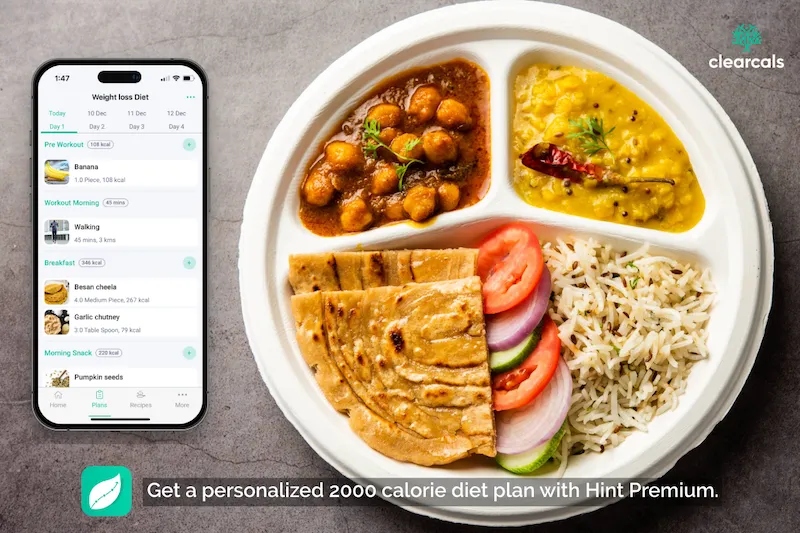
The Hint Pro app calculates your personalised calorie target automatically based on your weight, height, age, and activity level — and generates a vegetarian Indian meal plan to hit it.
High-Calorie Vegetarian Foods for Weight Gain
The fastest route to a calorie surplus is prioritising calorie-dense foods — foods that pack a lot of calories into a small volume so you don't need to eat massive portions.
Top High-Calorie Indian Vegetarian Foods
| Food | Serving | Calories | Why It Helps |
|---|---|---|---|
| Ghee | 1 tbsp (15g) | 135 kcal | Easiest way to add calories to any meal |
| Peanut butter | 2 tbsp (32g) | 188 kcal | Healthy fats + protein (8g per 2 tbsp) |
| Almonds | 1 handful (30g) | 174 kcal | Healthy fats, protein, vitamin E |
| Cashews | 1 handful (30g) | 166 kcal | Calorie-dense, high in healthy fats |
| Peanuts (roasted) | 1 handful (30g) | 170 kcal | Cheapest high-calorie snack available |
| Dates (khajoor) | 4–5 dates (50g) | 139 kcal | Natural sugar, fibre, iron |
| Raisins (kishmish) | 3 tbsp (30g) | 90 kcal | Easy to add to meals |
| Paneer | 100g | 265 kcal | 18g protein + high fat |
| Whole milk | 1 glass (250ml) | 150 kcal | Protein + fat + carbs in one drink |
| Banana | 1 medium (120g) | 107 kcal | Best weight gain fruit — easy calories |
| Avocado | ½ avocado (75g) | 120 kcal | Healthy fats, B vitamins |
| Brown rice (cooked) | 1 cup (200g) | 224 kcal | Complex carbs for sustained energy |
| Rajma (cooked) | 1 cup (200g) | 254 kcal | 15g protein + complex carbs |
| Soya chunks (cooked) | 1 cup (100g dry) | 350 kcal | 52g protein/100g dry — best veg protein |
| Whole wheat bread | 2 slices (60g) | 148 kcal | Easy breakfast carbs |
| Sweet potato (boiled) | 1 medium (150g) | 114 kcal | Complex carbs + fibre + Vitamin A |
Practical tip: Add 1–2 tsp ghee to dal and roti, eat a handful of nuts as a snack, and include whole milk in smoothies and porridge — these three changes alone add 400–500 kcal to your day without significantly increasing food volume.
Protein-Rich Vegetarian Foods for Weight Gain and Muscle Building
Calories alone build weight — but protein builds muscle. Without adequate protein (1.6–2.2g per kg body weight/day), a calorie surplus will produce fat gain, not muscle. Indian vegetarian foods can absolutely hit this target.
| Food | Protein per 100g | Best Form | Notes |
|---|---|---|---|
| Soya chunks | 52g (dry) | Curry, biryani, bhurji | Highest plant protein source |
| Paneer | 18g | Sabzi, stuffed paratha, bhurji | Also high in fat and calories |
| Chana dal (cooked) | 9g | Dal, chilla, tikki | Also high in fibre |
| Rajma (cooked) | 9g | Rajma chawal | Iron-rich too |
| Moong dal (cooked) | 7g | Dal, chilla, sprouts | Easiest to digest |
| Tofu | 8g | Stir fry, curry, scramble | Lower fat than paneer |
| Greek curd / hung curd | 10g | Raita, smoothie, dip | Higher protein than regular dahi |
| Peanut butter | 25g | Smoothie, toast, oats | Protein + healthy fats combo |
| Milk (full fat) | 3.2g per 100ml | Smoothies, oats, shakes | ~8g protein per glass |
| Curd (dahi) | 3.5g | Raita, lassi | Daily source, easy to include |
| Sprouted moong | 4g | Salad, sabzi, chilla | Easy to prepare at home |
Daily protein target: For someone weighing 60 kg aiming to build muscle, target 96–132g protein/day. Achievable example: 100g soya chunks (52g) + 100g paneer (18g) + 2 cups rajma (18g) + 1 glass milk (8g) = 96g protein.
Complete 7-Day Vegetarian Indian Weight Gain Diet Plan
This plan targets approximately 2,500–2,700 kcal/day — suitable for someone with a TDEE of ~2,200 kcal. Adjust portions based on your actual calorie target.
Day 1
| Meal | Food | Approx. Calories |
|---|---|---|
| Breakfast (8am) | 2 paneer-stuffed parathas + 1 cup curd + 1 tsp ghee | ~600 kcal |
| Mid-morning (11am) | 1 banana + 1 glass whole milk + 1 tbsp peanut butter | ~350 kcal |
| Lunch (1:30pm) | 2 cups brown rice + 1 cup rajma dal + mixed vegetable sabzi | ~650 kcal |
| Evening snack (4:30pm) | 1 handful mixed nuts (almonds + cashews) + 4 dates | ~300 kcal |
| Dinner (8pm) | 3 whole wheat rotis with ghee + soya chunk curry + salad | ~600 kcal |
| Bedtime (10pm) | 1 glass turmeric whole milk | ~160 kcal |
| Total | ~2,660 kcal |
Day 2
| Meal | Food | Approx. Calories |
|---|---|---|
| Breakfast | Oats porridge with full-fat milk + banana + 10 almonds | ~550 kcal |
| Mid-morning | Peanut butter banana smoothie (milk + banana + 2 tbsp PB) | ~400 kcal |
| Lunch | Rajma chawal (2 cups rice + 1 cup rajma) + cucumber raita | ~700 kcal |
| Evening snack | Roasted chana + coconut water | ~250 kcal |
| Dinner | 3 rotis + paneer bhurji + dal tadka | ~650 kcal |
| Bedtime | 1 glass whole milk | ~150 kcal |
| Total | ~2,700 kcal |
Day 3
| Meal | Food | Approx. Calories |
|---|---|---|
| Breakfast | Moong dal chilla (3 pieces) + green chutney + curd | ~500 kcal |
| Mid-morning | Mixed fruit bowl (banana + mango + chikoo) + 1 glass milk | ~380 kcal |
| Lunch | Quinoa pulao with tofu and vegetables + dal | ~620 kcal |
| Evening snack | Avocado toast (2 slices whole wheat bread + ½ avocado) | ~320 kcal |
| Dinner | 3 rotis + chana masala + sautéed vegetables + 1 tsp ghee | ~680 kcal |
| Bedtime | Banana milkshake | ~200 kcal |
| Total | ~2,700 kcal |
Day 4
| Meal | Food | Approx. Calories |
|---|---|---|
| Breakfast | 2 whole wheat bread slices + peanut butter + 1 boiled egg alternative (soya scramble) + milk | ~580 kcal |
| Mid-morning | Dates + cashews + raisins trail mix | ~280 kcal |
| Lunch | 2 cups white rice + mixed dal + aloo gobhi sabzi | ~650 kcal |
| Evening snack | Paneer tikka (100g paneer) | ~280 kcal |
| Dinner | 3 rotis + soya keema curry + raita | ~620 kcal |
| Bedtime | 1 glass full-fat milk with 1 tsp ghee | ~200 kcal |
| Total | ~2,610 kcal |
Day 5
| Meal | Food | Approx. Calories |
|---|---|---|
| Breakfast | Millet dosa (3 pieces) + sambar + coconut chutney | ~520 kcal |
| Mid-morning | Mango smoothie with whole milk and chia seeds | ~380 kcal |
| Lunch | Brown rice + sambar + rasam + papad + ghee | ~620 kcal |
| Evening snack | Roasted peanuts + 1 cup curd | ~320 kcal |
| Dinner | 3 rotis with ghee + palak paneer + dal | ~700 kcal |
| Bedtime | Banana milkshake or warm turmeric milk | ~180 kcal |
| Total | ~2,720 kcal |
Day 6
| Meal | Food | Approx. Calories |
|---|---|---|
| Breakfast | Upma with vegetables + 1 boiled egg alternative + 1 glass milk | ~520 kcal |
| Mid-morning | 1 banana + 2 tbsp peanut butter | ~300 kcal |
| Lunch | Chole chawal (2 cups rice + 1 cup chole) + salad | ~700 kcal |
| Evening snack | Mixed nuts and seed trail mix + coconut water | ~280 kcal |
| Dinner | 3 rotis + tofu and capsicum sabzi + moong dal | ~620 kcal |
| Bedtime | 1 glass whole milk | ~150 kcal |
| Total | ~2,570 kcal |
Day 7
| Meal | Food | Approx. Calories |
|---|---|---|
| Breakfast | Paneer paratha (2) + dahi + 1 tsp ghee | ~600 kcal |
| Mid-morning | Dry fruit energy balls (dates + almonds + coconut) | ~350 kcal |
| Lunch | Rajma + brown rice + mixed vegetable sabzi + raita | ~680 kcal |
| Evening snack | Roasted chana + 1 cup whole milk | ~300 kcal |
| Dinner | 3 rotis + soya chunk curry + dal + ghee | ~640 kcal |
| Bedtime | Banana smoothie with milk | ~200 kcal |
| Total | ~2,770 kcal |
How to Gain Weight in 7 Days (Vegetarian)
It is not possible to gain significant body weight (fat or muscle) in just 7 days — building 1 kg of actual body mass requires roughly 7,700 kcal in surplus, which cannot happen in a week without dangerous overeating.
What CAN happen in 7 days:
- Scale weight can increase 1–2 kg due to increased water retention, glycogen storage, and gut content — especially when you start eating more carbohydrates
- This is not fat or muscle gain, but it is real weight that shows on the scale
The honest 7-day approach: Start the plan above immediately. In week 1, you are primarily building the habit of consistent eating and setting up the calorie surplus. Visible body composition changes begin around weeks 3–6 with consistent effort.
To see scale weight increase quickly: Increase carbohydrate intake significantly (every gram of carbohydrate stores 3–4g of water). Eating 300–400g more carbs/day can add 1–1.5 kg of water weight within a week.
How to Gain 5 kg in 1 Month — Vegetarian Diet
Gaining 5 kg in 1 month requires a calorie surplus of 5 × 7,700 = 38,500 kcal over 30 days = ~1,280 kcal/day surplus. This is very aggressive and not recommended for most people — it would result in significant fat gain alongside any muscle.
Realistic expectation:
- 0.5–1 kg/week is the optimal rate for muscle gain with minimal fat gain
- In 1 month: 2–4 kg is achievable and predominantly lean mass with strength training
5 kg in 1 month target calorie plan (for a 60 kg male with TDEE 2,400):
| Meal | Target Calories |
|---|---|
| Breakfast | 700–750 kcal |
| Mid-morning snack | 400–450 kcal |
| Lunch | 800–850 kcal |
| Evening snack | 400–450 kcal |
| Dinner | 700–750 kcal |
| Bedtime snack | 250–300 kcal |
| Daily Total | ~3,250–3,550 kcal |
At this calorie level, expect 0.8–1 kg of weight gain per week — mostly a combination of muscle, fat, and water. Strength training 4–5 days/week shifts the ratio toward muscle.
Weight Gain Diet Plan for Males — Vegetarian
Men typically have higher TDEE (Total Daily Energy Expenditure) due to greater muscle mass and body size. A vegetarian weight gain diet for males should be:
Calorie target: TDEE + 400–600 kcal (typically 2,800–3,500 kcal for active males)
Key priorities:
- Higher protein: 1.8–2.2g protein per kg body weight (for a 70 kg male = 126–154g protein/day)
- More frequent meals: 5–6 meals spread across the day
- Post-workout nutrition: Within 30–60 minutes of training — fast protein (curd + banana, or milk + dates)
Best high-protein foods for males: Soya chunks (52g protein/100g dry), paneer (18g/100g), rajma (9g/100g cooked), chana (9g/100g), peanut butter (25g/100g)
Sample high-calorie day for males (targeting 3,000 kcal):
- Breakfast: 3 parathas + paneer bhurji + 1 glass milk = ~800 kcal
- Mid-morning: Banana + peanut butter smoothie (400ml milk) = ~450 kcal
- Lunch: 3 cups rice + soya chunk curry + dal + raita = ~900 kcal
- Evening: 1 cup curd + roasted peanuts + 4 dates = ~400 kcal
- Dinner: 4 rotis + paneer sabzi + dal + ghee = ~800 kcal
- Bedtime: 1 glass full-fat milk = ~150 kcal
- Total: ~3,500 kcal
Weight Gain Diet Plan for Females — Vegetarian
Women have different hormonal and nutritional considerations for healthy weight gain:
Calorie target: TDEE + 300–400 kcal (typically 2,000–2,800 kcal for active females)
Key priorities for women:
- Iron: Vegetarian women are at higher risk of iron deficiency — include iron-rich foods (rajma, palak, fortified cereals) with Vitamin C to enhance absorption
- Calcium: 1,000mg/day — milk, paneer, curd, ragi, sesame seeds
- Vitamin B12: Include fortified milk and curd; consider supplementation
- Omega-3: Walnuts, flaxseeds, chia seeds — support hormonal balance
- Avoid crash eating: Spreading calories across 5 meals is more effective and comfortable for women than 2–3 large meals
Best weight gain snacks for females:
- Trail mix (almonds + cashews + raisins + dates) — 200–300 kcal
- Banana + peanut butter — 300 kcal
- Curd with honey and nuts — 200 kcal
- Paneer tikka (100g) — 280 kcal
- Makhana (foxnuts) with ghee — 200 kcal
Special note for women: Weight gain during/after hormonal changes (PCOS, post-pill, post-pregnancy) may behave differently. Consult a dietitian through Hint Premium for a plan tailored to your hormonal profile.
Vegetarian Weight Gain Diet in Hindi
Weight gain karne ke liye kya khaye vegetarian? वजन बढ़ाने के लिए इन vegetarian खाद्य पदार्थों को शामिल करें:
- सोया चंक्स (Soya chunks): सबसे अधिक प्रोटीन (52g/100g dry) — वजन और मसल्स दोनों बढ़ाता है
- पनीर (Paneer): 265 kcal और 18g protein प्रति 100g
- घी (Ghee): प्रति 1 चम्मच 135 kcal — किसी भी खाने में मिलाएं
- केला (Banana): आसान कैलोरी — दूध के साथ शेक बनाएं
- मूंगफली का मक्खन (Peanut butter): 2 चम्मच = 188 kcal + 8g protein
- राजमा और छोले: Protein और complex carbs का अच्छा स्रोत
- नट्स (Nuts): बादाम, काजू, अखरोट — हर स्नैक में लें
Weight gain ke liye kitni calories chahiye? अपनी TDEE (रोज़ाना जलाई जाने वाली कैलोरी) से 300–500 kcal अधिक खाएं। उदाहरण: अगर आप रोज़ 2,200 kcal जलाते हैं, तो 2,500–2,700 kcal खाएं।
Vegetarian weight gain kaise karein? दिन में 5–6 बार खाएं, हर meal में protein जोड़ें, और कैलोरी dense foods जैसे घी, नट्स, और पनीर को priority दें।
Weight Gain Breakfast Ideas — Vegetarian
Breakfast is the most skipped meal for people trying to gain weight — and missing it means missing 500–700 kcal you need. High-calorie vegetarian breakfast options:
| Breakfast | Approx. Calories | Protein |
|---|---|---|
| 2 paneer parathas + curd + ghee | ~600 kcal | 22g |
| Oats with full-fat milk + banana + almonds | ~550 kcal | 16g |
| Moong dal chilla (3) + peanut chutney + milk | ~500 kcal | 20g |
| Banana peanut butter smoothie (300ml milk + 2 bananas + 2 tbsp PB) | ~620 kcal | 22g |
| Upma + 2 boiled eggs (or soya scramble) + 1 glass milk | ~520 kcal | 18g |
| Besan chilla (3) + paneer stuffing + curd | ~560 kcal | 24g |
| Millet dosa (3) + sambar + ghee | ~520 kcal | 14g |
Tip: A banana + peanut butter + milk smoothie prepared in 2 minutes is the fastest high-calorie vegetarian breakfast for busy mornings — 600+ kcal in one glass.
Weight Gain Tips for Vegetarians
- Eat every 3 hours — 5–6 smaller meals are more effective than 3 large ones; large meals cause discomfort, and you may not eat enough
- Drink calories — smoothies, lassi, milk-based drinks add 300–600 kcal without filling you up as much as solid food
- Add ghee to everything — 1 tsp ghee on dal, sabzi, and roti = +130–270 kcal per meal with zero extra fullness
- Never skip breakfast — it sets the calorie foundation for the day
- Strength train 4x/week — without resistance training, a calorie surplus builds fat, not muscle
- Track calories for at least 2 weeks — most underweight people significantly underestimate how little they eat; tracking reveals the real gap
- Prioritise sleep — growth hormone (which builds muscle) is released during deep sleep; 7–9 hours is non-negotiable for weight and muscle gain
- Be consistent for 12 weeks — weight gain is slower than weight loss; most people give up in 3–4 weeks before results are visible
Pro Workouts + Nutrition for Maximum Weight Gain
Nutrition alone builds weight — but combining it with strength training through Hint Pro ensures you gain lean muscle mass, not just fat:
- Personalised calorie targets based on your weight, height, and activity level
- High-protein Indian vegetarian meal plans with variety and your food preferences
- Guided strength training routines with animated demos in the app
- Progress tracking for both workouts and nutrition
For more tailored support, Hint Premium connects you with expert dietitians who create custom plans considering your medical history, food preferences, and specific weight gain goals.

Frequently Asked Questions
What is the best vegetarian diet for weight gain?
A diet high in calorie-dense foods (ghee, paneer, nuts, peanut butter, whole milk) combined with high-protein foods (soya chunks, rajma, chana, tofu) eaten across 5–6 meals per day. Pair with strength training for muscle gain rather than fat gain.
How can I gain weight fast on a vegetarian diet?
Add ghee to every meal (+130 kcal/tsp), drink a banana-peanut butter-milk smoothie daily (+600 kcal), snack on nuts and dates, and eat 5–6 times per day. These changes alone can add 500–800 kcal to your day without significantly more food volume.
What vegetarian foods are highest in calories?
Ghee (900 kcal/100g), peanut butter (588 kcal/100g), almonds (579 kcal/100g), cashews (553 kcal/100g), peanuts (567 kcal/100g), paneer (265 kcal/100g), and dates (277 kcal/100g) are the most calorie-dense Indian vegetarian options.
How much protein do I need to gain weight on a veg diet?
For muscle gain: 1.6–2.2g protein per kg of body weight per day. For a 60 kg person, that is 96–132g protein/day — achievable with a combination of soya chunks, paneer, dal, curd, and milk.
Can I gain 5 kg in 1 month on a vegetarian diet?
5 kg in 1 month requires a ~1,280 kcal/day surplus — very aggressive and will produce significant fat gain. A more realistic and healthier target is 2–4 kg/month (0.5–1 kg/week) with a 400–600 kcal surplus and strength training.
Is a non-veg diet better for weight gain?
Not necessarily. Chicken and eggs are good protein sources but the same protein targets are achievable with soya chunks (52g protein/100g dry — higher than chicken at 27g/100g), paneer, rajma, and dal. A well-planned vegetarian diet for weight gain is equally effective.
What should I eat before bed for weight gain?
1 glass of full-fat milk with a teaspoon of ghee (~200 kcal) is a classic Indian bedtime option. Alternatively, a small banana with peanut butter (~250 kcal) or a bowl of curd with honey and nuts (~200 kcal). A slow-digesting protein like curd helps with overnight muscle repair.
References
- ICMR-NIN (2020). Dietary Guidelines for Indians. National Institute of Nutrition, Hyderabad.
- Morton, R.W. et al. (2018). "A systematic review, meta-analysis and meta-regression of the effect of protein supplementation on resistance training-induced gains in muscle mass and strength." British Journal of Sports Medicine, 52(6), 376–384.
- Helms, E.R. et al. (2014). "A systematic review of dietary protein during caloric restriction in resistance-trained lean athletes." Journal of the International Society of Sports Nutrition, 11(1), 20.
- Clearcals TDEE Calculator. https://clearcals.com/tools/tdee-calculator/
🎁 Exclusive Offer for Clearcals Store Customers
- Buy select Garmin Watches → Get 1 Month FREE Hint Premium (worth ₹1,999) — includes unlimited dietitian consultations, personalised diet and workout plans, and advanced nutrition tracking
- Buy Apple Watch models → Get FREE Hint Pro access
About the Author
Asfia Fatima is the Chief Dietitian at Clearcals, with a Master's Degree in Dietetics and Clinical Nutrition and over a decade of experience in clinical nutrition and lifestyle management.
She specialises in evidence-based diet planning for weight loss, diabetes, and metabolic health. At Clearcals, she leads the nutrition strategy behind the Hint app, helping users achieve their goals with science-backed guidance.
🔗 Connect with Asfia on LinkedIn