Track your nutrition and health goals

Whoop vs Garmin (2026): Which Fitness Tracker Is Actually Worth It?
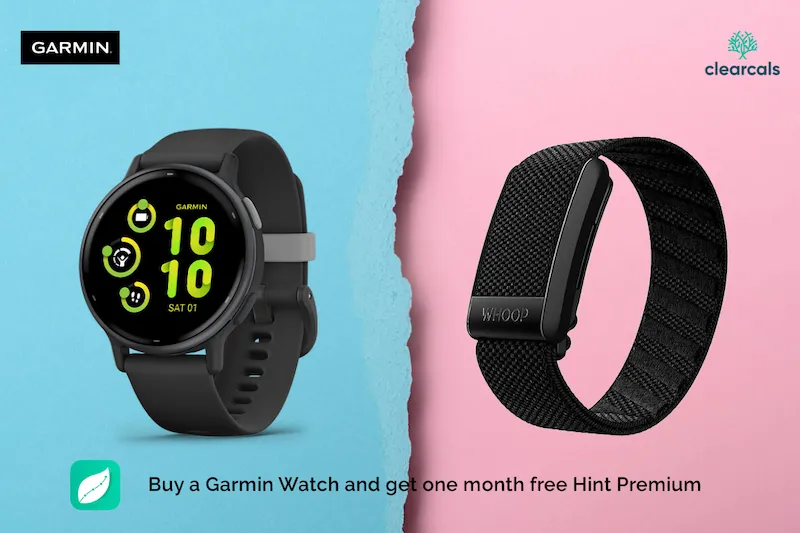
By Dr. Krishna Athmakuri, Co-Founder & CEO, Clearcals | Updated May 2026
Whoop and Garmin are both serious fitness trackers — but they are built for completely different types of people.
Choose Garmin if you want a screen, built-in GPS, real-time workout coaching, and a one-time purchase with no subscription. Garmin watches range from ₹19,990 to ₹48,990 and require no ongoing payment.
Choose Whoop if you are an elite athlete working with a coach and want passive, screenless recovery and strain monitoring. Whoop requires a mandatory annual subscription — ₹21,990/year (Whoop One) or ₹28,990/year (Whoop Peak) — with no GPS and no display.
This 2026 guide covers the full comparison: Garmin Instinct 3, Vivoactive 6, Vivoactive 5, Forerunner 265, Forerunner 165, Venu SQ 2 vs Whoop 5.0 and Whoop MG.
Clearcals is an official Garmin India partner. Every Garmin watch purchased at Clearcals includes a free Hint Premium subscription (worth ₹1,999) — registered dietitian consultations, personalised meal plans, and 300+ guided workout routines.
Garmin vs Whoop: Core Differences at a Glance
| Feature | Garmin | Whoop |
|---|---|---|
| Design | Smartwatch with a display | Screenless wristband (5.0) or smart apparel (MG) |
| Primary purpose | Active tracking — workouts, GPS, real-time coaching | Passive tracking — recovery, sleep, strain |
| Screen | Yes — AMOLED or MIP display | No screen — data via app only |
| GPS | Yes — built-in on all models | No built-in GPS |
| Battery life | 11–40+ days depending on model | 14+ days |
| Pricing model | One-time purchase from ₹19,990 | Annual subscription required |
| Coaching | On-device Garmin Coach, Morning Report | AI recovery insights — best with an external coach |
| Best for | Runners, trekkers, gym users, and everyday health monitoring | Elite athletes with coaches, recovery-focused training |
The key insight: these are not competing for the same user. Choosing between them is less about which is "better" and more about which philosophy matches how you train.
Whoop in India: What You Need to Know First
Before comparing features, it's worth addressing something most global reviews overlook — Whoop is significantly more expensive for Indian users than it appears.
Whoop operates on a subscription model — the band is included with the membership. In India, there are two plans:
Whoop One: ₹21,990/year Whoop Peak: ₹28,990/year (includes advanced health metrics)
Both plans are available with no-cost EMI over 3 or 6 months, which softens the upfront payment. But the annual renewal is unavoidable — and over two years, the total cost is ₹43,980 (One) to ₹57,980 (Peak).
For the same two-year investment, you could buy a Garmin Forerunner 265 (₹40,990) with money left over, own it outright, and pay nothing further.
This doesn't make Whoop a bad product. But it is a meaningful financial reality for Indian buyers that deserves to be stated upfront.
Garmin vs Whoop: Battery Life and Total Cost of Ownership
| Model | Battery | India Price | 2-Year Cost |
|---|---|---|---|
| Garmin Venu SQ 2 | 11 days | ₹19,990 | ₹19,990 |
| Garmin Forerunner 165 | 11 days | ₹27,990 | ₹27,990 |
| Garmin Vivoactive 5 | 11 days | ₹24,990 | ₹24,990 |
| Garmin Vivoactive 6 | 11 days | ₹40,990 | ₹40,990 |
| Garmin Forerunner 265 | 13 days | ₹40,990 | ₹40,990 |
| Garmin Instinct 3 Solar | 28+ days (40+ with solar) | ₹48,990 | ₹48,990 |
| Whoop One (annual subscription) | 14+ days | ₹21,990/year | ₹43,980 |
| Whoop Peak (annual subscription) | 14+ days | ₹28,990/year | ₹57,980 |
Over two years, every Garmin watch at Clearcals costs less in total than a Whoop subscription. For Indian buyers evaluating long-term value, this is a decisive factor.
Head-to-Head: Garmin vs Whoop Model Comparisons
1. Garmin Instinct 3 vs Whoop 5.0
The Garmin Instinct 3 is built for people who push limits outdoors — trekkers, trail runners, and adventure athletes. It combines MIL-STD-810 military-grade durability with a choice of AMOLED or Solar MIP display, multi-band GPS (GPS, GLONASS, Galileo), ABC sensors (altimeter, barometer, compass), a built-in flashlight, and 10 ATM water resistance. Battery life: 28+ days smartwatch mode, extended to 40+ days with solar charging.
Health and performance metrics include VO2 max, Body Battery, HRV Status, Sleep Score, Morning Report, stress tracking, and Training Readiness.
Whoop MG takes a different approach — it embeds Whoop 5.0's sensors into smart apparel (compression gear, bras, boxers). There is no wrist device at all. Tracking happens silently, which suits contact sports and athletes who cannot wear a wrist-based device.
Verdict: Choose the Garmin Instinct 3 if you need GPS, a display, rugged durability, and the full Garmin health ecosystem. Choose Whoop MG if you are an elite athlete with a professional coach and prefer completely invisible, apparel-based tracking.
Buy Garmin Instinct 3 Solar at Clearcals — ₹48,990
📺 Garmin Instinct 3 Feature Breakdown
2. Garmin Vivoactive 6 vs Whoop 5.0
The Garmin Vivoactive 6 is the most versatile all-around lifestyle watch in this comparison — suited for gym-goers, yoga practitioners, swimmers, and everyday users who want deep health monitoring alongside fitness tracking. It has an AMOLED display, 80+ sports modes, Sleep Coach with nap tracking, a skin temperature sensor for cycle phase monitoring, advanced running metrics, 8GB onboard storage, and 11-day battery life. GPS, GLONASS, and Galileo are all supported.
Whoop 5.0 focuses exclusively on the physiological layer — continuous HRV, respiratory rate, skin temperature, sleep stages, and daily strain. It is best understood as a recovery coach rather than a workout tracker. It has no GPS and no display.
Verdict: The Vivoactive 6 is the right choice for most Indian fitness users who train across multiple disciplines. Whoop 5.0 suits athletes working with coaches who prescribe structured training loads and want passive, continuous physiological monitoring.
Buy Garmin Vivoactive 6 at Clearcals — ₹40,990
📺 Garmin Vivoactive 6 Overview
3. Garmin Vivoactive 5 vs Whoop 5.0
The Garmin Vivoactive 5 covers the essential health monitoring suite at a lower price point — Body Battery, HRV Status, SpO2, sleep tracking with stages, stress, 30+ sports modes, GPS, Garmin Pay, and 11-day battery. It does not have the skin temperature sensor, Sleep Coach, or advanced running metrics of the VA6, but it delivers the complete Garmin health ecosystem.
Against Whoop 5.0 at ₹21,990/year, the VA5 at ₹24,990 one-time is the financially stronger choice for users who want recovery-oriented health tracking. Body Battery and HRV Status provide comparable insight into daily readiness — with GPS, a display, and no ongoing subscription.
Verdict: For users comparing Whoop 5.0 to an entry-level Garmin health watch, the Vivoactive 5 offers more practical daily utility at a lower total cost. Whoop 5.0 is the better choice only for athletes with a coach who needs subscription-grade passive monitoring.
Buy Garmin Vivoactive 5 at Clearcals — ₹24,990
4. Garmin Forerunner 265 vs Whoop 5.0
The Garmin Forerunner 265 is Garmin's most capable mid-range running watch — with multi-band GPS (SatIQ), Training Readiness, Running Power, race predictor, PacePro pacing strategy, VO2 max, triathlon mode, and 13-day battery. It also includes Body Battery, HRV Status, Sleep Score, and Morning Report for full recovery monitoring. It is available in 42mm (FR265S) and 46mm sizes, both at ₹40,990.
For runners considering Whoop for recovery data, the Forerunner 265 makes a compelling case — it provides recovery metrics (Training Readiness, HRV Status, Body Battery) alongside superior GPS tracking, real-time coaching, and race tools. The one-time cost of ₹40,990 is less than two years of Whoop One (₹43,980).
Verdict: For runners choosing between a performance watch and a recovery tracker, the Forerunner 265 covers both — at a lower two-year cost than Whoop. Whoop is the better choice for runners following coach-prescribed training who want passive monitoring without a display.
Buy Garmin Forerunner 265 at Clearcals — ₹40,990
5. Garmin Forerunner 165 vs Whoop 5.0
The Garmin Forerunner 165 is purpose-built for runners. It provides built-in GPS, real-time pace coaching, cadence tracking, Garmin Coach training plans, Body Battery, HRV Status, and Morning Report. AMOLED display, 43mm case, 11-day battery (19-hour GPS), 4GB music storage. It does not have Training Readiness or Running Power — those begin with the FR265.
At ₹27,990, the Forerunner 165 costs less in total than one year of Whoop Peak (₹28,990), and provides real-time workout feedback that Whoop cannot.
Verdict: If you are a self-coached runner who needs real-time GPS feedback, the Forerunner 165 is the clear choice. Whoop 5.0 suits runners following coach-prescribed programmes who want passive physiological monitoring alongside their training.
Buy Garmin Forerunner 165 at Clearcals — ₹27,990
📺 Garmin Forerunner 165 Overview
6. Garmin Venu SQ 2 vs Whoop 5.0
The Garmin Venu SQ 2 is the most affordable Garmin watch with an AMOLED display. 40mm square case, built-in GPS, 40+ sports modes, Body Battery, SpO2, stress, sleep tracking, and 11-day battery. Women's cycle and pregnancy tracking are included through the Garmin Connect app.
At ₹19,990 one-time, the Venu SQ 2 costs less than one year of the cheaper Whoop plan — while offering a display, GPS, and smartwatch features that Whoop cannot match.
Verdict: For everyday health-conscious users who want a complete smartwatch experience with no monthly fees, the Venu SQ 2 is a far more practical choice than Whoop. Whoop is only worth considering at this price point if passive recovery monitoring is the single primary requirement.
Buy Garmin Venu SQ 2 at Clearcals — ₹19,990
📺 Garmin Venu SQ 2 Overview
Screen vs No Screen: Which Approach Works Better?
This is the philosophical heart of the Garmin vs Whoop debate.
A screen (Garmin) works for most people because it provides immediate feedback during workouts — heart rate zones, pace, distance — without needing a phone. On-device coaching through Garmin Coach, Morning Report, and movement nudges gives independent athletes the data they need to make decisions in real time. Smart features — notifications, music, alarms — make it a complete daily device.
No screen (Whoop) works for some athletes because fully passive tracking collects data without any required interaction. There are no notification distractions during training or sleep. It is comfortable for 24/7 wear, including contact sports, where a hard watch case is a liability.
The honest limitation of Whoop without a coach: Whoop's data is most valuable when someone knows what to do with it. Recovery scores, HRV trends, and strain data are powerful inputs — but only if they are being interpreted and acted on. For athletes without external coaching, Garmin's on-device coaching provides the guidance layer that Whoop cannot.
Garmin Connect App vs Whoop App: Ecosystem Comparison
| Garmin Connect App | Whoop App | |
|---|---|---|
| Subscription required | No — free forever | Yes — mandatory |
| Real-time data | Yes — on device and in app | No — app only, no on-device display |
| Training plans | Yes — Garmin Coach with adaptive plans | Recovery guidance only |
| Nutrition integration | Yes — syncs with Hint app | No Indian nutrition app integration |
| Workout creation | Yes — with route mapping | No |
| Customisation | Watch faces, widgets, and Connect IQ apps | Limited |
The Garmin Connect + Hint integration is particularly relevant for Indian users managing weight, PCOS, insulin resistance, or diabetes. When your Garmin tracks calorie burn and your Hint app provides personalised diet guidance from a certified dietitian, you get a complete health picture — not just fitness data in isolation.
Garmin Training Load vs Whoop Strain: What's the Difference?
Both Garmin and Whoop measure exercise stress, but they use different methodologies.
Garmin Training Load aggregates workout intensity and duration over a 4-week rolling window. It compares your recent load to your long-term fitness trend to identify whether you are in a productive training range or accumulating too much stress. Training Status uses this data alongside VO2 max trends to classify your fitness direction as "Productive", "Maintaining", "Overreaching", or "Recovery".
Whoop Strain is a single-session score (0–21 scale) based on cardiovascular effort — essentially how hard your heart worked during the day. It includes both deliberate workouts and incidental activity. Whoop then compares that day's strain to your recovery score to advise whether your body is ready for high-effort work.
Both approaches are valid. Garmin's Training Load is better suited for runners and cyclists managing long-term periodisation. Whoop's Strain score is more intuitive for day-to-day effort calibration. For athletes using structured training plans with multi-week load building, Garmin's approach is more actionable.
Garmin vs Whoop for Endurance Athletes
For endurance athletes specifically — marathon runners, triathletes, cyclists, ultramarathon runners — the comparison shifts in an important direction.
Garmin provides the race-specific tools that endurance athletes need: course-aware pacing via PacePro, VO2 max and race predictor, triathlon mode with auto-transitions (Forerunner 265 and Instinct 3), running dynamics (cadence, stride length, vertical oscillation), and interval workout creation directly on the watch. For triathletes, the Forerunner 265 handles swim-to-bike-to-run transitions and provides event-specific battery estimates.
Whoop provides superior recovery monitoring for athletes who are training at high volume. The combination of HRV, respiratory rate, skin temperature, and sleep quality into a daily Recovery Score is valuable for high-load athletes who need to modulate intensity daily. However, it provides no GPS data, no real-time metrics, and no race tools.
For most endurance athletes, the practical approach is a Garmin watch for training and racing, with Whoop as a secondary recovery tool if budget allows. If only one device is possible, Garmin covers more ground.
Who Should Buy Garmin
Garmin is the right choice for runners, cyclists, swimmers, trekkers, and triathletes who need GPS; self-coached athletes who want real-time feedback during workouts; people managing health conditions (weight, PCOS, diabetes, thyroid) who want integrated nutrition and fitness tracking via Hint; anyone who wants a complete smartwatch without a recurring subscription; and fitness beginners building habits who need daily coaching and nudges.
Who Should Buy Whoop
Whoop is the right choice for elite athletes working with professional coaches who prescribe structured training loads; athletes who prefer a completely screenless, distraction-free wearable; those who prioritise recovery monitoring above all other features and have the budget for an ongoing subscription; and users who are already embedded in the Whoop ecosystem with existing historical data.
Final Verdict: Garmin vs Whoop
| Goal | Better Choice |
|---|---|
| Rugged outdoor GPS tracking | Garmin Instinct 3 Solar — ₹48,990 |
| Versatile training and wellness monitoring | Garmin Vivoactive 6 — ₹40,990 |
| Running with Training Readiness and GPS | Garmin Forerunner 265 — ₹40,990 |
| Entry-level running watch with GPS | Garmin Forerunner 165 — ₹27,990 |
| Everyday health tracking, no subscription | Garmin Venu SQ 2 — ₹19,990 |
| Budget health tracking with full Garmin ecosystem | Garmin Vivoactive 5 — ₹24,990 |
| Elite recovery monitoring with a coach | Whoop 5.0 or Whoop MG |
For the vast majority of Indian fitness users — whether you're a weekend runner, gym regular, managing a health condition, or trekking in the Himalayas — a Garmin watch delivers more practical value at a lower total cost than Whoop. The subscription model makes Whoop an expensive proposition over multiple years, and the lack of GPS means you always need a separate device for location tracking.
Buy Garmin Watches at Clearcals
Every Garmin watch from Clearcals includes a free Hint Premium subscription (worth ₹1,999) — registered dietitian consultations, personalised meal plans, and 300+ guided workout routines.
Shop All Garmin Watches at Clearcals
Frequently Asked Questions
Is Whoop available in India? Yes, Whoop is available in India with two subscription tiers — Whoop One at ₹21,990/year and Whoop Peak at ₹28,990/year. Both offer no-cost EMI over 3 or 6 months. Over two years, you'll spend ₹43,980 (One) or ₹57,980 (Peak). The band itself is included with the subscription. Whoop does not have a physical retail presence in Bangalore or other Indian cities — purchases are through the Whoop website.
Does Whoop have GPS? No. Whoop 5.0 and Whoop MG do not have built-in GPS. To track route, pace, and distance while running, you need to carry your phone with the Whoop app open or pair it with a compatible GPS watch. This is a significant limitation for runners, cyclists, and trekkers who want standalone GPS tracking.
Can Garmin replace Whoop? For most users, yes. Garmin's Body Battery, HRV Status, Sleep Score, Morning Report, and Training Readiness features (on Forerunner 265 and Instinct 3) cover the core recovery metrics Whoop provides — without a subscription and with the added benefit of GPS and real-time workout coaching. For elite athletes working with coaches who specifically use Whoop's strain and recovery model, Whoop provides a more focused recovery-tracking environment.
Does Garmin have a recovery score like Whoop? Yes. Garmin's Body Battery (0–100 energy score), HRV Status, Sleep Score, and Morning Report together provide a comprehensive daily recovery picture. On the Forerunner 265 and Instinct 3, Training Readiness consolidates sleep quality, HRV, training load, and recovery time into a single daily score — directly comparable to Whoop's Recovery Score.
Garmin Training Load vs Whoop Strain — what is the difference? Garmin Training Load tracks workout stress over a 4-week window and compares it to long-term fitness trends to classify your Training Status. Whoop Strain is a daily cardiovascular effort score (0–21) based on heart rate data across the entire day. Both measure exercise stress but at different timescales and with different interpretive frameworks. Garmin's approach is better suited for periodised training plans; Whoop's is more intuitive for daily effort calibration.
Is Garmin or Whoop better for running? Garmin is better for most runners. Garmin provides real-time pace, cadence, GPS route mapping, Garmin Coach training plans, and race predictors — none of which Whoop offers. For runners following coach-prescribed training who want passive recovery monitoring and do not need on-device metrics, Whoop 5.0 is a useful complement — but not a replacement.
Garmin vs Whoop for sleep tracking — which is more accurate? Both track sleep stages (light, deep, REM) and HRV overnight. Whoop's sleep tracking is generally considered slightly more granular, with an explicit Sleep Coach that gives personalised recommendations based on your recent recovery and training load. Garmin's Sleep Coach (available on Vivoactive 6) and Sleep Score provide comparable insight. The Vivoactive 6 also adds a skin temperature sensor that correlates overnight temperature with cycle phase — a feature that Whoop 5.0 also has. For most users, the sleep data quality is broadly comparable; the key difference is Whoop's dedicated coaching layer versus Garmin's broader all-day functionality.
Garmin vs Whoop VO2 Max — which is more accurate? Garmin calculates VO2 max using Firstbeat Analytics — the same company whose algorithms power sports science research and elite-level coaching tools. It uses heart rate and pace data from runs and cycling to estimate aerobic capacity. Whoop does not calculate VO2 max directly. For athletes who want an ongoing VO2 max estimate and trend over time, Garmin is the better choice. The Forerunner 265 and Instinct 3 provide the most accurate Garmin VO2 max estimates using multi-band GPS for precise pace data.
Which is more accurate — Garmin or Whoop heart rate? Both use optical heart rate sensors. Garmin is widely regarded as more accurate for GPS-based activity metrics and pace. Whoop is strong for passive continuous HRV monitoring during sleep and rest. Independent studies show both perform well for resting and moderate-intensity HR; accuracy can vary for both during high-intensity intervals. For GPS-linked metrics (pace zones, VO2 max, Training Readiness), Garmin has the advantage due to combined GPS and HR data.
About the Author
Dr. Krishna Athmakuri is the Co-Founder and CEO of Clearcals, where he leads the development of data-driven health technology through the Hint app.
With a Ph.D. in Chemical Engineering from Rensselaer Polytechnic Institute, New York, his expertise spans analytics, protein chemistry, and biotechnology.
Earlier in his career, he developed biotherapeutics for diabetes and metabolic diseases at companies like Aurobindo Pharma and Dr. Reddy's Laboratories.
At Clearcals, he now applies that scientific rigour to build personalised fitness tools — including Hint Pro Workouts, nutrition tracking, and real-time metabolic insights — helping users make smarter health decisions through technology.
Connect with Dr. Krishna on LinkedIn
Also Read
- Garmin vs Apple Watch: Which Should You Buy in India?
- Fitbit vs Garmin: Which is Better for Indian Users?
- Garmin vs Samsung Watch
- Coros vs Garmin: Full Comparison 2026
- The Best Garmin Watches in India: Ultimate Buyer's Guide 2026
- Shop All Garmin Watches at Clearcals