Track your nutrition and health goals

Best Direction to Sleep: What Science and Ayurveda Say
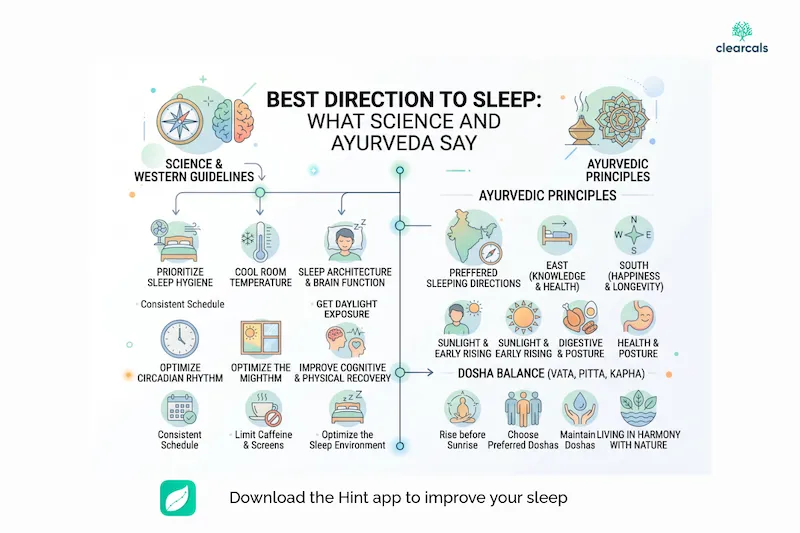
By Dr. Krishna Athmakuri, Co-Founder & CEO, Clearcals | Updated: July 2026
Why Direction to Sleep Is Such a Common Question in India
"Which direction should we sleep?" is searched tens of thousands of times each month in India — far more than in most other countries. This reflects a genuine intersection of traditional knowledge systems (Vastu Shastra, Ayurveda) and a growing interest in sleep quality optimisation. The question is asked by people ranging from those following traditional household rules to those who have read about geomagnetic effects on sleep and want a scientific perspective.
This article covers both — what Vastu Shastra and Ayurveda recommend and why, and what modern sleep science says about whether sleeping direction measurably affects health or sleep quality.
What Vastu Shastra Recommends
Vastu Shastra — the ancient Indian science of spatial arrangement — has clear and consistent recommendations on sleep direction, based on its principles of energy flow, directional significance, and the relationship between the body and the earth's cardinal directions.
South: The most recommended direction. Sleeping with your head pointing south and feet pointing north is the primary Vastu recommendation for adults. This aligns the body with the earth's magnetic field (magnetic north to south) and is considered the direction of stability, prosperity, and restorative rest.
East: Second best, especially for students. Head pointing east is associated with knowledge, learning, creativity, and new beginnings in Vastu. It is particularly recommended for children and students. Some traditions recommend this direction for all family members for spiritual benefits and mental clarity.
North: Generally avoided. Sleeping with the head pointing north — and feet towards south — is the most strongly discouraged direction in Vastu and in many Ayurvedic texts. The reasoning involves the earth's magnetic north pole: with the head pointing north, the body's own magnetic field (with the brain being positively charged, like the north pole) would repel rather than attract the earth's field. This is believed to disturb circulation and promote restlessness.
West: Acceptable but not ideal. Not as strongly contraindicated as north, but associated with restless sleep and less restorative rest in Vastu. Some texts permit it and note no specific harm.
What Ayurveda Says
Ayurvedic texts — particularly Charaka Samhita and Ashtanga Hridayam — also address sleeping direction in the context of health maintenance. The recommendations largely align with Vastu:
South-facing sleep is described as promoting longevity (dirghayu) and deep, restful sleep. East-facing sleep is linked to clarity and memory. North-facing sleep is described as inauspicious and associated with troubled sleep, dreams, and potential harm to longevity. The basis in Ayurveda is partly the five elements framework and partly the concept of prana (life force) flow being disrupted by unfavourable alignment.
What Modern Science Says
Sleep science does not have a strong evidence base specifically for the effect of cardinal sleep direction on sleep quality or health outcomes in most people. However, there are two relevant research areas worth noting:
Geomagnetic alignment: A small but cited 2004 study by Ruhenstroth-Bauer et al. and a more recent 2019 study by Mikulecký et al. found that humans slept differently when aligned with versus against the geomagnetic field. Specifically, east-west alignment (head east) was associated with higher REM sleep in some subjects, while north-south alignment showed different HRV patterns. These studies are small, methodologically limited, and have not been robustly replicated — they are interesting but not conclusive.
Earth's magnetic field and the brain: Human and animal brains do respond to magnetic fields at some level — magnetite crystals have been identified in human brain tissue, and birds use geomagnetic navigation reliably. Whether the Earth's relatively weak surface magnetic field meaningfully affects human sleep quality in a consistent, practically significant way remains unproven.
The honest scientific answer: There is currently no high-quality evidence that sleeping direction has a clinically meaningful impact on sleep quality or metabolic health for the average person in a modern environment. The effect of sleeping direction — if real — is likely to be very small compared to the effects of sleep duration, timing, alcohol, light exposure, temperature, and stress.
What Actually Matters Most for Sleep Quality
Whether you sleep facing south, east, north, or west, the following factors have robust evidence for their impact on sleep quality and metabolic health — and are far more influential than bed orientation:
Sleep duration: 7–8 hours is the evidence-based target for adults. Chronic sleep under 6 hours produces measurable metabolic deterioration regardless of sleeping direction.
Consistent timing: Going to bed and waking at the same time daily regulates the circadian system, maximises deep sleep, and stabilises blood pressure overnight.
Room temperature: 18–20°C is the optimal sleep temperature. A warm room suppresses deep sleep more reliably than any directional factor.
Darkness: Complete or near-complete darkness promotes melatonin secretion and deep sleep quality. Even low-level light exposure during sleep has been shown to suppress slow-wave sleep and raise morning blood sugar.
Alcohol avoidance: Alcohol — even 1–2 drinks — suppresses REM sleep and fragments slow-wave sleep. No sleeping position counteracts this.
Mattress and pillow quality: Spinal alignment during sleep affects sleep quality through pain, position-related arousals, and respiratory mechanics. A supportive mattress and appropriate pillow (that keeps the cervical spine neutral) have more direct evidence for sleep quality improvement than directional orientation.
Practical Recommendation
If your home layout and furniture arrangement permit south- or east-facing sleep (head towards south or east), this aligns with traditional Indian wisdom and has centuries of cultural endorsement. There is no evidence that it will harm you, and some traditional and emerging research suggests it may be mildly beneficial.
If your room does not easily permit south or east head placement — don't rearrange your bedroom at the expense of other sleep quality factors. Prioritise your sleep timing, room temperature, darkness, and alcohol intake first. These are the levers with unambiguous, large-magnitude evidence behind them.
The best direction to sleep is ultimately the one that lets you consistently get 7–8 hours of uninterrupted, cool, dark sleep — whatever compass point that points toward.
Which Side to Sleep On?
"Which side should we sleep?" is a related question with more direct physiological relevance. Here the evidence is clearer:
Left side: Generally considered the best sleep position for digestion and for people with acid reflux (GERD). The angle of the oesophagus and stomach means that left lateral sleeping reduces gastric acid reflux into the oesophagus. Left-side sleeping also improves lymphatic drainage (the thoracic duct runs on the left side of the body) and is recommended during pregnancy to maintain uterine blood flow.
Right side: May worsen acid reflux due to gastric anatomy. However, some studies suggest right-side sleeping may reduce cardiac workload in people with certain types of heart failure.
Back (supine): Generally good for spinal alignment but strongly associated with worse snoring and sleep apnoea — the tongue and soft palate fall backward in supine position, narrowing the upper airway. People prone to sleep apnoea are generally advised to avoid back sleeping.
Stomach (prone): Generally the least recommended position — produces neck rotation and spinal extension that leads to muscle tension and morning pain, and places pressure on the abdomen and chest that can restrict breathing.
For most healthy adults, left lateral or right lateral sleeping is preferable to prone or supine positions, with left side being slightly favoured for digestive and metabolic health reasons.
References
- Mikulecký M, et al. Geomagnetic activity and human sleep: seasonal changes. Physiological Research. 2000;49(suppl 1):S79–S83.
- Xue X, et al. Sleeping north-south polarized blunts cancer hallmarks: therapeutic implications for melatonin and circadian regulation. Scientific Reports. 2021;11:7164.
- Katz LC, et al. Geomagnetic fluctuations predict nocturnal motor activity in free-living animals. PLOS ONE. 2010.
- Tawk M, et al. The relationship between sleep position, snoring and apneas. Sleep Medicine. 2001;2(1):41–45.
- Jacobson BH, et al. Effect of prescribed sleep surfaces on back pain and sleep quality in patients diagnosed with low back and shoulder pain. Applied Ergonomics. 2010;41(2):255–260.
About the Author
Dr. Krishna Athmakuri is the Co-Founder and CEO of Clearcals, where he leads the development of data-driven health technology through the Hint app. With a Ph.D. in Chemical Engineering from Rensselaer Polytechnic Institute, New York, his expertise spans analytics, protein chemistry, and biotechnology. Earlier in his career, he developed biotherapeutics for diabetes and metabolic diseases at companies like Aurobindo Pharma and Dr. Reddy's Laboratories. At Clearcals, he now applies that scientific rigour to build personalised fitness tools — including Hint Pro Workouts, nutrition tracking, and real-time metabolic insights — helping users make smarter health decisions through technology. Connect with Dr. Krishna on LinkedIn
👉 Back to the pillar page: Sleep and Metabolism: Complete Guide 👉 Related: How to Get More Deep Sleep | Sleep Stages Explained