Track your nutrition and health goals

Low-Calorie Desserts & Indian Sweets (With Calorie Counts)
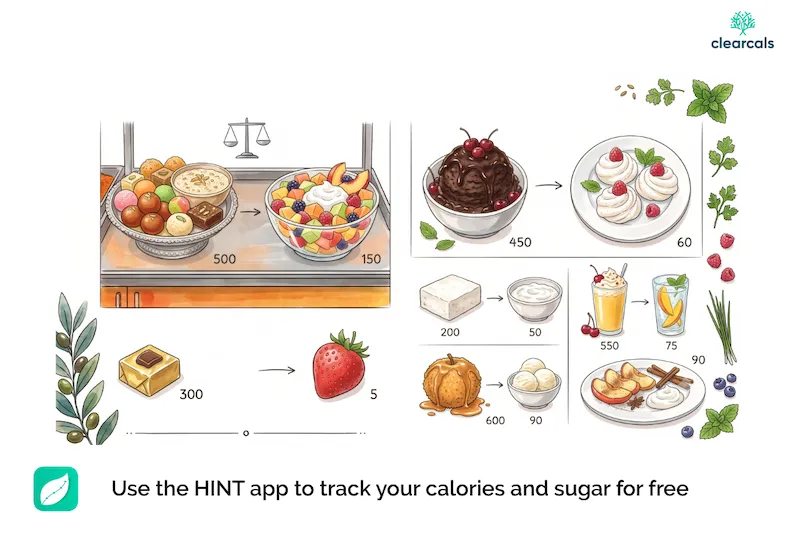
Low-Calorie Desserts & Indian Sweets (With Calorie Counts)
You Don't Have to Give Up Dessert to Lose Weight
Cutting dessert entirely works for some people and backfires for others. It's often the restriction that leads to a binge later.
A more sustainable approach for most people is choosing lower-calorie desserts and reasonable portions most of the time, while still allowing the occasional real treat within your calorie budget.
Low-Calorie Desserts (With Calorie Counts)
| Dessert | Approx. Calories | Notes |
|---|---|---|
| Dark chocolate (70%+), 2 small squares (~15g) | ~85 kcal | Rich flavour in a small portion; higher cocoa % means less sugar |
| Greek yogurt with berries and a drizzle of honey | ~150-180 kcal | High protein, genuinely dessert-like |
| Fruit chaat (no added sugar) | ~90-120 kcal | High volume, naturally sweet |
| Sugar-free/low-fat ice cream, 1 small scoop | ~80-120 kcal | Versus 150-250+ kcal for regular ice cream |
| Baked apple with cinnamon | ~100-130 kcal | Warm, satisfying, minimal added sugar needed |
| Roasted makhana with a light jaggery coating | ~120-150 kcal | A lighter take on a sweet-crunchy craving |
| Oats and banana "cookies" (mashed banana + oats, baked) | ~60-80 kcal per cookie | Naturally sweetened, no added sugar needed |
Desserts Under 100 Calories
If you're specifically looking for options under a set calorie threshold, several items from the table above already qualify: dark chocolate squares (~85 kcal), fruit chaat (~90-120 kcal, on the edge depending on portion), oats-banana cookies (~60-80 kcal each), and sugar-free ice cream in a small scoop (~80-120 kcal).
A few more genuinely land under 100 kcal on their own: a small square of jaggery (~20-30 kcal), 2 dates (~40-45 kcal), a few berries with a spoon of Greek yogurt (~60-80 kcal), and rasgulla in a single piece (~100-125 kcal, right at the edge).
The common thread across all of these is portion — most desserts can be made to fit under 100 kcal by having a genuinely small serving rather than needing a fundamentally different food.
Indian Sweets: Lighter Choices and Smart Portions
Festival and celebration sweets don't need to be avoided entirely — portion size and frequency matter more than any single bite:
- Gulab jamun runs roughly 150 kcal per piece — sticking to one piece rather than two or three is the single biggest lever.
- Barfi and ladoo are calorie-dense (often 100-150 kcal per small piece) due to ghee and sugar — a half-portion satisfies the craving for meaningfully fewer calories.
- Kaju katli runs similarly calorie-dense to barfi, typically 70-90 kcal per small piece — the cashew-and-sugar base means even a thin piece carries a real calorie cost, so treat it the same as barfi or ladoo rather than assuming it's lighter because it looks delicate.
- Rasgulla is comparatively lighter than syrup-heavy sweets like gulab jamun, since it isn't deep-fried, typically running 100-125 kcal per piece.
- Kheer, in a small bowl rather than a large serving, is a reasonable way to enjoy a festival dessert without a huge calorie cost — the size of the bowl matters more here than the dish itself.
The most effective approach during festivals like Diwali isn't avoiding mithai — it's having one or two pieces mindfully rather than grazing on a box over several hours, and balancing the day's other meals to be lighter around a planned dessert. If you know a big mithai day is coming, eating normally (not starving yourself in advance) and planning for one deliberate serving works better long-term than an all-or-nothing approach.
Low-Calorie Chocolate and Sweet Cravings
- Dark chocolate (70% cocoa or higher) satisfies chocolate cravings with less sugar and a smaller effective portion than milk chocolate, since the flavour is more intense.
- Read the label on "sugar-free" products — some substitute sugar with sugar alcohols that still carry meaningful calories; "sugar-free" doesn't automatically mean "low-calorie."
High-Protein, Low-Calorie Desserts
Adding protein to a dessert — Greek yogurt, cottage cheese, or a scoop of protein powder mixed into oats — makes it more filling and shifts it from "just sugar" to something with actual nutritional value.
A protein-powder "mug cake" (a scoop of protein powder, a splash of milk, microwaved for a minute) is a genuinely quick option that lands around 120-150 kcal while adding 15 - 20 g of protein, closer to a snack than a pure dessert.
See our high-protein, low-calorie foods guide for more ideas that work well in a dessert context too.
What About Keto, Vegan, or Sugar-Free Desserts?
The same core principles apply regardless of which dietary approach you're following — a smaller portion, a protein or fibre base, and genuinely reduced sugar are what make a dessert lower-calorie, whether or not it's also keto, vegan, or gluten-free.
A few notes specific to these: vegan desserts (dairy-free) can lean on the fruit-based and dark-chocolate options on this page without much adjustment; sugar-free doesn't automatically mean low-calorie (see below); and keto-style desserts often replace sugar with high-fat ingredients (nut flours, cream), which can keep the calorie count similar or even higher than the original despite being lower in carbs specifically.
Buying Packaged Low-Calorie Desserts
If you're buying rather than making dessert, a few label checks matter more than the front-of-pack claims: check calories per serving (not per package) against the actual portion you'll eat, look at the sugar content even on "sugar-free" or "low-fat" products, and watch for products that compensate for less fat with more sugar or a larger recommended serving size. A genuinely useful packaged option is usually one where the calorie count and portion size are both reasonable, not just one or the other.
Track Your Dessert With Hint
Dessert is one of the easiest things to underestimate, especially with Indian sweets where portion sizes vary widely by household and occasion. Logging it in the Hint app — even an estimate — keeps your daily total honest without requiring you to skip dessert altogether.
FAQs
What are good low-calorie desserts? Dark chocolate, Greek yogurt with berries, fruit chaat, sugar-free ice cream, and baked apple with cinnamon are all satisfying options typically running 80-180 kcal per serving.
How can I enjoy Indian sweets without derailing weight loss? Stick to one piece rather than several, choose comparatively lighter options like rasgulla over syrup-heavy sweets like gulab jamun, and balance the rest of your day's meals to be lighter around a planned treat.
Is sugar-free ice cream actually low calorie? Often lower than regular ice cream, but not always dramatically — check the label, since some sugar-free products still contain meaningful fat and calories from other ingredients.
How many calories are in a gulab jamun? Roughly 150 kcal per piece, depending on size and how much syrup it's soaked in.
What's a high-protein dessert option? Greek yogurt with fruit, cottage cheese with honey, or oats mixed with a scoop of protein powder all work well — they satisfy a sweet craving while adding real protein rather than just sugar.
Are there truly zero-calorie desserts? Not really — almost anything you eat has some calories. What's usually meant by "zero calorie" is a very low-calorie option (under 20-30 kcal), like a small square of dark chocolate, a few berries, or sugar-free jelly — genuinely low, but not literally zero.
Does the time of day I eat dessert matter for weight loss? Not much on its own — total daily calories matter far more than timing. Eating dessert at a consistent time (rather than grazing throughout the evening) can help with portion awareness, but there's no special metabolic penalty to having dessert at any particular hour.
How many calories are in kaju katli? Roughly 70-90 kcal per small piece — similar to barfi, since both are ghee-and-sugar based despite kaju katli's thinner, more delicate appearance.
About the Author
Asfia Fatima is the Chief Dietitian at Clearcals, with a Master's Degree in Dietetics and Clinical Nutrition and over a decade of experience in clinical nutrition and lifestyle management. She specialises in evidence-based diet planning for weight loss, diabetes, and metabolic health, and leads the nutrition strategy behind the Hint app.
Connect with Asfia on LinkedIn