
Track your nutrition and health goals

Soaking and grinding
Soak the moong dal for 30 minutes. Drain and transfer it to a blender and grind it into a smooth paste along with few green chilies.
Moong dal dhokla has 71.5 calories per serving (1 Small Piece) — that's 233.3 calories per 100g. It provides 2.9g protein, 7.5g carbs, and 3.3g fat. With a medium glycemic index (GI: 57), this recipe is suitable for heart health. It contains anti-inflammatory ingredients like turmeric and ginger.
Track the exact calories and macros of Moong dal dhokla in the Hint app — India's comprehensive recipe and nutrition tracking platform.
Detected from the ingredient list. If you have an allergy, always check product labels.
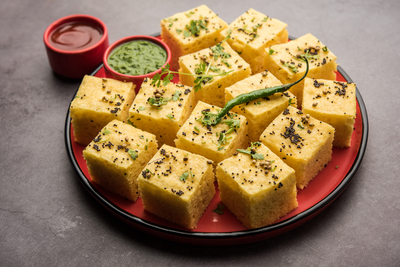
Calories and macros of Moong dal dhokla for common portion sizes.
| Portion | Weight (g) | Calories (kcal) | Protein (g) | Carbs (g) | Fat (g) |
|---|---|---|---|---|---|
| 1 Moong dal dhokla | 31 | 72 | 2.9 | 7.5 | 3.3 |
| 2 Moong dal dhokla | 61 | 143 | 5.9 | 15 | 6.6 |
| 3 Moong dal dhokla | 92 | 215 | 8.8 | 22.6 | 9.9 |
| 4 Moong dal dhokla | 123 | 286 | 11.8 | 30.1 | 13.2 |
| 100 g | 100 | 233 | 9.6 | 24.5 | 10.8 |
1 serving = 30.7g
Time a 65 kg adult needs to burn one serving (72 kcal).
Likely to produce a moderate blood glucose rise; pair with protein/fiber for better stability.
| Nutrient | Moong dal dhokla | Finger millet semolina dhokla | Ragi rava dhokla | Sooji jai dhokla |
|---|---|---|---|---|
| Calories | 71.5 kcal | 71.5 kcal | 71.5 kcal | 74.2 kcal |
| Carbs | 7.5 g | 9.2 g | 9.2 g | 9.3 g |
| Protein | 2.9 g | 1.5 g | 1.5 g | 1.8 g |
| Fat | 3.3 g | 3.2 g | 3.2 g | 3.3 g |
| Fiber | 1.8 g | 1.8 g | 1.8 g | 1.8 g |
| Sugar | 0.9 g | 0.7 g | 0.7 g | 0.7 g |
| Sodium | 215.5 mg | 213.4 mg | 213.4 mg | 213.5 mg |
| Cholesterol | 0 mg | 0 mg | 0 mg | 0 mg |
At 71.5 kcal per serving, this can fit into a weight loss diet with mindful portion control. Pair with a fiber-rich salad to improve satiety.
Moderate glycemic index (GI: 57). Consider swapping refined ingredients with whole grain alternatives. Adding a fiber-rich side dish can help moderate the blood sugar response.
Low protein content (2.9g per serving) — not sufficient alone for muscle building. Combine with high-protein sides like paneer, eggs, chicken, dal, or a protein shake to reach 25-30g protein per meal.
Zero cholesterol and low saturated fat (0.8g) make this heart-friendly. Anti-inflammatory ingredients benefit overall heart health. Low sodium content is ideal for blood pressure management.
Moderate-to-high GI (57) can spike insulin — Women with PCOS should pair this with fiber-rich vegetables and a protein source to improve the insulin response. Consider replacing refined ingredients with whole grains or millets.
No goitrogenic ingredients — generally safe for thyroid conditions. The iron content supports thyroid hormone production. The spices aid digestion, which can be sluggish in hypothyroidism.
1 Small Piece (~30.7g). A light, kcal-friendly portion. Pair with roti or salad for a complete meal under 300 kcal.
1 Small Piece (~30.7g) plus a protein-rich addition (100g paneer, 2 eggs, or 1 cup dal) to hit 25-30g protein per meal.
1 Small Piece (~30.7g). Pair with whole wheat roti (not rice) to lower glycemic load. Eat protein and fiber portions first, carbs last.
1 Small Piece (~30.7g) provides a balanced portion. Adjust based on your daily kcal target — track accurately in the Hint app.
Add 50g paneer, a boiled egg, or a side of sprouted moong dal. Stirring in 1 tbsp of peanut butter also adds 4g protein.
Replace refined flour (maida) with whole wheat atta, or swap white rice with brown rice or millets like jowar/bajra.
Replace potato with cauliflower or bottle gourd. Add a squeeze of lemon — the acidity lowers glycemic response.
Moong dal dhokla stores well for 2-3 days refrigerated. Reheat on stovetop for best texture. Prepare ingredients in advance for quick weeknight cooking.
Why it matters: Excess oil can double the calorie content without adding nutritional value.
Fix: Measure oil with a tablespoon instead of pouring freely. 1 tbsp = 120 kcal.
Why it matters: The nutrition values are for 1 standard serving. Eating 2-3x the serving means 2-3x the kcal (143.1-214.6 kcal).
Fix: Use the Hint app to scan and log the exact portion you eat for accurate tracking.
Why it matters: Eating rice with another starchy dish doubles the glycemic load, causing sharp blood sugar spikes.
Fix: Choose one carb source per meal. Pair with roti instead of rice, or add a protein-rich side.
One serving of Moong dal dhokla contains 71.5 kcal (2.9g protein, 7.5g carbs, 3.3g fat). That's 233.3 kcal per 100g. You can track exact portions in the Hint app.
At 71.5 kcal per serving, this can fit into a weight loss diet with mindful portion control. Pair with a fiber-rich salad to improve satiety. Pair with a salad or raita for a filling, low-calorie meal.
Moderate glycemic index (GI: 57). Consider swapping refined ingredients with whole grain alternatives. Adding a fiber-rich side dish can help moderate the blood sugar response. The glycemic index is 57 (Medium). Always consult your dietitian for personalized guidance — Hint Premium connects you with expert dietitians.
Moong dal dhokla has 2.9g protein per serving. For a protein boost, combine with paneer, eggs, dal, or chicken.
Yes, Moong dal dhokla is light enough for dinner at 71.5 kcal. Having a lighter dinner 2-3 hours before sleep supports better digestion and weight management.
Since Moong dal dhokla is low in protein, pair it with dal, paneer, curd, or eggs. Add a fiber-rich salad for completeness. Track your full meal in the Hint app for accurate nutrition totals.
Moderate-to-high GI (57) can spike insulin — Women with PCOS should pair this with fiber-rich vegetables and a protein source to improve the insulin response. Consider replacing refined ingredients with whole grains or millets.
Curcumin in turmeric has significant anti-inflammatory properties
Hewlings SJ & Kalman DS (2017). Curcumin: A Review of Its Effects on Human Health. Foods.
DOI: 10.3390/foods6100092Dietary iron from diverse food sources helps prevent iron deficiency anemia
WHO (2001). Iron deficiency anaemia: assessment, prevention, and control. World Health Organization.
DOI: WHO/NHD/01.3Portion control is one of the most effective strategies for managing calorie intake and body weight
Rolls BJ (2014). What is the role of portion control in weight management? International Journal of Obesity.
DOI: 10.1038/ijo.2014.82Nutrition is calculated from the ingredient quantities above using the Indian Food Composition Tables (IFCT 2017, ICMR-NIN) and USDA FNDDS. The glycemic index is estimated from the ingredients, not lab-tested. Activity times use the Compendium of Physical Activities for a 65 kg adult. This page is general information, not medical advice. Our data sources
Last updated:


