Track your nutrition and health goals

Dates (Khajoor) Calories, Nutrition & Health Benefits: Are They Good for You?
Dates (Khajoor) Calories, Nutrition & Health Benefits: Are They Good for You?
Are Dates Good for You? The Short Answer
Yes, dates are a genuinely nutrient-dense whole food, not just "natural candy."
They're calorie-dense and very high in natural sugar, so portion matters more than with most fruit, but they also bring real fibre, potassium, iron, and other micronutrients that a spoonful of refined sugar or a processed sweet doesn't.
The right way to think about dates is closer to "a concentrated, nutritious way to satisfy a sweet craving in small amounts" than "an unlimited health food."
Dates Calories: Quick Reference
| Serving | Calories |
|---|---|
| 1 date (medium/Medjool-style, ~24g) | 67 kcal |
| 2 dates | 135 kcal |
| 3 dates | 202 kcal |
| 4 dates | 269 kcal |
| 5 dates | 336 kcal |
| 100g dates (about 4 medium dates) | 280 kcal |
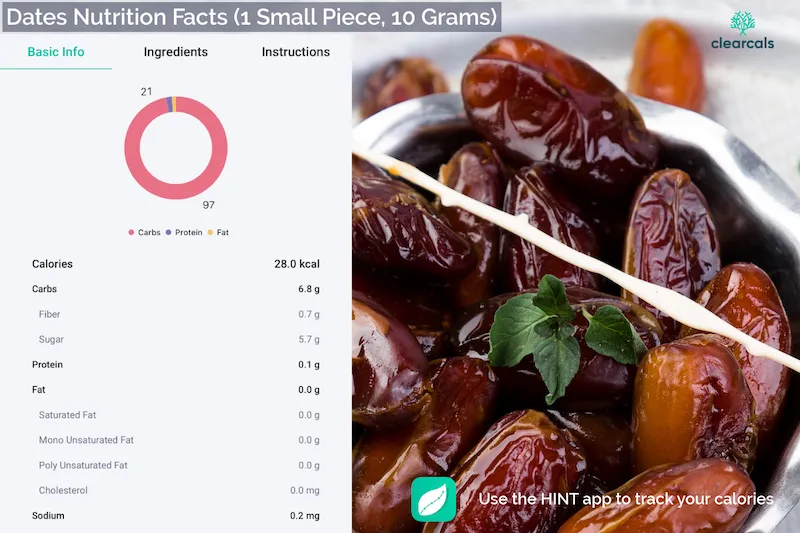
| 1 dry date (chuara/kharek, ~8-10g) | ~24-30 kcal |
| 100g dry dates (chuara) | 303 kcal |
Date sizes vary a lot by variety — a large Medjool or Ajwa date can be double the weight of a standard Deglet Noor date — so the per-date figures above are a reasonable average rather than an exact number for every jar or box.
Full Nutrition Facts (Per 100g and Per Date)
| Nutrient | Per 100g | Per Date (~24g) |
|---|---|---|
| Calories | 280 kcal | 67 kcal |
| Protein | 1.2g | 0.3g |
| Fat | 0.4g | 0.1g |
| Carbohydrates | 68g | 16.3g |
| Sugar | 57g | 13.7g |
| Fibre | 6.5g | 1.6g |
| Potassium | 289mg | 69mg |
| Iron | 0.9mg | 0.2mg |
| Magnesium | 14.3mg | 3.4mg |
Are Dates High in Protein?
No — this is a common misconception worth correcting directly. At roughly 1.2g of protein per 100g, dates are not a meaningful protein source, despite sometimes appearing in "high protein snack" lists alongside nuts or seeds.
What dates genuinely offer is concentrated carbohydrate energy, fibre, and micronutrients. If you're pairing dates with something for protein (a common combination), nuts, nut butter, or yogurt are doing the protein work, not the dates themselves.
Dates and Sugar: How High, and Should Diabetics Worry?
Dates are genuinely high in sugar — roughly 57g per 100g, almost all of it natural fructose and glucose, which is why a handful of dates carries noticeably more sugar than a similar-sized portion of most fresh fruit.
That said, dates have a low-to-moderate glycemic index (roughly 42-55 depending on variety and ripeness) thanks to their fibre content, which slows sugar absorption somewhat compared to what the raw sugar number alone would suggest.
This doesn't cancel out the sugar content — the glycemic load of several dates eaten at once is still meaningful — so for diabetics, the practical guidance is: dates aren't off-limits, but they're a portion-controlled treat (1-2 dates, ideally with some protein or fat alongside) rather than a free food.
If you have diabetes, talk to your doctor or dietitian about how dates fit into your specific carbohydrate targets — individual blood sugar responses vary, and this is general information, not personalised medical advice.
Dry Dates vs. Fresh Dates (Khajoor vs. Chuara)
"Dry dates" (often sold in India as chuara or kharek) and the softer, fresher-style dates typically sold as "khajoor" are related but distinct products, not just two names for the same thing:
- Soft/fresh-style dates (Medjool, Ajwa, Safawi, and similar varieties commonly imported and sold as khajoor) have higher moisture content, a softer, chewy texture, and run roughly 277-290 kcal per 100g.
- Dry dates (chuara) are more fully dehydrated, with a firmer, drier texture and a slightly higher calorie density per 100g (roughly 315 kcal) simply because there's less water weight diluting the same nutrients — the two aren't nutritionally identical, but they're closer than the different textures might suggest.
- Dry dates are more shelf-stable at room temperature, while soft dates generally keep better refrigerated.
Medjool, Ajwa & Other Date Varieties: Do Calories Differ Much?
Not dramatically. Medjool dates (large, very soft, caramel-like) and Ajwa dates (smaller, darker, often considered premium in the Middle East) both fall in the same general 270-290 kcal per 100g range as other common soft date varieties — the differences between varieties are mostly about size, texture, and flavour rather than a meaningfully different calorie or sugar profile. If a specific variety's serving size is notably larger (a jumbo Medjool date can weigh 30g+ versus a standard 20-24g date), that's a bigger driver of per-piece calorie differences than the variety itself.
Dates Health Benefits (Khajoor Ke Fayde)
- A genuine source of fibre — around 6.5g per 100g, which supports digestion and helps offset how quickly the natural sugar is absorbed.
- A good source of potassium — relevant for anyone not getting enough from fruits and vegetables generally, and modestly supportive of healthy blood pressure as part of an overall diet.
- Iron content — dates contribute a meaningful, if moderate, amount of dietary iron, useful in a vegetarian diet where iron sources can be more limited.
- A whole-food alternative to refined sugar — swapping a date or two for a spoon of sugar or a processed sweet brings fibre and micronutrients along with the sweetness, rather than "empty" calories alone.
- Natural energy — the concentrated carbohydrate content makes dates a genuinely useful quick-energy food (before exercise, for instance), which is part of why they're a traditional food for breaking a fast.
Khajoor khane ke fayde: fibre, potassium, iron aur natural energy milta hai — lekin yeh sugar mein bhi high hota hai, isliye portion control zaroori hai.
Dates for Digestion and Constipation
This is one of the better-supported traditional uses of dates — the combination of fibre and natural sorbitol (a sugar alcohol with a mild laxative effect) is understood to support more regular bowel movements, and some research has looked specifically at date consumption and stool frequency with encouraging results.
Eating a few dates daily, especially soaked overnight, is a common and reasonable approach if constipation is a recurring issue — though if it's a persistent or severe problem, it's worth discussing with a doctor rather than relying on diet alone.
Dates During Pregnancy
Dates have a long traditional association with late pregnancy in many cultures, and there's real research interest here — a small number of clinical studies have looked at whether regular date consumption in the final weeks of pregnancy is associated with more favourable labour outcomes (such as cervical readiness or reduced need for labour induction).
The evidence is genuinely promising but still limited in scale, so it's best treated as "an interesting area of research" rather than a guarantee.
Dates are a safe, nutritious food during pregnancy in normal dietary amounts either way — if you're pregnant and considering dates specifically for labour-related reasons, it's worth discussing timing and amount with your obstetrician, both because of the sugar content (relevant if you have gestational diabetes) and because individual medical circumstances vary.
Dates for Weight Loss or Weight Gain?
Like most calorie-dense whole foods, dates can fit either goal — it's about portion and context:
- For weight loss, dates work best as a controlled substitute for a less nutritious sweet (a date or two instead of a piece of candy or a sugary dessert), not as a free snack — at ~66 kcal each, it's easy to eat several without registering how much sugar and how many calories that adds up to. See our low-calorie desserts guide for other lower-calorie sweet options.
- For weight gain, that same calorie density is genuinely useful — dates blended into a shake, chopped into oats, or eaten alongside nuts are an easy, whole-food way to add calories without needing to eat a large volume of food. See our high-calorie foods for weight gain guide for how dates fit into a broader surplus plan.
Soaked Dates and Dates with Milk
Soaking dates in water overnight softens them and is a common way to make them easier to blend into shakes or eat if you find dry dates too chewy — it doesn't meaningfully change the calorie or sugar content, since you're not removing anything, just rehydrating.
Dates with milk, often eaten at night, are a traditional combination in many Indian households, valued as an energy- and calcium-rich combination before bed — nutritionally reasonable in moderate amounts (a couple of dates in a glass of milk), though it's worth counting toward your daily calories like any other snack, at roughly 66 kcal per date on top of the milk itself.
How Many Dates Should You Eat a Day?
There's no single universal number, but a practical range for most people is 2-4 dates a day as part of a balanced diet — enough to get real fibre, potassium, and iron benefits without the sugar content becoming the dominant part of your daily intake.
If you're managing diabetes, are in a calorie deficit for weight loss, or have other specific dietary constraints, that number may reasonably be lower — this is general guidance, not a target to hit regardless of your individual situation.
Track Your Dates With Hint
Because dates are easy to eat "a few at a time" without really counting, and each one carries a meaningful ~66 kcal, they're an easy food to under-log.
The Hint app makes it quick to log dates by count or weight, so a handful eaten while cooking or snacking doesn't quietly disappear from your daily total.
FAQs
How many calories are in a date? Roughly 67 kcal for a medium/Medjool-style date (~24g); smaller dried dates run closer to 24-30 kcal each.
How many calories are in 100g of dates? Around 280 kcal for soft/fresh-style dates, or roughly 303 kcal for dry dates (chuara), which have less moisture per gram.
Are dates high in protein? No — dates have only about 1.2g of protein per 100g. They're valued for fibre, natural sugar energy, and micronutrients, not protein.
Are dates good for diabetics? Do they raise blood sugar? Dates have a low-to-moderate glycemic index but are high in total sugar, so they can raise blood sugar, especially in larger amounts. Most guidance suggests 1-2 dates as an occasional portion-controlled choice rather than an unlimited food — check with your doctor or dietitian for advice specific to your situation.
Are dates good for constipation? Yes, generally — their fibre and natural sorbitol content are understood to support more regular digestion, and eating a few dates daily (soaked or fresh) is a common approach for mild, occasional constipation.
Are dates good during pregnancy? Dates are a safe, nutritious food during pregnancy in normal amounts, and some research suggests regular consumption in late pregnancy may support favourable labour outcomes — though the evidence is still limited, so it's worth discussing specifics with your obstetrician.
Are dates good for weight loss or weight gain? Both, depending on portion — a date or two as a controlled sweet substitute supports weight loss, while dates added generously to shakes or meals are an easy way to add calories for weight gain.
What's the difference between dates and dry dates (chuara)? Dry dates are more fully dehydrated, with a firmer texture and slightly higher calorie density per 100g (~303 kcal) than softer fresh-style dates like Medjool or Ajwa (~280-290 kcal per 100g), though nutritionally they're closer than the texture difference suggests.
How many dates should I eat per day? Roughly 2-4 dates a day is a reasonable range for most people — fewer if you're managing diabetes, watching sugar intake closely, or in a calorie deficit.
Khajoor khane ke fayde kya hain? Khajoor mein fibre, potassium, iron aur natural energy hota hai, jo isse ek healthy sweet substitute banata hai — lekin sugar content zyada hone ki wajah se portion control zaroori hai.
About the Author
Asfia Fatima is the Chief Dietitian at Clearcals, with a Master's Degree in Dietetics and Clinical Nutrition and over a decade of experience in clinical nutrition and lifestyle management. She specialises in evidence-based diet planning for weight loss, diabetes, and metabolic health, and leads the nutrition strategy behind the Hint app.
Connect with Asfia on LinkedIn