Track your nutrition and health goals

High-Calorie Foods for Weight Gain: The Complete Indian List (With Calorie Counts)
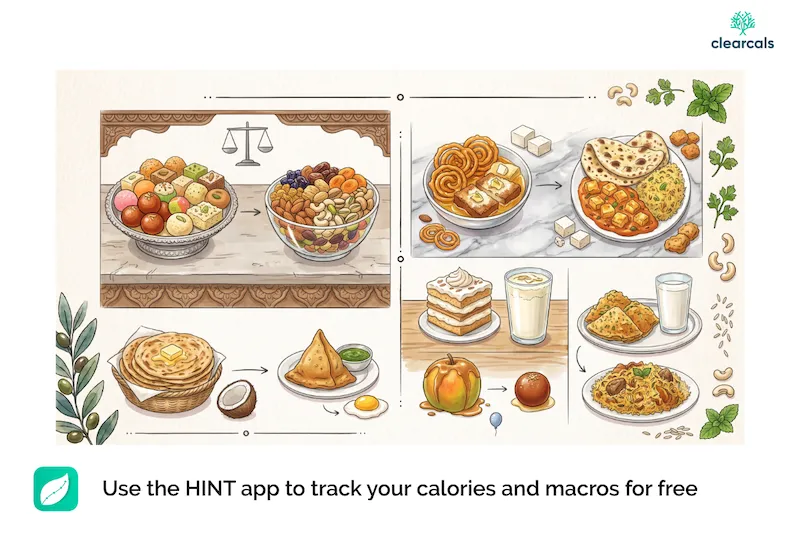
High-Calorie Foods for Weight Gain: The Complete Indian List (With Calorie Counts)
Gaining Weight Isn't Just "Eat More" — It's Eating More of the Right Things
Healthy weight gain works the same way weight loss does, just in reverse: you need a calorie surplus — eating more calories than you burn — sustained consistently over weeks and months. But not all extra calories are equal. Reaching for calorie-dense, nutrient-rich foods (nuts, dairy, whole grains, healthy fats) gets you there while also building muscle and supporting health; reaching for the easiest calorie-dense option (fried snacks, sugary drinks, packaged sweets) gets you there too, but adds mostly fat with little nutritional value. This guide is a practical, calorie-count list of foods that do the job well.
High-Calorie Foods List (With Calorie Counts, per 100g Unless Noted)
| Food | Approx. Calories | Notes |
|---|---|---|
| Ghee | The most calorie-dense common kitchen ingredient — a spoon stirred into dal or roti adds real calories with almost no volume | |
| Peanut butter | One of the easiest ways to add calories to a shake, toast, or fruit | |
| Almonds | ~579 kcal/100g | A small handful (7-8 almonds) is already ~55-60 kcal |
| Cashews | ~553 kcal/100g | Slightly higher carb, lower fat than almonds |
| Walnuts | ~654 kcal/100g | The most calorie-dense common nut |
| Chia seeds | ~486 kcal/100g | Calorie-dense and easy to add to milk, smoothies, or oats |
| Dates (khajur) | ~277 kcal/100g | A naturally sweet way to add calories without refined sugar |
| Raisins (kishmish) | ~299 kcal/100g | Concentrated calories from drying, like most dry fruits |
| Full-fat paneer | ~265 kcal/100g | Also a strong protein source — see it as a "gain weight and build muscle" food, not just calories |
| Whole milk | ~61 kcal/100ml | Add a glass or two extra a day, or use it as your shake base instead of water |
| Banana | ~89 kcal/100g | The most calorie-dense common fresh fruit, and pairs naturally with milk or peanut butter |
| Avocado | ~160 kcal/100g | Calorie-dense from healthy fat rather than sugar |
| Sweet potato | ~86 kcal/100g | More calorie-dense than most vegetables, and filling |
| Potato (boiled) | ~87 kcal/100g | Calories climb fast with ghee, butter, or frying |
| Oats | A calorie-dense base you can add milk, nuts, and banana to | |
| Whole eggs | High protein alongside the calories, unlike most items on this list | |
| Chicken thigh (with skin) | ~209 kcal/100g | Meaningfully more calorie-dense than chicken breast for anyone eating non-veg |
How to use this list: you don't need to eat unusual foods to gain weight — the fastest, most sustainable approach is adding a spoon of ghee, a handful of nuts, or a glass of milk to meals you already eat, rather than building entirely new "bulking" meals from scratch.
High-Calorie Fruits and Dry Fruits
Fresh fruit is rarely calorie-dense on its own — banana, mango, and chikoo are the exceptions worth leaning on. Dry fruits are a different story: drying concentrates calories the same way it does for low-calorie fruit, just used to your advantage here — almonds, cashews, raisins, and dates pack 275-580+ kcal per 100g in a small, portable portion. For the full ranked list and portion guidance, see our dedicated guides on fruits for weight gain and dry fruits for weight gain.
High-Calorie Vegetarian and Vegan Options
Vegetarian weight gain works well precisely because paneer, dairy, ghee, nuts, and legumes are all naturally calorie-dense — you don't need meat or eggs to hit a surplus. Favour full-fat dairy over toned/skimmed, cook with a slightly more generous hand with ghee or oil, and add nuts or peanut butter to breakfast rather than treating dal-roti as the only source of extra calories. Our vegetarian weight gain diet guide covers full meal plans built around this approach.
For a fully vegan approach (no dairy or ghee), the same calorie-density principle still holds: plant milks fortified and blended with nut butter, tofu, nuts and seeds, avocado, dried fruit, and oats cooked in coconut milk all add calories efficiently without dairy — a bit more planning is needed to also hit your protein target, since paneer and milk won't be doing that work for you.
High-Calorie Meal Ideas by Time of Day
If you want a few concrete meals rather than building one up from individual ingredients, here's a starting point for each time of day — each one uses foods from the list above:
- Breakfast: Paratha made with a generous amount of ghee, served with full-fat curd or a glass of whole milk (
450-550 kcal); or oats cooked in milk with banana, a spoon of peanut butter, and a handful of nuts (500-600 kcal). - Lunch: Rice or 2-3 roti with dal (finished with a spoon of ghee), a paneer or chicken curry, and a side of nuts or a banana (~700-800 kcal).
- Dinner: Khichdi made with extra ghee, a side of curd, and a banana or peanut butter shake alongside (~600-700 kcal).
- Meal prep tip: Batch-cooking dal, rice, and a protein source (paneer, chicken, or rajma/chana) for a few days at a time makes it easier to consistently hit a surplus without needing to cook calorie-dense food from scratch at every meal.
These aren't the only combinations that work — the underlying idea is the same as the food list above: build meals around what you already eat, and add ghee, nuts, dairy, or a shake around the edges.
High-Calorie Snacks and Between-Meal Options
Between-meal snacking is one of the easiest ways to add calories without needing to eat unusually large meals:
- A handful of mixed nuts (almonds, cashews, walnuts) — ~150-180 kcal for a small handful
- Peanut butter on toast or with banana — ~250-300 kcal for a simple combination
- Trail mix (nuts, seeds, dried fruit) — ~450-500 kcal per 100g
- Oats with milk, banana, and a spoon of peanut butter — easily 400-500 kcal in one bowl
- Full-fat yogurt or paneer with fruit — ~200-250 kcal
- A protein or granola bar — ~200-300 kcal, genuinely useful when you're out and can't sit down for a full snack
If budget is a factor, the most cost-effective options on this list are usually banana, peanut butter, whole milk, and eggs — you don't need expensive specialty products to build a real calorie surplus.
High-Calorie Shakes and Weight Gainer Supplements
Shakes are the fastest way to add calories without needing to eat more volume, since you can pack a lot into a drinkable form — useful for anyone who struggles to eat large meals. A simple homemade shake (whole milk, banana, peanut butter, and a spoon of oats blended together) can run 500-600 kcal, comparable to many commercial mass gainer shakes without the added sugar some products carry. If you're using a protein powder or commercial gainer, check the label — some "mass gainer" products carry 1,000+ kcal per serving, which can be more than intended if you're not tracking it. See our guides on weight gain shakes and protein powder for weight gain for specific recipes and product guidance.
How Many Extra Calories Do You Actually Need to Gain Weight?
Gaining weight requires a calorie surplus — eating more than your body burns (your maintenance calories, or TDEE) — sustained over time, the same way a deficit is required to lose it.
- A moderate surplus of 300-500 kcal/day above maintenance is a reasonable, sustainable target for most people aiming for steady, mostly-lean weight gain, roughly translating to about 0.25-0.5 kg per week.
- Gaining 1kg of body weight requires roughly a 7,700 kcal surplus in total (this isn't exact — some of that weight gain is water and glycogen, especially early on — but it's a useful planning estimate).
- A very large surplus (1,000+ kcal/day above maintenance) speeds up the scale number but adds a much higher proportion of fat relative to muscle — rarely the actual goal for most people trying to "gain weight" healthily.
- Know your starting point first — your maintenance calories (TDEE) and BMR tell you the baseline you're adding a surplus on top of; without that number, "eat more" has no reference point.
For full day-by-day meal structures built around a surplus, see our weight gain diet chart, weight gain diet plan, or 7-day weight gain diet. If your goal is specifically muscle gain or "bulking" rather than weight gain in general, the food strategy on this page still applies, but pairing the surplus with resistance training is what determines how much of it becomes muscle rather than fat — see our gym diet plan for muscle gain for the full approach.
Are High-Calorie Foods Always Unhealthy?
No — "high-calorie" and "unhealthy" aren't the same thing, even though they get treated as synonyms. Ghee, nuts, dairy, and whole grains are calorie-dense and nutrient-dense — they bring protein, healthy fats, vitamins, and minerals along with the calories. Deep-fried snacks, sugary drinks, and packaged sweets are calorie-dense too, but bring mostly sugar and refined fat with little else. When the goal is healthy weight gain rather than just a higher number on the scale, prioritising the first group most of the time — and treating the second as occasional, not the default — makes a real difference to body composition, not just body weight.
Foods to treat as occasional rather than a daily surplus source: deep-fried snacks (samosas, pakoras, chips), sugary sodas and packaged juices, packaged sweets and pastries, and heavily processed packaged snacks. These will get you to a calorie surplus, but with very little protein, fibre, or micronutrients alongside the calories — using them occasionally is fine, but building your surplus around the nutrient-dense list above gets you the same weight gain with meaningfully better results for muscle, energy, and long-term health.
Track Your Weight Gain Progress With Hint
Consistently hitting a calorie surplus is just as easy to get wrong as hitting a deficit — many people trying to gain weight are surprised to find they're actually eating close to maintenance once they log accurately. The Hint app's Indian food database makes it straightforward to log ghee, dal, paneer, and shakes accurately, so you know whether you're actually in a surplus, not just assuming you are.
FAQs
What are the best high-calorie foods for weight gain? Ghee, nuts (almonds, cashews, walnuts), peanut butter, full-fat dairy, paneer, bananas, dry fruits, and oats are among the most calorie-dense, nutrient-rich options — all easy to add to meals you already eat rather than requiring a separate "bulking" diet.
What are high-calorie foods for vegetarians in India? Ghee, full-fat paneer and milk, nuts, peanut butter, dry fruits, and legumes are all naturally calorie-dense and don't require meat or eggs — see our vegetarian weight gain diet guide for full meal plans.
How many extra calories do I need per day to gain weight? A surplus of 300-500 kcal/day above your maintenance calories is a reasonable target for steady, mostly-lean weight gain — roughly 0.25-0.5 kg per week. Knowing your maintenance calories (TDEE) first is essential, since a surplus only means something relative to that baseline.
Are high-calorie foods always unhealthy? No. Nutrient-dense, calorie-dense foods like ghee, nuts, dairy, and whole grains support healthy weight gain, while fried snacks and sugary foods add calories with little nutritional value — both are "high-calorie," but they're not equivalent choices.
How much of a calorie surplus do I need to gain 1kg? Roughly 7,700 kcal in total, as a planning estimate — though some of the weight gained early on is water and glycogen rather than pure fat or muscle.
What are good high-calorie snacks? A handful of mixed nuts, peanut butter on toast or banana, trail mix, or oats with milk and peanut butter all add 150-500 kcal in a single, easy snack.
What's a good high-calorie breakfast for weight gain? A paratha made with a generous amount of ghee alongside full-fat curd or milk, or oats cooked in milk with banana, peanut butter, and nuts, both typically land around 450-600 kcal — a meaningful step up from a typical light breakfast.
Are foods like rice, fruit, or sushi actually high in calories? Usually not as high as people assume — cooked rice runs roughly 130 kcal/100g, most whole fruit is well under 100 kcal/100g, and much of a typical sushi order is similarly moderate. These are useful additions to a weight-gain diet, but they're not calorie-dense on their own the way ghee, nuts, or dried fruit are — you'll generally need to pair them with a calorie-dense addition to meaningfully move a surplus.
What are high-calorie vegan foods for weight gain? Nut butters, tofu, nuts and seeds, avocado, dried fruit, and oats cooked in a fortified plant milk all add calories efficiently without dairy. Vegan weight gain takes a bit more planning to also hit a protein target, since paneer and milk aren't available as defaults.
About the Author
Asfia Fatima is the Chief Dietitian at Clearcals, with a Master's Degree in Dietetics and Clinical Nutrition and over a decade of experience in clinical nutrition and lifestyle management. She specialises in evidence-based diet planning for weight loss, diabetes, and metabolic health, and leads the nutrition strategy behind the Hint app.
Connect with Asfia on LinkedIn