Track your nutrition and health goals

Peanut Butter Calories, Protein & Nutrition: Is It Good for You?
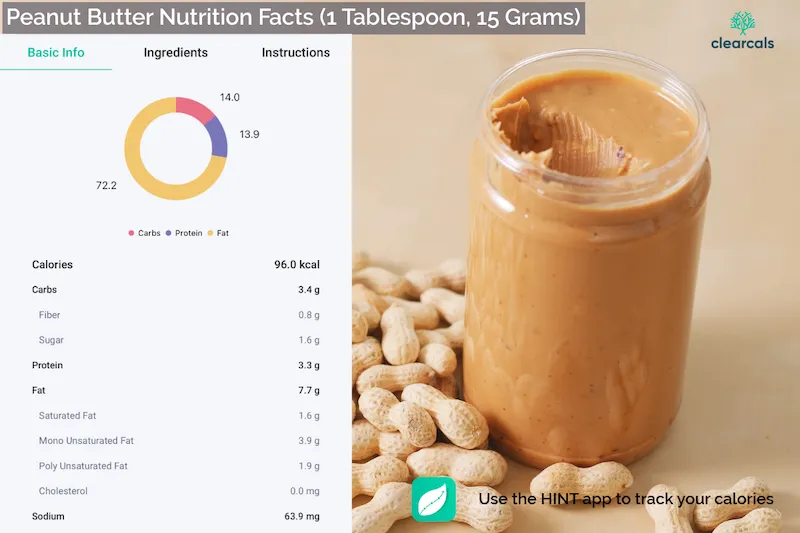
Peanut Butter Calories, Protein & Nutrition: Is It Good for You?
Peanut Butter Calories: Quick Reference
Peanut butter is calorie-dense — around 640 kcal per 100g — so the number that actually matters day-to-day is how much you're spooning out, not the per-100g figure most labels lead with:
| Serving | Approx. Calories | Approx. Protein |
|---|---|---|
| 1 tsp (5g) | 32 kcal | 1.1g |
| 1 tbsp (15g) | 96 kcal | 3.3g |
| 2 tbsp (30g) | 192 kcal | 6.6g |
| 1 scoop (30g) | 192 kcal | 6.6g |
| 20g | 128 kcal | 4.4g |
| 30g | 192 kcal | 6.6g |
| 50g | 320 kcal | 11g |
| 100g | 640 kcal | 22g |
"1 spoon" is genuinely ambiguous — a teaspoon and a tablespoon differ by 3x in calories — so when a recipe or label just says "1 spoon," it's worth checking whether it means a teaspoon (32 kcal) or a tablespoon (96 kcal) before you log it.
Full Nutrition Facts (Per 100g and Per Tablespoon)
| Nutrient | Per 100g | Per Tbsp (15g) |
|---|---|---|
| Calories | 640 kcal | 96 kcal |
| Protein | 22g | 3.3g |
| Fat | 51.3g | 7.7g |
| Carbohydrates | 22.3g | 3.4g |
| Sugar | 10.5g (varies by brand) | 1.6g |
| Fibre | 5g | 0.8g |
Most of peanut butter's calories come from fat — but it's predominantly unsaturated (monounsaturated and polyunsaturated) fat, the same category found in olive oil and nuts generally, rather than the saturated fat found in ghee or butter. That's a meaningfully different nutritional profile even though the calorie count per gram is similar.
Powdered Peanut Butter: The Real "Low-Calorie" Option
Regular peanut butter can't really be made "low-calorie" — the calories come from the fat naturally present in peanuts, and there's no version of real peanut butter that removes that without changing what it fundamentally is.
Powdered peanut butter (sold as PB2 and similar defatted peanut powder products) is the genuine answer to "low-calorie peanut butter": most of the natural oil is pressed out during processing, leaving a powder you mix with water into a spread.
| Regular Peanut Butter (2 tbsp) | Powdered Peanut Butter (2 tbsp) | |
|---|---|---|
| Calories | ~190 kcal | ~45 kcal |
| Fat | ~16g | ~1.5g |
| Protein | ~8g | ~5g |
| Carbs | ~6g | ~4g |
That's roughly a 75% calorie cut for a similar flavour and a similar (even slightly higher, gram-for-gram) protein contribution — a genuinely useful swap if you want peanut flavour in a shake, oats, or a sauce without the full calorie load of the real thing, though it isn't a direct substitute in recipes that rely on peanut butter's fat content for texture (like baking or a thick spread with real richness).
Is Peanut Butter High in Protein?
Yes, relative to most spreads — at roughly 25g of protein per 100g (about 4g per tablespoon), peanut butter is one of the more protein-dense common pantry items, which is why it shows up so often in high-protein meal plans.
That said, "high-protein peanut butter" as a product category (several popular brands sell one) usually means peanut butter with added whey or soy protein isolate blended in, pushing the protein content up to roughly 28- 32 g per 100g — a real but modest boost over what peanut butter already delivers naturally, not a completely different food.
One nuance worth knowing: peanut butter isn't a complete protein on its own — like most plant proteins, it's relatively low in one essential amino acid (methionine). Pairing it with a grain, like whole wheat bread in a sandwich, gives a more complete amino acid profile, though for most people eating a varied diet across the day, this matters far less than simply hitting your total daily protein target.
Is Peanut Butter Good for You? (Health Benefits)
Yes, in most everyday contexts — peanut butter brings real nutritional value alongside its calories, not just calories on their own:
- A genuine protein source — useful for anyone looking to add protein without dairy, meat, or legumes at every meal, and especially relevant for vegetarians and vegans (pure peanut butter is vegan by default — see the diet notes below).
- Mostly unsaturated fat — the predominant fat type in peanut butter is linked to better heart-health outcomes than saturated fat when it replaces it in the diet, rather than adding on top of it.
- Fibre content — around 5g per 100g, which helps slow digestion and supports fullness, relevant given how calorie-dense peanut butter is.
- Micronutrients — peanut butter is a reasonable source of vitamin E, magnesium, and niacin (vitamin B3), nutrients that are easy to under-consume.
- Genuinely filling per calorie — the combination of protein, fat, and fibre makes a tablespoon or two noticeably more satiating than a similar calorie amount of, say, a sugary spread.
Peanut butter khane ke fayde: protein, healthy fat, fibre aur vitamin E/magnesium jaise zaroori nutrients milte hain — bas portion control zaroori hai kyunki yeh calorie-dense hota hai.
The main caveat isn't the peanut butter itself — it's portion and what's added. A tablespoon or two of plain peanut butter fits easily into a healthy diet; eating it by the half-cup, or choosing a variety loaded with added sugar and oil, is where "good for you" starts to break down.
Peanut Butter Carbs, Keto & Dietary Notes
- Carbs: roughly 20g of total carbohydrate per 100g (about 3g per tablespoon), of which around a third is fibre — so net carbs land closer to 2g per tablespoon.
- Is peanut butter keto-friendly? In typical portions, yes — a tablespoon or two fits comfortably into most keto carb budgets. Where it goes wrong is portion size (it's easy to eat far more than a tablespoon) and added sugar, which varies meaningfully by brand and is usually the bigger factor pushing a specific jar out of a strict keto budget, more than the peanuts themselves.
- Is peanut butter gluten-free? Plain peanut butter (peanuts, oil, salt) is naturally gluten-free. Flavoured or mix-in varieties can include gluten-containing additives, so check the label if you're strictly avoiding gluten, and note that cross-contamination warnings do apply to some brands.
- Is peanut butter vegan? Pure peanut butter is vegan — just peanuts, and usually oil and salt. The exception is honey-roasted or specialty varieties that include honey, which isn't considered vegan.
Peanut Butter for Weight Loss or Weight Gain?
Peanut butter can support either goal — the difference is entirely about portion and what you build around it:
- For weight loss, peanut butter's protein and fibre content can help with fullness, but its calorie density (588 kcal/100g) means portion control matters more here than with almost any other common food — a rounded tablespoon rather than a generous scoop straight from the jar is the difference between a smart addition and a diet derailment. See our dedicated peanut butter for weight loss guide for the full breakdown.
- For weight gain, that same calorie density works in your favour — a spoon of peanut butter stirred into a shake, spread on toast, or added to oats is one of the easiest ways to add 100-200+ kcal to a meal without needing to eat more volume. See our guides on high-calorie foods for weight gain and weight gain shakes for how peanut butter fits into a broader surplus plan.
Everyday Peanut Butter Combos (With Calorie Counts)
| Combo | Approx. Calories |
|---|---|
| Peanut butter and jelly sandwich (2 bread slices, 2 tbsp peanut butter, 1 tbsp jam) | ~380-420 kcal |
| Peanut butter on toast (1 slice, 1 tbsp peanut butter) | ~170 kcal |
| Apple with peanut butter (1 medium apple, 1 tbsp peanut butter) | ~190 kcal |
| Banana with peanut butter (1 medium banana, 2 tbsp peanut butter) | ~295 kcal |
These are useful reference points rather than exact figures — bread, jam, and fruit sizes vary — but they show how quickly a "light" snack can double or triple in calories depending on how generous the peanut butter portion is.
Choosing a Healthier Peanut Butter
Not all peanut butter is nutritionally identical, even though the calorie count stays fairly similar across brands:
- Sugar-free / no added sugar peanut butter is essentially the same thing as "natural" peanut butter — just peanuts (and often salt), with nothing added. It's a straightforward way to cut the 3- 5 g of added sugar some standard jars carry per serving, without changing the calorie count much.
- Check the label for added oils — some brands add palm oil or hydrogenated oils for texture and shelf stability, which doesn't change the calorie count much but is worth knowing if you're specifically avoiding those.
- Making it at home (just roasted peanuts blended, no additions) gives you full control over sugar and oil content, though the calorie count of the peanuts themselves stays essentially the same as store-bought.
- If you have a peanut allergy, almond butter, sunflower seed butter, and tahini are the most common substitutes — similar in texture and calorie density, though each carries its own allergen profile worth checking separately.
Track Your Peanut Butter With Hint
Because a "spoon" of peanut butter can mean anywhere from 30 to 190+ kcal depending on the spoon, it's one of the easiest foods to under- or overestimate when logging by eye.
The Hint app lets you log peanut butter by exact quantity — teaspoon, tablespoon, or grams — so your calorie total reflects what you actually ate rather than a rough guess.
FAQs
How many calories are in a tablespoon of peanut butter? Roughly 95 kcal per tablespoon (about 15g), with around 4g of protein.
How many calories are in 1 spoon of peanut butter? It depends whether "spoon" means a teaspoon (~30 kcal) or a tablespoon (~95 kcal) — a meaningful difference, so it's worth checking which one a recipe or label actually means.
Is peanut butter good for you? Yes, in typical portions — it provides protein, mostly unsaturated fat, fibre, and micronutrients like vitamin E and magnesium. The main caveats are portion size, since it's calorie-dense, and added sugar or oil content, which varies by brand.
How much protein is in peanut butter, and is it a complete protein? About 25g of protein per 100g, or roughly 4g per tablespoon. It isn't a complete protein on its own — like most plant proteins, it's relatively low in methionine — but pairing it with a grain (like bread) rounds that out.
How many carbs are in peanut butter, and is it keto-friendly? Around 20g of total carbs per 100g (about 3g per tablespoon, roughly 2g net after fibre). It fits comfortably into most keto budgets in typical portions — added sugar in specific brands and portion size are usually the bigger factors that push a jar out of a strict keto diet.
Is peanut butter gluten-free and vegan? Plain peanut butter is both — just peanuts, oil, and salt. Check labels for flavoured varieties, which can include gluten-containing additives, or honey-roasted versions, which aren't vegan.
What's the lowest-calorie way to eat peanut butter? Powdered peanut butter (like PB2) is the genuine low-calorie option — roughly 45 kcal for 2 tablespoons mixed with water, versus ~190 kcal for the same amount of regular peanut butter, since most of the natural oil is removed during processing.
How many calories are in a peanut butter and jelly sandwich? Roughly 380-420 kcal for a standard sandwich (2 bread slices, 2 tbsp peanut butter, 1 tbsp jam), though this varies with bread and portion size.
Peanut butter khane ke fayde kya hain? Peanut butter provides protein, mostly unsaturated fat, fibre, and micronutrients like vitamin E and magnesium — a genuinely useful addition to a vegetarian or vegan diet in particular, as long as portions stay controlled given its calorie density.
Is peanut butter good for weight loss or weight gain? Both, depending on portion — its protein and fibre support fullness for weight loss when eaten in controlled amounts (roughly a tablespoon), while its calorie density makes it an efficient way to add calories for weight gain when eaten more generously.
About the Author
Asfia Fatima is the Chief Dietitian at Clearcals, with a Master's Degree in Dietetics and Clinical Nutrition and over a decade of experience in clinical nutrition and lifestyle management. She specialises in evidence-based diet planning for weight loss, diabetes, and metabolic health, and leads the nutrition strategy behind the Hint app.
Connect with Asfia on LinkedIn