Track your nutrition and health goals

Does Ghee Increase Cholesterol? How Much Is Safe & What the Research Shows
By Hafsaa Farooq | Medically Reviewed | Updated April 2026
Ghee is one of the most debated foods in Indian nutrition.
On one side: traditional use going back thousands of years, with claims of health benefits from Ayurveda.
On the other hand, modern cardiovascular guidelines urge caution over saturated fat. The truth, as usual, sits in the details — specifically, how much ghee and what else is in the diet.
What Is Ghee and What Does It Contain?
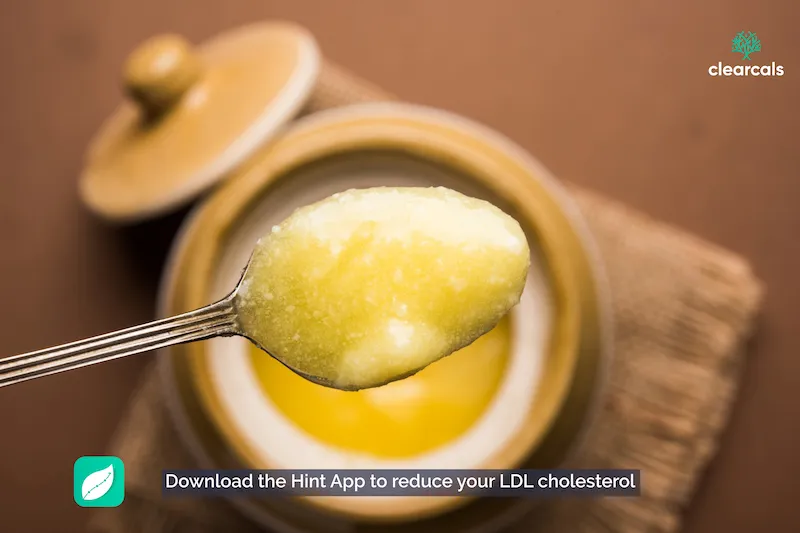
Ghee is clarified butter — butter from which water and milk solids have been removed by slow cooking. It is almost entirely fat, with negligible protein or carbohydrates.
The fat composition of ghee per 100g:
- Saturated fat: ~62g
- Monounsaturated fat (MUFA): ~29g
- Polyunsaturated fat (PUFA): ~4g
- Trans fat (naturally occurring): ~4g (conjugated linoleic acid and vaccenic acid — different from industrial trans fat)
One teaspoon (5g) of ghee contains approximately 3.1g of saturated fat.
Does Ghee Raise Cholesterol?
The honest answer: yes, in large quantities — primarily LDL cholesterol.
Saturated fat raises LDL by reducing the activity of LDL receptors in the liver. With fewer receptors available to clear LDL from the bloodstream, LDL levels rise. This is one of the most well-established findings in nutritional science.
Ghee is approximately 62% saturated fat — comparable to butter (~63% saturated fat) and significantly higher than most cooking oils. When consumed in large quantities, it will raise LDL.
However, the degree of impact depends on:
Total saturated fat intake across the whole diet. If ghee is used in small quantities in an otherwise low-saturated-fat diet (minimal full-fat dairy, no vanaspati, limited processed foods), its contribution to total saturated fat may be modest. If it is used alongside other saturated fat sources, it compounds the effect.
How much is "large quantities"? 1 teaspoon (5g) of ghee provides ~3.1g of saturated fat. The general dietary guideline is to keep saturated fat below 7–10% of total calories — for a 2000 kcal diet, that is 15–22g of saturated fat per day. One teaspoon of ghee uses up about 3g of that allowance. Three teaspoons (a common amount in many Indian meals) uses up ~9g — more than half the daily limit before accounting for other sources.
Is A2 Ghee Better for Cholesterol?
A2 ghee — made from milk of desi Indian breeds (Gir, Sahiwal) carrying the A2 beta-casein protein — is marketed as being safer for cholesterol than regular (A1) ghee. The current evidence does not support this claim for cholesterol outcomes. Both A1 and A2 ghee have the same saturated fat content and fatty acid profile. The A1 vs A2 distinction relates to a protein in milk (not present in ghee, which is pure fat) and has not been shown to affect LDL in clinical studies. A2 ghee may have other claims around digestibility, but its effect on cholesterol is the same as regular ghee.
Ghee vs Butter vs Vanaspati for Cholesterol
| Fat | Saturated Fat (%) | Trans Fat | Effect on LDL | Verdict |
|---|---|---|---|---|
| Ghee (desi) | ~62% | Natural CLA (~4%) | Raises LDL at high intake | Small amounts acceptable |
| Butter | ~63% | Natural CLA (~4%) | Raises LDL at high intake | Similar to ghee |
| Vanaspati (dalda) | ~40–50% | Industrial trans fat (10–30%) | Raises LDL AND lowers HDL | Avoid completely |
| Coconut oil | ~82% | None | Raises LDL significantly | Use sparingly |
| Mustard oil | ~12% | None | Neutral to slightly beneficial | Best everyday choice |
Vanaspati is categorically worse than ghee for cardiovascular health because it contains industrial trans fats, which raise LDL and simultaneously lower HDL. Ghee contains naturally occurring trans fats (CLA, vaccenic acid), which have a different metabolic profile and are not associated with the same cardiovascular harm.
How Much Ghee Is Safe If You Have High Cholesterol?
This depends on your current LDL level and overall cardiovascular risk:
If your LDL is in the optimal range (below 100 mg/dL) and you have no cardiovascular risk factors: Up to 1 teaspoon (5g) of ghee per day as part of an otherwise heart-healthy diet is unlikely to cause meaningful LDL elevation for most people.
If your LDL is borderline high (130–159 mg/dL) or high (160+ mg/dL): Ghee should be minimised or avoided during the period of active lipid management. Replace it with mustard oil or rice bran oil as the primary cooking fat. Once LDL reaches the target, small amounts (½ tsp per day) can be reintroduced cautiously.
If you have diabetes, established heart disease, or a previous heart attack: Your LDL target is below 70–55 mg/dL. Ghee should be used sparingly (½ tsp occasionally, not daily) and saturated fat kept as low as possible.
Does Ghee Raise Triglycerides?
No, not directly. Triglycerides are primarily driven by refined carbohydrates, sugar, and alcohol — not dietary fat. Ghee's saturated fat raises LDL but has minimal direct effect on triglycerides. This is a common misconception. The concern with ghee is specifically LDL cholesterol, not triglycerides.
The Real Problem in the Indian Diet
In practice, ghee consumption rarely occurs in isolation. The foods that typically accompany ghee in Indian meals — white rice, rotis, parathas, dal with rice — are themselves high in refined carbohydrates. The combination of ghee (raising LDL) with excess refined carbohydrates (raising triglycerides) is what creates the atherogenic lipid profile commonly seen in urban Indians.
Replacing ghee with mustard oil while simultaneously reducing white rice portions and eliminating sugary drinks would have a far greater positive effect on the lipid profile than simply removing ghee while keeping the rest of the diet unchanged.
Practical Guidance
Use ghee as a flavouring in small amounts — ½ to 1 teaspoon to finish a dish — rather than as the primary cooking fat. Cook with mustard oil, rice bran oil, or olive oil instead. This approach preserves the culinary and cultural role of ghee without using it in quantities that meaningfully raise LDL.
👉 See: Which Oil is Good for Cholesterol in India? Best & Worst Oils Ranked
Get a Personalised Cholesterol Diet Plan
If your LDL or total cholesterol is elevated, a personalised plan that accounts for your food preferences — including how much ghee you typically use — will produce better results than generic advice. The Hint app provides condition-specific dyslipidemia diet plans through Hint Pro and Hint Premium, with unlimited dietitian consultations via Hint Premium.
Frequently Asked Questions
Does ghee increase cholesterol? Yes, in large quantities. Ghee is approximately 62% saturated fat, which raises LDL cholesterol when consumed in excess. Small amounts — up to 1 teaspoon (5g) per day — have minimal impact for most people with normal or borderline lipid levels. People with high LDL, diabetes, or established heart disease should minimise ghee and use mustard oil or rice bran oil as their primary cooking fat.
Is ghee better or worse than butter for cholesterol? Ghee and butter have almost identical saturated fat content (~62–63%) and a similar effect on LDL. Neither is significantly better than the other from a cardiovascular standpoint. Both should be used in small quantities. Ghee has a higher smoke point than butter, making it more suitable for Indian high-heat cooking — but this cooking advantage does not translate to a cholesterol advantage.
Does ghee raise triglycerides? No, not directly. Triglycerides are raised primarily by refined carbohydrates (white rice, sugar, maida) and alcohol, not by dietary fat from ghee. Ghee's effect on lipids is specifically on LDL cholesterol. The concern with ghee for heart health is LDL elevation from saturated fat, not triglycerides.
Is A2 ghee better for cholesterol than regular ghee? No evidence supports A2 ghee being better for cholesterol outcomes. Both A1 and A2 ghee have the same saturated fat content and fatty acid profile — the A1/A2 distinction is about the milk protein beta-casein, which is not present in pure ghee. A2 ghee may have different digestibility properties for some people, but its effect on LDL cholesterol is the same as regular ghee.
How much ghee is safe per day with high cholesterol? For people with high LDL (above 130 mg/dL) or cardiovascular risk factors, minimise ghee to ½ teaspoon occasionally — or avoid it entirely during active lipid management. Replace it with mustard oil or rice bran oil for everyday cooking. Once LDL reaches target through dietary changes, small amounts (up to 1 tsp/day) can be reintroduced carefully.
About the Author
Hafsaa Farooq is a Consultant Dietitian at Clearcals with a strong passion for nutrition, fitness, and evidence-based health practices.
She is deeply interested in clinical nutrition and enjoys helping individuals build healthier lifestyles through practical dietary guidance.
Beyond her professional work, Hafsaa enjoys developing healthy recipes, writing evidence-based nutrition blogs, and staying active through sports.
She is also expanding her expertise in the science of exercise and weight training to better support holistic health and fitness goals.
🔗 Connect with Hafsaa on LinkedIn
Also Read
- Which Oil is Good for Cholesterol in India? Best & Worst Oils Ranked
- Dyslipidemia Diet Plan: 7-Day Indian Meal Plan to Lower Cholesterol & Triglycerides
- Does Eating Eggs Increase Cholesterol?
- Cholesterol Levels by Age: Normal Range for Men and Women (Chart)
- Managing Dyslipidemia: Improve Your Cholesterol and Triglycerides