
Track your nutrition and health goals

Idli Calories: 1 Idli = 61 kcal | 2, 3, 4, 5, 6 Idli Table + Sambar, Rava & Ragi
Written by Asfia Fatima, Chief Dietitian at Clearcals
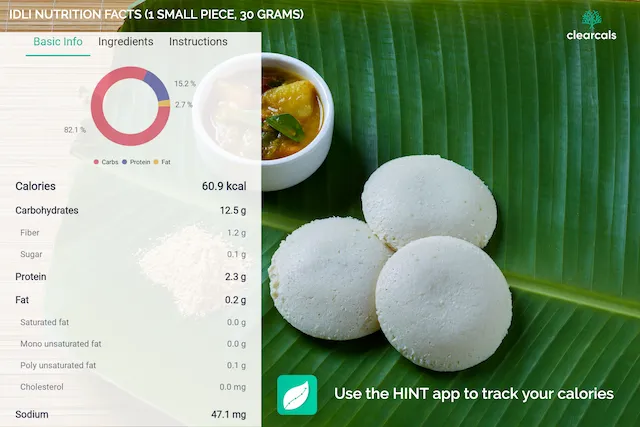
One small idli (30g) has 61 kcal, 2.3g protein, and 12.4g carbohydrates. Idlis are steamed, oil-free, and one of the lowest-calorie Indian breakfast foods — but the total calories depend heavily on how many idlis you eat and what you pair them with.
How many calories are in 1-10 Idli? (Quick Reference)
| Number of Idlis | Small (30g each) | Medium (40g each) | Large (50g each) |
|---|---|---|---|
| 1 idli | 61 kcal | 81 kcal | 102 kcal |
| 2 idli | 122 kcal | 162 kcal | 203 kcal |
| 3 idli | 183 kcal | 244 kcal | 305 kcal |
| 4 idli | 244 kcal | 325 kcal | 406 kcal |
| 5 idli | 305 kcal | 406 kcal | 508 kcal |
| 6 idli | 366 kcal | 487 kcal | 609 kcal |
| 8 idli | 488 kcal | 650 kcal | 813 kcal |
| 10 idli | 610 kcal | 813 kcal | 1,016 kcal |
Track your exact serving in the Hint app, which has all three idli sizes in its database.
How Many Calories in 1 Idli?
One small idli (30g) has 61 kcal. One medium idli (40g) has 81 kcal, and one large idli (50g) has 102 kcal.
The calorie count depends entirely on the size. A typical South Indian breakfast idli weighs 30–40g. Thatte idlis or restaurant idlis are often 50–70g and can have 100–140 kcal each.
| 1 Idli Size | Weight | Calories |
|---|---|---|
| Small | 30g | 61 kcal |
| Medium | 40g | 81 kcal |
| Large | 50g | 102 kcal |
| Thatte/Restaurant | 60–70g | 120–140 kcal |
How many calories are in 2 Idli?
Two small idlis (30g each) have 122 kcal. Two medium idlis have 162 kcal. Two large idlis have 203 kcal.
A two-idli serving is a common light snack or half a breakfast. On its own, 2 small idlis is very low in calories — you'll need sambar or chutney alongside to make it a complete meal.
How many calories are in 3 Idli?
Three small idlis (30g each) have 183 kcal. Three medium idlis have 244 kcal. Three large idlis have 305 kcal.
A typical Indian breakfast is 3–4 idlis with sambar and chutney. Three small idlis alone is only 183 kcal — lower in calories than most breakfast cereals.
How many calories are in 4 Idli?
Four small idlis (30g each) have 244 kcal. Four medium idlis have 325 kcal. Four large idlis have 406 kcal.
Four idlis are the most common full breakfast serving in South India. Paired with sambar and coconut chutney, a 4-idli meal totals approximately 370–450 kcal.
| 4 Idli Meal Combination | Approx. Calories |
|---|---|
| 4 small idli only | 244 kcal |
| 4 medium idli only | 325 kcal |
| 4 small idli + coconut chutney (2 tbsp) | ~290 kcal |
| 4 small idli + sambar (1 cup) | ~315 kcal |
| 4 small idli + sambar + chutney | ~365 kcal |
| 4 small idli + peanut chutney | ~330 kcal |
How many calories are in 5 Idli?
Five small idlis (30g each) have 305 kcal. Five medium idlis have 406 kcal. Five large idlis have 508 kcal.
Five idlis is a larger meal and starts to add up. With sambar and chutney, a 5-idli meal can reach 430–520 kcal — still reasonable for breakfast if the rest of the day is balanced.
How many calories are in 6 Idli?
Six small idlis (30g each) have 366 kcal. Six medium idlis have 487 kcal. Six large idlis have 609 kcal.
A 6-idli serving is typically for active individuals or those with higher calorie needs. With sambar and chutney, the total meal reaches 480–570 kcal for small idlis.
Idli Calories per 100g
Per 100g, plain rice idlis have 203 kcal, 7.7g protein, 41g carbohydrates, and 0.6g fat.
This makes idlis one of the lowest-calorie foods per 100g in Indian cuisine. For comparison, rice has 365 kcal per 100g (dry), and bread has 265 kcal per 100g.
| Idli Variety | Calories per 100g | Protein per 100 g |
|---|---|---|
| Moong Dal Idli | 147 kcal | 14.7g |
| Foxtail Millet Idli | 150 kcal | 8g |
| Oats & Dalia Idli | 167 kcal | 10g |
| Ragi Idli | 173 kcal | 6g |
| Rava / Sooji Idli | 193 kcal | 7g |
| Plain Rice Idli | 203 kcal | 7.7g |
| Rava Oats Idli | 243 kcal | 9g |
Idli Sambar Calories
A standard serving of idli sambar — 2 idlis with 1 cup sambar (150ml) — has approximately 190–200 kcal.
| Idli Sambar Combination | Approx. Calories |
|---|---|
| 1 idli + sambar | ~130 kcal |
| 2 idli + sambar | ~195 kcal |
| 3 idli + sambar | ~255 kcal |
| 4 idli + sambar | ~315 kcal |
| 5 idli + sambar | ~375 kcal |
| 6 idli + sambar | ~435 kcal |
| 2 idli + sambar + coconut chutney | ~240 kcal |
| 4 idli + sambar + coconut chutney | ~365 kcal |
| 4 idli + sambar + peanut chutney | ~400 kcal |
These values use small idlis (30g each) with sambar at approximately 65–70 kcal per cup and coconut chutney at approximately 45 kcal per 2 tbsp.
1 plate of idli sambar (typically 4 idli + 1 cup sambar) = ~315 kcal.
Idli with Chutney Calories
| Idli + Chutney Combination | Approx. Calories |
|---|---|
| 2 idli + coconut chutney | ~165 kcal |
| 2 idli + peanut chutney | ~195 kcal |
| 4 idli + coconut chutney | ~285 kcal |
| 4 idli + peanut chutney | ~325 kcal |
| 3 idli + peanut chutney | ~260 kcal |
Peanut chutney adds approximately 80 kcal per 2-tbsp serving. Coconut chutney adds approximately 45 kcal per 2-tbsp serving.
Idli Protein
One small idli (30g) has 2.3g of protein. Per 100g, plain rice idlis have 7.7g of protein.
Idlis are primarily a carbohydrate food (82% of calories from carbs) with only modest protein. Pairing idlis with sambar or protein-rich chutney (peanut, dal) substantially improves the protein content of the meal.
| Idli Servings | Protein (small, 30g each) | Protein (medium, 40g each) |
|---|---|---|
| 1 idli | 2.3g | 3.1g |
| 2 idli | 4.6g | 6.2g |
| 3 idli | 6.9g | 9.2g |
| 4 idli | 9.2g | 12.3g |
| 5 idli | 11.6g | 15.4g |
| 6 idli | 13.9g | 18.5g |
4 idli with sambar (protein ~6g from sambar) = approximately 15g protein total.
The Hint app tracks all 31 essential nutrients, including protein, so you can see exactly how your idli breakfast fits into your daily targets.
Watch: How to Track Idli Calories on the Hint App
Idli Carbs
One small idli (30g) has approximately 12.4g of carbohydrates. Per 100g, idlis have about 41g of carbohydrates — making it a high-carb food (82% of calories come from carbs).
| Idli Servings | Carbs (small, 30g each) |
|---|---|
| 1 idli | 12.4g |
| 2 idli | 24.8g |
| 3 idli | 37.2g |
| 4 idli | 49.6g |
For individuals managing diabetes or PCOS, this high carbohydrate content is worth monitoring. Pairing idlis with sambar (lentil-based) and a fat source like coconut chutney slows down glucose absorption and lowers the effective glycemic impact.
Idli Nutrition Facts per 100g
| Nutrient | Per 100g (Plain Rice Idli) |
|---|---|
| Calories | 203 kcal |
| Protein | 7.7g |
| Carbohydrates | 41g |
| Fat | 0.6g |
| Fiber | ~1g |
| Sodium | Low |
Idli is 82% carbohydrates, 15% protein, and 3% fat by calorie contribution. It is low in fat and sodium, and provides small amounts of phosphorus, magnesium, selenium, and vitamin D.

Rava Idli Calories (Sooji / Suji Idli)
One small rava idli (30g) has 58 kcal. One medium rava idli (40g) has 78 kcal. Per 100g, rava idli has 193 kcal.
Rava idli is very slightly lower in calories than plain rice idli (58 vs 61 kcal per 30g piece) and has a similar macronutrient profile: 75% carbs, 14% protein, 11% fat.
| Rava Idli Servings | Small (30g) | Medium (40g) | Large (50g) |
|---|---|---|---|
| 1 rava idli | 58 kcal | 78 kcal | 97 kcal |
| 2 rava idli | 116 kcal | 155 kcal | 194 kcal |
| 3 rava idli | 175 kcal | 233 kcal | 291 kcal |
| 4 rava idli | 233 kcal | 311 kcal | 388 kcal |
Rava idli is a good source of dietary fiber, copper, selenium, thiamin, and manganese. It is slightly richer in fat than plain rice idlis (11% vs 3%) due to the ghee and cashews typically added in the recipe.
Ragi Idli Calories
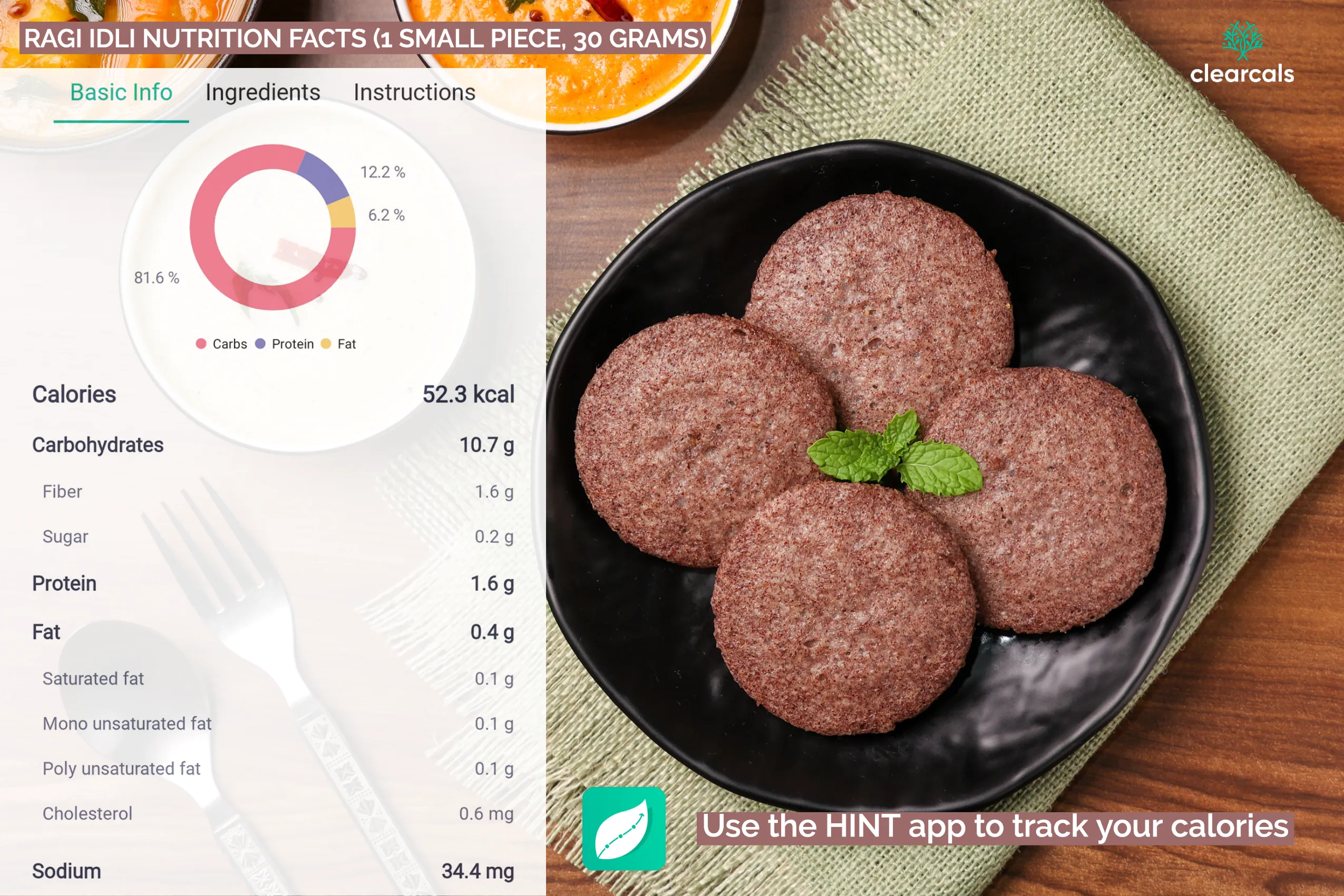
One small ragi idli (30g) has 52 kcal. One medium ragi idli (40g) has 70 kcal. Per 100g, ragi idli has 173 kcal.
Ragi idli is one of the lowest-calorie idli varieties and is richer in calcium than plain rice idli. It has 82% carbs, 12% protein, and 6% fat.
| Ragi Idli Servings | Small (30g) | Medium (40g) | Large (50g) |
|---|---|---|---|
| 1 ragi idli | 52 kcal | 70 kcal | 87 kcal |
| 2 ragi idli | 105 kcal | 140 kcal | 174 kcal |
| 3 ragi idli | 157 kcal | 209 kcal | 262 kcal |
| 4 ragi idli | 209 kcal | 279 kcal | 349 kcal |
Ragi idlis help lower blood cholesterol and support blood sugar control. It is a particularly good choice for diabetics and people with PCOS.

Oats Idli Calories
One small oats idli (30g) has 50 kcal. Per 100g: 167 kcal, 10g protein.
Oats and dalia idlis are the highest in fiber and protein among the common idli varieties and one of the lowest in total calories. It contains 74% carbs, 18% protein, and 8% fat.
| Oats Idli Servings | Small (30g) | Medium (40g) | Large (50g) |
|---|---|---|---|
| 1 oats idli | 50 kcal | 66 kcal | 83 kcal |
| 2 oats idli | 100 kcal | 133 kcal | 166 kcal |
| 3 oats idli | 150 kcal | 199 kcal | 249 kcal |
| 4 oats idli | 200 kcal | 266 kcal | 332 kcal |

Moong Dal Idli Calories
One small moong dal idli (30g) has 44 kcal — the lowest calorie count of all common idli varieties. It is also the highest in protein: 30% of calories from protein (65% carbs, 5% fat).
| Moong Dal Idli Servings | Small (30g) | Medium (40g) |
|---|---|---|
| 1 moong dal idli | 44 kcal | 59 kcal |
| 2 moong dal idli | 89 kcal | 118 kcal |
| 3 moong dal idli | 133 kcal | 177 kcal |
| 4 moong dal idli | 177 kcal | 236 kcal |
Moong dal idlis are the healthiest variety for those managing blood sugar, cholesterol, or PCOS, and for anyone wanting to increase protein intake from their idli breakfast.
All Idli Varieties: Calorie Comparison
| Idli Variety | Calories per 30g (1 small piece) | Calories per 100g |
|---|---|---|
| Green Moong Dal Idli | 44 | 147 |
| Foxtail Millet Idli | 45 | 150 |
| Bajra / Pearl Millet Idli | 45 | 150 |
| Kodo Millet Idli | 46 | 153 |
| Oats and Dalia Idli | 50 | 167 |
| Ragi Idli | 52 | 173 |
| Rava / Sooji Idli | 58 | 193 |
| Plain Rice Idli | 61 | 203 |
| Jowar Idli | 63 | 210 |
| Poha Idli | 65 | 217 |
| Vermicelli Idli | 67 | 223 |
| Red Rice Idli | 69 | 230 |
Download the Hint app for nutrition facts on all these varieties.
Is Idli Good for Weight Loss?
Yes — idlis are well-suited for weight loss. It is steamed (not fried), low in fat, and has only 61 kcal per small piece. For comparison, a single paratha has 180–220 kcal, and a dosa has 170–200 kcal.
The key consideration is quantity. Eating 2–3 small idlis with sambar and chutney (190–250 kcal total) is an effective low-calorie breakfast. Eating 6–8 idlis pushes the meal above 500 kcal and reduces the benefit.
For weight loss, pair idlis with sambar (high in protein and fiber) rather than coconut chutney alone. The protein and fiber from sambar help you feel fuller for longer.
Is Idli Good for Diabetes?
Idlis have a high glycemic index (GI of approximately 85), which can cause blood sugar spikes when eaten in large quantities. However, pairing idlis with healthy fats (sesame chutney, peanut chutney) and protein (sambar, dal) substantially lowers the effective glycemic impact of the meal.
Ragi idli and moong dal idli are significantly better options for diabetics than plain rice idli — both have lower GI and higher fiber or protein content.
Is Idli Healthy?
Yes, when eaten in moderation. Idli is:
- Low in fat (only 3% of calories)
- Low in sodium
- Easy to digest (fermented)
- A good source of selenium, phosphorus, and vitamin D
- Gut-friendly due to the fermentation process
The primary limitation is that plain rice idlis are low in fiber and protein. Opting for moong dal, oats, or ragi varieties significantly improves the nutritional profile.
Is Idli Better than Chapati?
For weight loss: Both are similar in calories, but idlis are lower in fat. Chapati (1 medium, 30g) has approximately 71 kcal with more fiber and complex carbs.
For blood sugar control: Chapati is better — it is made from whole wheat with higher fiber and a lower GI.
For digestibility and post-illness recovery, Idli is better — the fermentation makes it easier on the digestive system.
Is Idli Good for Weight Gain?
Idlis alone are too low in calories to drive weight gain. To use idlis as part of a weight-gain diet, significantly increase the portion size (6–8 idlis per meal), add ghee, pair with full-fat curd or sambar with dals, and add protein-rich chutneys. Even so, idlis are better suited for balanced or weight-loss diets; calorie-dense foods like rice, dal makhni, or whole milk are more efficient for bulking.
FAQs
Can I eat idlis every day? Yes. Idlis are one of the safest daily breakfast options available in Indian cuisine. Rotate varieties (ragi, oats, moong dal) to avoid nutrient gaps.
How many idlis should I eat for weight loss? 2–4 small idlis with sambar is an ideal weight-loss breakfast (190–315 kcal). Avoid eating more than 4–5 idlis in a single sitting if calories matter.
What are the disadvantages of idlis? Plain rice idlis are low in fiber and protein. It has a high GI and can spike blood sugar if eaten in large quantities without fat or protein accompaniments. Store-bought idlis may contain preservatives.
Is idli high in carbs? Yes. Idli gets 82% of their calories from carbohydrates. Per 100g, it has approximately 41g of carbs.
Final Thoughts
Idli is one of India's best breakfast foods from a calorie perspective — steamed, low-fat, and filling when paired with sambar. The exact calorie count depends on size and variety: a 2-idli breakfast can be as low as 122 kcal, while a 6-idli meal with accompaniments can reach 500+ kcal.
For a more accurate picture of your idli intake, use the Hint app to track each component — idli size, sambar, and chutney — and see exactly how your breakfast fits into your daily goals. Hint Pro tracks all 31 nutrients, including protein and carbohydrates, while Hint Premium includes personalized dietitian consultations.
🎁 Free Hint with Every Watch Purchase
Garmin watches: Purchase any Garmin watch from the Clearcals Store and receive 1 month of Hint Premium (worth ₹1,999) free — including unlimited dietitian consultations, personalised diet and workout plans, and advanced nutrition tracking.
Apple Watch: Purchase any Apple Watch from the Clearcals Store and receive a free Hint Pro subscription — including personalised Indian diet plans, 300+ workouts, weekly insights, and more.
About the Author
Asfia Fatima is the Chief Dietitian at Clearcals, with a Master's Degree in Dietetics and Clinical Nutrition and over a decade of experience in clinical nutrition and lifestyle management. She specializes in evidence-based diet planning for weight loss, diabetes, and metabolic health.
🔗 Connect with Asfia on LinkedIn


